Learn how fan anomaly detection artificial intelligence spots vibration, temperature, and airflow faults early to prevent downtime and cut maintenance costs.
Fan Anomaly Detection Artificial Intelligence
Fans rarely fail without warning. Long before a bearing seizes or a motor burns out, a fan sends subtle signals: a slightly higher vibration, a temperature creep, an airflow drop, or a faint change in sound. The problem is that humans cannot monitor thousands of these signals around the clock. This is exactly where fan anomaly detection artificial intelligence changes the game, turning raw sensor noise into early, actionable warnings.
In this guide, I will explain how AI detects fan faults, the data it relies on, the algorithms involved, and how teams deploy it in data centers, HVAC systems, and industrial plants. Everything here reflects real deployment patterns used in predictive maintenance programs today.
Quick Answer: Fan anomaly detection artificial intelligence uses machine learning to analyze sensor data like vibration, temperature, current, and sound, then flags patterns that deviate from normal operation. It predicts bearing wear, imbalance, and motor faults early, reducing unplanned downtime and cutting maintenance costs across industrial and cooling systems.
What Is Fan Anomaly Detection?
Fan anomaly detection is the process of continuously monitoring a fan's operating signals and automatically identifying behavior that deviates from its healthy baseline. An anomaly is any measurement pattern that does not match the fan's normal signature under similar conditions.
Traditional monitoring relies on fixed thresholds, such as "alert if vibration exceeds 7 mm/s." That approach misses gradual degradation and generates false alarms when operating conditions change. AI-based detection instead learns what "normal" looks like for each fan across load, speed, and temperature, then measures how far current behavior drifts from that learned baseline.
The result is earlier, more accurate detection. According to Deloitte, predictive maintenance can reduce maintenance costs by up to 40% and cut unplanned downtime by as much as 50%, and fans are among the most common rotating assets these programs protect.
Why Fans Need AI-Based Monitoring
Fans are everywhere: server rooms, cooling towers, manufacturing lines, ventilation systems, and electronics. When a critical fan fails, the consequences cascade quickly, from overheating servers to production halts.
The U.S. Department of Energy estimates that motor-driven systems, including fans, pumps, and compressors, account for roughly 70% of the electricity used in manufacturing. A degrading fan does not just risk failure; it also wastes energy through imbalance, friction, and restricted airflow. AI monitoring catches both reliability and efficiency losses at once.
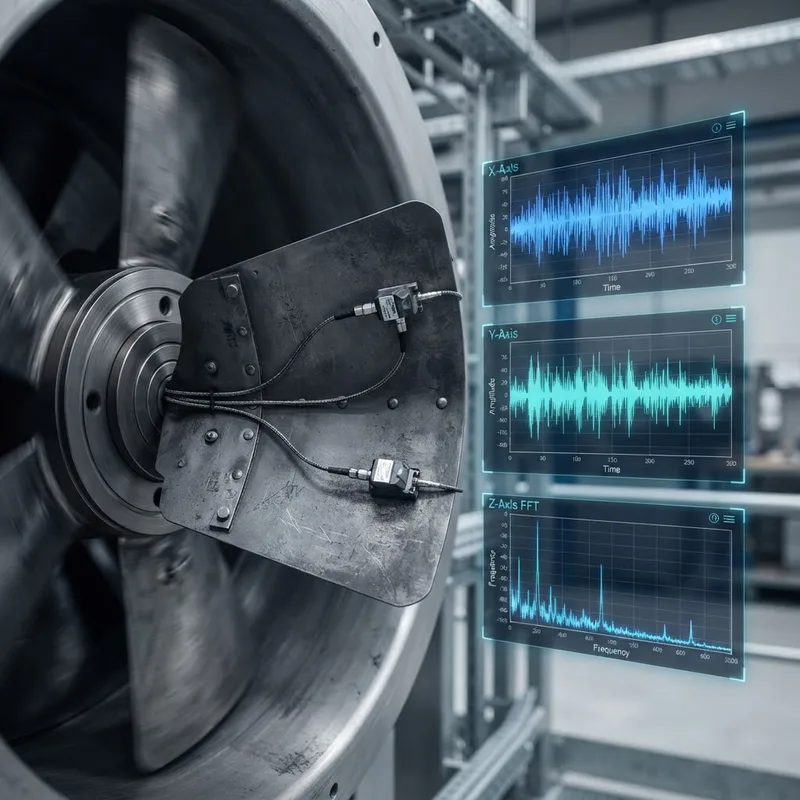
Manual inspections happen weekly or monthly at best. AI monitors continuously, meaning a fault developing at 2 a.m. is flagged instantly rather than discovered days later during a scheduled walk-through.
The Data Behind Fan Anomaly Detection
AI is only as good as the signals it learns from. Effective fan anomaly detection combines several data streams.
Vibration Data
Vibration is the single richest source of fan health information. Accelerometers capture frequency patterns that reveal imbalance, misalignment, looseness, and bearing wear. Each fault produces a distinct frequency signature, which machine learning models learn to recognize even in noisy environments.
Temperature and Current
Motor temperature and electrical current reveal load stress and mechanical friction. A rising current draw at constant speed often signals bearing degradation or blade fouling before vibration becomes severe.
Acoustic and Airflow Signals
Microphones capture sound anomalies, while airflow and pressure sensors detect blockages or blade damage. Combining these with vibration gives the model a fuller picture and reduces false positives.
Operating Context
Speed, ambient temperature, and load must be included so the model understands that higher vibration at higher RPM can be perfectly normal. Context is what separates smart detection from crude threshold alarms.
How the AI Actually Detects Anomalies
Fan anomaly detection artificial intelligence generally follows a clear pipeline, from raw signals to a confident alert.
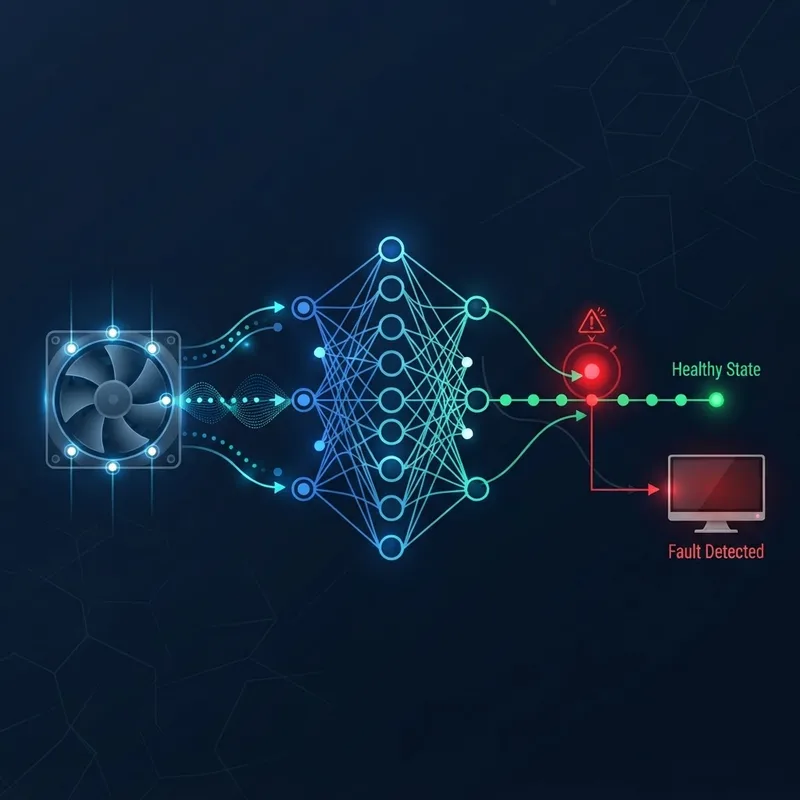
- Data collection: Sensors stream vibration, temperature, current, and sound at high frequency.
- Feature extraction: Signals are transformed, often using Fast Fourier Transform, into frequency and statistical features.
- Baseline learning: The model trains on healthy operation to learn the fan's normal signature.
- Scoring: Live data is compared to the baseline, producing an anomaly score.
- Alerting: When the score crosses a learned confidence threshold, the system flags the issue and often suggests a likely cause.
Common Algorithms Used
Several proven techniques power these systems:
- Autoencoders: Neural networks that reconstruct normal signals; large reconstruction errors indicate anomalies.
- Isolation Forest: An unsupervised model that isolates rare, unusual data points efficiently.
- One-Class SVM: Learns a boundary around normal behavior and flags anything outside it.
- LSTM networks: Recurrent models that detect anomalies in time-series sequences, ideal for gradual drift.
Most real deployments use unsupervised or semi-supervised learning, because labeled failure data is scarce. You rarely have thousands of examples of a specific bearing failure, but you always have plenty of normal running data to learn from.
Supervised vs Unsupervised Detection
Choosing the right learning approach is one of the most important design decisions. The table below compares the two dominant strategies.
| Factor | Supervised Learning | Unsupervised Learning |
|---|---|---|
| Labeled data needed | Yes, many labeled faults | No, learns from normal data |
| Detects unknown faults | Limited | Yes |
| Setup effort | High | Moderate |
| Best for | Well-documented failure types | New or rare fault patterns |
| Common models | Random Forest, CNN | Autoencoder, Isolation Forest |
In practice, teams often start unsupervised to catch anything abnormal, then add supervised classification once enough labeled failures accumulate to name specific fault types.
Real-World Applications
Fan anomaly detection is already delivering measurable value across industries.
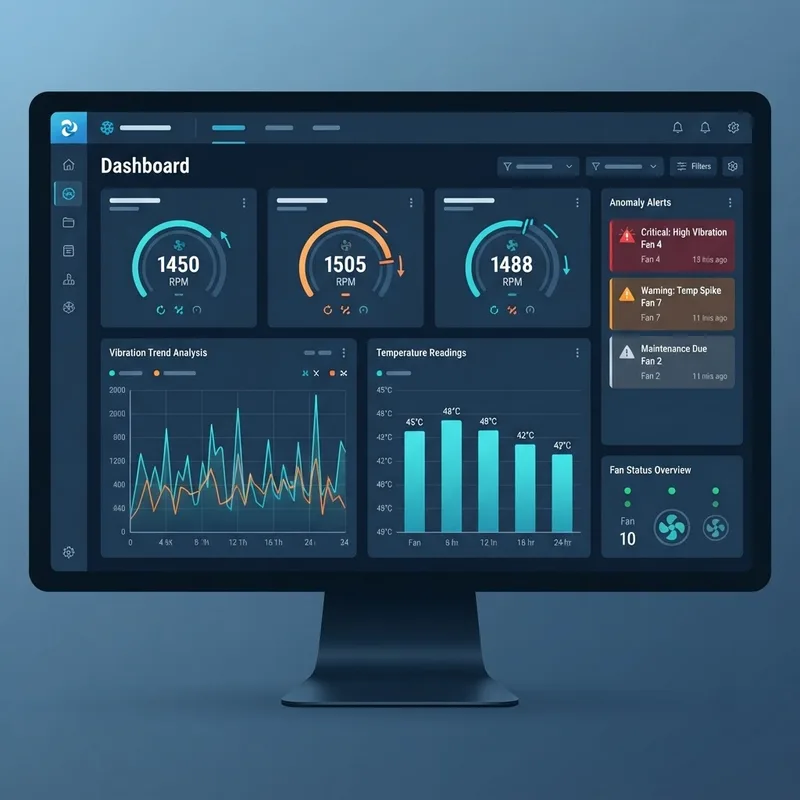
- Data centers: Cooling fans are mission critical. AI detection prevents thermal shutdowns and protects expensive hardware.
- HVAC systems: Building fans run constantly; early detection avoids comfort complaints and energy waste.
- Manufacturing: Exhaust and process fans keep production safe; unexpected failure can stop an entire line.
- Electronics: Even small cooling fans in devices benefit from embedded anomaly detection to prevent overheating.
Businesses building these monitoring platforms often pair sensor pipelines with custom machine learning models. If you are developing such a system, our artificial intelligence services team helps design and deploy production-grade anomaly detection tailored to your assets.
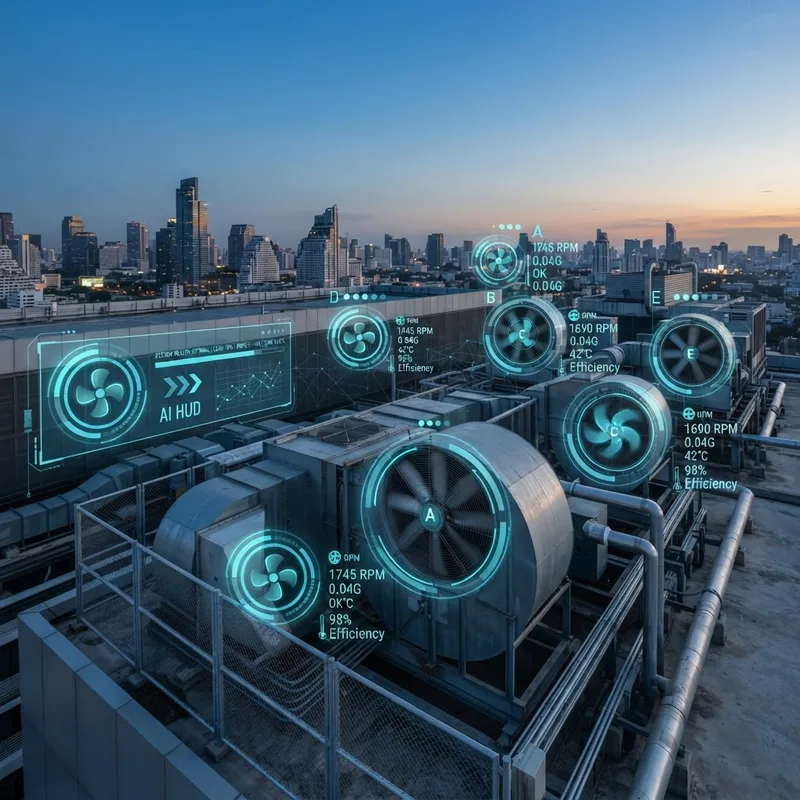
Building a Fan Anomaly Detection System
Deploying an effective system follows a repeatable path. Here is the workflow experienced teams rely on.
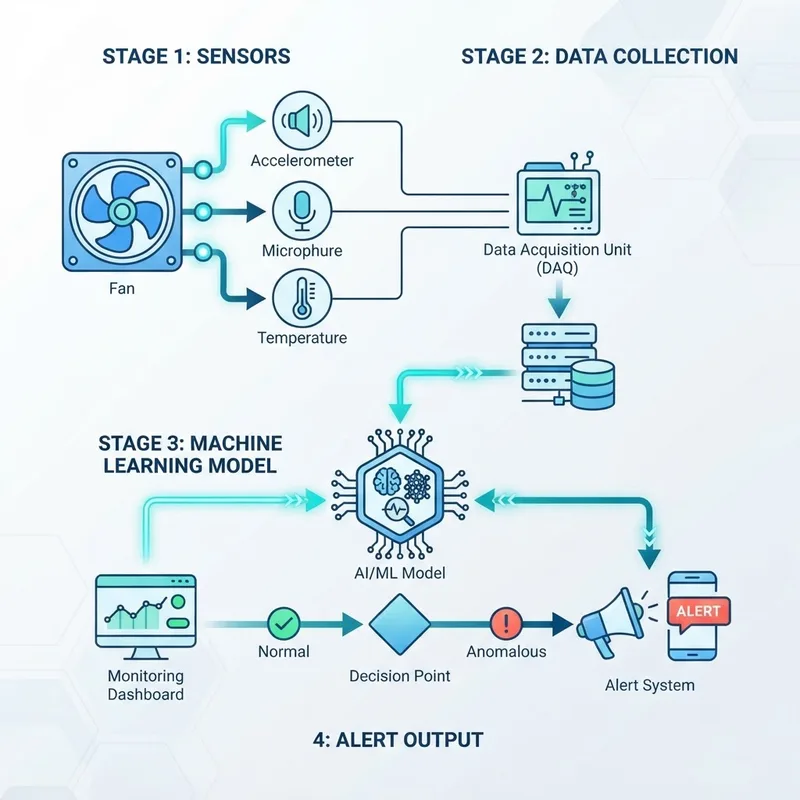
- Instrument the fan with vibration, temperature, and current sensors at the right mounting points.
- Collect healthy baseline data across the full range of normal operating conditions.
- Engineer features from raw signals, focusing on frequency bands linked to known fault modes.
- Train and validate an unsupervised model, tuning sensitivity to balance early detection against false alarms.
- Deploy at the edge or cloud, streaming scores to a dashboard with clear alerts.
- Close the loop by labeling confirmed faults to continuously improve accuracy.
The most common mistake is skipping step two. Without clean, representative baseline data, the model learns a distorted definition of normal and generates constant noise. Invest time in solid baseline collection before optimizing algorithms.
Benefits and Business Impact
The payoff from AI-driven fan monitoring is concrete and measurable.
- Less downtime: Faults are caught days or weeks before failure, enabling planned repairs.
- Lower costs: Fixing a worn bearing is far cheaper than replacing a seized motor and paying for emergency labor.
- Longer asset life: Early intervention prevents secondary damage that shortens equipment lifespan.
- Energy savings: Balanced, clean fans move air efficiently, reducing wasted electricity.
- Safety: Reliable ventilation and cooling protect people, products, and infrastructure.
For teams building the broader digital infrastructure around these systems, resources at ZoneTechify and WebPeak cover the engineering and deployment practices that make monitoring platforms reliable at scale.
Key Takeaways
- Fan anomaly detection AI learns each fan's normal signature and flags deviations, outperforming fixed-threshold alarms.
- Vibration is the richest signal, but combining it with temperature, current, and sound reduces false positives.
- Unsupervised models like autoencoders and Isolation Forest dominate because labeled failure data is scarce.
- Predictive maintenance can cut maintenance costs up to 40% and unplanned downtime up to 50%, per Deloitte.
- Clean baseline data collection is the single most important factor in accurate detection.
Frequently Asked Questions (FAQ)
How does AI detect a failing fan before it breaks?
AI continuously analyzes signals like vibration, temperature, and current, comparing them to the fan's learned healthy baseline. When patterns drift, such as rising bearing frequencies, it produces an anomaly score and alerts technicians early, often days or weeks before an actual mechanical failure occurs.
What sensors are needed for fan anomaly detection?
The core sensors are accelerometers for vibration, temperature sensors for the motor and bearings, and current sensors for electrical load. Many systems add acoustic microphones and airflow or pressure sensors. Combining multiple signals improves accuracy and reduces false alarms compared to relying on vibration alone.
Is labeled failure data required to build the system?
No. Most fan anomaly detection uses unsupervised learning, which trains only on normal operating data. Models like autoencoders and Isolation Forest learn what healthy behavior looks like and flag anything unusual, so you can detect faults even without historical examples of specific failures.
Can fan anomaly detection run on edge devices?
Yes. Lightweight models can run directly on edge hardware near the fan, enabling instant local alerts without constant cloud connectivity. Edge deployment reduces latency and bandwidth, while the cloud is often used for long-term storage, model retraining, and fleet-wide analytics across many fans.
How accurate is AI fan anomaly detection?
Accuracy depends on sensor quality and baseline data, but well-tuned systems reliably catch developing faults with few false alarms. Because AI adapts to each fan's operating context, it typically outperforms fixed thresholds, detecting subtle degradation that manual inspections and static rules routinely miss.
What industries benefit most from this technology?
Data centers, HVAC and building management, manufacturing, energy, and electronics gain the most. Any operation that depends on continuous cooling, ventilation, or airflow benefits, because an unexpected fan failure in these settings can trigger overheating, safety issues, production stoppages, and costly emergency repairs.