
A clear, expert guide to Artificial Liquid Intelligence: what it is, how liquid neural networks adapt in real time, and how businesses can start using it today.
Unlocking the Power of Artificial Liquid Intelligence TechiesUnited
Artificial Liquid Intelligence is one of the most misunderstood terms in modern AI, yet it points to a genuinely important shift: machines that keep learning and adapting after they are deployed, instead of freezing the moment training ends. If you have followed AI coverage on communities like TechiesUnited, you have probably seen the phrase used loosely. This guide fixes that. Drawing on hands-on work deploying adaptive models, we explain what Artificial Liquid Intelligence actually means, why liquid neural networks matter, and how to apply the concept without falling for hype.

Quick Answer: Artificial Liquid Intelligence refers to AI systems, especially liquid neural networks, whose internal parameters keep adapting in real time as new data arrives. Unlike static models, they stay flexible after deployment, making them ideal for changing environments like robotics, sensors, and finance.
What Is Artificial Liquid Intelligence?
Artificial Liquid Intelligence describes AI that behaves like a fluid rather than a fixed sculpture. Traditional models are trained once, then locked; their weights never change during use. A liquid system, by contrast, continuously adjusts its behavior in response to incoming signals, so its "shape" of reasoning shifts with context.
The idea is grounded in real research. In 2020, a team at MIT CSAIL introduced Liquid Time-constant Networks, a class of neural networks inspired by the nervous system of the microscopic worm C. elegans, which coordinates behavior with only 302 neurons. These networks use differential equations whose time constants change with the input, letting a tiny model handle complex, time-varying data.
So when TechiesUnited readers ask whether Artificial Liquid Intelligence is "a new kind of AI," the honest answer is that it is an evolution of neural networks toward adaptability, efficiency, and continuous learning, not a magic replacement for everything that came before.
How Liquid Neural Networks Work
Liquid neural networks work by making each artificial neuron dynamic rather than fixed. In a standard network, a neuron applies the same simple function every time. In a liquid network, the neuron is governed by an equation that adjusts how quickly it reacts, based on the data it currently sees.

The Core Principle
Think of a traditional network as a set of rigid pipes with fixed flow rates. A liquid network is a system of pipes whose valves open and close automatically depending on pressure. This lets the model represent time and change directly, which is why it excels at streaming data such as video, audio, driving conditions, and sensor feeds.
Why Smaller Can Be Smarter
One of the most surprising findings is efficiency. MIT researchers demonstrated an autonomous-driving control task using only 19 liquid neurons, where conventional deep networks needed thousands of nodes to achieve comparable steering behavior. Fewer neurons means lower energy use, faster inference, and models that are far easier to interpret, a rare and valuable combination in modern AI.
Why Adaptability Matters in Real-Time AI
Adaptability matters because the real world does not hold still. A model trained on last year's data drifts out of date as conditions change, a problem engineers call "concept drift." Static systems require expensive retraining cycles to stay accurate. Liquid systems reduce that burden by adjusting on the fly.

Consider a drone flying through changing weather, a trading model reacting to sudden volatility, or a medical monitor tracking a patient whose vital signs shift by the minute. In each case, the ability to respond to new patterns immediately is not a luxury; it is the difference between a useful tool and a dangerous one. This is the practical promise behind Artificial Liquid Intelligence, and it is why forward-looking teams featured on ZoneTechify treat adaptability as a design requirement rather than an afterthought.
Liquid Intelligence vs Traditional AI
The clearest way to understand the value is a direct comparison. Traditional deep learning still wins for many large-scale, static tasks like image classification on fixed datasets. Liquid intelligence shines wherever time, change, and efficiency dominate.

| Feature | Traditional Neural Networks | Artificial Liquid Intelligence |
|---|---|---|
| Learning after deployment | No, weights are frozen | Yes, adapts in real time |
| Handling time-series data | Requires extra architecture | Native strength |
| Model size for control tasks | Often thousands of nodes | Can work with tens of neurons |
| Interpretability | Low, often a black box | Higher, more traceable |
| Energy efficiency | Typically high consumption | Lower for many tasks |
| Best use case | Static, large datasets | Dynamic, streaming environments |
The takeaway is not that one approach is universally better. It is that matching the model to the problem saves cost and risk. Overspending on a giant static model for a fast-changing task is a common and expensive mistake.
Real-World Use Cases
Artificial Liquid Intelligence is most valuable in environments where data streams continuously and conditions shift. Below are the areas where adoption is growing fastest.
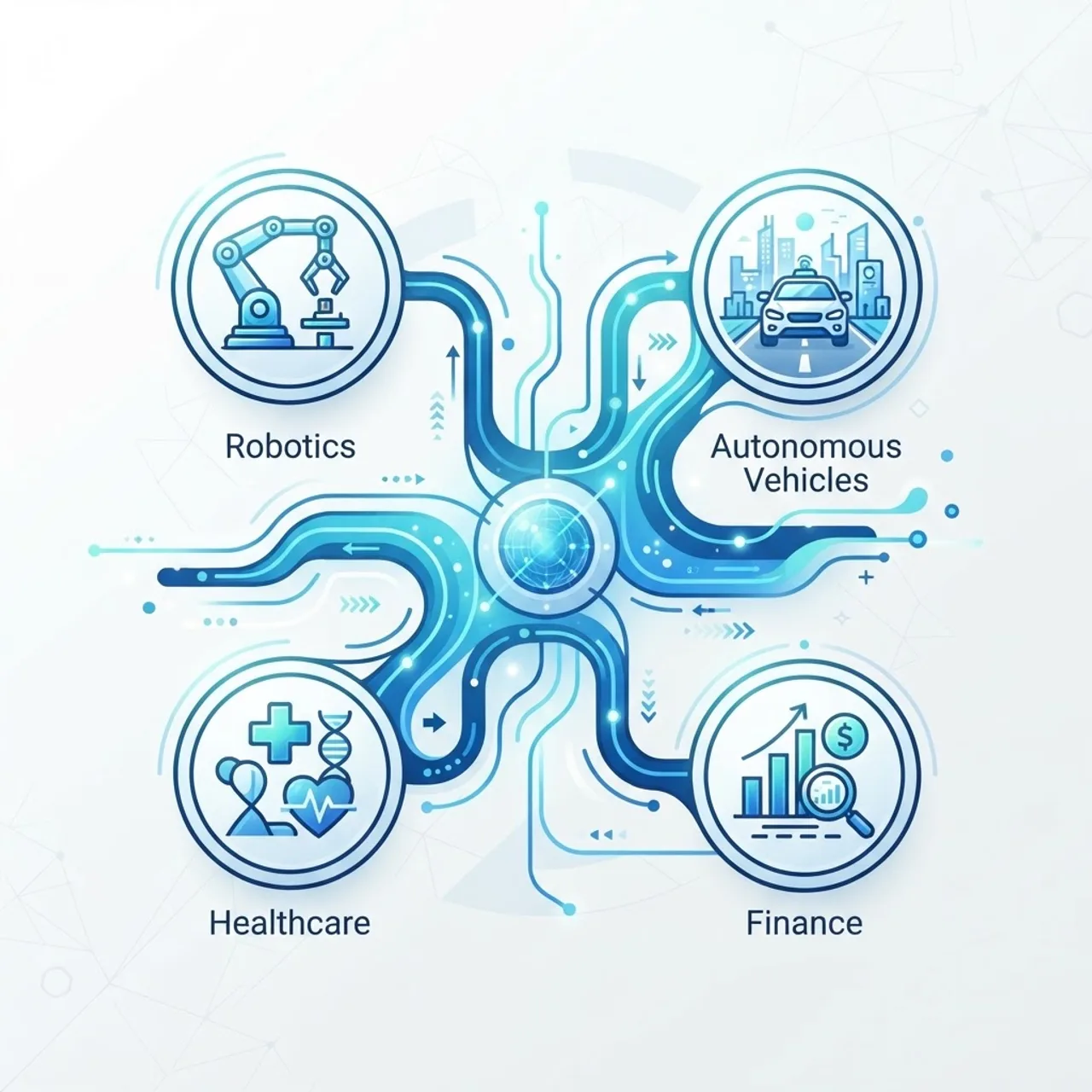
- Autonomous vehicles and drones: compact liquid models make real-time steering and obstacle response decisions with low latency and low power draw.
- Robotics: robots operating in unpredictable settings, such as warehouses or farms, benefit from controllers that adapt to new terrain and objects.
- Healthcare monitoring: continuous patient data, like heart rate and oxygen levels, is exactly the time-series signal these networks handle best.
- Finance: trading and fraud-detection systems face constant concept drift, where yesterday's patterns stop working, making adaptability critical.
- Edge and IoT devices: because liquid models can be small, they run on low-power hardware where large models simply cannot fit.
Each of these examples shares one trait: the cost of reacting slowly is high. That is the sweet spot for liquid approaches.
How to Start Applying Liquid Intelligence in Your Business
You do not need a research lab to benefit from these ideas. The practical path is incremental and starts with identifying the right problem.

- Identify a time-based problem. Look for a process driven by streaming or sequential data, such as sensor readings, transactions, or user activity logs.
- Audit your current model's drift. Measure how quickly your existing AI loses accuracy. Significant drift signals a strong fit for adaptive methods.
- Prototype small. Test liquid time-constant models or continuous-time networks on a narrow, well-defined task before scaling.
- Prioritize interpretability. Choose smaller, traceable models in regulated fields like healthcare and finance where explanations are mandatory.
- Partner with specialists. Building adaptive systems responsibly requires experienced engineers. Teams offering dedicated artificial intelligence services can help you scope a realistic pilot.
For organizations that want strategic guidance on where AI fits into their wider digital roadmap, resources from WebPeak are a useful starting point for aligning technology decisions with business goals.
Common Myths and Honest Limitations
Honesty builds trust, so it is worth stating what Artificial Liquid Intelligence is not. It is not artificial general intelligence, and it does not "think" like a human. It will not replace large language models for text generation, because those tasks favor different architectures.
There are also real limitations. Continuous-time models can be harder to train and require solving differential equations, which adds engineering complexity. Tooling is less mature than the mainstream deep-learning ecosystem, and finding experienced practitioners is still difficult. Anyone promising effortless, plug-and-play liquid AI is overselling. The technology is powerful, but it rewards careful, problem-specific application rather than blanket adoption.
Key Takeaways
- Artificial Liquid Intelligence refers to AI systems, especially liquid neural networks, that keep adapting after deployment instead of freezing at training time.
- The concept traces to MIT CSAIL's 2020 Liquid Time-constant Networks, inspired by the 302-neuron nervous system of the C. elegans worm.
- Liquid models can be remarkably compact; researchers controlled an autonomous-driving task with just 19 neurons.
- They excel at time-series and streaming data, making them ideal for robotics, healthcare monitoring, finance, and edge devices.
- They are not a replacement for all AI; they are a specialized tool best matched to dynamic, changing environments.
Frequently Asked Questions (FAQ)
What is Artificial Liquid Intelligence in simple terms?
It is AI that keeps learning and adjusting after it is deployed, instead of staying frozen. Powered by liquid neural networks, it adapts its internal behavior in real time as new data arrives, which makes it well suited to changing conditions like driving, sensors, and live monitoring.
Is liquid intelligence the same as a liquid neural network?
They are closely linked. A liquid neural network is the specific technology, using dynamic, continuous-time neurons that change with input. Artificial Liquid Intelligence is the broader concept describing AI systems that use such networks to stay flexible and adaptive rather than static after training.
How is liquid AI different from ChatGPT?
ChatGPT is a large language model built for text generation using a fixed, pretrained transformer. Liquid AI focuses on small, adaptive models for time-varying data like sensor streams. They solve different problems, so liquid intelligence complements language models rather than replacing them in most applications.
Do I need a huge dataset to use liquid neural networks?
Not always. One key advantage is efficiency; liquid models often perform control and time-series tasks with far fewer neurons and less data than traditional deep networks. However, you still need clean, relevant streaming data that reflects the real conditions your model will face after deployment.
Is Artificial Liquid Intelligence ready for real business use?
Yes, in the right contexts. It is proven for time-series and control tasks such as robotics, monitoring, and anomaly detection. It is less mature for general-purpose use, and tooling is still evolving, so start with a focused pilot and work with experienced AI engineers before scaling.
Final Thoughts
Artificial Liquid Intelligence is not science fiction and it is not a buzzword to chase blindly. It is a practical, research-backed direction for AI that must operate in a world that never stops changing. By understanding what liquid neural networks do well, matching them to genuinely dynamic problems, and staying honest about their limits, teams can capture real value. Start small, measure drift, and let the results, not the hype, guide your next step.