
A practical, expert guide to how robotic process automation and artificial intelligence transform finance operations, from invoice processing to fraud detection and forecasting.
Robotic Process Automation and Artificial Intelligence in Finance
Finance teams are drowning in repetitive, rule-heavy work: reconciling accounts, chasing invoices, closing books, and answering the same compliance questions every quarter. Robotic Process Automation (RPA) and Artificial Intelligence (AI) are the two technologies quietly rewriting how that work gets done. Having helped finance departments deploy both, I can tell you the biggest wins rarely come from one technology alone; they come from using each where it is strongest.

This guide breaks down exactly where RPA and AI fit in modern finance, how they differ, and how to combine them into intelligent automation that actually reduces cost and risk. Every section answers a real question a CFO, controller, or finance operations lead asks before signing off on an automation project.
Quick Answer: In finance, Robotic Process Automation handles high-volume, rule-based tasks like data entry and reconciliation, while Artificial Intelligence adds judgment through prediction, pattern detection, and language understanding. Combined as intelligent automation, they cut processing costs, reduce errors, speed up reporting, and strengthen fraud detection and compliance.
What Is the Difference Between RPA and AI in Finance?
RPA is software that mimics repetitive human clicks and keystrokes across systems, while AI is software that learns from data to make predictions or decisions. RPA follows explicit rules; AI infers patterns. That distinction matters because deploying the wrong tool for a task is the most common reason automation projects stall.
RPA excels when a process is structured, high-volume, and predictable, like copying invoice totals from a PDF into an ERP. AI excels when a process requires interpretation, such as reading an unstructured contract, scoring credit risk, or flagging an unusual transaction. When you connect the two, a bot can gather and move data while an AI model decides what the data means.

Definitions Finance Leaders Should Know
- Robotic Process Automation (RPA): Configurable software bots that execute rule-based digital tasks across applications without changing the underlying systems.
- Artificial Intelligence (AI): Systems that use machine learning to recognize patterns, predict outcomes, and process natural language.
- Intelligent Automation (IA): The combination of RPA and AI, where bots handle execution and AI provides judgment.
Why Does Finance Adopt RPA and AI So Aggressively?
Finance adopts these technologies because its core work is transaction-heavy, deadline-driven, and error-sensitive, exactly the conditions where automation delivers measurable returns. According to Deloitte's Global RPA Survey, organizations reported that RPA delivered payback in under 12 months on average, with respondents citing improved compliance and accuracy as top benefits alongside cost reduction.
The pressure is real. A McKinsey analysis has estimated that roughly 40 percent of finance activities, such as cash disbursement, revenue management, and general accounting, can be fully automated with current technology, and another 17 percent can be mostly automated. For a controller managing month-end close, that is the difference between a five-day scramble and a two-day, mostly hands-off process.
The strategic payoff is not just savings. When bots absorb the mechanical work, skilled accountants shift toward analysis, forecasting, and advising the business, roles that are far harder to outsource or commoditize. Firms like ZoneTechify and WebPeak increasingly help finance teams design this shift so automation augments people rather than simply replacing headcount.
High-Impact Use Cases for RPA in Finance
The strongest RPA use cases in finance are the tasks people find most tedious: reconciliation, data entry, and report generation. These are structured, repeatable, and audit-friendly, which makes them ideal candidates.
1. Accounts Payable and Invoice Processing
Bots extract invoice data, match it against purchase orders, route exceptions, and post approved payments. This three-way matching is slow and error-prone manually but nearly instant for a well-configured bot.

2. Account Reconciliation
RPA pulls balances from multiple ledgers, compares them, and flags mismatches for human review. What once took an analyst a full day can run overnight, unattended.
3. Regulatory and Management Reporting
Bots gather figures from source systems, populate templates, and distribute reports on schedule. This removes copy-paste errors that regulators and auditors punish.
4. Payroll and Expense Management
RPA validates timesheets, applies policy rules, and processes reimbursements, reducing both delays and disputes.
High-Impact Use Cases for AI in Finance
AI adds value where judgment, prediction, or language understanding is required, tasks that rules alone cannot solve. These use cases turn finance from a backward-looking record keeper into a forward-looking advisor.
Fraud Detection and Anomaly Monitoring
AI models learn normal transaction behavior and flag deviations in real time. Unlike a static rule, a machine learning model adapts as fraud patterns evolve, catching threats a fixed threshold would miss.

Credit Scoring and Risk Assessment
AI evaluates thousands of variables to predict default risk more accurately than traditional scorecards, expanding responsible lending while controlling exposure.
Financial Forecasting and Planning
Machine learning models detect seasonality and hidden drivers in historical data, producing cash-flow and revenue forecasts that update automatically as new numbers arrive.

Document and Contract Intelligence
Natural language processing reads contracts, extracts key terms, and surfaces obligations, turning unstructured documents into structured, searchable data. Teams building these capabilities often lean on specialized artificial intelligence services to move from proof of concept to production safely.
RPA vs AI vs Intelligent Automation: A Side-by-Side Comparison
The table below clarifies where each approach fits so you can match the tool to the task.
| Capability | RPA | AI | Intelligent Automation |
|---|---|---|---|
| Handles structured, rule-based tasks | Yes | Partial | Yes |
| Handles unstructured data | No | Yes | Yes |
| Learns and improves over time | No | Yes | Yes |
| Makes predictions | No | Yes | Yes |
| Speed of deployment | Fast | Slower | Moderate |
| Best for reconciliation and data entry | Yes | No | Yes |
| Best for fraud detection and forecasting | No | Yes | Yes |
| Requires large training data | No | Yes | Sometimes |
The pattern is clear: RPA gives you speed and reliability on structured work, AI gives you insight on complex work, and intelligent automation gives you both.
How RPA and AI Work Together in a Finance Workflow
The most valuable finance automations chain RPA and AI so bots handle movement and models handle meaning. Consider a modern invoice workflow: an RPA bot retrieves incoming invoices, an AI document model reads and classifies unstructured line items, a rules engine validates them, and the bot posts the result to the ERP, escalating only true exceptions to a human.
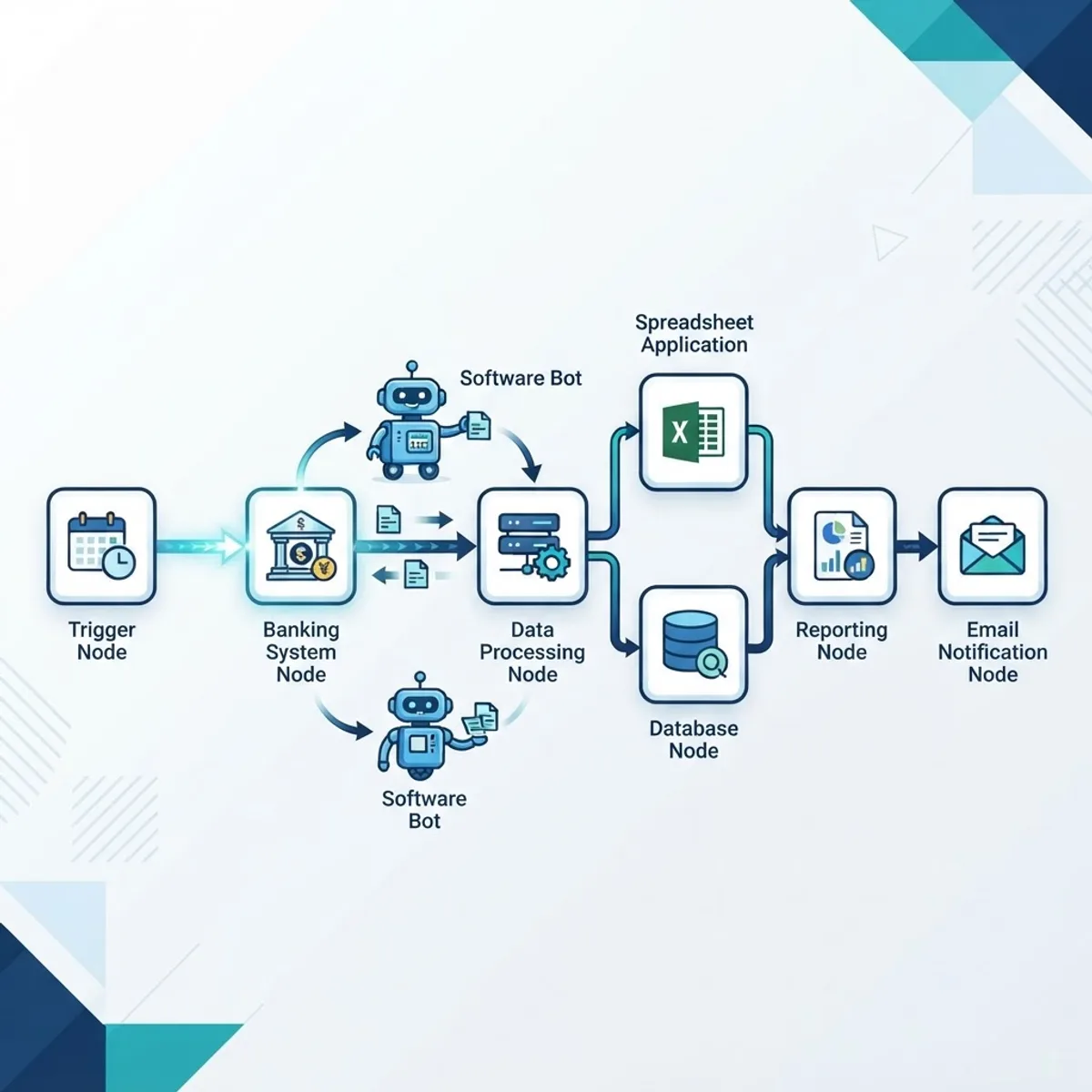
This division of labor is why intelligent automation outperforms either technology alone. The bot never gets tired or distracted, and the model handles the ambiguity that would otherwise force manual intervention. For teams building these end-to-end pipelines, partnering with an experienced provider of artificial intelligence solutions shortens the path from pilot to reliable production system.
How to Implement RPA and AI in Finance: A Step-by-Step Approach
Successful adoption is less about technology and more about disciplined sequencing. Based on real deployments, this order minimizes risk and builds momentum.
- Map and prioritize processes. Document your highest-volume, most repetitive tasks and rank them by effort and return.
- Start with RPA on structured wins. Automate reconciliation or invoice matching first to prove value quickly.
- Clean and centralize your data. AI is only as good as its inputs, so fix data quality before training models.
- Layer AI onto proven bots. Add document intelligence or anomaly detection to workflows already automated with RPA.
- Keep humans in the loop. Route exceptions and high-risk decisions to people, especially early on.
- Govern and monitor. Track accuracy, audit trails, and model drift continuously.

Avoid the classic mistake of automating a broken process. If a workflow is confusing for humans, a bot will simply make the confusion faster. Redesign first, then automate.
The Future of RPA and AI in Finance
The next wave is agentic automation, where AI systems plan multi-step finance tasks and orchestrate bots with minimal human prompting. Instead of a person triggering each step, an AI agent interprets a goal like "close the month" and coordinates the underlying processes.

Expect tighter integration between large language models and traditional RPA, real-time continuous auditing rather than periodic reviews, and forecasting that refreshes hourly instead of monthly. The finance professionals who thrive will be those who understand both the numbers and the systems producing them.
Key Takeaways
- RPA automates structured, rule-based finance tasks; AI adds prediction, pattern detection, and language understanding.
- McKinsey estimates roughly 40 percent of finance activities can be fully automated with current technology.
- Deloitte research found RPA often pays back in under 12 months while improving compliance and accuracy.
- Intelligent automation, combining RPA and AI, outperforms either technology used alone.
- Start with RPA quick wins, fix data quality, then layer AI and keep humans in the loop for high-risk decisions.
Frequently Asked Questions (FAQ)
What is the difference between RPA and AI in finance?
RPA uses software bots to perform repetitive, rule-based tasks such as data entry and reconciliation. AI learns from data to make predictions and interpret unstructured information like contracts or fraud patterns. RPA follows fixed rules, while AI applies judgment, and together they form intelligent automation.
Can RPA and AI replace accountants?
No. RPA and AI replace repetitive tasks, not accountants. By automating data entry, reconciliation, and reporting, they free finance professionals to focus on analysis, forecasting, and advisory work. The role shifts from manual processing toward higher-value judgment, strategy, and interpretation that machines cannot reliably perform alone.
Is RPA safe for sensitive financial data?
Yes, when governed properly. RPA bots operate within existing security controls, create detailed audit trails, and reduce human error that causes data leaks. Strong access management, encryption, and monitoring are essential. In fact, automated processes are often more auditable and consistent than manual ones, improving overall compliance and traceability.
How long does it take to see ROI from finance automation?
Many RPA projects report payback within twelve months, according to Deloitte research. Simple, high-volume automations like invoice processing often deliver value in weeks. AI initiatives take longer because they require quality data and model training, but they generate compounding returns as accuracy improves over time.
Where should a finance team start with automation?
Start with a structured, repetitive, high-volume process such as account reconciliation or invoice matching. These deliver fast, measurable wins with low risk. Once RPA proves value and your data is clean, layer AI capabilities like anomaly detection or forecasting onto the workflows you have already automated successfully.