A complete, expert guide to the ISACA Artificial Intelligence Fundamentals Certificate, covering exam structure, benefits, study tips, and who should earn it.
ISACA Artificial Intelligence Fundamentals Certificate
Artificial intelligence has moved from a boardroom buzzword to a daily operational reality, and professionals across audit, security, and governance now need a credible way to prove they understand it. The ISACA Artificial Intelligence Fundamentals Certificate is designed to close exactly that gap. It gives non-technical and technical professionals a shared, verifiable baseline of AI knowledge from a body that already governs frameworks like COBIT and certifications like CISA and CISM.
In this guide, I break down what the certificate actually covers, how the exam works, who it is for, and whether it is worth your time and money. I have reviewed ISACA's official learning materials and benchmarked this credential against other entry-level AI certifications so you can decide with confidence.
Quick Answer: The ISACA Artificial Intelligence Fundamentals Certificate is an entry-level, vendor-neutral credential that validates core AI concepts, terminology, machine learning basics, ethics, risk, and governance. It uses a self-paced online course plus an assessment, requires no prerequisites, and suits professionals in audit, security, IT, and management.
What Is the ISACA AI Fundamentals Certificate?
The ISACA Artificial Intelligence Fundamentals Certificate is a foundational credential that confirms you understand the essential building blocks of artificial intelligence and how they apply to business and governance. Unlike deep technical certifications aimed at data scientists, this one is intentionally accessible. It focuses on comprehension and application rather than coding or model building.
Definition: An AI fundamentals certificate is a credential that verifies baseline literacy in AI concepts, including machine learning, data handling, ethics, and risk, without requiring advanced programming or mathematics.
ISACA delivers the program as an on-demand, self-paced online course bundled with an assessment. When you pass, you earn a digital badge and a certificate you can share on LinkedIn and in professional profiles. Because ISACA is globally recognized in IT governance and assurance, the badge carries weight with employers who already trust the organization's other credentials.
The certificate is vendor-neutral. That means it does not tie you to AWS, Microsoft, or Google tooling. Instead, it teaches transferable principles you can apply regardless of the platform your organization uses. For governance and audit professionals, that neutrality is a genuine advantage.
What Topics Does the Certificate Cover?
The curriculum is organized into clear domains that move from concepts to real-world application. Based on ISACA's published outline, expect coverage across the following areas:
- AI and machine learning basics — definitions, history, and the difference between AI, ML, and deep learning.
- Machine learning types — supervised, unsupervised, and reinforcement learning explained in plain terms.
- Data and its role — how data quality, bias, and preparation shape AI outcomes.
- AI applications — practical use cases across industries, from fraud detection to customer service.
- Ethics and responsible AI — fairness, transparency, accountability, and explainability.
- Risk and governance — how AI introduces new risks and how frameworks help manage them.
This structure reflects ISACA's core strength. Where many AI courses stop at technical concepts, ISACA connects those concepts to risk, control, and governance. That governance lens is what distinguishes this credential from generic online AI classes.
How Is the Exam Structured?
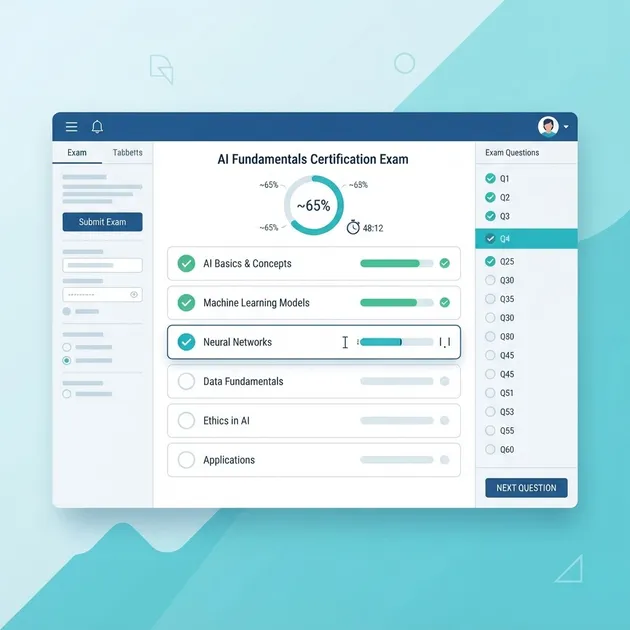
The assessment for the ISACA Artificial Intelligence Fundamentals Certificate is straightforward and low-pressure compared to ISACA's flagship exams. Here is what you can expect:
- Format — an online, multiple-choice assessment taken after completing the course modules.
- Delivery — fully remote and on-demand, so you can complete it on your own schedule.
- Prerequisites — none. You do not need prior AI experience or another ISACA certification.
- Retakes — the program allows you to review material and attempt the assessment as your enrollment permits.
- Outcome — passing awards a shareable digital badge and certificate.
Because this is a certificate rather than a certification, it does not carry ongoing continuing professional education (CPE) renewal requirements the way CISA or CISM do. That makes it lower maintenance and ideal as a stepping stone. You earn it once and it stands as proof of foundational knowledge.
Why the Certificate Matters in 2026
Demand for AI literacy is accelerating faster than the supply of qualified professionals. According to the World Economic Forum's Future of Jobs report, AI and machine learning specialists rank among the fastest-growing roles this decade, and analytical thinking plus AI literacy top the list of skills employers say are rising in importance. A credential that proves baseline AI understanding is increasingly a hiring filter, not a nice-to-have.
There is also a governance driver. As organizations adopt AI, regulators and boards demand oversight. The EU AI Act, the first comprehensive AI law, began phasing in obligations in 2025, pushing companies to build internal AI risk capabilities. Professionals who can speak the language of both AI and governance are exactly who these organizations need, and ISACA's certificate signals that dual fluency.
If your organization is building AI capabilities and needs expert support beyond certification, teams like ZoneTechify and WebPeak help businesses implement AI responsibly. For hands-on strategy and deployment, WebPeak's artificial intelligence services pair well with the governance mindset this certificate builds.
Who Should Take This Certificate?

The certificate is deliberately broad in appeal, but it delivers the most value to specific roles. You are an ideal candidate if you are:
- An IT auditor or assurance professional needing to evaluate AI systems and controls.
- A cybersecurity practitioner assessing AI-related threats and safeguards.
- A risk or compliance officer responsible for AI governance and policy.
- A manager or executive making decisions about AI adoption without a technical background.
- A career changer or student seeking a credible, recognized entry point into AI.
If you are already a machine learning engineer writing production models, this certificate will feel basic. It is not built for you. But if your job touches AI decisions, oversight, or strategy without deep technical work, it fits perfectly.
How to Prepare and Pass

Preparation is refreshingly manageable. Because the course and assessment are bundled, most learners finish within a few focused weeks. Here is a practical study plan I recommend:
- Complete every module in order. The content builds progressively, so skipping around creates gaps.
- Take notes on definitions. The assessment rewards precise understanding of terms like supervised learning and explainability.
- Connect concepts to your work. Ask how each risk or control applies to your organization; application aids retention.
- Review the ethics and governance domains twice. These are ISACA's specialty and often the most nuanced.
- Use the built-in resources before attempting the assessment. Do not rush to the test until you can explain concepts in your own words.
Most candidates report needing only a modest time commitment because the material is foundational. Consistency matters more than intensity here.
ISACA AI Fundamentals vs. Other AI Certificates
Choosing an entry-level AI credential means weighing focus, recognition, and cost. The table below compares the ISACA certificate with common alternatives so you can match one to your goals.
| Feature | ISACA AI Fundamentals | Vendor AI Foundations (e.g. cloud provider) | Generic Online AI Course |
|---|---|---|---|
| Governance and risk focus | Strong | Limited | Varies |
| Vendor neutral | Yes | No | Usually yes |
| Prerequisites | None | None | None |
| Recognized digital badge | Yes | Yes | Often no |
| Ongoing renewal required | No | Sometimes | No |
| Best for | Audit, risk, governance | Cloud practitioners | General learners |
The takeaway is clear. If your career sits in assurance, audit, risk, or governance, ISACA's certificate aligns better than a cloud vendor's product-focused foundation. If your goal is to operate a specific platform, a vendor credential may serve you better.
Career and Salary Impact

While a single foundational certificate rarely triggers a large raise on its own, it strengthens your profile in measurable ways. It demonstrates initiative, adds a recognized badge to your resume, and prepares you for more advanced credentials. For professionals already holding CISA or CISM, it complements those certifications by adding AI fluency to an established governance skill set.
More importantly, it positions you for the emerging category of AI governance and AI audit roles, which are expanding as regulation tightens. Being early and credentialed in this niche is a strategic advantage that compounds over time.
Key Takeaways
- The ISACA Artificial Intelligence Fundamentals Certificate is an entry-level, vendor-neutral credential focused on AI concepts, ethics, risk, and governance.
- It requires no prerequisites and uses a self-paced online course plus an online assessment.
- It is a certificate, not a certification, so it carries no CPE renewal burden.
- It best serves auditors, security, risk, compliance, and management professionals rather than hands-on ML engineers.
- AI literacy is now a top rising skill, and governance-focused credentials align with laws like the EU AI Act.
- It pairs well with CISA and CISM and opens doors to growing AI audit and governance roles.
Frequently Asked Questions (FAQ)
Is the ISACA AI Fundamentals Certificate worth it?
Yes, if you work in audit, security, risk, or management and need credible AI literacy. It is affordable, requires no prerequisites, and comes from a globally trusted body. It will not replace deep technical training, but it proves foundational understanding and complements existing governance certifications well.
Do I need coding experience to earn this certificate?
No. The certificate is intentionally non-technical and requires no programming or advanced mathematics. It focuses on concepts, terminology, ethics, and governance rather than building models. Anyone comfortable with business technology can complete it, which makes it ideal for managers, auditors, and career changers entering AI.
How long does it take to complete?
Most learners finish within a few focused weeks because the material is foundational and self-paced. There is no fixed deadline pressure, so your timeline depends on your schedule. Setting aside a few consistent study sessions each week is usually enough to complete the course and pass the assessment.
Is this a certificate or a full certification?
It is a certificate, not a certification. That means it validates foundational knowledge without ongoing continuing professional education requirements. ISACA's certifications, like CISA and CISM, require renewal and CPE credits. This certificate is a one-time credential, making it a lower-maintenance stepping stone toward those advanced options.
Does it expire or require renewal?
No. Because it is a foundational certificate rather than a professional certification, it does not expire or require CPE credits to maintain. Once you earn the digital badge, it remains a permanent record of your achievement that you can display on LinkedIn and professional profiles indefinitely.
Can beginners with no AI background take it?
Absolutely. The certificate is designed for beginners and has no prerequisites. It starts with core definitions and builds toward applications, ethics, and governance. Students, career changers, and non-technical professionals can all succeed. It is one of the most accessible ways to gain a recognized, credible AI foundation.