
Learn how to choose a digital marketing agency in 2026: proven vetting steps, pricing models, red flags, and key questions to ask before signing a contract.
How to Choose a Digital Marketing Agency

Hiring the wrong digital marketing agency costs more than money. It burns six to twelve months of momentum, hands your competitors a head start, and often leaves you with locked accounts, unclear reporting, and a strategy you cannot audit. After a decade of helping businesses recover from bad agency relationships at ZoneTechify, we have seen the same avoidable mistakes repeated: choosing on price alone, skipping reference checks, and signing long contracts before seeing a single strategy document.
This guide gives you the exact vetting process we recommend to our own clients. It covers goal-setting, evaluation criteria, pricing models, red flags, and the specific questions that separate genuine experts from confident salespeople.
Quick Answer: To choose a digital marketing agency, define your goals and budget first, then shortlist 3 to 5 agencies with proven results in your industry. Verify case studies, check client references, review their reporting process, and confirm you own all accounts and data. Start with a 3-month trial engagement before committing to a long-term contract.
Step 1: Define Your Goals Before You Contact Anyone

A digital marketing agency is a partner that executes a strategy toward measurable business outcomes such as leads, sales, or brand visibility. If you cannot state your outcome in one sentence, no agency can deliver it.
Before your first discovery call, write down three things: your primary goal (for example, 40 qualified leads per month), your monthly budget range, and your timeline for seeing results. Agencies quote differently depending on scope, so vague goals produce vague proposals. In our experience at ZoneTechify, clients who arrive with a documented goal negotiate 20 to 30 percent more precise scopes of work because the agency cannot pad the proposal with services you do not need.
Also decide which channels actually matter for your business. A local service company usually needs local SEO and Google Ads. A B2B SaaS company usually needs content marketing, LinkedIn, and email nurturing. An ecommerce brand usually needs paid social, product feed optimization, and retention email. Knowing this prevents you from paying for a "full-service package" where half the deliverables never move your revenue.
Step 2: Decide Between an Agency, a Freelancer, or In-House

An agency is not automatically the right answer. The honest comparison looks like this:
| Factor | Agency | Freelancer | In-House Hire |
|---|---|---|---|
| Typical monthly cost | $2,500 to $12,000+ | $500 to $5,000 | $4,000 to $8,000+ salary |
| Skill coverage | Multi-channel team | Single specialty | Depends on hire |
| Speed to start | 2 to 4 weeks | Days | 1 to 3 months |
| Scalability | High | Low | Medium |
| Accountability | Contract and SLA | Informal | Direct management |
| Best for | Multi-channel growth | One defined channel | Long-term brand control |
Choose an agency when you need more than one channel executed simultaneously, when you lack internal marketing leadership, or when you need results faster than a new hire could ramp up. Choose a freelancer when you have one clearly defined task, such as Google Ads management under a small budget. Build in-house when marketing is your core competitive advantage and you can afford a full team.
Step 3: Evaluate Agencies Against Objective Criteria

Once you shortlist 3 to 5 candidates, score each one against the same criteria. This removes the bias created by polished sales presentations.
Proven Results in Your Industry or Business Model
Ask for case studies with numbers: starting baseline, actions taken, and measured outcome over a defined period. A credible case study says "organic traffic grew from 8,000 to 21,000 monthly sessions in nine months, producing 340 additional leads." A weak one says "we boosted their online presence." If the agency has no experience in your exact industry, that is acceptable — but they must show results in a comparable business model, such as another lead-generation or ecommerce client.
Their Own Marketing Performance
An agency that claims SEO expertise should rank for competitive terms itself. Check their organic visibility, content quality, and review profile. Teams like WebPeak demonstrate this principle well: an agency's own digital footprint is its most honest portfolio, because it cannot be selectively edited the way case studies can.
Team Composition and Who Actually Does the Work
Many agencies sell with senior strategists and deliver with junior staff or outsourced contractors. Ask directly: "Who will manage my account day to day, and how many other accounts do they handle?" A dedicated account manager juggling more than 10 to 12 clients cannot give your business meaningful attention. Ask to meet the actual team members before signing.
Transparency of Process and Data Ownership
You must own your ad accounts, analytics, website, and creative assets. This is non-negotiable. Agencies that run campaigns inside their own accounts create hostage situations: if you leave, your campaign history, audiences, and quality scores leave with them. Confirm in writing that all accounts are created under your business ownership with the agency added as a managed user.
Step 4: Understand Pricing Models So You Can Compare Quotes Fairly
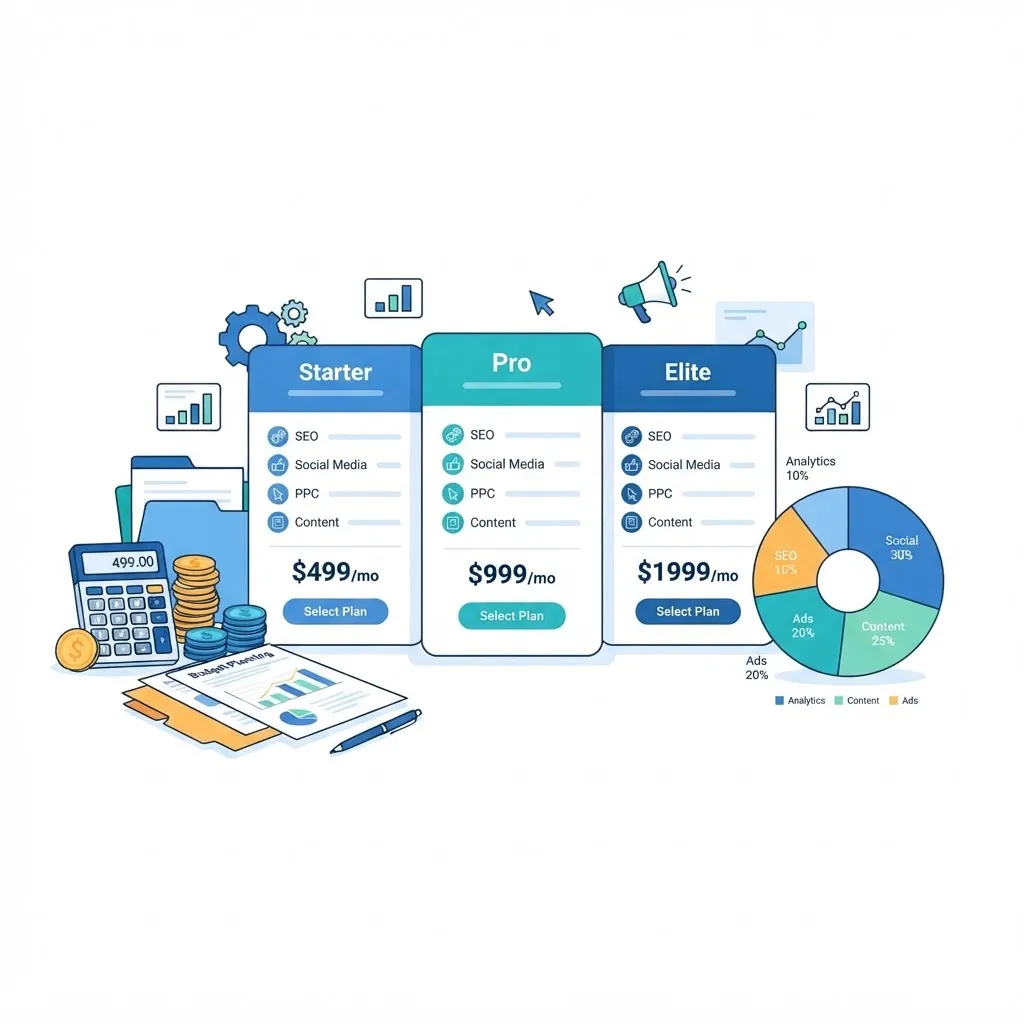
Agencies price in four main ways, and each model shapes their incentives:
- Monthly retainer — a fixed fee for a defined scope, typically $2,500 to $12,000 per month for small and mid-sized businesses. Best for ongoing multi-channel work because it makes costs predictable.
- Percentage of ad spend — usually 10 to 20 percent of your media budget. Watch the incentive here: the agency earns more when you spend more, which can encourage budget inflation rather than efficiency.
- Project-based — a one-time fee for a defined deliverable such as a website migration or campaign launch. Good for testing an agency before a retainer.
- Performance-based — payment tied to leads or revenue. It sounds ideal but often comes with lead-quality disputes and inflated cost-per-lead definitions, so demand a written definition of a "qualified" lead.
A practical benchmark: expect meaningful multi-channel results to require a combined budget (fees plus ad spend) of at least $3,000 to $5,000 per month. Quotes far below market rate almost always mean templated work, outsourced execution, or dangerously thin hours allocated to your account.
Step 5: Watch for These Red Flags

These warning signs predicted nearly every failed agency relationship we have audited:
- Guaranteed rankings or guaranteed results. Google explicitly states that no one can guarantee a number one ranking, and any agency promising one is either lying or planning to use tactics that risk penalties.
- No questions about your business. If the first call is all pitch and no discovery, the agency sells packages, not strategy.
- Long lock-in contracts with no exit clause. Twelve-month minimums with no performance-based exit protect the agency, not you. Push for a 3-month initial term with 30-day notice afterward.
- Vanity-metric reporting. Impressions, reach, and follower counts without conversion data hide poor performance. Demand reports tied to leads, sales, and cost per acquisition.
- Refusal to give you account ownership. Walk away immediately.
- Suspiciously cheap pricing. Real strategists, writers, designers, and media buyers cost money. A $299-per-month "full SEO package" is automation dressed as a service.
Step 6: Ask These Questions on the Discovery Call

Use the same question set with every finalist so answers are directly comparable:
- What results did you achieve for a client similar to us, and can we speak to them?
- Who exactly works on our account, and what are their qualifications?
- How do you define success in the first 90 days?
- What tools and reporting will we have direct access to?
- What happens to our accounts, data, and creative if we end the contract?
- What do you need from us to succeed, and how much of our time will it take?
- When was the last time a campaign underperformed, and what did you do about it?
That last question is the most revealing. Every honest agency has failures; the good ones can explain the diagnosis and correction in detail. Vague or defensive answers signal a team that hides problems instead of solving them.
Step 7: Judge Their Reporting Before You Sign

Reporting is where agency relationships live or die. According to HubSpot's State of Marketing research, marketers who track ROI are significantly more likely to earn increased budgets, yet many businesses still receive agency reports with no revenue connection at all. Separately, Nielsen research has found that roughly a third of digital ad spend is wasted on poorly targeted delivery — waste that only surfaces when reporting is honest and granular.
Ask each finalist for a sample client report (anonymized). A strong report includes: performance against agreed KPIs, spend and cost per acquisition by channel, what was done that month, what is planned next, and a plain-language commentary explaining why numbers moved. Insist on a live dashboard you can open any day, not just a monthly PDF, and a standing monthly review call.
If you want a benchmark for what structured, accountable campaign management looks like, review the process outlined on our digital marketing services page — the same framework described there is the standard you should hold any agency to.
Making the Final Decision
Score your finalists on results evidence (40 percent), team and communication quality (25 percent), transparency and data ownership (20 percent), and price fit (15 percent). Notice that price carries the least weight: the most expensive mistake is not a higher retainer, it is six months paid to an agency that produces nothing.
Then start small. A 90-day pilot with 2 or 3 defined KPIs tells you more than any proposal ever will. Good agencies accept pilots confidently because they expect to earn the renewal.
Key Takeaways
- Define one measurable goal, a budget range, and priority channels before contacting any agency.
- Shortlist 3 to 5 agencies and score them on identical criteria to neutralize sales polish.
- Verify case studies with real numbers and speak directly to current or former clients.
- Typical retainers run $2,500 to $12,000 monthly; percentage-of-spend fees run 10 to 20 percent of media budget.
- You must own every account, dashboard, and asset — no exceptions.
- Guaranteed rankings, vanity metrics, and 12-month lock-ins are the three most reliable red flags.
- Start with a 90-day pilot tied to 2 or 3 KPIs before committing long term.
Frequently Asked Questions (FAQ)
How much does a digital marketing agency cost per month?
Most small and mid-sized businesses pay between $2,500 and $12,000 per month in agency fees, plus ad spend. Single-channel engagements like SEO-only or PPC-only management often start around $1,000 to $3,000 monthly. Be cautious of full-service offers under $1,000 — they typically rely on automation and templated deliverables.
How long before I see results from a digital marketing agency?
Paid advertising can produce measurable data within 2 to 4 weeks, while SEO and content marketing typically need 4 to 9 months for significant organic growth. A competent agency sets 90-day milestones with leading indicators — rankings, traffic, cost per click — so you can verify progress well before full ROI arrives.
What questions should I ask before hiring a marketing agency?
Ask who will manage your account daily, what results they achieved for similar clients, how they define success in 90 days, what reporting you will access, and what happens to your accounts if you leave. Also ask about a past campaign failure — honest, detailed answers indicate a trustworthy partner.
Should I hire a digital marketing agency or a freelancer?
Hire a freelancer when you need one clearly defined channel, like Google Ads, on a limited budget. Hire an agency when you need multiple channels coordinated under one strategy, faster execution, and formal accountability. Agencies cost more but provide broader skills, backup staffing, and structured reporting that freelancers rarely match.
What are the biggest red flags when choosing a marketing agency?
The biggest red flags are guaranteed rankings, refusal to give you account ownership, long contracts with no exit clause, reports built on vanity metrics instead of conversions, and pricing far below market rate. Any one of these signals should remove the agency from your shortlist immediately.
Can I switch agencies without losing my data and ad accounts?
Yes, if you set the relationship up correctly. All ad accounts, analytics properties, and creative assets should be created under your business ownership with the agency added as a user. Confirm this in the contract before signing, because migrating campaign history out of an agency-owned account is often impossible.