
Explore how Islamic ethics can guide AI through justice, privacy, accountability, governance, education, healthcare, and responsible innovation.
Islam Artificial Intelligence
Artificial intelligence is changing how people learn, work, receive healthcare, access financial services, and obtain religious information. For Muslims, the central question is not whether every algorithm is inherently permissible or forbidden. The practical question is whether a particular system, purpose, dataset, and deployment uphold Islamic duties concerning justice, human dignity, privacy, accountability, knowledge, and public welfare.
This guide offers a practical framework rather than a religious ruling. Organizations should consult qualified scholars, technical experts, affected communities, and relevant regulators before making consequential decisions.
Quick Answer: Islam does not prescribe one universal judgment about artificial intelligence. AI is generally evaluated as a tool whose ruling depends on its purpose, methods, consequences, and safeguards. Responsible use should advance genuine benefit, prevent harm, protect dignity and privacy, ensure justice, and preserve meaningful human accountability.

What Does Artificial Intelligence Mean in an Islamic Context?
Artificial intelligence is software that performs tasks commonly associated with human intelligence, including prediction, language generation, pattern recognition, classification, and decision support. Current AI does not possess verified consciousness, moral agency, spiritual responsibility, or human intention. It processes information according to mathematical models, training data, programmed objectives, and user instructions.
That distinction matters because Islamic moral responsibility remains with people. Developers choose objectives and datasets. Executives approve deployment. Users decide whether to trust or act upon outputs. An organization cannot transfer accountability to an algorithm by claiming that the computer made the decision.
Islamic evaluation can draw upon established concepts such as maslahah, or public benefit; mafsadah, meaning harm or corruption; adl, meaning justice; amanah, meaning entrusted responsibility; and maqasid al-Shariah, the higher objectives associated with protecting faith, life, intellect, family, and property. Applying these concepts requires contextual scholarship, evidence, and technical understanding.
Is Artificial Intelligence Halal or Haram?
AI cannot be classified responsibly through a single blanket label. Its permissibility depends on what the system does, how it operates, what information it uses, who may be harmed, and whether safeguards address foreseeable risks.
A translation assistant supporting education differs materially from surveillance software targeting a community. A diagnostic model reviewed by clinicians differs from an unverified chatbot issuing treatment instructions. The underlying technology may be similar, but the intentions, consequences, and controls are different.
| Evaluation question | Responsible indicator | Warning indicator |
|---|---|---|
| Purpose | Clear lawful benefit | Deception, exploitation, or prohibited activity |
| Data | Consensual, relevant, protected | Stolen, excessive, biased, or exposed |
| Impact | Measured benefit with safeguards | Predictable harm without remedy |
| Oversight | Named humans can intervene | Automated decisions without appeal |
| Transparency | Limits and sources are disclosed | Capabilities are exaggerated |
The safest approach is use-case assessment. Document the purpose, evidence, risks, beneficiaries, affected groups, human controls, and exit plan before deployment. Seek a qualified ruling when the application affects worship, religious law, medicine, finance, family matters, or fundamental rights.

Which Islamic Principles Should Guide AI?
Justice and nondiscrimination
An AI system should not systematically disadvantage people because of ethnicity, gender, disability, income, language, nationality, or religious identity. Teams should test performance separately across relevant groups because an acceptable average can conceal serious localized failures. If disparities appear, pause deployment, investigate data and design choices, and provide an accessible appeal process.
Human dignity and autonomy
People should understand when they are interacting with AI or being evaluated by it. Systems should not manipulate vulnerability, impersonate trusted authorities, or pressure users into decisions. Meaningful consent requires understandable explanations, realistic alternatives, and the ability to refuse without unreasonable punishment.
Privacy and entrusted information
Personal data is an amanah, not an unlimited commercial resource. Collect only what the task requires, restrict access, encrypt sensitive records, define deletion periods, and prohibit secondary uses without valid permission. Never place confidential medical, financial, legal, or pastoral information into public AI tools unless approved protections exist.
Prevention of harm
Risk assessment must consider physical, financial, reputational, psychological, social, and spiritual harm. Higher-risk applications require stronger evidence and oversight. Red-team testing should examine false accusations, unsafe advice, fabricated citations, privacy leakage, prompt injection, and deliberate misuse before launch.
Accountability
Every system needs an identifiable owner with authority to stop it. Maintain logs, incident procedures, review schedules, and channels for correction. Human oversight is meaningful only when reviewers have adequate knowledge, sufficient time, independent judgment, and permission to reject the model's recommendation.
Where Can AI Benefit Muslim Communities?
Useful applications include accessible education, manuscript discovery, administrative automation, disability support, translation assistance, healthcare research, disaster response, and tools that help charities allocate resources more effectively. The benefit must be demonstrated rather than assumed.
For example, optical character recognition can make historical manuscripts searchable, but specialists must verify uncertain characters and preserve provenance. Speech tools can improve access for people with disabilities, while educational assistants can offer personalized practice when teachers supervise accuracy and student privacy.
Organizations exploring ethical implementation can combine community consultation with professional artificial intelligence services that address governance, testing, security, and measurable outcomes. Readers can also follow practical technology analysis from ZoneTechify and digital strategy perspectives from WebPeak.

What Risks Require Immediate Attention?
Generative AI can produce fluent but false answers, a behavior commonly called hallucination. This makes unsupervised religious, medical, and legal guidance particularly dangerous. A convincing response is not evidence of correctness, and an invented quotation can spread quickly when users assume confident language indicates authority.
Bias is another documented concern. The 2018 Gender Shades study reported error rates of up to 34.7% for darker-skinned women in evaluated commercial gender-classification systems, compared with 0.8% for lighter-skinned men. The historical result illustrates why teams must inspect subgroup performance rather than trust aggregate accuracy.
Environmental cost also deserves scrutiny. The International Energy Agency reported that data centers consumed about 415 terawatt-hours of electricity in 2024, approximately 1.5% of global electricity consumption. Not all usage came from AI, but expanding AI workloads are increasing demand. Organizations should select efficient models, avoid unnecessary generation, and measure resource use.
Other urgent risks include deepfake fraud, automated harassment, labor displacement, surveillance, copyright disputes, and concentration of power. Each requires proportionate controls, transparent procurement, worker participation, and remedies for affected people.

Can AI Give Fatwas or Religious Guidance?
AI can help locate sources, compare translations, organize research, or prepare questions for a scholar. It should not be treated as an independent mufti. Religious rulings require qualifications, contextual reasoning, awareness of disagreement, understanding of the questioner's circumstances, and responsibility for the answer.
A religious chatbot should disclose that it is automated, identify its source collection, distinguish quotation from generated explanation, and link every important claim to a verifiable reference. It should refuse to manufacture rulings and escalate sensitive questions to qualified humans. Users should verify Quranic verses, hadith classifications, legal positions, and attributed quotations independently.

How Should Organizations Adopt AI Responsibly?
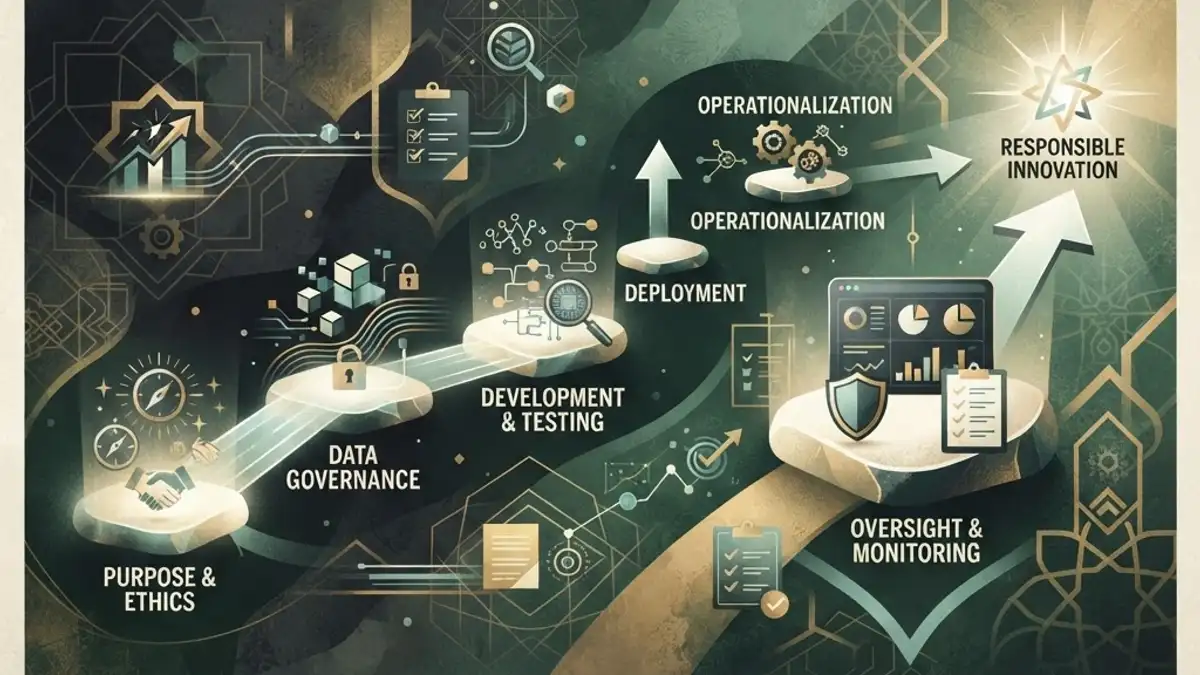
- Define the benefit. State the real problem, intended users, measurable outcome, and reason AI is preferable to a simpler solution.
- Classify the risk. Treat healthcare, employment, finance, education, surveillance, and religious guidance as high-impact contexts requiring enhanced review.
- Audit the data. Confirm lawful access, consent, relevance, quality, representation, retention limits, and security controls.
- Test realistic failures. Evaluate factual accuracy, subgroup performance, adversarial misuse, privacy leakage, and performance outside normal conditions.
- Assign human authority. Name accountable owners, escalation contacts, reviewers, and the person empowered to suspend operation.
- Explain the system. Tell users when AI is involved, what data it uses, its limitations, and how to challenge an outcome.
- Monitor continuously. Track incidents, complaints, drift, resource consumption, and unintended effects after launch.
Procurement teams should demand model documentation, security evidence, incident-notification terms, deletion commitments, and audit rights from vendors. A polished demonstration is not a substitute for independent testing with representative users.
How Should Individuals Use AI Wisely?
Use AI as an assistant, not an unquestionable authority. Avoid sharing secrets, verify consequential claims through primary sources, and disclose AI assistance when audiences could otherwise be misled. For school or professional work, follow applicable attribution and originality policies.
Before acting, ask three questions: Can I verify this answer? Who could be harmed if it is wrong? Am I still exercising informed judgment? If verification is impossible and consequences are serious, consult a qualified person instead.
Parents and educators should teach AI literacy alongside digital safety. Young users need to understand fabricated information, persuasive design, data collection, plagiarism, and synthetic media. Supervision should match a child's age, vulnerability, and the tool's capabilities.
Frequently Asked Questions (FAQ)
Does Islam allow Muslims to use ChatGPT and other AI tools?
Using an AI tool is not automatically prohibited. The judgment depends on its purpose, content, methods, and consequences. Muslims should avoid unlawful activities, protect confidential information, verify important outputs, respect intellectual property, and retain personal responsibility. Sensitive religious, medical, financial, or legal decisions require qualified human guidance.
Can artificial intelligence understand the Quran correctly?
AI can search translations, identify patterns, and summarize selected commentaries, but it does not possess scholarly authority or guaranteed contextual understanding. Models may omit disagreements or invent citations. Quranic interpretation should rely on authenticated texts, recognized scholarship, Arabic expertise where necessary, and qualified teachers who can explain context and methodology.
Is it permissible to create images with AI?
The answer depends on the image, intended use, creation process, rights involved, and scholarly position followed. Avoid deceptive impersonation, sexualized or harmful content, copyright abuse, and representations intended to mislead. Because opinions concerning images can differ, consult a trusted scholar about personal or commercial cases requiring a religious ruling.
Can a mosque use AI to answer community questions?
A mosque can use AI for administrative questions, schedules, translations, or routing inquiries if information is maintained and privacy is protected. Religious answers need scholar-approved sources and human review. The interface should clearly disclose automation, cite references, record corrections, and direct sensitive personal matters to qualified staff rather than guessing.
Will AI replace Islamic scholars?
AI may accelerate research, transcription, comparison, and information retrieval, but it cannot replace scholarly formation, moral responsibility, lived community knowledge, or context-sensitive judgment. The productive model is supervised assistance: scholars use carefully governed tools while retaining authority, checking evidence, explaining disagreement, and accepting accountability for conclusions.
How can Muslim businesses check whether an AI vendor is trustworthy?
Request documentation covering training data, privacy, security, accuracy, bias testing, human oversight, subcontractors, retention, and incident response. Test the product with realistic cases before purchase. Contracts should establish deletion rights, breach notification, audit access, service limitations, and responsibility when outputs cause foreseeable harm or violate agreed requirements.
Key Takeaways
- AI is a tool evaluated through its purpose, methods, consequences, and safeguards.
- Islamic ethics emphasizes justice, dignity, privacy, benefit, harm prevention, and accountable stewardship.
- Humans remain morally and operationally responsible for AI-assisted decisions.
- High-impact systems require evidence, subgroup testing, human review, appeal mechanisms, and continuous monitoring.
- AI may support religious research, but qualified scholars must verify sources and provide rulings.
- Responsible adoption begins with a defined need, not enthusiasm for technology.

A Responsible Path Forward
The strongest Islamic contribution to AI governance is not a simplistic approval or rejection. It is a disciplined demand that innovation serve people without sacrificing justice, dignity, truth, privacy, or responsibility. Developers should understand social consequences, scholars should learn enough technology to evaluate real systems, and institutions should include affected communities before deployment.
AI will continue evolving, but the governing questions remain human: What benefit are we pursuing? What harm might follow? Who bears the risk? Who can challenge the decision? Who accepts responsibility? Answering those questions honestly creates a practical foundation for technology that supports human flourishing rather than weakening it.