
Explore practical artificial intelligence project ideas for beginners, with tools, datasets, evaluation steps, and portfolio-building guidance.
Artificial Intelligence Project Ideas for Beginners
Artificial intelligence becomes easier to understand when you build something useful. A beginner project turns abstract concepts such as training data, prompts, classification, and model evaluation into observable results. You also learn where AI fails, which is essential knowledge for creating reliable applications.
This guide presents approachable projects that can be completed with Python, hosted APIs, or visual development tools. Each idea includes a practical scope, recommended workflow, and evaluation method. Start with one narrowly defined problem rather than attempting to reproduce a commercial AI platform.
Quick Answer: Beginners should start with a focused AI project such as a rule-grounded chatbot, image classifier, sentiment analyzer, recommendation system, or prediction model. Choose accessible data, define one measurable outcome, build a basic version, evaluate errors, and document limitations. A small working project demonstrates more skill than an ambitious unfinished system.
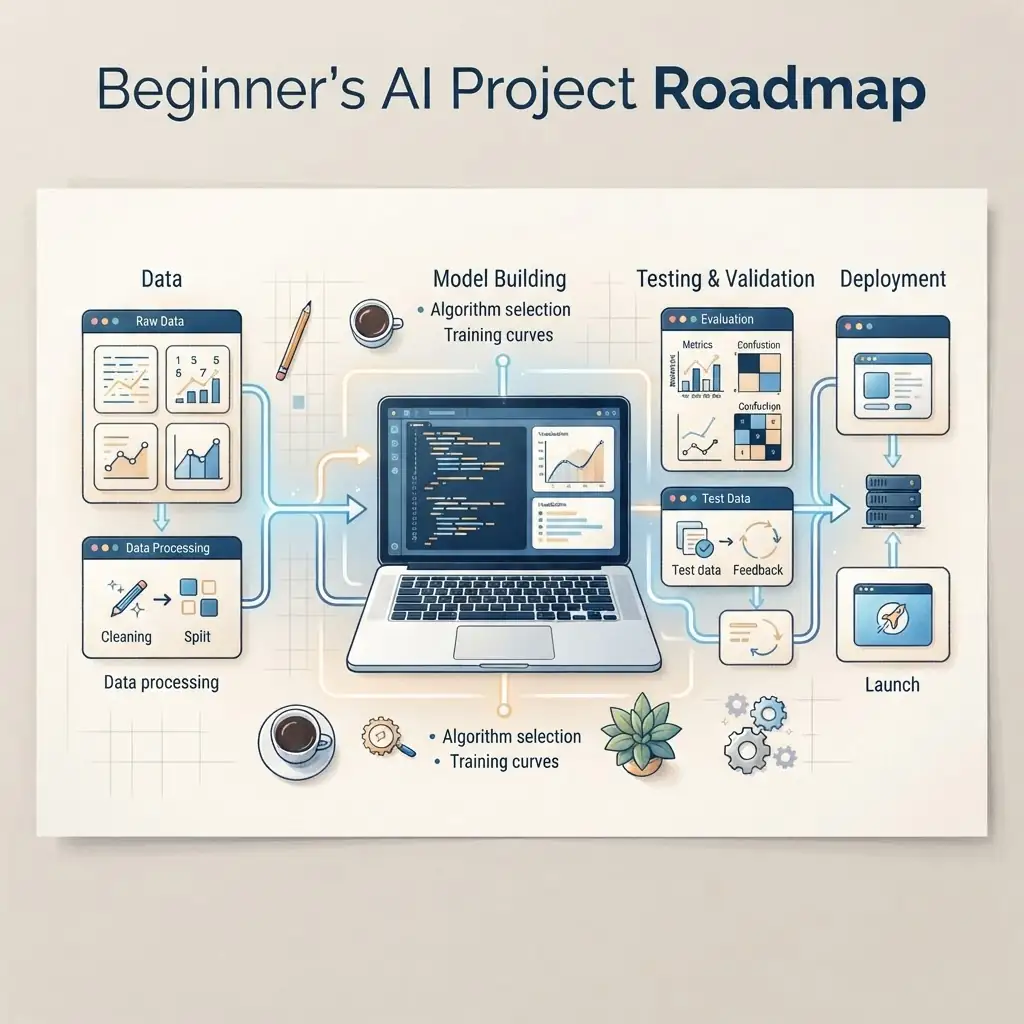
What Makes an AI Project Beginner-Friendly?
A beginner-friendly AI project has a clear input, a visible output, accessible data, and an evaluation method you can explain. For example, an image classifier receives a picture, predicts a category, and can be measured using accuracy on images it did not see during training.
Good first projects should meet four conditions:
- Narrow scope: Solve one specific problem for one identifiable user.
- Manageable data: Use a reputable public dataset or information you have permission to process.
- Observable performance: Measure accuracy, precision, response quality, or another relevant outcome.
- Safe consequences: Avoid medical, legal, employment, credit, or security decisions while learning.
Do not judge suitability by whether a project uses the newest model. A spreadsheet-sized dataset and a simple algorithm often teach more than connecting an opaque model without evaluating it.
Which Tools Should a Beginner Use?
Python is the most practical starting language because its AI ecosystem includes pandas for data preparation, scikit-learn for traditional machine learning, and established libraries for visualization. Google Colab provides hosted notebooks, so beginners can experiment without configuring a local graphics processor.
No-code tools are useful for learning workflow concepts, while APIs help you build applications around capable pretrained models. Understand the trade-off: hosted APIs reduce model-training work but introduce cost, privacy, availability, and vendor-dependency considerations.
| Approach | Best for | Main advantage | Main limitation |
|---|---|---|---|
| No-code tools | First experiments | Minimal setup | Limited customization |
| Python and scikit-learn | Learning fundamentals | Transparent workflow | Requires basic coding |
| Hosted AI APIs | Application prototypes | Strong capabilities quickly | Usage costs and dependency |
| Open-source models | Deeper experimentation | Greater control | Higher hardware requirements |
According to Stanford's 2024 AI Index, the cost of querying a model performing near GPT-3.5 level fell by more than 280 times between November 2022 and October 2023. That decline makes prototyping more accessible, although production expenses still require monitoring.
1. Build a Grounded FAQ Chatbot
A grounded FAQ chatbot answers questions only from a defined collection of approved information. It is more useful than a general conversational demo because you can verify every answer against source material.

Begin with ten to twenty frequently asked questions from a fictional business, student club, or personal website. Store each question, answer, and source reference in a structured file. Retrieve the most relevant entry for a user's query, then instruct the model to answer exclusively from that context.
Your minimum version should:
- Accept a natural-language question.
- retrieve the closest matching source passage.
- Return a concise answer with its source.
- Say that information is unavailable when evidence is missing.
- Log unanswered questions for improvement.
Test the chatbot with paraphrases, misspellings, unrelated requests, and questions whose answers are absent. Record grounded-answer accuracy rather than judging whether responses merely sound convincing. If you later need production implementation support, ZoneTechify's artificial intelligence service is directly relevant to AI application planning.
2. Train an Everyday Image Classifier
An image classifier assigns a predefined label to an image. A practical beginner example distinguishes recyclable paper, plastic, and metal, or recognizes several plant species without making health claims.

Collect balanced examples for every category and verify that you may use them. Separate images into training, validation, and test sets before training. This prevents information from the test set influencing model decisions and producing misleading results.
Accuracy alone can hide weaknesses. If 90 of 100 pictures show paper, a model predicting paper every time achieves 90 percent accuracy while failing completely on other materials. Review a confusion matrix to see which classes the system confuses. Precision measures how often a predicted class is correct, while recall measures how many actual examples of that class the model finds.
Improve performance by adding representative examples, correcting incorrect labels, and testing different lighting or backgrounds. Document conditions under which predictions become unreliable.
3. Analyze Sentiment in Customer Feedback
Sentiment analysis classifies text by expressed attitude, commonly positive, neutral, or negative. It can help summarize large feedback collections, but it should not be treated as a perfect measure of human emotion.

Use a public review dataset and remove personal information before processing. Start with a baseline such as logistic regression using term frequency-inverse document frequency features. Then compare it with a pretrained language model. Keeping the same test set makes the comparison meaningful.
Inspect at least thirty errors manually. Sarcasm, mixed opinions, slang, negation, and domain-specific meanings frequently cause failures. For example, “the camera is sick” may be praise, while a literal classifier may label it negatively.
Report per-class precision, recall, and sample counts. This reveals whether improvements benefit every category or only the majority class. A useful extension highlights the words influencing each prediction, helping users understand that outputs are probabilistic assessments rather than verified facts.
4. Create a Book Recommendation System
A recommendation system ranks items according to predicted relevance for a user. Beginners can build one using books, films, recipes, or learning resources instead of collecting sensitive behavioral data.

Start with content-based filtering. Represent each item's genres, topics, author, or description, then recommend items similar to something the user already likes. This approach remains understandable because you can display shared attributes as an explanation.
Collaborative filtering uses preference patterns across multiple users. It may discover less obvious relationships, but it struggles when new users or items have little interaction history. This is called the cold-start problem.
Evaluate recommendations with held-out preferences rather than asking whether a list looks reasonable. Precision at K measures how many of the top K recommendations are relevant. Also inspect diversity: ten nearly identical recommendations may score well yet offer little discovery value. Let users remove interests and reset their profile.
5. Predict a Numerical Outcome
A regression project predicts a continuous number, such as bicycle rental demand, electricity consumption, or journey duration. Choose a public dataset with clear documentation and avoid predictions that could materially affect people.

Begin with linear regression as a baseline. Prepare features, handle missing values, and divide records chronologically when predicting future behavior. A random split can leak future patterns into training and exaggerate real-world performance.
Compare mean absolute error with a simple baseline, such as always predicting the historical median. Mean absolute error reports the average absolute prediction difference in the outcome's original unit, making results easier to explain. If your model misses bicycle demand by 24 rentals on average, readers can assess whether that error is useful.
Examine errors by season, location, or demand range. Overall performance can conceal systematic failure during holidays or unusual weather. Add an uncertainty range when possible, because a precise-looking prediction can create unjustified confidence.
How Do You Complete Your First AI Project?
Follow a repeatable process instead of changing models randomly:
- Write one sentence defining the user, input, output, and intended benefit.
- Choose lawful, representative data and create a separate test set.
- Build the simplest non-AI or statistical baseline.
- Train or connect one model without unnecessary features.
- Select metrics before reviewing final test results.
- Analyze failures and identify affected users or conditions.
- Create a small interface demonstrating the core workflow.
- Publish setup instructions, evidence, limitations, and next steps.
Google's Machine Learning Crash Course warns that data quality and representation directly influence model behavior. Treat dataset inspection as engineering work, not administrative preparation. Check duplicates, missing values, inconsistent labels, class imbalance, and information that would be unavailable when a real prediction occurs.
How Should You Present the Project in a Portfolio?
A strong portfolio case study explains decisions and evidence rather than displaying screenshots alone. Recruiters and collaborators need to understand what you personally built, how you evaluated it, and whether you recognize its limitations.

Include these components:
- A one-sentence problem statement and intended user.
- A diagram showing input, processing, model, and output.
- Dataset origin, license, size, and preparation decisions.
- Baseline and final metrics using an untouched test set.
- Three representative failures with your analysis.
- Privacy, bias, accessibility, cost, and security considerations.
- A working demonstration or reproducible notebook.
Never claim that a model “understands” users merely because it produces fluent output. State exactly what was tested. Teams such as ZoneTechify and WebPeak can provide broader implementation context, but your portfolio should clearly separate personal work from external tools or assistance.
Frequently Asked Questions (FAQ)
What is the easiest artificial intelligence project for a complete beginner?
A grounded FAQ chatbot is often easiest because its knowledge source and expected answers are limited. You can begin with a small question-and-answer file, simple similarity search, and an optional language model. Test whether every response matches a source and whether the chatbot declines unsupported questions.
Can I build an AI project without knowing advanced mathematics?
Yes. You can build useful prototypes with pretrained models, visual tools, or scikit-learn while learning mathematics gradually. However, understand basic averages, probability, train-test separation, and evaluation metrics. Mathematics becomes more important when diagnosing performance, selecting algorithms, or explaining why a model's results are trustworthy.
Where can I find free datasets for beginner AI projects?
Start with government open-data portals, university repositories, Kaggle datasets with clear licenses, or scikit-learn's included datasets. Confirm provenance, usage rights, documentation, and collection methods before downloading. Avoid scraped personal data. A smaller, well-documented dataset is safer and more educational than a large unexplained collection.
How long should my first AI project take?
Scope the first version so it can be completed through several focused sessions, not months. Limit it to one dataset, one baseline, one model, one interface, and one evaluation report. If the project keeps expanding, publish the tested core first and list additional features as future work.
Do I need a powerful computer to start learning AI?
No. Traditional machine-learning projects often run comfortably on an ordinary laptop. Hosted notebooks can provide temporary acceleration for larger experiments, while APIs handle model inference remotely. Begin with small datasets and efficient baselines. Upgrade hardware only after measurements show that computing resources are genuinely blocking progress.
How do I know whether my AI project is accurate enough?
Compare it with a simple baseline and define an acceptable error based on the intended use. Review performance across important categories, not only the overall average. For harmless demonstrations, moderate accuracy may support learning. High-impact decisions require expert validation, monitoring, governance, and often should not be automated.
Key Takeaways
- Beginner AI projects need a narrow problem, accessible data, measurable output, and low-risk use case.
- A chatbot, image classifier, sentiment analyzer, recommender, or regression model can teach an entire workflow.
- Separate test data before training and compare results with a simple baseline.
- Accuracy is insufficient when classes are imbalanced; inspect precision, recall, confusion matrices, or subgroup errors.
- Document data rights, limitations, failures, costs, privacy considerations, and intended users.
- A small reproducible project with honest evidence is more credible than an unfinished, oversized concept.
Your best first project is not the most technically impressive idea. It is the smallest problem you can define, test, explain, and responsibly improve. Choose one option from this guide, establish a baseline, and publish what the evidence actually shows.