Learn how ISO 27001 applies to artificial intelligence, including AI risk assessments, security controls, audit evidence, governance, and ISO 42001 alignment.
ISO 27001 Artificial Intelligence
Artificial intelligence changes how organizations collect data, make decisions, and deliver services, but it also expands the information security attack surface. ISO/IEC 27001 provides a management system for identifying those risks, assigning controls, proving accountability, and improving safeguards over time. It does not certify an algorithm as ethical or accurate. Instead, it certifies that an organization operates a risk-based information security management system, or ISMS, within a scope.
Quick Answer: ISO 27001 helps organizations secure artificial intelligence by placing AI data, models, infrastructure, suppliers, users, and incidents inside a documented ISMS. Teams assess risks, select proportionate controls, retain audit evidence, and continually improve. For broader AI governance, ISO 27001 works best alongside ISO/IEC 42001 and applicable laws.
What Does ISO 27001 Mean for Artificial Intelligence?
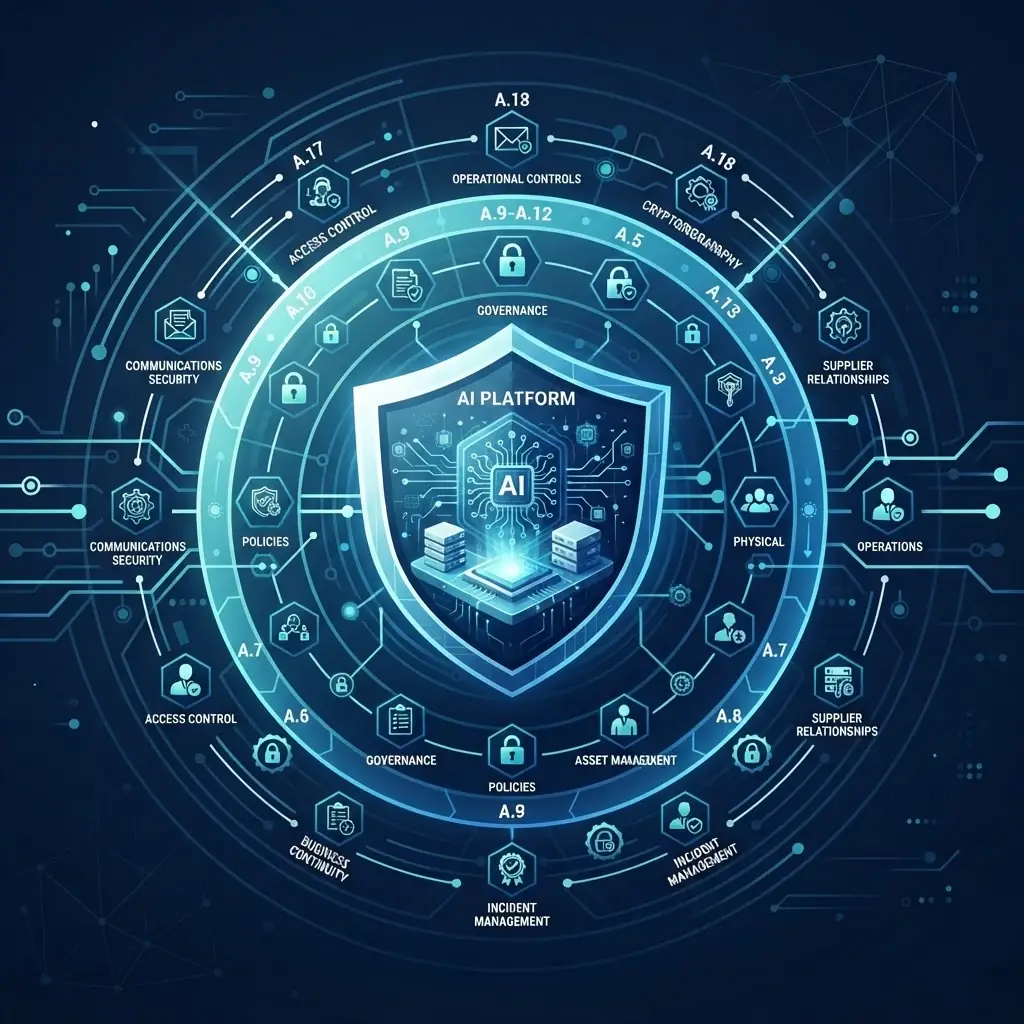
ISO 27001 is an international standard specifying requirements for establishing, implementing, maintaining, and continually improving an ISMS. For AI, the protected information includes training data, prompts, model weights, retrieval indexes, source code, evaluation results, system instructions, outputs, logs, credentials, and customer records. The organization decides which assets fall within certification scope and documents why.
The standard's value is managerial discipline. It requires leadership commitment, risk assessment, treatment planning, competence, operational controls, performance evaluation, internal audits, management reviews, and corrective action. This lifecycle turns scattered security activities into an accountable program. A certificate does not prove that every AI output is safe; it shows that scoped information risks are governed through an independently auditable system.
ISO states that more than 80,000 valid ISO/IEC 27001 certificates covered over 100,000 sites worldwide in the 2023 ISO Survey. That adoption matters because customers, insurers, and procurement teams recognize the framework. Separately, IBM's 2024 Cost of a Data Breach Report placed the global average breach cost at $4.88 million, illustrating why preventive governance deserves executive attention.
Which AI Risks Should the ISMS Cover?
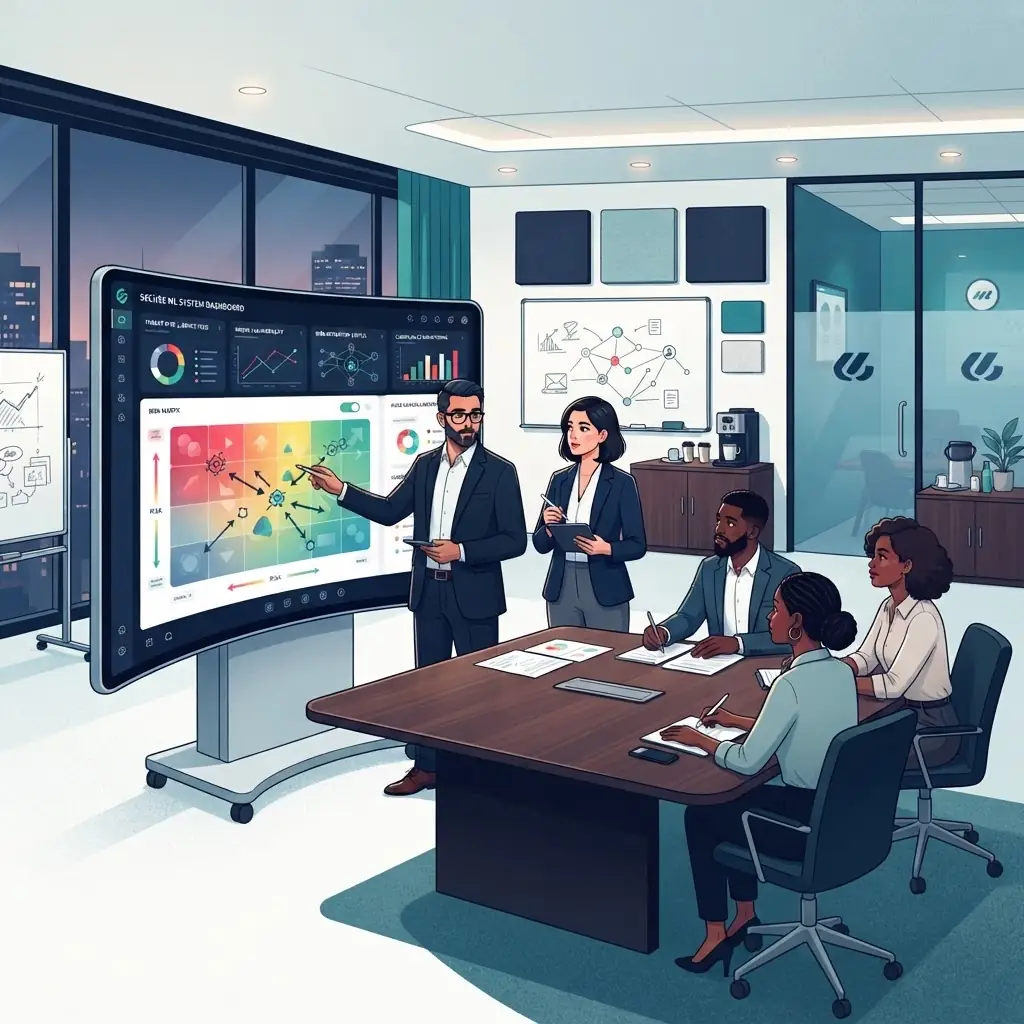
An AI risk assessment should follow information from collection through deletion, not stop at the model endpoint. Begin with an inventory of systems, owners, vendors, deployment environments, interfaces, users, and affected data subjects. Then describe threats, vulnerabilities, existing controls, likelihood, consequences, and risk owners using one consistent scoring method.
Prioritize these common scenarios:
- Confidentiality loss: Sensitive prompts, training records, embeddings, or model parameters leak through access mistakes, logs, attacks, or vendor retention.
- Integrity failure: Poisoned data, insecure updates, prompt injection, or unauthorized configuration changes alter behavior or retrieved evidence.
- Availability disruption: Provider outages, resource exhaustion, denial-of-service attacks, or dependency failures interrupt AI-supported operations.
- Uncontrolled access: Excessive privileges allow staff, service accounts, plugins, or agents to reach systems beyond their business purpose.
- Supplier exposure: Hosted models, annotation services, vector databases, and monitoring tools introduce dependencies outside direct control.
- Unsafe output handling: Users trust fabricated, malicious, discriminatory, or confidential output without verification appropriate to impact.
Record each material risk in the risk register. Name an accountable owner, choose treatment, specify controls, set a target date, and define residual risk acceptance. Reassess after model changes, new data sources, incidents, supplier changes, regulatory updates, or movement into higher-impact use cases.
Which ISO 27001 Controls Apply to AI Systems?
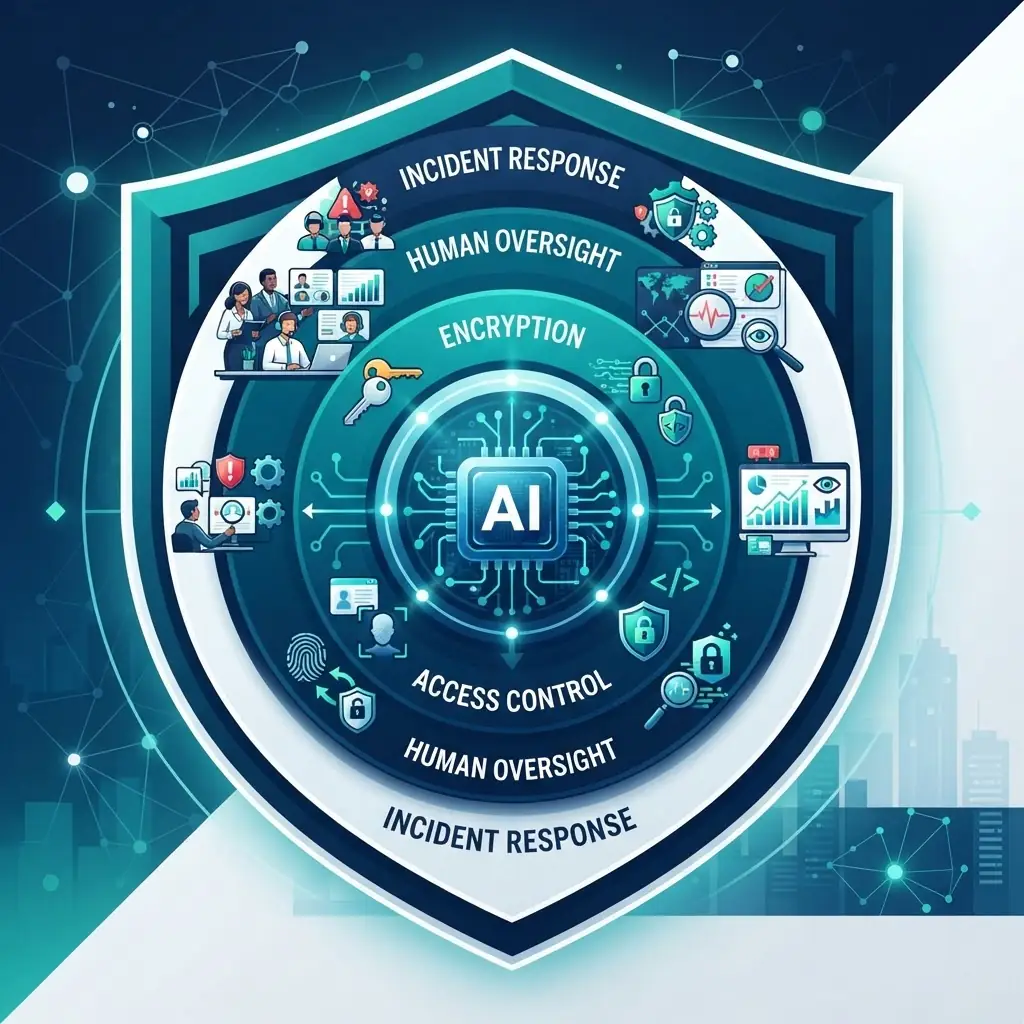
ISO 27001:2022 Annex A contains 93 reference controls grouped into organizational, people, physical, and technological themes. Organizations do not apply every control automatically. They select controls based on assessed risks, legal duties, contracts, and operating context, then explain inclusions and exclusions in the Statement of Applicability.
| AI concern | Practical control | Useful evidence |
|---|---|---|
| Sensitive training data | Classification, minimization, encryption, retention rules | Data inventory, approvals, deletion logs |
| Model or prompt changes | Secure development and change management | Reviews, tests, version history |
| Unauthorized use | Identity, least privilege, strong authentication | Access matrix, review records, logs |
| Vendor model exposure | Supplier assessment and contractual controls | Due diligence, terms, monitoring reports |
| AI service outage | Capacity, backup, redundancy, recovery planning | Test results, recovery metrics, runbooks |
| Prompt injection or abuse | Input controls, isolation, monitoring, response | Test cases, alerts, incident tickets |
Translate broad controls into testable operating procedures. For example, "protect model access" is not measurable. A stronger requirement states that production model endpoints use centrally managed identities, deny public administrative access, log privileged actions, and undergo quarterly access review. Auditors can verify that wording against configuration and records.
How Should AI Governance Roles Be Assigned?
Clear ownership prevents security gaps between data science, engineering, legal, procurement, and operations. The ISMS leader maintains the framework, but operational risk remains with business owners. Assign one accountable owner to every AI system and one owner to every accepted risk; committees can advise, but they cannot replace named accountability.

A practical responsibility model includes:
- Executive leadership approves scope, resources, risk criteria, and residual risks exceeding delegated thresholds.
- System owners document purpose, users, dependencies, data flows, expected performance, and acceptable use.
- Security teams assess threats, design controls, monitor events, test response, and track remediation.
- Data and engineering teams maintain provenance, testing, versioning, deployment approvals, and rollback capability.
- Legal and privacy specialists identify regulatory, contractual, intellectual property, and data protection obligations.
- Procurement teams evaluate suppliers, negotiate security terms, and monitor material service changes.
- Users and reviewers follow acceptable-use rules, verify outputs, report anomalies, and avoid unauthorized data entry.
What Evidence Will an ISO 27001 Auditor Expect?
Auditors test whether documented controls operate consistently. They usually sample records rather than accepting screenshots prepared immediately before an audit. Strong evidence is dated, attributable, repeatable, connected to a requirement, and retained under an approved schedule.
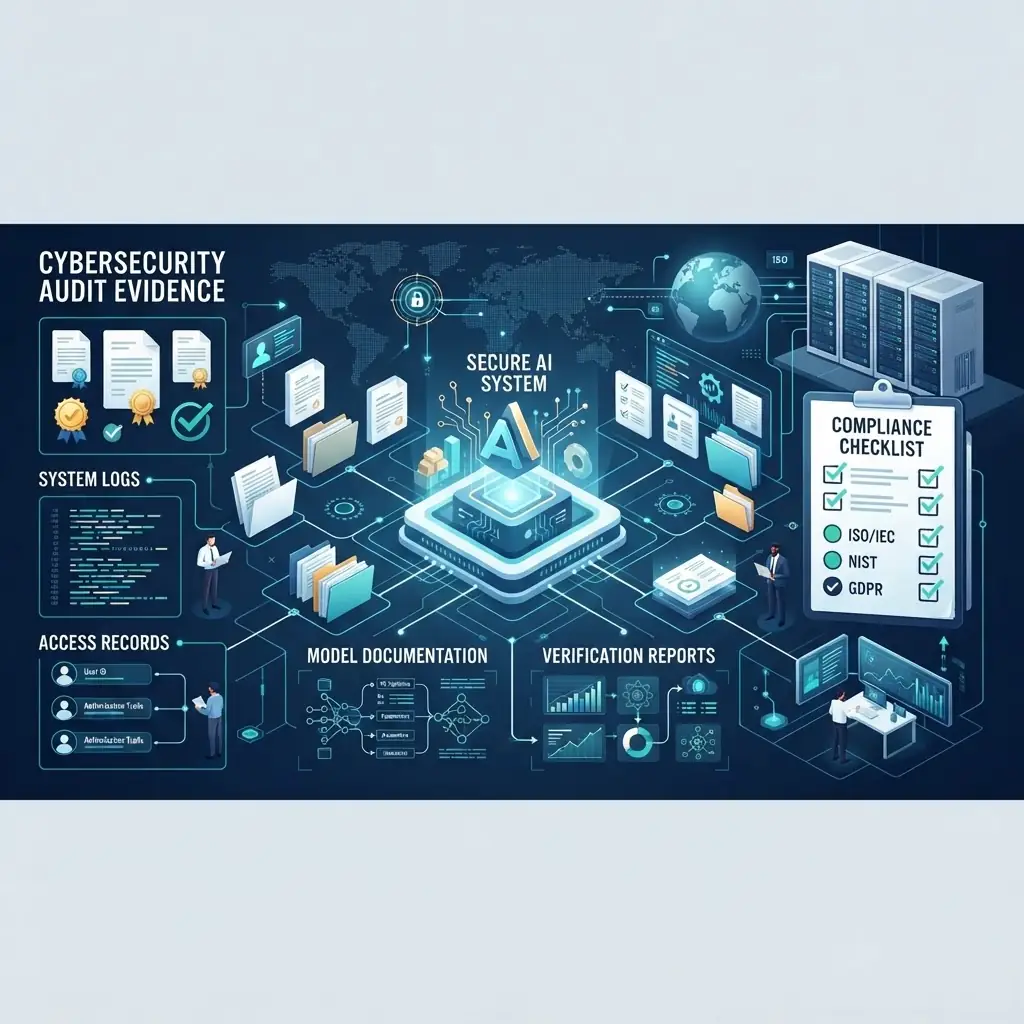
Maintain an evidence map linking each selected control to its owner, procedure, system, frequency, and record location. Relevant AI evidence may include architecture and data-flow diagrams, risk assessments, model cards, data approvals, threat models, red-team results, access reviews, change tickets, evaluation reports, supplier assessments, incident exercises, monitoring alerts, corrective actions, and management review minutes.
ISO 27001 vs ISO 42001: Which Standard Do You Need?
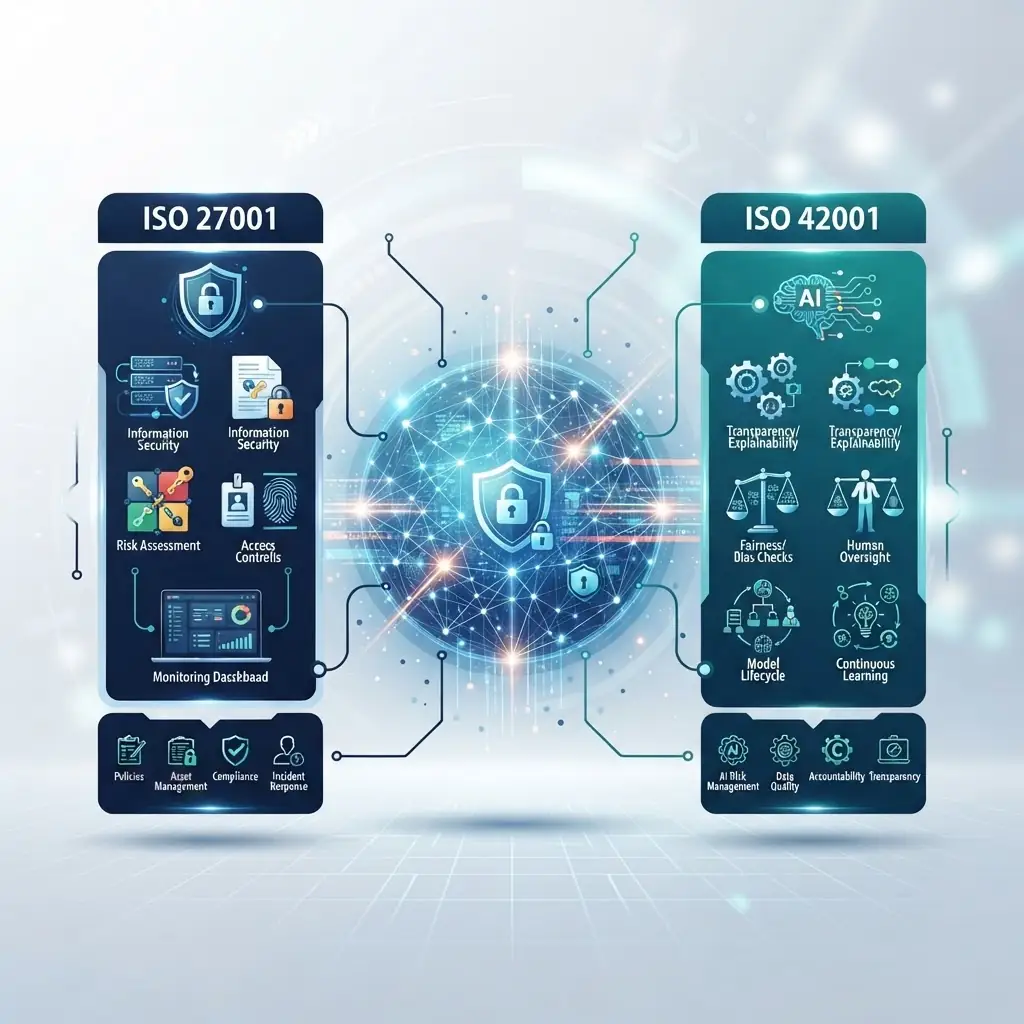
| Question | ISO 27001 | ISO 42001 |
|---|---|---|
| Primary objective | Information security | Responsible AI management |
| Core risk focus | Confidentiality, integrity, availability | AI impacts, lifecycle, transparency, oversight |
| Applies beyond AI | Yes | No |
| Independent certification available | Yes | Yes |
| Replaces legal compliance | No | No |
How Do You Implement ISO 27001 for AI?
Implementation succeeds when controls match real workflows rather than audit templates. Teams can review ZoneTechify and WebPeak resources, then connect security governance with practical delivery through ZoneTechify's artificial intelligence services. Independent leaders should challenge assumptions and retain control ownership internally.
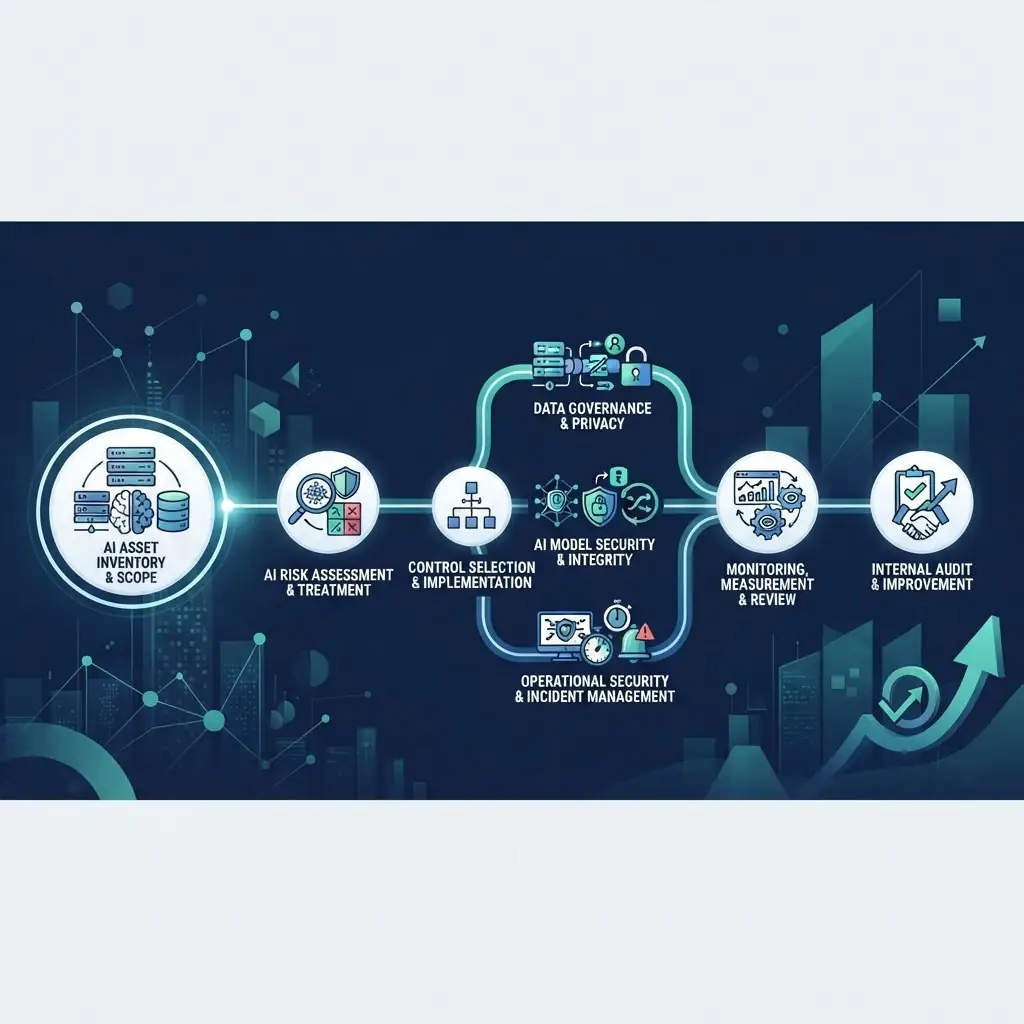
- Define scope: Identify legal entities, locations, platforms, people, suppliers, interfaces, and AI use cases included in the ISMS.
- Inventory assets and flows: Map where data originates, how models process it, where outputs travel, and when records are deleted.
- Set risk criteria: Establish consistent likelihood, impact, acceptance, escalation, and review rules approved by leadership.
- Assess and treat risks: Select avoidance, modification, sharing, or acceptance; document control owners and residual risk.
- Build repeatable procedures: Embed approvals, testing, access review, monitoring, incident response, and supplier checks into delivery.
- Measure effectiveness: Use indicators such as overdue access reviews, critical findings, recovery performance, and remediation age.
- Audit and review: Conduct internal audits and management reviews, correct causes, then engage an accredited certification body.
Key Takeaways
- ISO 27001 certifies an information security management system, not an AI model's accuracy, fairness, or ethics.
- AI scope should include data, models, prompts, infrastructure, suppliers, identities, outputs, logs, and operational users.
- Annex A offers 93 reference controls, selected and justified through risk assessment and the Statement of Applicability.
- Evidence should come from routine operations and demonstrate that controls are assigned, repeatable, reviewed, and effective.
- ISO 42001 complements ISO 27001 by addressing broader AI management impacts throughout the lifecycle.
- Certification supports assurance, but it never replaces laws, contracts, privacy duties, safety validation, or accountable human judgment.
Frequently Asked Questions (FAQ)
Does ISO 27001 cover artificial intelligence?
Yes. ISO 27001 can cover AI systems when they fall within the ISMS scope. Organizations assess risks to training data, prompts, models, infrastructure, suppliers, users, and outputs, then implement proportionate controls. The standard focuses on information security management rather than certifying model quality, fairness, or legal compliance.
Is ISO 27001 mandatory for companies using AI?
Usually not, unless a law, regulator, customer contract, procurement framework, or corporate policy requires it. Certification is voluntary in many markets. However, organizations often adopt it to demonstrate systematic security governance, answer customer assurance questions, reduce duplicated assessments, and establish evidence that security risks receive accountable oversight.
What is the difference between ISO 27001 and ISO 42001?
ISO 27001 focuses on information security management across any organizational technology or process. ISO 42001 focuses specifically on responsible AI management, including lifecycle impacts and oversight. Organizations with significant AI operations may integrate both standards, sharing common governance processes while maintaining distinct objectives, controls, and evidence for each.
Do we need to certify every AI tool we use?
No. Certification applies to the defined ISMS scope, not separately to every tool. Still, scoped operations must account for relevant AI assets and supplier dependencies. Excluding a shared platform without a defensible boundary can undermine risk treatment, so document interfaces, responsibilities, assumptions, and reasons for every significant exclusion.
How long does ISO 27001 certification take for an AI company?
Timing depends on scope, maturity, staffing, risk complexity, evidence availability, and certification-body scheduling. Rather than targeting an arbitrary date, complete a gap assessment, assign owners, operate controls long enough to produce reliable records, perform internal audit and management review, and close material findings before the certification audit.
Can ISO 27001 prevent harmful AI outputs?
It can reduce related security risks through governance, access controls, testing, monitoring, incident response, change management, and human review. It cannot guarantee truthful or harmless outputs. Teams need use-case-specific evaluations, safety controls, domain expertise, user guidance, and legal analysis in addition to the ISMS, especially for consequential decisions.
Final Perspective
ISO 27001 gives AI programs a durable security operating system: identify assets, evaluate risks, assign ownership, implement controls, test evidence, and improve after change. Its strongest outcome is not the certificate on a website; it is the ability to explain, with current records, how sensitive AI information remains protected and who acts when safeguards fail.