
A clear, expert guide to deep intelligence: what it means, how it differs from machine learning, real business uses, and how to implement it responsibly.
Deep Intelligence

Deep intelligence is quickly moving from research labs into everyday business tools, yet most explanations are either too shallow or buried in jargon. Having built and advised on AI systems for content, marketing, and web platforms, I have seen the same confusion repeat: teams adopt "AI" without understanding what deep intelligence actually does, where it excels, and where it fails. This guide fixes that. You will learn what deep intelligence means in plain language, how it differs from traditional machine learning, where it delivers measurable value, and how to implement it without wasting budget.
Quick Answer: Deep intelligence is the ability of layered neural networks to learn complex patterns directly from large amounts of raw data, then apply that learning to reason, predict, and generate outputs. It powers modern AI systems like chatbots, recommendation engines, and image recognition with minimal manual programming.
What Is Deep Intelligence?
Deep intelligence refers to AI systems built on deep neural networks that learn hierarchical patterns from data without being explicitly programmed for every rule. The word "deep" points to the many processing layers stacked between input and output, each layer extracting a more abstract feature than the one before it.

A Clear Definition
Deep intelligence is a branch of artificial intelligence where multi-layered neural networks automatically discover the features needed to solve a task, learning directly from examples rather than hand-coded logic. In practice, this means you feed the system thousands of labeled emails, images, or sentences, and it teaches itself the rules that separate spam from real mail, or a cat from a dog.
This matters because traditional software requires a human to define every decision path. Deep intelligence flips that model: the system infers the rules on its own. That single shift is why AI progressed so fast between 2012 and today, and why tools that once needed teams of engineers now run in a browser tab.
Deep Intelligence vs Traditional Machine Learning
Many people use "machine learning" and "deep intelligence" interchangeably, but they are not the same. Deep intelligence is a specialized, more capable subset of machine learning that thrives on large datasets and raw, unstructured inputs like images, audio, and natural language.

| Factor | Traditional Machine Learning | Deep Intelligence |
|---|---|---|
| Feature engineering | Manual, done by humans | Automatic, learned by the model |
| Data needs | Works with smaller datasets | Needs large datasets |
| Best data type | Structured tables | Images, text, audio, video |
| Hardware | Runs on standard CPUs | Often needs GPUs |
| Interpretability | Easier to explain | Harder to explain |
| Accuracy on complex tasks | Moderate | High |
The practical takeaway: if your problem is a clean spreadsheet with a few hundred rows, classic machine learning is faster and cheaper. If you are working with raw language, images, or massive behavioral data, deep intelligence is worth the extra compute. Choosing the wrong approach is one of the most common and costly mistakes I see teams make.
How Deep Intelligence Actually Works
Deep intelligence works by passing data through layers of artificial neurons, each adjusting its internal weights until the network's predictions match reality. This training loop, repeated millions of times, is what turns raw numbers into useful intelligence.

Here is the process in simple terms:
- Input layer: Raw data enters, such as the pixels of an image or the words in a sentence.
- Hidden layers: Each layer detects increasingly abstract patterns, from edges to shapes to whole objects.
- Weights and biases: These numeric values are tuned during training to strengthen useful connections.
- Backpropagation: The network compares its guess to the correct answer and adjusts weights to reduce the error.
- Output layer: The system produces a prediction, label, or generated result.
According to Google, its deep learning models cut speech recognition errors by roughly 30% after the shift to neural networks, one of the largest single accuracy jumps the field had seen in two decades. That gain came not from more rules, but from letting the network learn patterns humans could never fully hand-code.
Real-World Business Applications
Deep intelligence is no longer experimental. It powers products used by billions of people daily, and it is now accessible to small businesses through affordable APIs and platforms. The strongest returns come when you apply it to repetitive, data-heavy tasks that drain human time.

High-impact business uses include:
- Customer support: AI chatbots that resolve common questions instantly, freeing agents for complex cases.
- Content and marketing: Drafting, summarizing, and personalizing copy at scale, a service area we handle at ZoneTechify.
- Recommendation engines: Suggesting products or articles based on behavior, a driver behind much of modern e-commerce revenue.
- Fraud detection: Spotting unusual transaction patterns faster than any manual review.
- Image and document analysis: Automating quality checks, medical imaging support, and data extraction.
McKinsey research has reported that a majority of organizations now use AI in at least one business function, up sharply from just a few years earlier, signaling that deep intelligence has crossed from novelty into standard operating practice. Companies that delay adoption increasingly compete against rivals who ship faster and personalize better.
If you want expert help deploying these systems, our AI development services at WebPeak focus on turning deep intelligence into practical, revenue-generating features rather than science projects. You can explore the wider toolset at WebPeak.
Why Data Quality Decides Everything
Deep intelligence is only as good as the data it learns from. A model trained on biased, incomplete, or noisy data will confidently produce biased, incomplete, and noisy results, a problem often summarized as "garbage in, garbage out."

In real projects, teams routinely spend more time cleaning and labeling data than building the model itself. This is not wasted effort. Clean, representative, well-labeled data is the single biggest lever for accuracy, often more impactful than switching to a fancier algorithm. Before investing in a larger model, audit your data for gaps, duplicates, and hidden bias. That discipline separates AI projects that ship from those that quietly fail.
How to Implement Deep Intelligence in Your Business
Implementing deep intelligence works best as a focused, staged process rather than a company-wide overhaul. Start narrow, prove value, then expand. This reduces risk and builds internal trust in the technology.
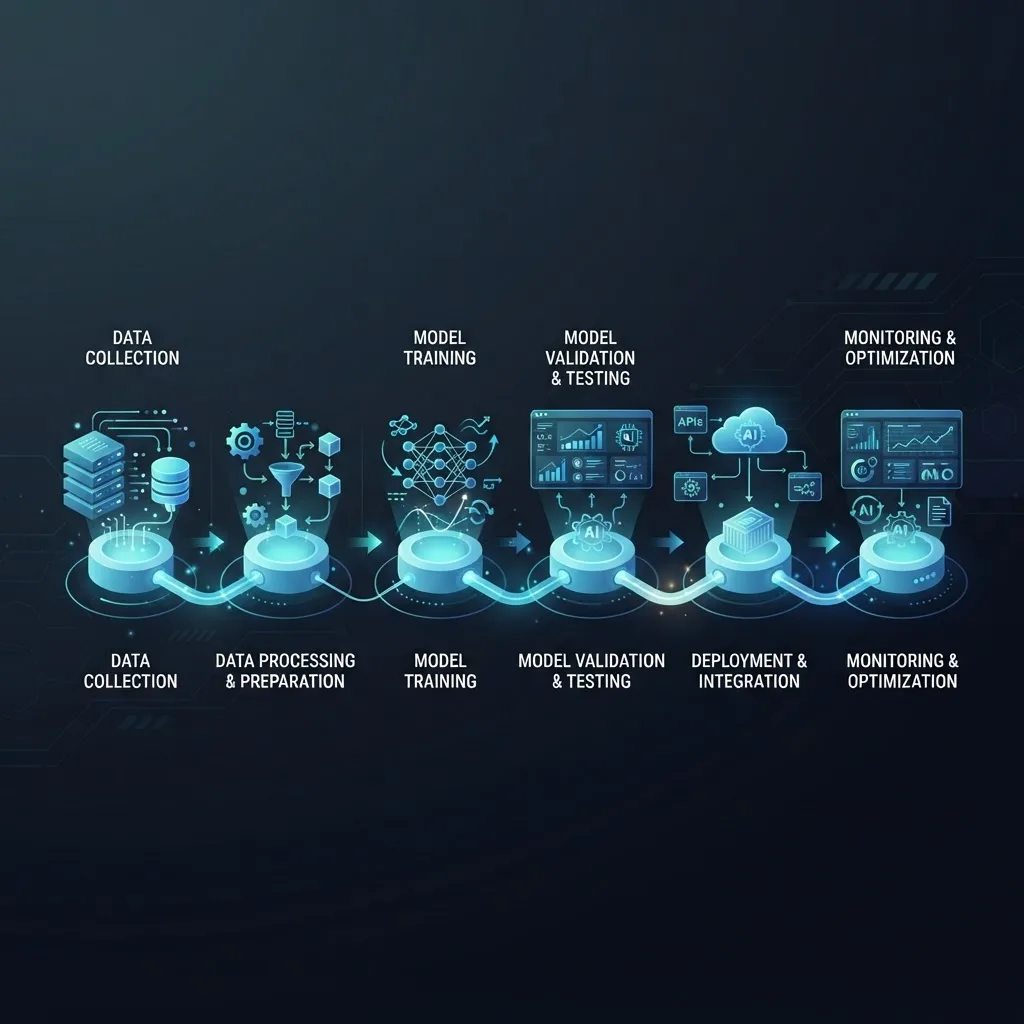
Follow these practical steps:
- Define one clear problem. Pick a task with measurable value, such as reducing support response time.
- Check your data. Confirm you have enough clean, relevant examples to train or fine-tune a model.
- Start with existing models. Use pre-trained APIs before building from scratch to save time and cost.
- Run a small pilot. Test on a limited scope, measure results, and gather real user feedback.
- Measure against a baseline. Compare AI performance to your current manual process.
- Scale what works. Expand only after you see reliable, repeatable results.
The biggest efficiency win is step three. Modern pre-trained models mean most businesses never need to train a network from zero. Fine-tuning an existing model on your own data delivers strong results at a fraction of the cost and time.
The Future of Deep Intelligence
Deep intelligence is trending toward smaller, faster, and more specialized models that run closer to the user. The era of one giant model for everything is giving way to efficient, task-specific systems that are cheaper to run and easier to control.

Three shifts are worth watching. First, on-device intelligence is putting capable models directly on phones and laptops, improving privacy and speed. Second, multimodal systems that combine text, images, and audio in one model are becoming standard. Third, regulation and transparency requirements are rising, which means explainability will move from a nice-to-have to a compliance necessity. Businesses that build responsibly now will avoid painful retrofits later.
Key Takeaways
- Deep intelligence uses multi-layered neural networks to learn patterns directly from raw data, without hand-coded rules.
- It is a subset of machine learning that excels at unstructured data like text, images, and audio.
- Google reported roughly a 30% reduction in speech recognition errors after adopting deep learning.
- Data quality, not model size, is usually the biggest driver of real-world accuracy.
- Most businesses should fine-tune pre-trained models rather than train from scratch.
- Start with one measurable problem, run a small pilot, then scale what proves valuable.
Frequently Asked Questions (FAQ)
What is deep intelligence in simple terms?
Deep intelligence is a type of AI where layered neural networks learn patterns directly from examples instead of following hand-written rules. You give it lots of data, and it teaches itself how to recognize, predict, or generate results, which is why it powers chatbots, image recognition, and recommendations.
Is deep intelligence the same as deep learning?
In everyday use, yes. Deep intelligence describes the capabilities produced by deep learning, the technique of training multi-layered neural networks. Deep learning is the method, while deep intelligence is the practical, reasoning-like behavior that emerges from it when applied to real tasks and data.
Does my business need deep intelligence or regular machine learning?
It depends on your data. If you work with clean, structured spreadsheets and small datasets, traditional machine learning is faster and cheaper. If you handle raw text, images, audio, or very large behavioral data, deep intelligence delivers noticeably higher accuracy and is worth the added computing cost.
How much data do you need for deep intelligence?
Generally thousands of quality examples per category, though fine-tuning a pre-trained model needs far less. Data quality matters more than quantity, so clean, representative, well-labeled data often beats a larger but messy dataset. Always audit your data before assuming you need more of it.
Is deep intelligence expensive to implement?
Not anymore. Thanks to pre-trained models and affordable APIs, most businesses can add deep intelligence features without training networks from scratch. The main costs are data preparation, integration, and testing. Starting with a small, focused pilot keeps spending controlled while you prove measurable value.