
A practical, experience-based guide to search engine optimisation companies: what they actually do, how pricing works, how to vet them, and how to measure real ROI.
Search Engine Optimisation Companies
Hiring an SEO partner is one of the few marketing decisions that compounds. Get it right and organic search becomes a channel that keeps delivering long after the invoice is paid. Get it wrong and you spend twelve months paying for reports nobody reads. Having audited hundreds of agency engagements, the pattern is consistent: the difference between a good and bad outcome is rarely the agency's talent. It is whether the scope, the measurement, and the incentives were defined properly before work began.
This guide explains how search engine optimisation companies actually operate, what different pricing models buy you, the specific questions that separate operators from resellers, and how to judge results within 90 days instead of waiting a year.

Quick Answer: Search engine optimisation companies are agencies that improve a website's organic visibility through technical fixes, keyword research, content, and link acquisition. The best ones tie work to revenue, not rankings. Expect USD 1,500 to 10,000 per month, a 3 to 6 month ramp, and transparent reporting on traffic, leads, and conversions.
What Search Engine Optimisation Companies Actually Do
Definition: A search engine optimisation company is a specialist agency that increases the quantity and quality of unpaid search traffic to a website by improving how search engines crawl, understand, and rank its pages.
In practice, credible agencies deliver work across four disciplines. Understanding these lets you read any proposal critically.
Technical SEO
This is the engineering layer: crawlability, indexation, site architecture, structured data, Core Web Vitals, canonical logic, and JavaScript rendering. Google has confirmed Core Web Vitals are a ranking signal within its page experience systems, and Google's own research found that as page load time goes from one second to three seconds, the probability of a mobile visitor bouncing increases by 32 percent. Technical work is where the fastest wins usually hide, especially on sites over 500 pages.
Keyword and Intent Research
Good agencies do not hand you a spreadsheet of 5,000 keywords. They map a small set of commercially meaningful queries to specific pages and specific intents, then identify the gap between what you rank for and what actually converts.
Content Production
Content is where most engagements silently fail. An agency that publishes eight thin articles a month is manufacturing liability, not authority. Look for topical depth, subject matter interviews, and content refresh workflows on existing pages.
Authority and Links
Links still matter, but the method matters more. Digital PR, original data, partnerships, and genuine placements are durable. Bought link networks are a rollback risk.

How a Professional SEO Engagement Is Sequenced
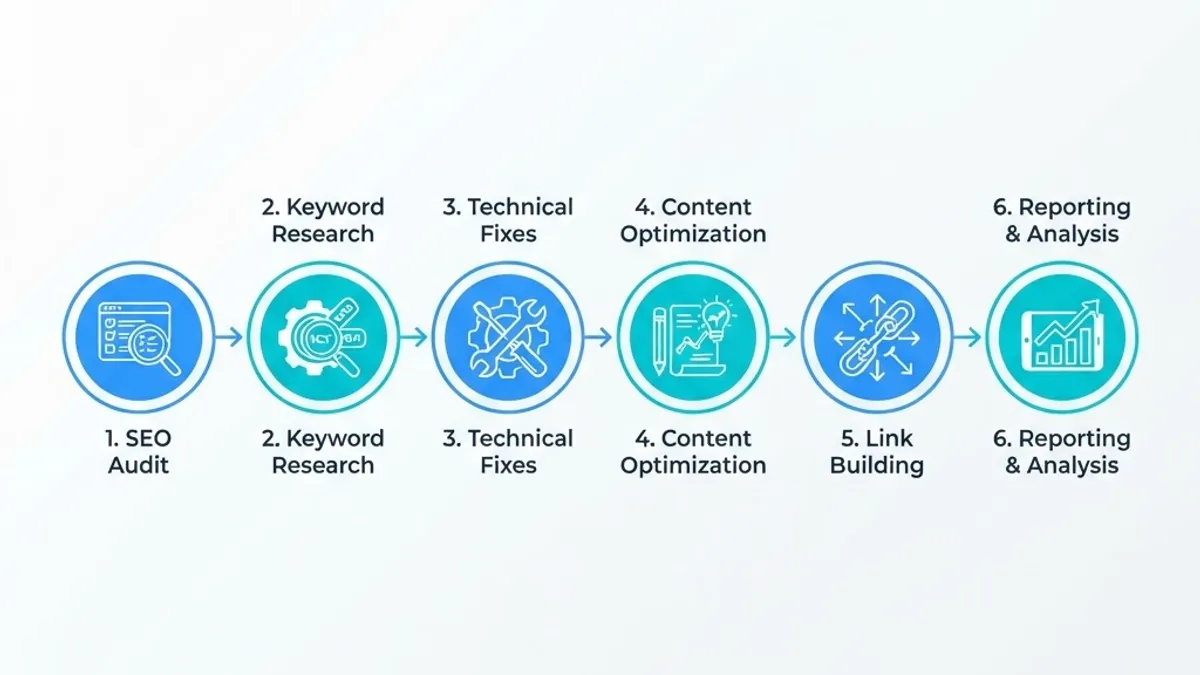
The order of operations matters more than the individual tactics. Publishing content on a site that Google cannot crawl efficiently is wasted budget. A well-run engagement follows this sequence:
- Discovery and baseline (week 1 to 2). Analytics audit, conversion tracking validation, and a documented starting position for traffic, rankings, and leads.
- Technical audit and remediation (week 2 to 6). Crawl the site, prioritise issues by traffic impact, and ship fixes with developer support.
- Keyword to page mapping (week 4 to 6). Assign one primary intent per URL and eliminate cannibalisation.
- Content build and refresh (month 2 onward). New pages for gaps, upgrades for pages already ranking positions 5 to 20 where gains are cheapest.
- Authority building (month 3 onward). Earn links to the pages that carry commercial value, not the homepage by default.
- Measurement and iteration (monthly). Report on assisted conversions and pipeline, then reallocate effort.
If a proposal starts at step 5 in month one, it is a link-selling operation wearing an agency's clothes. Teams like ZoneTechify and WebPeak sequence discovery and technical remediation before content volume for exactly this reason.
SEO Company Pricing Models Compared
Pricing confuses buyers more than any other part of the decision. There are four common models, and each one is appropriate for a different situation.
| Pricing Model | Typical Range (USD) | Best For | Main Risk |
|---|---|---|---|
| Monthly retainer | 1,500 to 10,000 per month | Ongoing growth, competitive markets | Scope drift, paying for activity not outcomes |
| Project based | 3,000 to 25,000 one off | Migrations, technical audits, replatforming | No follow through after delivery |
| Hourly consulting | 100 to 300 per hour | In-house teams needing direction | Costs escalate without a clear brief |
| Performance based | Variable, often plus a base fee | Mature sites with clean attribution | Short-term tactics, disputes over credit |
A practical benchmark: retainers below roughly USD 1,000 per month rarely fund enough senior time to move a competitive market. Below that threshold you are typically buying automated reports and templated content. Conversely, a USD 12,000 retainer is only justified if the agency is producing content, doing digital PR, and supplying developer resource.
Ask one clarifying question on any retainer: how many senior hours per month, and who specifically does the work? Junior execution behind a senior pitch is the most common cause of disappointing results.
How to Choose an SEO Company: A Vetting Checklist
Use these questions in the first call. They are difficult to answer well without genuine experience.
- Show me a client in a similar market and walk me through what did not work. Honest agencies have failure stories with lessons. Perfect track records are marketing.
- What will you not do? A specialist with clear boundaries is a better sign than a generalist who says yes to everything.
- How do you handle developer dependencies? Technical recommendations that never ship are the single biggest cause of stalled campaigns.
- Which metric will you be judged on in month six? The answer should include revenue, qualified leads, or pipeline, not just rankings.
- Who owns the deliverables and accounts? You should own your Google Search Console, Analytics, content, and any assets built.
- What is the exit process? Ask for a documented handover. Agencies confident in their work do not fear it.
Also request read-only access to a live client dashboard rather than a polished PDF case study. Real dashboards show flat months, and flat months are normal.

Red Flags That Predict a Bad Engagement
These warning signs are reliable because each one indicates a structural problem, not a stylistic preference.
- Guaranteed number one rankings. Google's own guidance states that no one can guarantee a top position in organic results. A guarantee signals either dishonesty or a plan to rank for zero-volume terms.
- No technical audit in the first month. Skipping diagnosis means the plan is generic.
- Reporting that only shows rankings. Rankings without traffic and conversion context can hide declining performance.
- Unnamed link sources. If an agency will not disclose where links come from, you are inheriting the risk.
- Twelve-month lock-ins with no performance review. A 3 to 6 month initial term with a documented checkpoint is fairer to both sides.
- Cold outreach promising instant fixes. Legitimate agencies rarely need to spam.

Local, National, and Enterprise SEO Companies Are Not Interchangeable
The skill sets diverge sharply, and hiring the wrong category wastes months.
Local SEO is dominated by Google Business Profile optimisation, review velocity, local citations, and service-area landing pages. Google reports that 76 percent of people who search for something nearby on their smartphone visit a related business within a day, which is why proximity and profile quality outweigh content volume for local businesses.
National or e-commerce SEO depends on scalable templates, faceted navigation control, internal linking at scale, and product schema. A local specialist will not have handled 50,000-URL crawl budget problems.
Enterprise SEO is mostly stakeholder management, log file analysis, and shipping changes through complex release cycles. The bottleneck is organisational, not tactical.
Match the agency's case studies to your category specifically. An agency with brilliant local results has not proven it can fix an international hreflang implementation. If your growth depends on the underlying build quality, pair SEO with a capable web development team so fixes actually ship.

Measuring Whether Your SEO Company Is Working
Do not wait six months to form an opinion. Use staged expectations instead.
Month 1 to 2: Judge process, not results. Was tracking validated? Was a prioritised technical backlog delivered? Are fixes shipping?
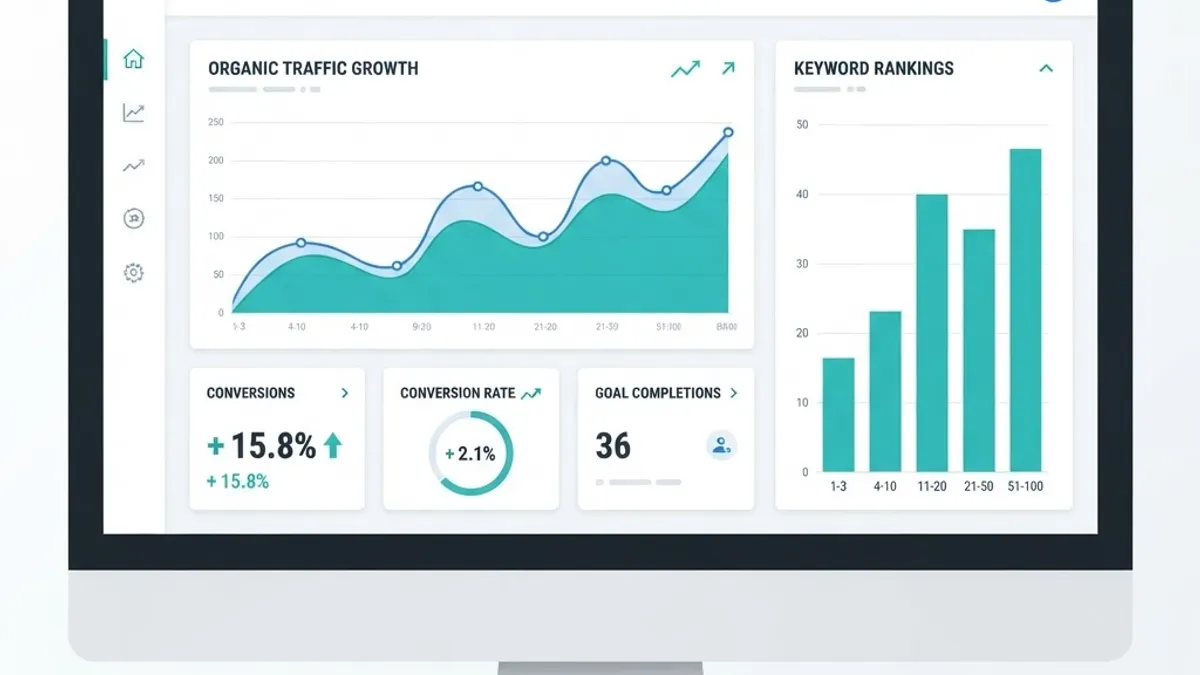
Month 3 to 4: Look for leading indicators. Impressions in Google Search Console rising, more pages indexed, average position improving for mapped keywords, and Core Web Vitals moving into the green.
Month 5 to 6: Expect lagging indicators. Non-brand organic sessions, organic conversions, and revenue or qualified leads from organic.
The single most useful report filter is non-brand organic traffic. Brand searches grow with any marketing activity, so including them lets an underperforming campaign look healthy. Ask for non-brand segmentation from month one.
Two additional checks: compare year-over-year rather than month-over-month to remove seasonality, and annotate your analytics with algorithm update dates so volatility is interpreted correctly.
Agency, Freelancer, or In-House: Choosing the Right Structure
Agencies win on breadth. You get technical, content, and link capability plus tooling that costs thousands per year to license independently. Freelancers win on depth and cost efficiency for a narrow problem, such as a migration or a content programme. In-house wins on context and speed once organic search is a primary revenue channel.
The most effective structure we see repeatedly is hybrid: one in-house owner who controls priorities and internal buy-in, plus an agency supplying specialist execution. That arrangement solves the two failure modes of each option, namely the agency's lack of internal influence and the in-house hire's lack of specialist range.

Key Takeaways
- Search engine optimisation companies deliver four things: technical fixes, keyword and intent mapping, content, and authority building. Judge proposals against all four.
- Typical retainers run USD 1,500 to 10,000 per month; below roughly USD 1,000 there is rarely enough senior time to compete.
- Google states no one can guarantee number one rankings, so any guarantee is a red flag.
- Google's data shows bounce probability rises 32 percent as load time moves from one to three seconds, making technical performance a commercial issue.
- 76 percent of nearby smartphone searches lead to a business visit within a day, which is why local SEO requires a different specialism.
- Measure process in months 1 to 2, leading indicators in months 3 to 4, and revenue in months 5 to 6.
- Always segment non-brand organic traffic; brand traffic masks underperformance.
Frequently Asked Questions (FAQ)
How much do SEO companies charge per month?
Most credible SEO companies charge between USD 1,500 and 10,000 per month, depending on competition and scope. Small local campaigns sit at the lower end, while national e-commerce and enterprise work sits higher. Retainers under USD 1,000 usually fund automated reporting rather than meaningful senior strategy or content production.
How long does it take to see results from an SEO company?
Expect leading indicators such as rising impressions and improved average position within 8 to 16 weeks, and measurable traffic or revenue gains between months 4 and 6. Established sites with strong authority move faster. New domains typically need 6 to 12 months before organic search becomes a dependable channel.
Are SEO companies worth it for small businesses?
Yes, if the business has commercial search demand and a website capable of converting visitors. For local service businesses, an agency focused on Google Business Profile, reviews, and service pages often returns more than paid ads. If nobody searches for your offering, invest in demand generation first.
How do I know if my SEO company is doing anything?
Ask for a shared task log, monthly non-brand organic traffic, and evidence of shipped changes such as new pages, technical fixes, and earned links. Verify independently in Google Search Console. If the only deliverable is a ranking report, no substantive work is likely happening.
Should I hire a local SEO company or a remote agency?
Skill matters far more than location. A remote agency with proven results in your industry beats a nearby generalist. Local presence only helps when you need frequent in-person workshops or the agency has genuine market knowledge, such as regional search behaviour and local link relationships.
Can an SEO company get my site penalised by Google?
Yes. Agencies using purchased link networks, private blog networks, or mass AI-generated content expose you to manual actions and spam algorithm demotions. Always ask for a full list of link sources and require written approval before any link is acquired on your behalf.