
Discover how private equity artificial intelligence transforms deal sourcing, due diligence, portfolio management, and value creation with practical, expert-backed insights.
Private Equity Artificial Intelligence

Private equity has always been a business of information advantage. The firms that find the best deals, price risk most accurately, and improve portfolio companies fastest tend to win. Today, that advantage is increasingly built on artificial intelligence. Private equity artificial intelligence is no longer a pilot project sitting in an innovation lab; it is becoming the operating layer that touches sourcing, diligence, monitoring, and exit. In this guide, drawn from how leading deal teams actually deploy these tools, you will learn exactly where AI delivers measurable returns and where it still falls short.
Quick Answer: Private equity artificial intelligence uses machine learning and generative AI to source deals, automate due diligence, forecast performance, and create value in portfolio companies. It helps firms screen more targets, reduce manual research, price risk faster, and make data-backed investment decisions with greater speed and consistency.
What Is Private Equity Artificial Intelligence?
Private equity artificial intelligence refers to the application of machine learning, natural language processing, and generative AI across the full investment lifecycle of a private equity firm. In plain terms, it means using software that learns from data to do tasks that previously required analysts, associates, and operating partners working manually for weeks.
Three categories matter most. Predictive AI forecasts revenue, churn, or default risk. Natural language processing (NLP) reads contracts, filings, and management interviews. Generative AI drafts memos, summarizes data rooms, and answers questions across thousands of documents. Together they compress timelines and surface patterns humans miss.
The key shift is that AI moves PE from sampling to scale. A team can no longer read every data point in a market, but a model can. That changes which deals firms even consider.
Why AI Matters in Private Equity Right Now
The pressure to adopt is structural. According to Bain & Company, global private equity dry powder reached record levels above 1.2 trillion dollars, intensifying competition for quality assets. When more capital chases similar targets, speed and precision become the differentiators, and that is exactly what AI provides.
There is also a productivity case. Research from McKinsey estimates that generative AI could automate work activities that absorb 60 to 70 percent of employees' time across knowledge industries. Deal teams are knowledge workers by definition, so even partial automation of research and document review frees senior talent for judgment-heavy work.
Finally, limited partners increasingly ask how managers use data and AI to drive returns. Demonstrating a credible AI strategy is becoming part of fundraising itself.
AI-Powered Deal Sourcing
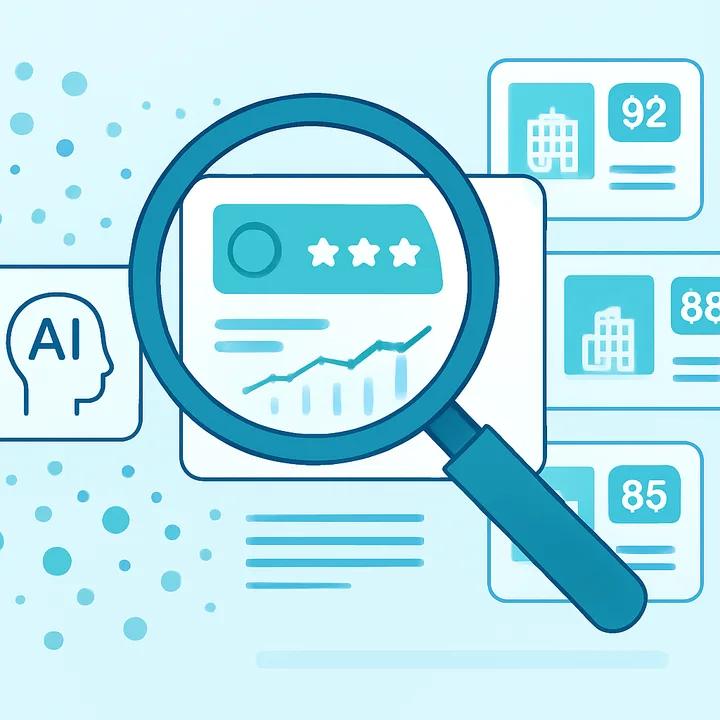
Deal sourcing is where many firms see the fastest payoff. Traditionally, origination depended on networks and inbound flow from bankers. AI expands the funnel by continuously scanning millions of companies against a firm's investment thesis.
A sourcing model ingests signals such as hiring trends, web traffic, patent filings, customer reviews, funding history, and management changes. It then scores companies on fit, growth, and acquisition likelihood. Instead of reviewing a handful of intermediated deals, partners see a ranked list of proprietary targets refreshed daily.
The practical benefit is proprietary, off-market access. One mid-market firm can realistically track an entire sector rather than a slice of it. Building these systems often pairs internal data with custom platforms, an area where teams frequently lean on specialized web application development to turn raw signals into usable deal pipelines.
AI in Due Diligence
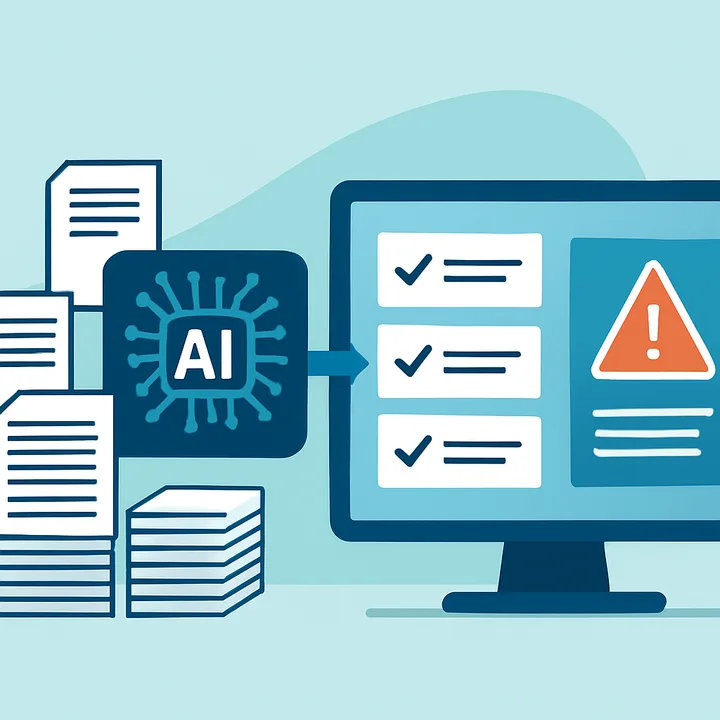
Due diligence is document-heavy, deadline-driven, and expensive, which makes it ideal for AI. Generative AI and NLP can read an entire data room in hours, extract key contract terms, flag change-of-control clauses, and surface inconsistencies across financial statements.
In legal diligence, models identify non-standard indemnities, auto-renewal traps, and missing signatures. In financial diligence, AI reconciles revenue recognition and highlights customer concentration. In commercial diligence, sentiment analysis of reviews and support tickets reveals churn risk before it appears in the numbers.
The goal is not to replace lawyers or accountants. It is to direct expert attention to the 5 percent of issues that actually move valuation, while the routine 95 percent is summarized automatically. This shortens timelines and reduces the risk of a missed red flag.
Predictive Analytics for Portfolio Management

Once a deal closes, AI shifts from evaluation to optimization. Predictive analytics gives operating partners an early-warning system across the entire portfolio rather than a quarterly rear-view mirror.
Models forecast cash flow, predict customer churn, optimize pricing, and detect margin erosion weeks before it shows up in board decks. A portfolio-wide dashboard can benchmark companies against each other, so best practices in one asset are quickly applied to others.
For example, a demand-forecasting model can reduce excess inventory, directly improving working capital. A churn model can target retention spend where it matters most. These compounding operational gains are often where the strongest returns in modern private equity artificial intelligence are realized.
A Typical AI Workflow Across the Deal Lifecycle
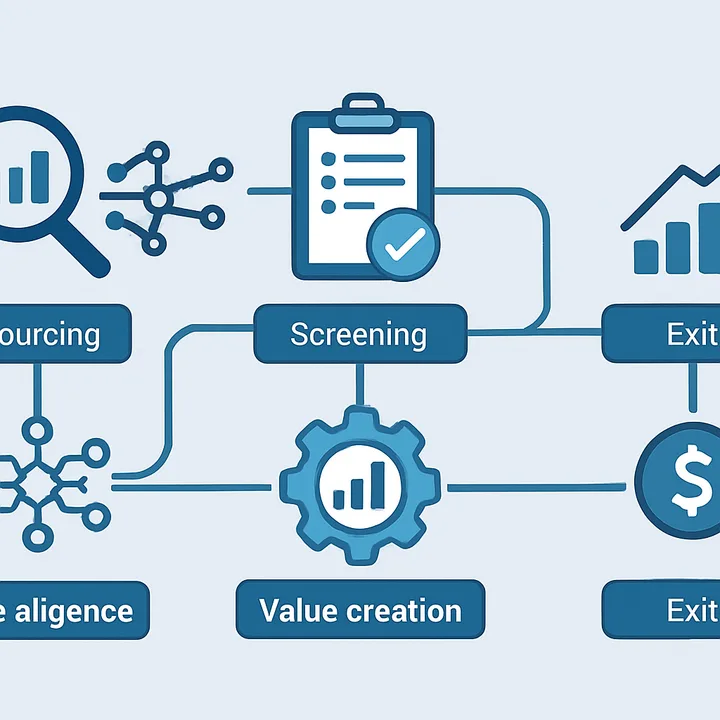
Understanding how these pieces connect helps clarify where to invest first. A mature AI workflow follows the deal lifecycle end to end:
- Sourcing: Models scan markets and rank proprietary targets against the thesis.
- Screening: AI builds first-pass company profiles and preliminary valuations.
- Due diligence: NLP reviews the data room and generates risk summaries.
- Value creation: Predictive analytics guides operational improvements post-close.
- Exit: AI identifies optimal timing and buyer fit using market signals.
Each stage feeds the next. Data captured during sourcing improves diligence; diligence findings shape the value-creation plan. This continuity is what separates firms experimenting with AI from those operating with it.
Comparison: Traditional PE vs AI-Enhanced PE
| Function | Traditional Approach | AI-Enhanced Approach |
|---|---|---|
| Deal sourcing | Network and inbound flow | Continuous market-wide scanning |
| Targets reviewed | Dozens per year | Thousands per year |
| Due diligence | Manual document review | Automated extraction and flags |
| Portfolio monitoring | Quarterly reporting | Real-time predictive alerts |
| Memo drafting | Days of analyst work | Hours with generative AI |
| Risk pricing | Experience-led estimates | Data-backed probability models |
The table makes the shift clear: AI does not change the goals of private equity, it changes the speed, scale, and consistency with which those goals are pursued.
AI in Investment Risk Assessment
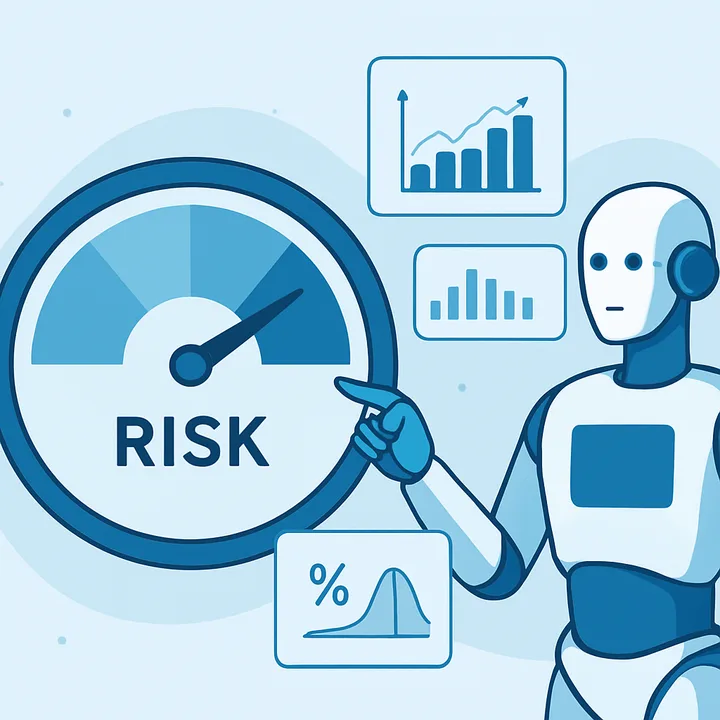
Risk assessment is where AI's probabilistic thinking adds real discipline. Instead of relying solely on a partner's intuition, firms run scenario simulations that model thousands of outcomes for revenue, interest rates, and exit multiples.
Machine learning models can estimate default probability, sensitivity to macro shocks, and concentration risk with quantified confidence levels. This reframes debate from opinion to evidence, helping investment committees make more consistent decisions across deals and cycles.
The expert caveat: models are only as good as their data and assumptions. Garbage inputs produce confident-looking but wrong outputs. Strong firms always pair model outputs with human judgment and clear documentation of assumptions.
Generative AI for Value Creation

Generative AI is reshaping value creation inside portfolio companies, not just at the fund level. Operating teams deploy AI to automate customer support, accelerate software development, optimize marketing, and streamline finance functions.
A portfolio company can use AI to draft proposals, summarize contracts, or personalize outreach at scale, lifting margins without proportional headcount growth. Because PE firms own multiple companies, a single proven AI playbook can be replicated across the portfolio, multiplying its impact.
Firms implementing these initiatives often partner with specialists in artificial intelligence services to deploy production-grade automation rather than fragile prototypes. Done well, this is one of the clearest ROI levers available today.
The Future of AI in Private Equity

The trajectory points toward AI agents that handle multi-step workflows autonomously, drafting an initial investment memo from a teaser, or building a 100-day plan from diligence findings. Human partners will shift further toward judgment, relationships, and strategy.
Expect three trends to define the next phase. First, proprietary data becomes the real moat, since models commoditize quickly but unique data does not. Second, governance and explainability become non-negotiable as regulators scrutinize AI-driven decisions. Third, smaller firms gain access to capabilities once reserved for mega-funds, leveling parts of the playing field.
For practical guidance and implementation support, resources from ZoneTechify and WebPeak outline how firms can adopt these tools responsibly and effectively.
Key Takeaways
- Private equity artificial intelligence spans the full lifecycle: sourcing, diligence, monitoring, value creation, and exit.
- Record dry powder above 1.2 trillion dollars makes AI-driven speed and precision a competitive necessity.
- McKinsey estimates generative AI could automate 60 to 70 percent of knowledge-work time, directly benefiting deal teams.
- AI expands sourcing from dozens to thousands of targets reviewed per year.
- Proprietary data, not the model itself, is the durable competitive advantage.
- Human judgment remains essential; AI augments decisions rather than replacing them.
Frequently Asked Questions (FAQ)
How is AI used in private equity?
AI is used across the private equity lifecycle to source deals, automate due diligence, forecast portfolio performance, assess risk, and create value in portfolio companies. It analyzes large datasets quickly, surfaces patterns humans miss, and frees senior teams to focus on judgment, strategy, and relationships rather than manual research.
Will AI replace private equity professionals?
No, AI will not replace private equity professionals, but it will change their work. AI automates research, document review, and reporting, while humans retain control over judgment, negotiation, relationships, and final investment decisions. Professionals who learn to use AI effectively will outperform those who do not, making it a skill rather than a threat.
What data does private equity AI rely on?
Private equity AI relies on financial statements, contracts, market data, hiring trends, web traffic, customer reviews, patent filings, and internal portfolio metrics. The most valuable models combine public signals with proprietary firm data, since unique datasets create a lasting competitive edge that off-the-shelf models cannot replicate.
Is AI in private equity worth the investment?
For most firms, yes. AI delivers measurable returns by expanding deal flow, shortening diligence timelines, and improving portfolio operations. The strongest ROI usually comes from value creation inside portfolio companies. However, results depend on data quality, clear use cases, and combining AI outputs with experienced human judgment.
How do small PE firms adopt AI?
Small private equity firms can adopt AI by starting with one high-impact use case, such as deal sourcing or document review, rather than building everything at once. Using specialized partners and existing AI platforms lowers cost and risk, letting smaller firms access capabilities once limited to large mega-funds.