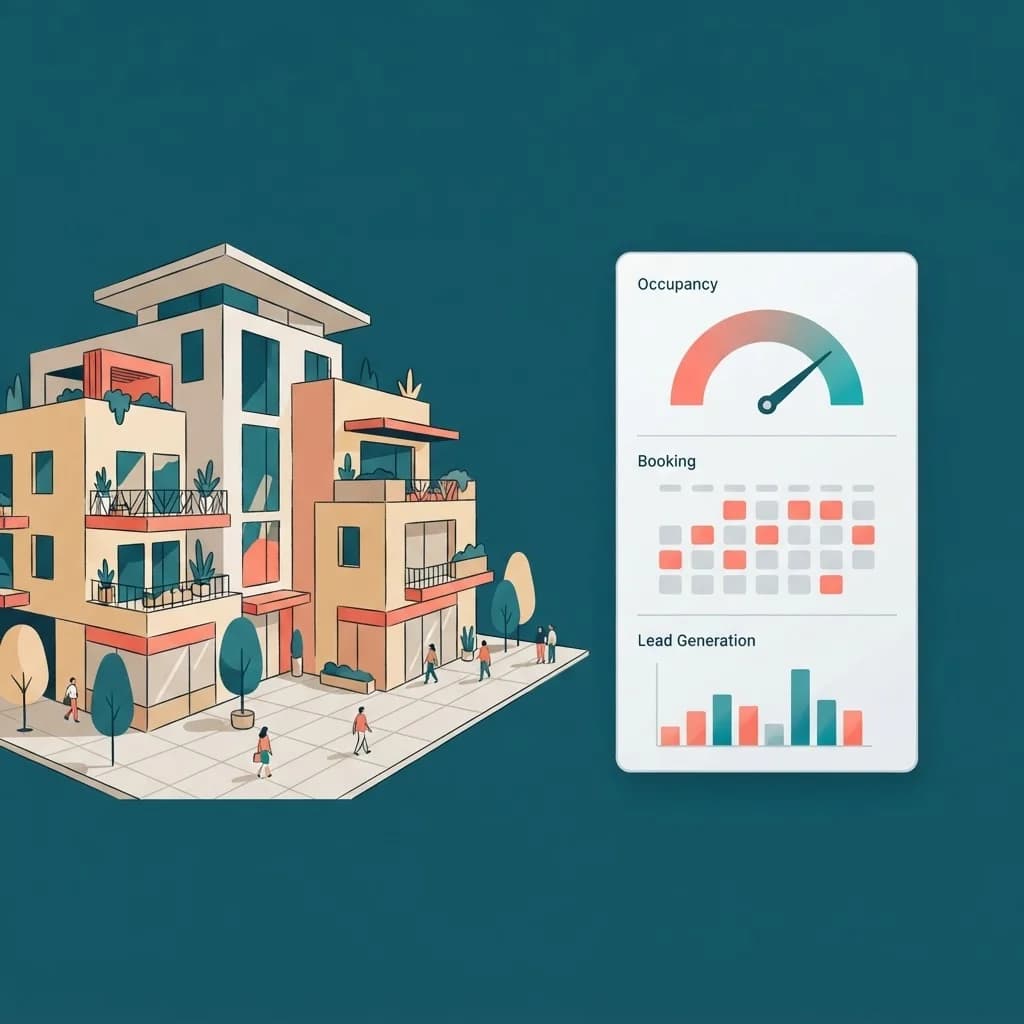
A data-driven multifamily digital marketing guide covering renter intent, ILS versus owned channels, tour conversion, reputation, and true cost per lease.
Multifamily Digital Marketing
Multifamily digital marketing has one honest measure of success: cost per signed lease. Everything else, including traffic, tours, and lead volume, is a leading indicator that only matters if it eventually moves occupancy at the right rent. Yet most property marketing budgets are still reported in leads and clicks, which is why owners routinely fund channels that produce plenty of activity and very few residents.
This guide covers how renters actually search, where syndication platforms help and hurt, what to build on owned channels, and how to attribute leases well enough to reallocate budget with confidence.
Quick Answer: Multifamily digital marketing combines internet listing services, Google Business Profile optimisation, community websites, paid search, and reputation management to fill units. Success is measured by cost per lease rather than cost per lead, because lead volume alone does not predict occupancy or effective rent.
How Renters Actually Search
The modern renter journey is short, mobile, and comparison-heavy. Typical behaviour looks like this:
- A broad discovery search on a listing marketplace or a map search for a neighbourhood.
- A shortlist of three to six communities, built mostly on photos, price transparency, and reviews.
- Direct brand searches for those shortlisted communities, where the property website and Google Business Profile decide who gets contacted.
- A tour request, increasingly self-guided or virtual, followed by an application within days.
The critical insight is step three. Renters discover on marketplaces but validate on your owned properties. A community with excellent listing presence and a slow, outdated website loses prospects at the validation stage and then blames the listing service.
The Channel Mix and What Each One Is For
| Channel | Primary Role | Typical Cost Behaviour | Key Weakness |
|---|---|---|---|
| Internet listing services | Volume and discovery | Fixed monthly, rises with market | Rented audience, weak differentiation |
| Google Business Profile | Capture validation searches | Free, time cost only | Requires constant photo and review work |
| Paid search on brand terms | Defend against competitor bids | Low cost per click, high intent | Looks redundant until you pause it |
| Paid search on category terms | Incremental demand | Expensive in dense markets | Attracts unqualified area shoppers |
| Community website | Conversion and proof | One-time build plus upkeep | Neglected content and slow load times |
| Reputation management | Shortlist survival | Staff time | Slow to recover from a bad quarter |
| Retargeting and social | Stay in the shortlist | Cheap impressions | Hard to attribute to leases |
Most portfolios overweight the first row and underweight the last four. Listing services deliver volume but no competitive advantage, because every competitor in the submarket uses the same platform with the same layout. Owned assets are where differentiation is possible.
Make the Community Website Do Real Work
A property website converts when it removes uncertainty. Six elements matter more than design fashion.
- Real-time pricing and availability. Renters treat call for pricing as a red flag and skip the listing. Published ranges with unit-level availability increase qualified contacts.
- Floor plan pages with their own URLs. Each plan should be indexable, with square footage, price range, availability date, and photos of that specific plan rather than generic staging.
- Fast mobile performance. Property sites are browsed on phones on cellular connections. Heavy image carousels are the most common cause of abandonment before the gallery even loads.
- Self-scheduling for tours. Instant booking without a phone call converts materially better than a contact form, especially outside office hours.
- Honest neighbourhood content. Transit times, grocery options, school zones, and pet policy details answer the questions that actually decide the lease.
- Accessibility compliance. Housing marketing carries fair housing obligations, and accessible sites reduce both legal exposure and lost prospects.
Portfolios that treat the website as a leasing tool rather than a brochure see the difference in tour-to-lease rates. Working with a data-driven marketing team that instruments every step from floor plan view to booked tour makes those gains visible rather than anecdotal.
Google Business Profile Is the Cheapest Occupancy Lever
Google reports that a large majority of consumers who run a local search on a smartphone visit a related business within a day, and for apartment communities the map pack is often the first result a validating renter sees. Treat the profile as a leasing asset:
- Use the exact community name, address, and phone that appear on the site and all listings.
- Choose the correct primary category, usually apartment complex or apartment rental agency, and add secondary categories deliberately.
- Upload fresh photos monthly, including amenity spaces and actual unit interiors.
- Publish updates for specials, events, and availability changes.
- Answer questions in the question and answer section before a competitor's prospect answers incorrectly.
Reviews Decide the Shortlist
Consumer research from BrightLocal has repeatedly found that nearly all consumers read online reviews for local businesses, and in multifamily the effect is amplified because a lease is a year-long commitment. Three operational rules:
- Ask at the right moment. Request reviews after a successful maintenance resolution or at move-in, not during renewal negotiations.
- Respond to everything within 48 hours. A calm, specific response to a negative review persuades the reader far more than the complaint does.
- Track recency, not just average. Twenty reviews from this year outrank one hundred from four years ago in perceived credibility.
Attribution: Getting to Cost Per Lease
Lead-level reporting is the norm in multifamily and it is the reason budget decisions are so often wrong. Building lease-level attribution requires four connections.
- Unique tracking numbers and unique email addresses per channel and per listing source.
- Guest card creation in the property management system that preserves the original source.
- A rule for duplicate handling, since one renter typically arrives through three channels.
- A monthly reconciliation that joins signed leases back to first and last touch.
Once connected, common findings repeat across portfolios: brand paid search looks expensive per click but cheap per lease, category search looks efficient per lead and expensive per lease, and retargeting rarely earns credit under last click while clearly influencing shortlists. Position-based or first-touch models correct part of that distortion.
Operational Speed Beats Clever Creative
Lead response time is the single highest-leverage operational metric in leasing. Industry shopping studies consistently find that a large share of prospect enquiries never receive a reply at all, and that communities responding within minutes book far more tours than those responding the next day. Practical fixes:
- Automated instant acknowledgement with a scheduling link.
- An AI leasing assistant to cover evenings and weekends, with a clear handoff to staff.
- A daily uncontacted lead report reviewed by the regional manager.
Marketing spend cannot compensate for unanswered enquiries. Fixing response time is usually cheaper than any channel expansion, and it improves the return of every channel simultaneously.
Renewals Are Marketing Too
Replacing a resident costs far more than retaining one when turnover, vacancy loss, and make-ready expense are counted. A renewal programme deserves the same rigour as acquisition: segmented email sequences starting 120 days before lease end, personalised offers based on payment history, resident event promotion, and a satisfaction survey that feeds the review request workflow. Portfolios that build this properly, often with implementation support from a delivery partner where you can learn more about integrated web and campaign systems, reduce reliance on expensive acquisition channels.
Key Takeaways
- Measure multifamily marketing by cost per signed lease, not cost per lead.
- Renters discover on listing services but validate on your website and Google Business Profile.
- Published pricing and availability increase qualified contacts; call for pricing suppresses them.
- Indexable floor plan pages with unique URLs capture high-intent long-tail searches.
- Review recency matters more than review count, and responses persuade future readers.
- Reducing lead response time to minutes improves the return on every other channel at once.
Frequently Asked Questions (FAQ)
What is multifamily digital marketing?
It is the set of online channels used to lease apartment communities, including internet listing services, property websites, Google Business Profile, paid search, social retargeting, and reputation management. The goal is filling units at target rent, so performance is judged on cost per signed lease and occupancy impact.
Are internet listing services still worth the cost?
Usually yes for discovery volume, but they should not be the entire strategy. Listing platforms rent you an audience everyone else also rents, offering little differentiation. Measure each platform by cost per lease rather than leads delivered, then reallocate the weakest performers into owned channels and reputation work.
How do I track which channel produced a lease?
Assign unique phone numbers and email addresses per channel, preserve the original source on the guest card in your property management system, define a duplicate handling rule, and reconcile signed leases to source monthly. Without that chain, reporting stops at leads and budget decisions become guesswork.
Should apartment communities publish pricing online?
Yes. Renters filter by price first, and listings without pricing are commonly skipped entirely. Publishing accurate ranges with availability dates attracts prospects who can afford the unit and reduces wasted leasing conversations, which improves both tour-to-lease rate and staff productivity.
How important are reviews for apartment leasing?
Critical. Nearly all consumers read reviews for local businesses, and a lease is a year-long commitment that raises the perceived risk. Recent reviews carry more weight than old ones, and a calm, specific management response to criticism often reassures readers more than the original complaint concerns them.
Final Thought
Multifamily marketing improves fastest when the basics are fixed in order: answer every enquiry quickly, publish real pricing, make floor plan pages searchable, keep reviews recent, then reallocate budget using lease-level attribution. Channel expansion should be the last move, not the first.