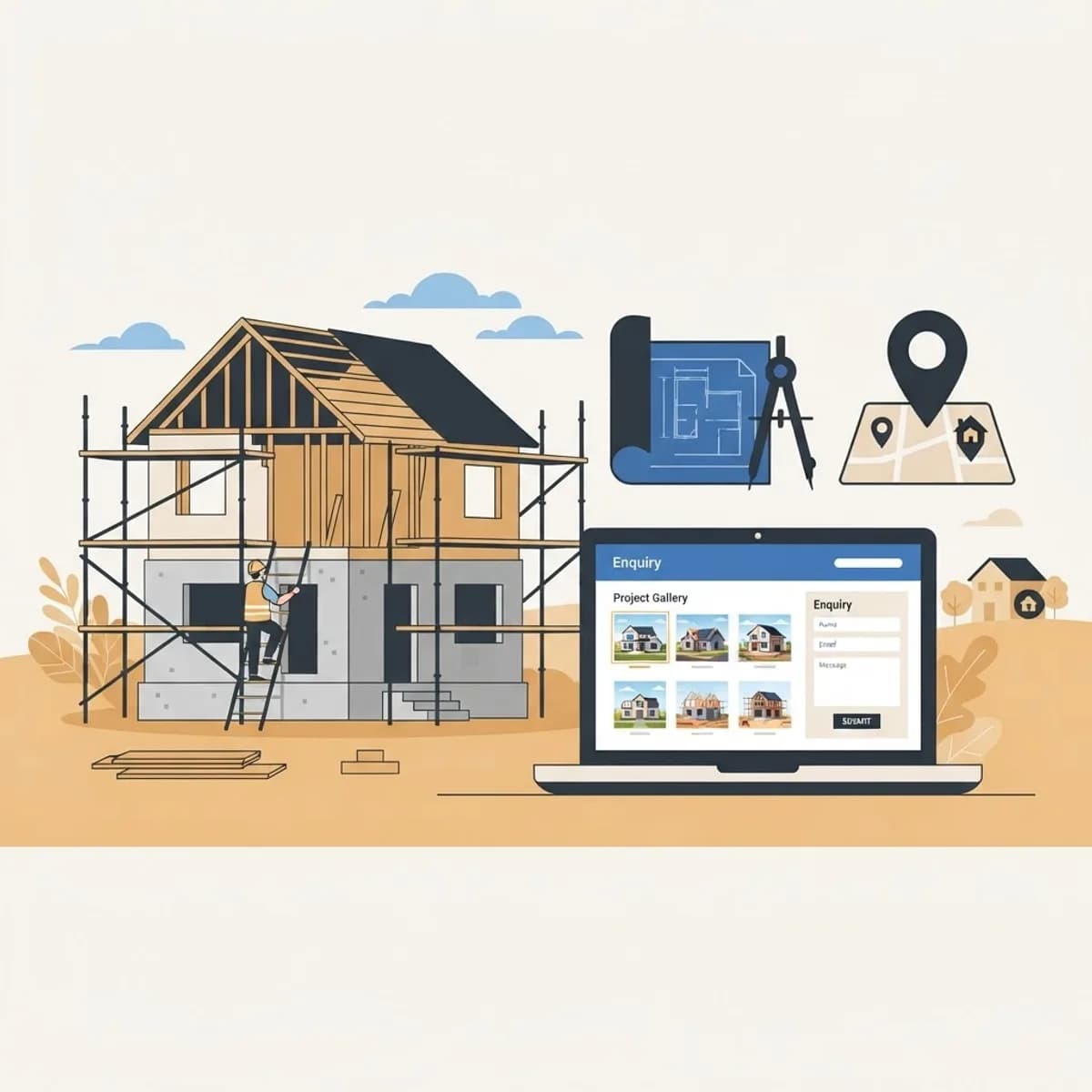
A practical digital marketing guide for home builders and construction firms covering local search, project galleries, lead quality, budgets, and measurement.
Digital Marketing for Builders
Builders sell one of the largest purchases a person ever makes, through a decision process that can last a year, to buyers who are simultaneously excited and frightened. Marketing that works in this category looks nothing like marketing for products bought on impulse.
This guide covers what actually generates qualified enquiries for custom home builders, renovation contractors, and construction firms, including how to filter out the unqualified enquiries that consume estimating time without producing contracts.
Quick Answer: Digital marketing for builders works best when it combines local search visibility, detailed project galleries with real budget ranges, review generation, and qualification built into enquiry forms. Publishing price ranges reduces enquiry volume but substantially improves the quality of enquiries that convert.
The Builder Marketing Problem Nobody Names
Most builders do not have a lead volume problem. They have a lead quality problem.
Estimating a custom home or major renovation takes real hours from senior staff. Every enquiry from someone with a budget less than half the realistic project cost consumes that time without any chance of a contract. A builder receiving forty enquiries a month and winning two projects is often worse off than one receiving twelve enquiries and winning three.
This reframes the entire strategy. Your marketing should attract fewer, better-matched prospects, and every tactic below is designed accordingly.
Publish Price Ranges
This is the highest-impact and most resisted recommendation in builder marketing.
Most builders avoid publishing any pricing because every project differs. The consequence is that every prospective client must contact you to discover whether you are within reach, which means your estimating team becomes a price filtering service.
What to publish instead of exact prices:
- Cost per square metre or square foot ranges by build quality tier.
- Typical total investment ranges for common project types such as a kitchen renovation, a two-storey extension, or a custom home in your region.
- Clear explanation of the main factors that move a project between ranges, such as site access, finish level, and structural complexity.
- Honest statement of your minimum project size.
Builders who do this consistently report fewer total enquiries and a higher percentage converting to quotes and contracts. The enquiries lost were largely those that would never have proceeded.
Project Galleries That Actually Sell
A gallery of finished photographs is a portfolio. A project case study is a sales asset. The difference is information.
Each project page should include:
- The brief. What the client needed and why.
- The constraints. Site issues, planning restrictions, heritage requirements, or budget limits.
- The approach. Specific decisions you made and the reasoning behind them.
- Process photographs, not only finished shots. Buyers evaluating builders want evidence of construction quality that finished photos hide.
- Timeline and investment range.
- Location at suburb or district level, which supports local search visibility.
- A direct client quote about the experience of working with you.
Twenty properly documented projects will outperform two hundred photographs. Each one also targets long-tail searches combining project type, style, and location.
Local Search Fundamentals for Builders
Builders operate within a service radius, which makes local search the primary acquisition channel.
- Complete the Google Business Profile with service categories, licence details, service area, and regular project photo uploads.
- Build service pages for each distinct offering, such as custom homes, extensions, renovations, and commercial fit-out, rather than one services page listing everything.
- Create location pages only for areas where you have completed real projects, and reference those projects specifically. Empty location pages targeting suburbs you have never worked in rarely rank and damage credibility.
- Maintain consistent business information across directories, trade association listings, and licensing registers.
- Display licence numbers, insurance details, and accreditations prominently, since these are trust signals buyers actively verify.
Channel Comparison for Builders
| Channel | Typical Monthly Cost | Lead Quality | Time to Results | Best Use |
|---|---|---|---|---|
| Local SEO and project content | 1,500 to 5,000 USD | High | 3 to 8 months | Long-term primary channel |
| Google Business Profile and reviews | Under 800 USD | High | 4 to 10 weeks | Immediate local visibility |
| Google Search Ads | 1,500 to 8,000 USD | Medium to high | Days | Filling capacity gaps |
| Lead marketplace platforms | Per lead, 30 to 200 USD | Low to medium | Immediate | Short-term capacity filling |
| Social media project showcases | 500 to 2,000 USD | Medium | 2 to 6 months | Referral support and brand |
| Email to past clients and architects | Under 500 USD | Very high | Immediate | Referral generation |
Lead marketplace platforms deserve particular caution. They sell the same enquiry to several builders, which puts you in a price comparison you did not choose and typically attracts the most price-sensitive buyers.
Qualification Built Into the Enquiry Process
Your enquiry form is a filtering tool. Use it deliberately.
Include:
- Budget range as a required selection, with your minimum clearly represented.
- Project timeline, distinguishing planning stage from ready to build.
- Site status, such as land owned, under offer, or still searching.
- Whether architectural plans exist.
- Project location within or outside your service area.
This reduces form completions and increases the value of the ones you receive. Builders resist adding fields because conventional advice says shorter forms convert better. That advice optimises for enquiry volume, which is the wrong target when each unqualified enquiry costs estimating hours.
The Referral Network Most Builders Underuse
Architects, designers, real estate agents, and structural engineers refer high-value, pre-qualified work. A structured programme beats occasional coffee meetings.
- Maintain a current list of professionals who have referred work or could.
- Send a quarterly update showing recent completed projects relevant to their client base.
- Provide them with material they can share with clients, such as a realistic cost guide for their area.
- Track referral sources in your CRM so you know which relationships produce contracts.
Referred enquiries typically convert at several times the rate of cold web enquiries because trust is transferred rather than built from scratch.
Website Requirements
Builder websites fail on the same points repeatedly.
- Mobile performance. Buyers browse project galleries on phones, often over mobile data. Large unoptimised images are the most common cause of abandonment.
- Image handling. Galleries need modern formats, correct sizing, and lazy loading, or the site becomes unusable on anything but fast connections.
- Clear trust evidence including licence, insurance, warranty, and association membership on every page.
- Simple navigation from project type to relevant examples to enquiry.
Because image-heavy sites are technically demanding, many builders benefit from working with a full stack development team rather than using a generic template that collapses under a large gallery. Builders wanting to connect their site enquiries directly to a CRM and job costing system can look at how production grade web apps handle integrating business systems with marketing data for accurate cost per contract reporting.
Measuring What Matters
Track these five numbers, not website traffic.
- Cost per qualified enquiry, where qualified means budget and timeline match your business.
- Enquiry to quote rate, which reveals whether your marketing attracts suitable prospects.
- Quote to contract rate, which reflects pricing and sales process rather than marketing.
- Cost per contract by source, reconciled against actual signed jobs.
- Average contract value by source, since some channels consistently deliver smaller projects.
A channel with a high cost per enquiry but strong contract value is often more profitable than a cheap channel delivering small jobs. Averages across all sources hide this entirely.
Key Takeaways
- Builders usually have a lead quality problem rather than a lead volume problem, because unqualified enquiries consume senior estimating time.
- Publishing price ranges reduces enquiry volume and improves conversion rate from enquiry to contract.
- Documented project case studies with constraints, process photos, and investment ranges outperform photo galleries.
- Referrals from architects, designers, and agents convert far better than cold web enquiries.
- Measure cost per contract and average contract value by source, not website traffic or form fills.
Frequently Asked Questions (FAQ)
How do builders get more leads online?
Prioritise a complete Google Business Profile, systematic review collection, detailed project case studies, and service pages for each offering. Add paid search for high-intent terms when you need to fill capacity. Qualification questions on enquiry forms improve lead quality substantially.
Should builders publish their prices online?
Publishing ranges rather than fixed prices works well. Cost per square metre by quality tier and typical total investment ranges by project type filter out prospects outside your range before they consume estimating hours, while signalling transparency to buyers who are within range.
How much should a construction company spend on marketing?
Most builders invest between two and six percent of revenue, commonly 2,000 to 10,000 US dollars monthly for small to mid-sized firms. Because contract values are high, a single additional project usually justifies a full year of marketing investment.
Are lead generation platforms worth it for builders?
They fill capacity gaps quickly but sell the same enquiry to multiple builders, which pushes competition toward price and attracts the most price-sensitive buyers. Use them tactically for short-term capacity rather than as a primary long-term acquisition channel.
What should a builder website include?
Documented project case studies with process photographs and investment ranges, service pages for each offering, visible licence and insurance details, client testimonials, a qualifying enquiry form, and fast mobile performance with properly optimised images across the entire gallery.
Final Thoughts
Builder marketing succeeds when it attracts fewer, better-matched clients. Publish ranges, document projects properly, build referral relationships deliberately, qualify at the form, and measure cost per signed contract. That combination protects your estimating capacity while filling your schedule with the projects you actually want.