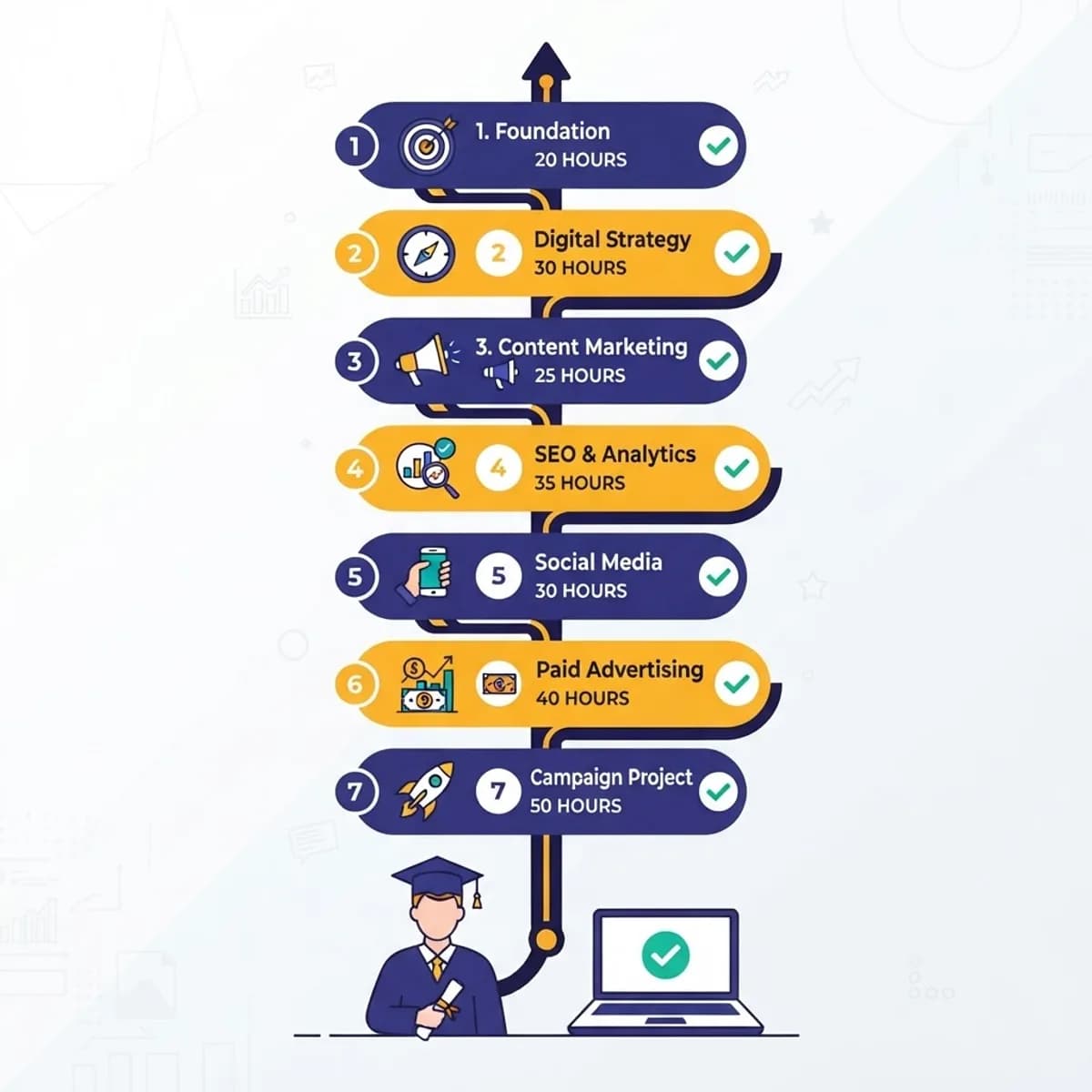
A complete 100 hour digital marketing bootcamp syllabus with module-by-module hour allocation, learning outcomes, tools covered, and assessment criteria.
Comprehensive Digital Marketing Bootcamp 100 Hours Syllabus
One hundred hours is enough time to make someone genuinely employable in digital marketing, but only if the hours are allocated correctly. Most bootcamp syllabi fail by spending too long on platform tours and too little on measurement, analysis, and actual campaign execution with real budget constraints.
This syllabus is structured around a simple principle: every module ends with a deliverable a hiring manager could review. The hour allocations reflect how much time each skill genuinely needs to reach working competence, not how much content exists to cover.
Quick Answer: A well-designed 100 hour digital marketing bootcamp allocates roughly 12 hours to analytics and measurement, 14 to SEO, 14 to paid search, 12 to paid social, 10 to content, 8 to email, 10 to conversion optimisation, 8 to strategy, and 12 to a capstone project with live campaign work.
Syllabus Overview
| Module | Hours | Format | Key Deliverable |
|---|---|---|---|
| 1. Foundations and funnel economics | 6 | Lecture and workshop | Unit economics model for a sample business |
| 2. Analytics and measurement | 12 | Hands-on lab | Working analytics setup with conversion tracking |
| 3. Search engine optimisation | 14 | Lab and audit work | Full technical and content SEO audit |
| 4. Paid search | 14 | Live account work | Structured campaign with keyword and bid plan |
| 5. Paid social | 12 | Live account work | Creative testing plan and campaign build |
| 6. Content and copywriting | 10 | Workshop | Content plan plus three published pieces |
| 7. Email and lifecycle marketing | 8 | Hands-on lab | Automated welcome and recovery sequences |
| 8. Conversion rate optimisation | 10 | Lab and analysis | Landing page audit and test design |
| 9. Strategy, budgeting and reporting | 8 | Case-based | Quarterly plan with budget allocation |
| 10. Capstone project | 6 | Project and presentation | Live campaign results presentation |
Total: 100 hours.
Module 1: Foundations and Funnel Economics (6 Hours)
Starting with economics rather than channels prevents the most common beginner error of optimising activity instead of profit.
Topics covered:
- Marketing funnel stages and matching intent to channel.
- Customer acquisition cost, lifetime value, contribution margin, and payback period.
- How margin determines which channels are viable for a given business.
- Building a simple unit economics model in a spreadsheet.
Learning outcome: the learner can calculate the maximum viable acquisition cost for any business before choosing any tactic.
Module 2: Analytics and Measurement (12 Hours)
The highest value module and the one most bootcamps shortchange.
- Analytics implementation, event configuration, and conversion definitions.
- Tag management, including trigger logic and variable setup.
- UTM parameter discipline and campaign taxonomy.
- Attribution models, their assumptions, and where each one misleads.
- Consent management and privacy-aware measurement.
- Building a one-page dashboard that answers the questions a manager actually asks.
Learning outcome: the learner can implement tracking from scratch and explain why platform-reported conversions usually exceed actual sales.
Module 3: Search Engine Optimisation (14 Hours)
Split across three areas with a bias toward diagnosis over theory.
Technical SEO, 5 hours. Crawling, indexing, site architecture, structured data, page performance metrics, and log file basics.
On-page and content SEO, 5 hours. Search intent classification, keyword research using real data, internal linking, and content structure for featured snippets.
Off-page and local, 4 hours. Link acquisition ethics and methods, digital PR fundamentals, Google Business Profile optimisation, and citation consistency.
Learning outcome: the learner can audit a website, identify the three highest-impact issues, and justify the priority order with reasoning a client would accept.
Module 4: Paid Search (14 Hours)
Taught with live accounts and a small real budget wherever possible, because judgement develops from spending money.
- Account structure, campaign types, and when each applies.
- Keyword match types, search term analysis, and negative keyword discipline.
- Ad copy testing frameworks and responsive asset strategy.
- Bidding strategies, including when automated bidding fails.
- Quality score components and the practical levers behind each one.
- Shopping and performance campaign fundamentals for retail.
Learning outcome: the learner can build, launch, and optimise a campaign against a defined cost per acquisition target and explain every structural decision.
Module 5: Paid Social (12 Hours)
- Platform selection based on audience and objective rather than familiarity.
- Campaign objectives and how platform optimisation targets affect results.
- Audience building, including first party data, lookalikes, and exclusions.
- Creative testing methodology and iteration frameworks.
- Measurement limitations after privacy changes, and how to work within them.
Learning outcome: the learner can design a creative testing programme that produces valid conclusions rather than noise.
Module 6: Content and Copywriting (10 Hours)
- Mapping content to search intent and funnel stage.
- Writing for clarity, specificity, and scannability.
- Editorial planning and distribution, since content without distribution does nothing.
- Practical, disciplined use of AI writing tools, including where they reliably fail.
- Demonstrating experience and expertise in line with search quality expectations.
Learning outcome: three published pieces targeting defined search intents, each with a distribution plan.
Module 7: Email and Lifecycle Marketing (8 Hours)
- List building with genuine value exchange, plus consent requirements.
- Segmentation based on behaviour rather than demographics alone.
- Automation sequences: welcome, abandonment, reactivation, and post-purchase.
- Deliverability fundamentals including authentication and list hygiene.
- Why open rates became unreliable after mail privacy features began pre-loading images, and which metrics replaced them.
Learning outcome: two live automated sequences with measurable revenue attribution.
Module 8: Conversion Rate Optimisation (10 Hours)
- Research methods: session recordings, heatmaps, surveys, and user testing.
- Hypothesis writing that states the expected mechanism, not just the change.
- Test design, sample size requirements, and statistical validity.
- Common false positives and why most reported test wins do not replicate.
- Page speed as a conversion factor, with practical measurement.
Learning outcome: a documented test plan with sample size calculations and defined success criteria.
Module 9: Strategy, Budgeting and Reporting (8 Hours)
- Channel selection frameworks based on business model and margin.
- Budget allocation across discovery, scaling, and maintenance activity.
- Forecasting with explicit assumptions rather than flat cost projections.
- Reporting to non-marketing stakeholders in revenue language.
- Agency and freelance client management, including scope definition.
Learning outcome: a quarterly marketing plan with budget allocation and a forecast that names its assumptions.
Module 10: Capstone Project (6 Hours)
Learners run a real campaign for a small business or non-profit with a modest budget, then present results including what failed and what they would change. Assessment weights honest analysis of failure as heavily as performance, because that reflects professional practice.
Tools Every Learner Should Finish Competent In
- Google Analytics and Google Tag Manager.
- Google Search Console.
- Google Ads and Meta Ads Manager.
- One SEO platform such as Ahrefs, Semrush, or Moz.
- One email platform such as Klaviyo, Mailchimp, or HubSpot.
- A spreadsheet application at intermediate level, including pivot tables.
- A dashboard tool such as Looker Studio.
Spreadsheet competence matters more than most syllabi acknowledge. Most real marketing analysis happens in a spreadsheet, not in a platform interface.
Where a cohort lacks access to live client accounts, partnering with a practising team solves the biggest weakness in classroom training. Agencies running real campaigns, including specialists such as an on-page SEO agency, can supply anonymised account data and realistic briefs so learners practise on genuine constraints rather than invented scenarios. Programmes that want a technical track covering tracking implementation and site performance can check this out as a reference for how production measurement setups are actually built.
Assessment Structure
| Component | Weight | Assessment Method |
|---|---|---|
| Module deliverables | 40 percent | Portfolio review against rubric |
| Live campaign execution | 25 percent | Performance against stated targets |
| Analysis and reasoning | 20 percent | Written analysis of results |
| Capstone presentation | 15 percent | Panel review |
Note that performance carries only twenty five percent. A learner can run a campaign that loses money and still score highly if the analysis demonstrates correct reasoning, because in professional practice the ability to diagnose failure is what makes someone hireable.
Key Takeaways
- Allocate roughly a quarter of the hundred hours to measurement and conversion optimisation, which are the skills employers find hardest to hire.
- Every module should end with a portfolio deliverable a hiring manager could evaluate.
- Live campaign work with real budget develops judgement that simulated exercises cannot.
- Spreadsheet and analysis skills matter as much as platform familiarity.
- Assess reasoning quality alongside campaign performance, since diagnosing failure is a core professional skill.
Frequently Asked Questions (FAQ)
How many hours does it take to learn digital marketing?
Around 100 structured hours produces working competence across core channels and enough portfolio evidence for entry-level roles. Reaching specialist level in a single channel such as paid search or technical SEO typically requires an additional six to twelve months of practical account management.
What should a digital marketing bootcamp syllabus include?
Funnel economics, analytics implementation, SEO, paid search, paid social, content, email, conversion optimisation, and strategy, plus a capstone using real budget. Measurement and conversion optimisation deserve the largest share, because those skills are the hardest for employers to find.
Is a 100 hour bootcamp enough to get a marketing job?
It is enough to qualify for junior roles if the hours produce a genuine portfolio with measurable results. Employers hire on demonstrated outcomes rather than course completion, so live campaign work and documented analysis matter far more than certificates.
Which digital marketing skills are most in demand?
Analytics implementation, paid media management with proven efficiency, technical SEO, and conversion rate optimisation consistently command the highest demand. These skills are harder to learn than content creation and social posting, which is precisely why they pay better.
Should a bootcamp teach AI marketing tools?
Yes, integrated into relevant modules rather than taught separately. Learners should understand where AI tools genuinely accelerate work, such as drafting and data summarisation, and where they fail, such as factual accuracy, original analysis, and strategic judgement under constraints.
Final Thoughts
A hundred hour curriculum succeeds or fails on hour allocation and deliverables. Prioritise measurement, force live campaign work, and grade reasoning as heavily as results. Learners who finish able to calculate unit economics, implement tracking, and explain a failed campaign honestly are employable. Those who only toured platform interfaces are not.