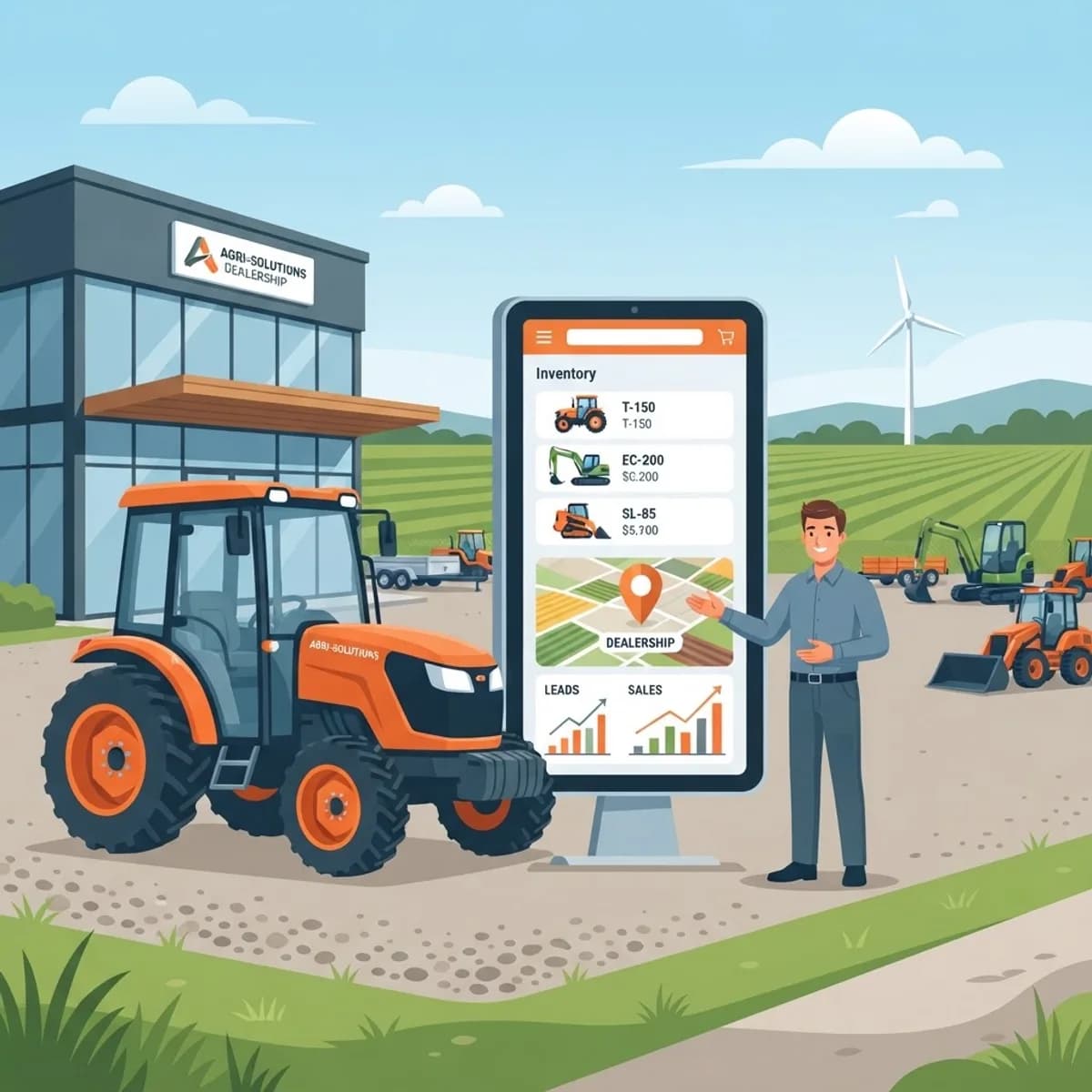
The digital marketing strategies that separate top performing equipment dealers, covering inventory search, local visibility, financing intent, and parts revenue.
Top Performing Kubota Dealers Digital Marketing Strategies
Equipment dealerships operate a business model that most marketing advice ignores. A single tractor sale can represent tens of thousands of dollars, the buyer researches for weeks or months, financing is usually part of the decision, and the real profit often sits in parts and service revenue over the following decade rather than in the initial machine margin.
Top performing dealers market accordingly. This article breaks down the strategies that consistently separate high-performing equipment dealerships from those relying on manufacturer co-op advertising and a static website.
Quick Answer: Top performing equipment dealers win by making live inventory searchable and indexable, dominating local search across their full service radius, capturing financing and comparison intent early, and building parts and service revenue through owner-focused follow-up rather than relying only on new machine promotions.
Why Equipment Dealer Marketing Is Different
Four characteristics shape every effective dealer strategy.
- Long consideration cycles. Buyers research for weeks to months, comparing horsepower, implements, financing terms, and dealer service reputation.
- Large service radius. Buyers routinely travel one to two hours for the right machine and a dealer they trust, which makes single-location local SEO insufficient.
- Inventory-driven search. Many searches are model specific, such as a compact tractor model number plus for sale plus a region.
- Lifetime value in service. The machine sale opens a relationship where parts, maintenance, and eventual trade-in generate substantial ongoing revenue.
A dealership that markets only the machine sale is monetising the least profitable part of the relationship.
Strategy One: Make Inventory Findable
This is the single highest-return change most dealers can make. Many dealership inventory systems load listings through scripts that search engines index poorly or not at all, which means the most commercially valuable pages on the site are invisible.
What top performers do:
- Server-render inventory pages so each unit has a crawlable URL with model, hours, year, location, and price.
- Apply product structured data including price, availability, and condition so listings qualify for rich results.
- Create permanent model landing pages that persist when a specific unit sells, rather than returning errors that waste accumulated ranking value.
- Include used and trade-in inventory, which often carries higher search demand and better margin than new units.
- Show real photographs of the actual unit, not manufacturer stock images. Buyers of used equipment specifically search for genuine condition photos.
A dealership with two hundred indexable inventory pages competes for hundreds of long-tail searches. A dealership with one inventory page competes for none of them.
Strategy Two: Own Local Search Across the Full Radius
Equipment buyers search geographically, but the geography extends well beyond your immediate town.
- Fully complete the Google Business Profile for every physical location, including service hours, parts counter hours, and brands carried.
- Build service area pages for the meaningful towns and counties within a realistic driving distance, each with genuinely local content such as regional crop types, terrain, or applications rather than a template with the town name swapped.
- Collect reviews systematically after every service visit, not only after machine sales. Service visits occur far more frequently and generate review volume faster.
- Publish location-specific inventory views so a buyer searching a nearby town sees units available at the nearest branch.
Strategy Three: Capture Financing and Comparison Intent
Two research behaviours precede almost every equipment purchase, and most dealers address neither.
Financing intent. Buyers search for payment estimates, interest programmes, and lease versus buy comparisons before contacting a dealer. A payment calculator page combined with clear explanations of available programmes captures this traffic and qualifies buyers early.
Comparison intent. Buyers compare models against each other and against competing brands. A dealer willing to publish honest, specific comparisons, including where another machine may suit a particular use case better, earns disproportionate trust and captures searches competitors avoid.
Both content types serve buyers who are months from purchase, which is exactly when a dealer relationship should begin.
Channel Priorities for Equipment Dealers
| Channel | Priority | Typical Monthly Cost | Time to Impact | Primary Value |
|---|---|---|---|---|
| Indexable inventory pages | Critical | One-time build plus maintenance | 4 to 10 weeks | Long-tail model searches |
| Google Business Profile and reviews | Critical | Under 1,000 USD | 3 to 8 weeks | Local discovery and trust |
| Paid search on model and brand terms | High | 1,500 to 8,000 USD | Days | High-intent capture |
| Service and parts email programme | High | 300 to 1,000 USD | Immediate | Recurring revenue |
| Comparison and financing content | Medium | 1,000 to 3,000 USD | 2 to 5 months | Early-stage capture |
| Video walkarounds | Medium | 500 to 2,500 USD | 1 to 3 months | Remote buyer confidence |
| Broad awareness display | Low | Varies | Unclear | Limited measurable value |
Strategy Four: Monetise the Ownership Period
The most overlooked revenue opportunity in equipment retail is the existing customer base. Dealers with accurate customer and machine records can run programmes that competitors cannot copy.
- Service interval reminders tied to machine hours or purchase date, which consistently produce the lowest cost per transaction of any dealer marketing activity.
- Seasonal parts campaigns aligned to regional work cycles, such as pre-season preparation in agricultural areas.
- Attachment and implement offers targeted by machine model, since implement compatibility is model specific and highly relevant.
- Trade-in outreach to owners approaching typical replacement age, which generates both a used unit for inventory and a new sale.
These programmes require clean data linking customers to machines. Dealers whose records live in disconnected systems usually need integration work before the marketing becomes possible, and this is where a technical partner focused on search engine optimization and connected site infrastructure earns its keep by making inventory, customer records, and content work together.
Strategy Five: Video That Answers Real Questions
Equipment buyers watch video before travelling to a dealership. The videos that perform are not brand films.
- Walkaround videos of specific used units showing hours, wear, and any defects honestly.
- Implement demonstrations showing the machine performing the actual task the buyer needs.
- Maintenance explainers that position your service department as the knowledgeable option.
- Comparison videos between two models in your lineup, helping buyers self-select.
Honesty about used equipment condition is a competitive advantage, not a risk. Buyers who drive two hours and find undisclosed problems do not return, and they tell others.
Measuring What Matters
Dealership marketing measurement fails when it counts website leads. Track these instead:
- Cost per machine sale by channel, reconciled against your dealership management system.
- Parts and service revenue per customer in the twenty four months after purchase.
- Phone call volume and answer rate, since a large share of equipment enquiries still arrive by phone and unanswered calls are lost sales.
- Inventory page views to enquiry rate by unit type, which reveals listing quality problems.
- Average distance travelled by buyers, which tells you whether your radius targeting is working.
Dealers wanting this level of reporting typically need their website, inventory feed, and management system connected. If you want to see how that integration is structured, visit website resources on connecting business systems to marketing reporting.
Key Takeaways
- Indexable, individually crawlable inventory pages are the highest-return technical change for most equipment dealers.
- Equipment buyers routinely travel one to two hours, so local SEO must cover the full service radius rather than one town.
- Financing and model comparison content captures buyers months before they contact a dealer.
- Service and parts programmes to existing owners deliver the lowest cost per transaction in dealership marketing.
- Measure cost per machine sale and service revenue per customer, not website form fills.
Frequently Asked Questions (FAQ)
What is the most effective digital marketing strategy for equipment dealers?
Making inventory individually indexable is usually the highest-return move, because buyers search specific models, years, and hours. Combined with a complete Google Business Profile and systematic review collection, it captures high-intent local demand that competitors with script-driven inventory pages cannot reach.
How much should an equipment dealership spend on digital marketing?
Most independent dealerships invest between 3,000 and 12,000 US dollars monthly including advertising spend. Manufacturer co-op programmes often cover part of this. Allocate the majority to inventory visibility, local search, and high-intent paid search before broader awareness advertising.
Should dealers advertise used equipment online?
Yes, and often more aggressively than new equipment. Used units frequently carry better margin, attract high search demand, and face fewer manufacturer advertising restrictions. Listings need genuine photographs of the actual machine, accurate hours, and honest condition notes to convert distant buyers.
How do dealers get more Google reviews?
Request reviews after every service visit rather than only after sales, since service interactions are far more frequent. Send the request by text within a day of the visit with a direct link. Systematic requesting, not incentives, produces sustainable review volume.
Does video marketing work for equipment dealerships?
Yes, particularly walkaround videos of specific used units and implement demonstrations. Buyers travelling long distances want to verify condition and capability first. Honest videos showing actual wear build more trust and produce better-qualified visits than polished brand content.
Final Thoughts
High performing equipment dealers treat their website as an inventory search engine, their local presence as a multi-county footprint, and their existing owners as the most profitable audience they have. Get inventory indexable, collect reviews from service visits, publish honest comparisons, and measure against actual machine sales rather than form submissions.