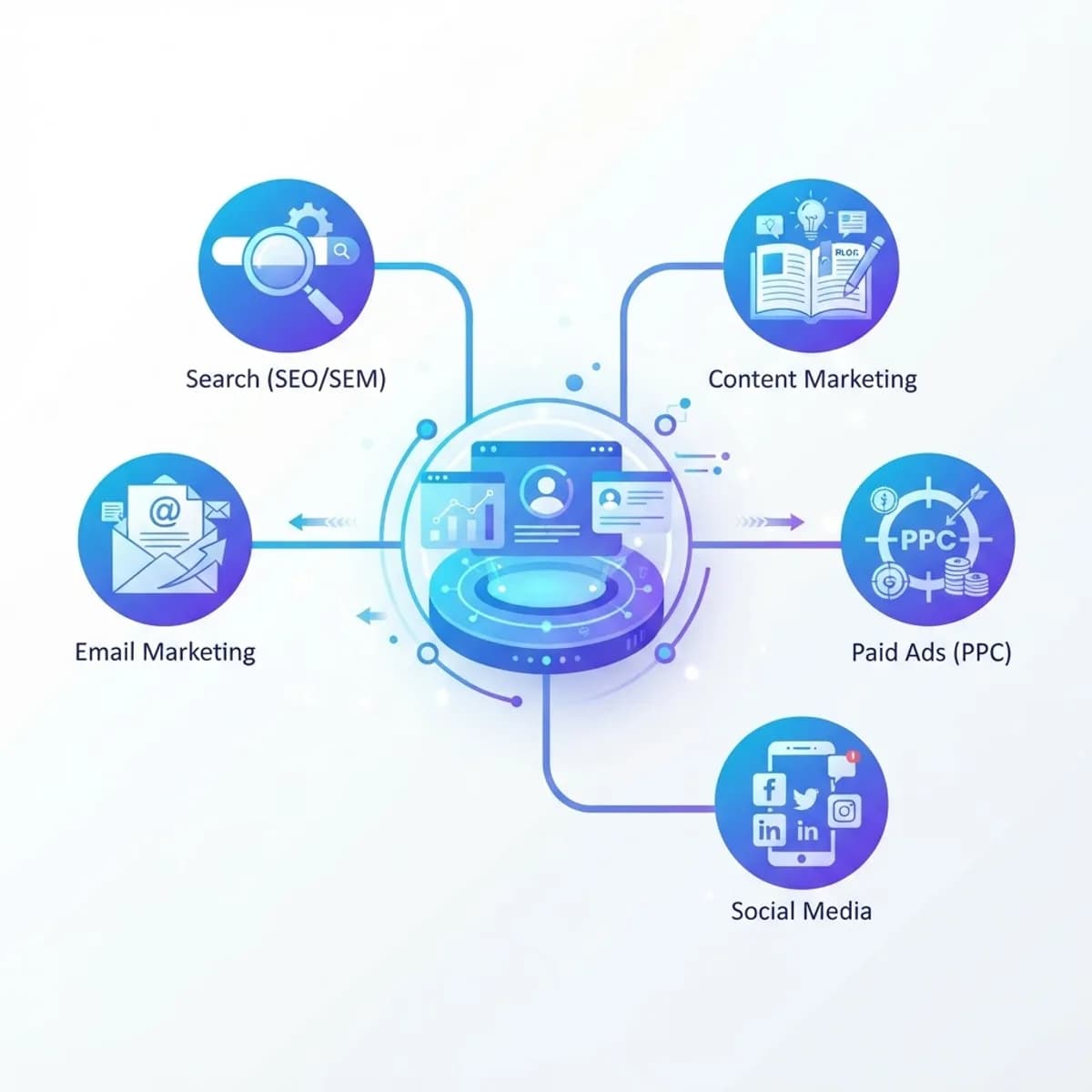
What integrated digital marketing means in practice, how to connect channels around one measurement model, and the operating structure that makes integration work.
Integrated Digital Marketing
Integrated digital marketing is one of the most used and least defined phrases in the industry. Most companies that claim to run integrated marketing are actually running parallel marketing: separate channels, separate reports, separate agencies, and a monthly meeting where nobody can explain why the numbers disagree.
Genuine integration is an operating model, not a service package. This article defines what integration requires, how to build it in a specific order, and how to tell whether your current setup is integrated or merely coordinated.
Quick Answer: Integrated digital marketing connects every channel to one shared audience definition, one message architecture, and one measurement model. It differs from multi-channel marketing, where channels run in parallel with separate goals. Integration typically improves efficiency because channels reinforce rather than duplicate each other.
Integrated Versus Multi-Channel Versus Omnichannel
These three terms are used interchangeably and mean different things.
- Multi-channel means you are present on several channels. Each has its own plan and its own success metric. This describes most companies.
- Omnichannel means the customer experience is continuous across channels, so a person can start on mobile, continue on desktop, and finish in store without repeating themselves.
- Integrated means the channels are planned, measured, and budgeted as a single system serving one strategy.
A company can be multi-channel without being integrated. It cannot be genuinely omnichannel without integration, because a continuous experience requires shared data and shared messaging.
The Four Layers of Real Integration
Integration happens across four layers. Missing any one of them reduces the whole model to coordination.
Layer one: shared audience definition
Every channel must target the same defined segments, described in the same language. When the paid team targets by interest categories, the email team segments by purchase history, and the content team writes for a persona invented two years ago, no amount of reporting alignment will fix the underlying mismatch.
Practical requirement: one documented segmentation model, with each segment defined by observable behaviour and firmographic or demographic data available in your systems.
Layer two: message architecture
A message architecture defines your core proposition, the three to five supporting claims, and the proof for each. Every channel then expresses that architecture at the appropriate depth.
The test is simple. Take your latest search ad, your last email, and your homepage hero section. If a customer could not tell they came from the same company solving the same problem, you have a message architecture problem rather than a creative problem.
Layer three: unified measurement
This is where most integration efforts fail. Each platform reports conversions it believes it caused, which is why the sum of channel-reported conversions routinely exceeds actual sales.
What unified measurement requires:
- One primary conversion definition, owned centrally.
- A single source of truth, usually the CRM or order system, against which all platform claims are reconciled.
- An agreed attribution approach, documented and applied consistently.
- Regular incrementality checks, such as geo holdouts or scheduled pauses, to test whether channels are genuinely adding sales.
Incrementality testing is the honest answer to attribution disputes. Turning a channel off in matched regions for a defined period reveals its true contribution far more reliably than any attribution model.
Layer four: shared planning and budget
If each channel defends its own budget, integration cannot survive contact with the annual planning cycle. Integrated teams allocate budget to objectives and customer segments, then decide channel mix underneath that allocation.
Integration Maturity Model
| Maturity Level | Planning | Measurement | Budget | Typical Symptom |
|---|---|---|---|---|
| Fragmented | Channel by channel | Platform reported only | Fixed per channel | Reported conversions exceed actual sales |
| Coordinated | Shared calendar | Consolidated dashboard | Negotiated annually | Consistent timing, inconsistent messaging |
| Aligned | Shared objectives | Single conversion definition | Reallocated quarterly | Channels agree on goals but not on credit |
| Integrated | One plan per segment | Source of truth plus attribution model | Reallocated monthly | Debate shifts to strategy rather than credit |
| Optimised | Continuous testing | Incrementality validated | Reallocated weekly | Spend follows measured marginal return |
Most mid-market companies sit between coordinated and aligned. Moving one level up typically delivers more efficiency gain than adding a new channel.
How Channels Reinforce Each Other When Integrated
Integration is worth the effort because channels interact. Three well-documented interaction effects matter most.
Brand activity reduces performance costs. As brand awareness rises, branded search volume increases and click-through rates on all channels improve. Paid search becomes cheaper because relevance and expected click-through rate improve.
Content supports paid conversion. Prospects who read substantive content before clicking an ad convert at higher rates. Running content and paid search against the same keyword themes therefore improves both.
Email and paid social compound. Uploading customer segments to advertising platforms for suppression or lookalike targeting makes both channels more efficient, and email engagement data improves ad targeting quality.
None of these effects appear in single-channel reporting. That is precisely why fragmented measurement leads to underinvestment in the activities that make everything else work.
Building an Integrated Programme in Six Steps
- Document one segmentation model and get sales, marketing, and product to agree on it in writing.
- Write the message architecture with proof points, then audit every live asset against it and fix the outliers.
- Define the single conversion event and connect every channel to your source of truth system.
- Build one dashboard that reports platform-claimed results alongside source of truth results, so discrepancies are visible rather than hidden.
- Run one incrementality test per quarter on your largest channel.
- Move to monthly budget reallocation based on marginal return rather than annual channel budgets.
Steps three and four are technical projects. Companies without internal data engineering usually need a partner here, and an experienced WEBPEAK Agency style team can build the reporting layer alongside the marketing work rather than treating it as a separate initiative.
Organisational Structures That Support Integration
Structure determines behaviour more than strategy documents do.
- Channel-based teams optimise their own metrics and resist integration naturally. Workable at small scale, problematic beyond four channels.
- Segment-based teams own a customer segment across all channels. Strongest alignment with integrated measurement, but requires broader skill sets.
- Pod structures combine a strategist, a channel specialist, a content producer, and an analyst around one objective. Most practical structure for mid-sized teams.
- Centre of excellence plus embedded specialists works at enterprise scale, where central standards govern measurement while regional teams execute.
Whichever structure you choose, one person must own the measurement definition. Shared ownership of measurement reliably produces multiple definitions.
Common Integration Mistakes
- Buying a platform and calling it integration. Tools support integration, they do not create it.
- Integrating reporting without integrating planning. A shared dashboard over separate strategies just makes disagreement more visible.
- Assuming attribution solves credit disputes. Every model distributes credit differently. Incrementality testing answers the question that attribution only estimates.
- Adding channels before integrating existing ones. Each new channel multiplies coordination cost.
- Treating brand and performance as opposing budgets. Integrated programmes treat brand investment as an input that lowers performance costs over time.
Teams that want an honest assessment of where their programme sits on the maturity model can read more about building unified measurement and connected channel infrastructure.
Key Takeaways
- Integrated marketing means shared audience definitions, message architecture, measurement, and budgeting, not simply running several channels.
- Platform-reported conversions routinely exceed actual sales, which is why a single source of truth is essential.
- Incrementality testing, such as geo holdouts, answers channel contribution questions that attribution models can only estimate.
- Brand activity lowers performance marketing costs by increasing branded search and improving click-through rates.
- Moving one level up the integration maturity model usually delivers more efficiency than adding a new channel.
Frequently Asked Questions (FAQ)
What is integrated digital marketing?
Integrated digital marketing plans, measures, and budgets all channels as a single system built around one audience definition and one message architecture. It differs from multi-channel marketing, where each channel operates with separate goals, separate reporting, and separate budget negotiations.
How is integrated marketing different from omnichannel marketing?
Integrated marketing describes how the company plans and measures internally. Omnichannel describes the customer experience being continuous across touchpoints. Integration is usually a prerequisite for omnichannel, because a seamless experience requires shared data and consistent messaging across teams.
Does integrated marketing cost more?
Initial setup costs more because measurement infrastructure and planning discipline take effort. Ongoing costs typically fall, since integration removes duplicated spend, reduces conflicting messaging, and allows budget to move toward channels with the strongest measured marginal return.
How do I measure integrated marketing performance?
Use one primary conversion definition reconciled against a source of truth such as your CRM, report platform claims alongside actual results so discrepancies stay visible, and run periodic incrementality tests by pausing channels in matched regions to measure genuine contribution.
How long does it take to integrate marketing channels?
Documenting segmentation and message architecture takes four to eight weeks. Connecting measurement systems typically takes one to three months depending on data complexity. Changing budgeting and planning behaviour takes longest, usually two to three quarters, because it requires structural and cultural change.
Final Thoughts
Integration is an operating discipline rather than a service you can buy. Agree one audience model, one message architecture, and one measurement definition, then let budget follow measured marginal return. Companies that do this stop arguing about channel credit and start making decisions on evidence.