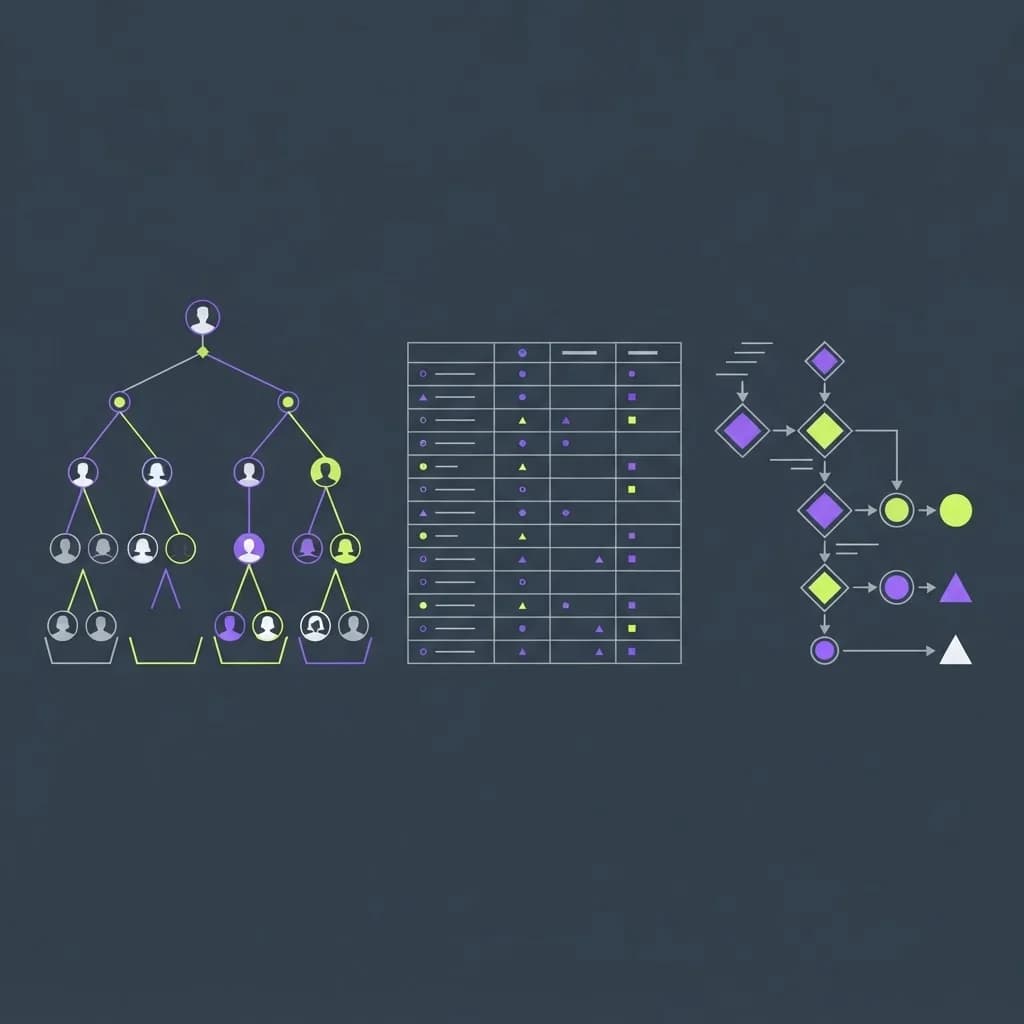
How to build a job title classification taxonomy for digital, product, experience, and marketing data so segmentation, routing, and reporting stay accurate.
Job Title Classification Taxonomy Digital Product Experience Marketing Data
Job title is the most requested and least reliable field in commercial data. Every form collects it, every CRM stores it, and almost no organisation can answer a simple question like how many product leaders are in the database without a manual export and an afternoon of spreadsheet work. The reason is that job titles are free text written by humans for internal politics, not for analysis.
A job title classification taxonomy fixes this by mapping infinite raw strings onto a finite, governed set of dimensions. This guide explains how to design one specifically for digital, product, experience, and marketing roles, how to build the classification pipeline, and how to measure whether it is actually correct.
Quick Answer: A job title classification taxonomy maps free-text titles onto structured dimensions such as function, sub-function, seniority, and scope. For digital, product, experience, and marketing data, it converts thousands of unique strings into a governed set of segments that power routing, personalisation, and reporting with measurable accuracy.
Why Raw Job Titles Break Analytics
Large contact databases routinely contain tens of thousands of distinct title strings, and the long tail is brutal: a majority of unique titles may appear only once. Four failure patterns cause most of the damage.
- Synonym explosion. Growth Marketer, Demand Generation Manager, Performance Marketing Lead, and Acquisition Manager can describe the same job.
- Inflation and deflation. A Vice President at a 12 person startup and a Vice President at a bank are not comparable seniority.
- Hybrid roles. Head of Product and Design is genuinely two functions and must be handled deliberately.
- Noise. Emoji, certifications, taglines, multiple languages, and personal branding text appear inside the title field constantly.
Any segmentation built directly on raw strings inherits all four problems, which is how campaigns end up addressing a Chief Technology Officer as a marketing manager.
The Four Dimensions Every Taxonomy Needs
Resist the urge to build one flat list of job categories. A single list forces impossible choices. Use orthogonal dimensions instead, each independently assignable.
1. Function
The top-level business area. For this domain, a workable set is Product, Design and Experience, Marketing, Data and Analytics, Engineering, Growth, Operations, Sales, Executive, and Other.
2. Sub-function
The specialisation inside the function. Examples within Marketing: brand, content, demand generation, lifecycle, product marketing, communications, marketing operations, search, paid media, partnerships. Within Design and Experience: UX research, UX design, UI and visual design, service design, content design, design operations, accessibility.
3. Seniority
A normalised ladder independent of the company's internal naming. A durable six-level model: individual contributor entry, individual contributor senior, manager, director, vice president, and executive or founder.
4. Scope
What the person controls. Useful values include individual, team, department, regional, and global. Scope is the dimension that rescues seniority from title inflation when combined with company size.
| Dimension | Example Values | What It Answers | Common Mistake |
|---|---|---|---|
| Function | Product, Marketing, Design | Which department | Merging design into marketing |
| Sub-function | Lifecycle, UX research | Which specialisation | Too granular to maintain |
| Seniority | Manager, Director, VP | How much authority | Trusting the literal title word |
| Scope | Team, Regional, Global | How wide the remit | Omitting it entirely |
| Confidence | 0.0 to 1.0 | How sure the system is | Storing only the label |
That last row matters more than people expect. Storing a confidence score turns classification from a black box into something you can filter, audit, and improve.
Building the Classification Pipeline
A production pipeline has five stages, and skipping any one of them degrades accuracy noticeably.
Stage 1: Normalisation
Lowercase, strip punctuation and emoji, expand common abbreviations such as sr to senior and vp to vice president, remove credential suffixes, and split composite titles on separators like slash, ampersand, and the word and. Detect language so non-English titles route to the correct mapping table rather than falling into Other.
Stage 2: Deterministic dictionary matching
Map the highest-frequency exact strings to taxonomy nodes. In most databases a few thousand mapped strings will cover 60 to 80 percent of all records, because title frequency follows a steep power law. Deterministic matching is fast, free, fully auditable, and should always run before any model.
Stage 3: Rules and pattern matching
Apply ordered regular expression rules for structures the dictionary missed, for example any title containing head of plus a known function token maps to director-level seniority with that function. Order matters: run the most specific rules first and log which rule fired.
Stage 4: Model-based classification for the tail
The remaining long tail is where machine learning earns its place. Embedding-based nearest neighbour matching against labelled examples, or a fine-tuned classifier, handles novel phrasing well. Language models can label ambiguous titles at scale, but they must write into the same governed taxonomy and return a confidence value. Teams building this kind of hybrid system often lean on specialist help; an AI agency for startups partner like ZoneTechify will usually insist that the model only ever proposes existing taxonomy nodes rather than inventing new ones.
Stage 5: Human review queue
Route low-confidence predictions and high-value accounts to a review interface. Every human correction becomes labelled training data, which is how accuracy compounds instead of plateauing.
Handling the Hard Cases
Four edge cases account for most disputes between teams.
- Hybrid titles. Store a primary function and an optional secondary function rather than forcing a single choice. Reporting defaults to primary; targeting can use either.
- Founders and owners. Classify as executive seniority with function derived from company size and available context, since a solo founder performs every function.
- Consultants and freelancers. Add an employment type flag rather than distorting seniority.
- Regional and language variants. Maintain separate mapping tables per language and map to the same canonical nodes. Established public frameworks such as the O NET occupational system and the European ESCO classification are useful reference structures, though both are too coarse for product and experience roles and should be borrowed from, not adopted wholesale.
Governance: The Part That Decides Long-Term Value
A taxonomy without governance decays within a year as new roles appear and teams add ad hoc values.
- Name a single owner. Usually marketing operations or the data team, never a committee.
- Version the taxonomy. Semantic versioning with a changelog, so historical reports remain interpretable.
- Set a review cadence. Quarterly is sufficient for most organisations.
- Define an intake process. Anyone can propose a new node, one owner approves, and every proposal must state the decision the new node enables.
- Never delete nodes silently. Deprecate and remap, keeping the old value in an archive field.
Measuring Accuracy Honestly
Classification quality needs numbers, not impressions. Sample 300 to 500 records at random, label them manually, and compute four metrics.
- Coverage. Share of records assigned something other than Other or Unknown.
- Precision. Of records assigned a label, how many are correct.
- Recall per node. For important segments such as product leadership, how many true members were found.
- Confusion pairs. Which two nodes are most often swapped, which tells you exactly which rule to fix next.
A mature pipeline in this domain typically reaches 90 percent or better precision on function and 80 to 85 percent on seniority, with seniority always the harder dimension because of title inflation.
Where the Taxonomy Pays Off
Once clean, the same classified data powers several systems at once: lead routing by function and seniority, website and email personalisation by role, account scoring that requires the right buying committee members, product analytics cohorts by user role, and executive reporting on which functions actually convert. Organisations that connect classification to a live personalisation layer see the benefit fastest, which is why implementation partners offering AI automation services generally build the taxonomy, the pipeline, and the activation surface as one project rather than three. For broader delivery context, WebPeak Digital documents how these data layers connect to production applications.
Key Takeaways
- Job titles are free text and must be mapped to orthogonal dimensions: function, sub-function, seniority, and scope.
- Title frequency follows a steep power law, so a few thousand dictionary entries usually cover most records.
- Always store a confidence score alongside every predicted label so results can be audited and filtered.
- Use deterministic matching first, rules second, and machine learning only for the long tail.
- Seniority is harder to classify than function because of title inflation; combine it with scope and company size.
- Governance with a named owner, versioning, and a quarterly review prevents taxonomy decay.
Frequently Asked Questions (FAQ)
What is a job title classification taxonomy?
It is a governed structure that maps free-text job titles onto standard dimensions such as function, sub-function, seniority, and scope. Instead of thousands of inconsistent strings, you get a finite set of labels that reporting, routing, personalisation, and audience building can all rely on consistently.
Should I use rules or machine learning to classify job titles?
Use both. Deterministic dictionary and rule matching handles the majority of records cheaply, transparently, and with perfect repeatability. Machine learning is worth applying only to the remaining long tail of unusual titles, and its output should always include a confidence score plus a human review path.
How many seniority levels should a taxonomy have?
Six levels work for most organisations: entry individual contributor, senior individual contributor, manager, director, vice president, and executive or founder. Fewer levels lose targeting precision, while more levels increase disagreement between reviewers and reduce measurable classification accuracy without improving decisions.
How do I handle hybrid titles like Head of Product and Design?
Store a primary function and an optional secondary function rather than forcing one label. Reports default to the primary value so totals stay clean, while campaign targeting can query either field. This avoids both double counting and the loss of genuinely useful signal about the role.
How often should the taxonomy be updated?
Review quarterly and version every change with a changelog. New roles appear continuously in product, experience, and data functions, so a fixed intake process matters more than frequency. Deprecate and remap outdated nodes instead of deleting them, so historical reporting remains interpretable.
Final Thought
A job title taxonomy is unglamorous infrastructure that quietly determines whether segmentation, routing, and reporting can be trusted. Build it with orthogonal dimensions, deterministic matching before models, confidence scores on every prediction, and one accountable owner. The payoff is every downstream system suddenly agreeing on who your audience actually is.