Learn what intents mean in artificial intelligence, how AI intent recognition and NLP classification work, plus real-world uses of intent detection today.
Intents Definition Artificial Intelligence
Every time you ask a voice assistant to "set an alarm for 7 AM" or type "where is my order" into a support chat, a machine has to figure out what you actually want. That single step, understanding your goal, is one of the most important building blocks in modern artificial intelligence. In this guide we break down the intents definition in artificial intelligence, explain how AI systems recognize them, and show where this technology quietly powers the tools you use daily.
We have built and tuned intent-driven systems for chatbots and search tools, and the biggest lesson is simple: an AI is only as helpful as its ability to correctly read intent. Get this wrong, and even the most advanced model gives useless answers.
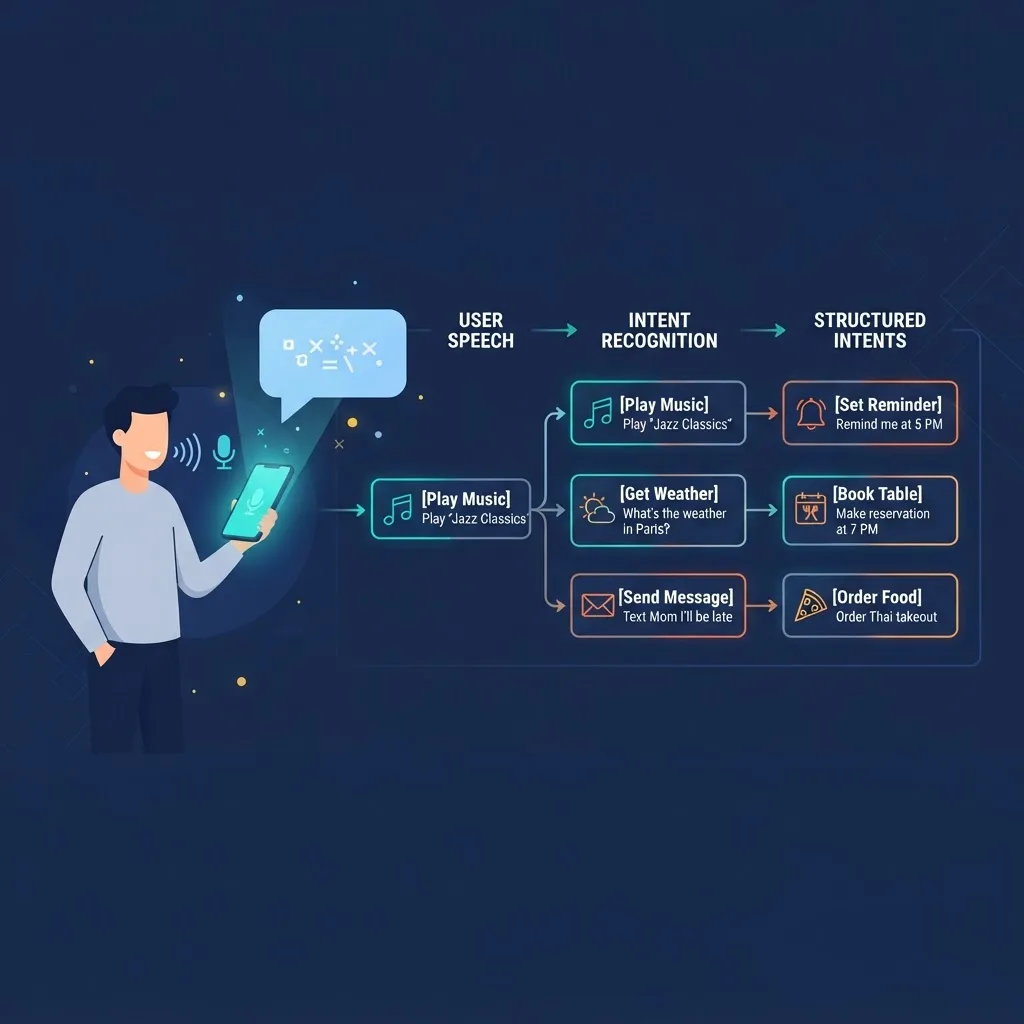
Quick Answer: In artificial intelligence, an intent is the goal or purpose behind a user's input. It is the machine-readable label that tells an AI system what the user wants to do, such as booking a flight, checking weather, or resetting a password, so the system can respond with the correct action.
What Is an Intent in Artificial Intelligence?
An intent is the underlying goal a user is trying to accomplish when they interact with an AI system. Instead of reacting to raw words, the AI maps the input to a predefined category of purpose. For example, the phrases "book me a table for two," "I need a reservation tonight," and "can I get a table at 8" all share one intent: make a reservation.
Think of an intent as the answer to the question: what does this person actually want? The exact wording changes from user to user, but the goal stays the same. This is why intent recognition is far more powerful than simple keyword matching. Keyword systems break the moment someone phrases a request differently, while intent-based systems generalize across countless variations.
Intents matter because human language is messy. According to research summarized by IBM, unstructured data, including free-form text and speech, makes up roughly 80% to 90% of all data generated. Intent classification is how AI turns that chaos into structured, actionable meaning.
How AI Intent Recognition Works
AI intent recognition works by converting human language into numerical representations, then predicting which goal category best matches the input. It is a pipeline, not a single step, and each stage refines the machine's understanding.
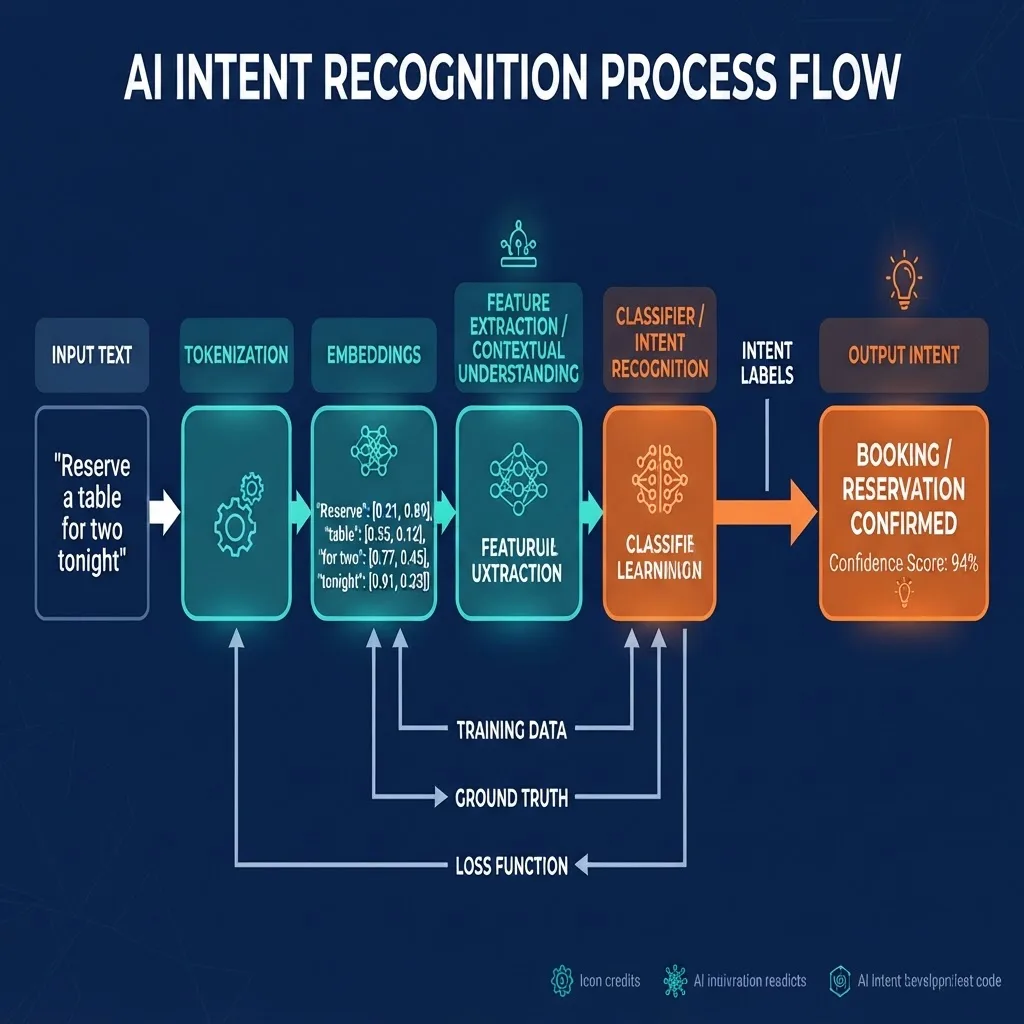
Here is the typical flow:
- Input capture: The system receives text or transcribed speech, for example "turn off the living room lights."
- Preprocessing: Text is cleaned and tokenized, breaking the sentence into smaller units the model can process.
- Embedding: Words and phrases are converted into vectors, numerical representations that capture meaning, so "lights off" and "turn off the lights" sit close together in mathematical space.
- Classification: A trained model scores the input against every known intent and assigns probabilities to each.
- Decision and action: The highest-confidence intent is selected, and the system triggers the matching response or workflow.
The critical insight from real deployments is the confidence threshold. A well-designed system does not blindly accept the top result. If the model is only 40% sure, a good design asks a clarifying question rather than guessing, which dramatically reduces frustrating errors.
Intent Classification in Natural Language Processing
Intent classification is the natural language processing (NLP) task of assigning a user's input to one of several predefined intent categories. It is essentially a supervised learning problem: the model learns from labeled examples and then predicts labels for new, unseen inputs.
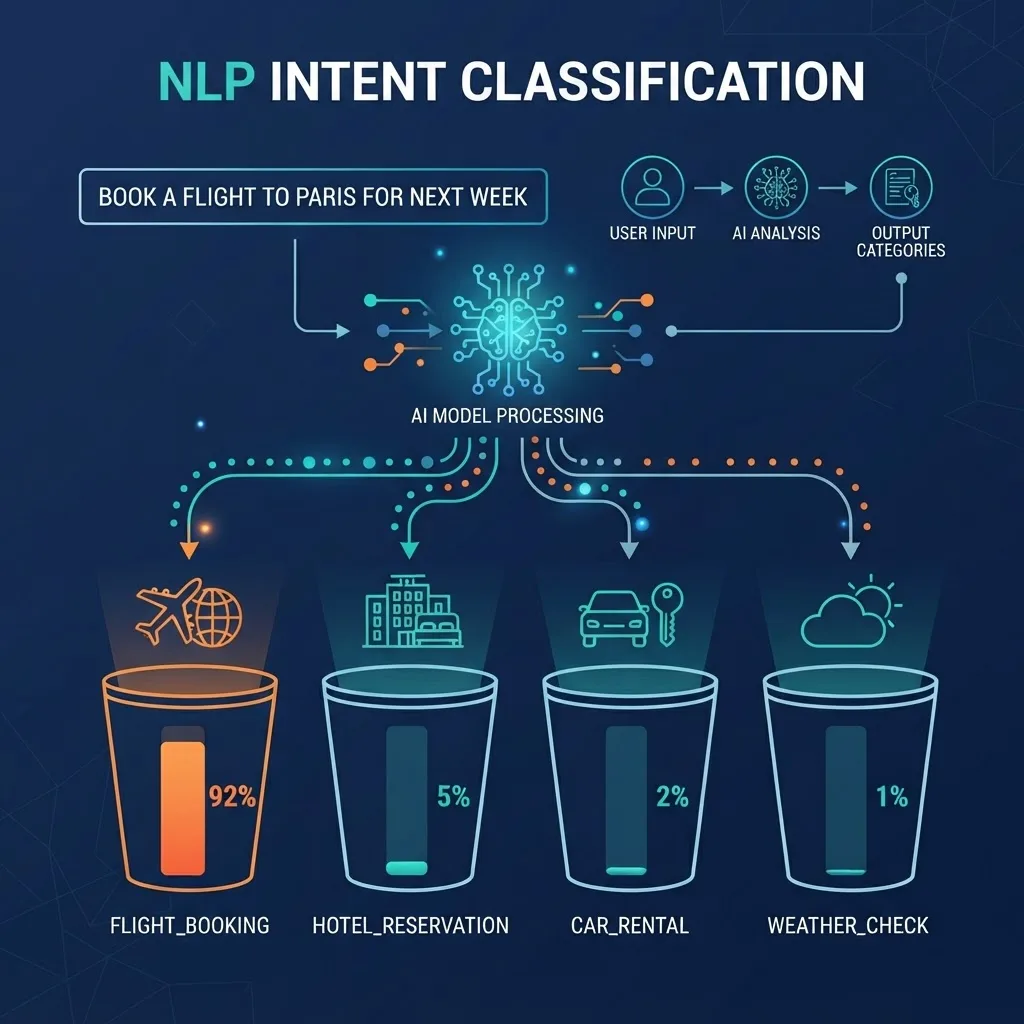
Modern classification relies on transformer-based language models. These models read the full context of a sentence rather than isolated words, which is why they handle nuance so well. For instance, "I want to close my account" and "how do I open an account" contain overlapping words but represent opposite intents. Context-aware models catch that difference reliably.
A key term worth defining here is utterance: an utterance is a single example phrase a user might say to express an intent. The more varied and realistic your utterances, the better your model generalizes. In practice, we have found that quality and diversity of training utterances matter more than sheer volume. Fifty thoughtfully varied examples often outperform five hundred near-duplicates. If you want expert help building this kind of system, our artificial intelligence services team designs and trains custom intent models for real business use cases.
Intents vs Entities: What Is the Difference?
Intents and entities work together, but they answer different questions. The intent is what the user wants to do, while the entity is the specific detail needed to complete that action. Confusing the two is one of the most common early mistakes in conversational AI design.
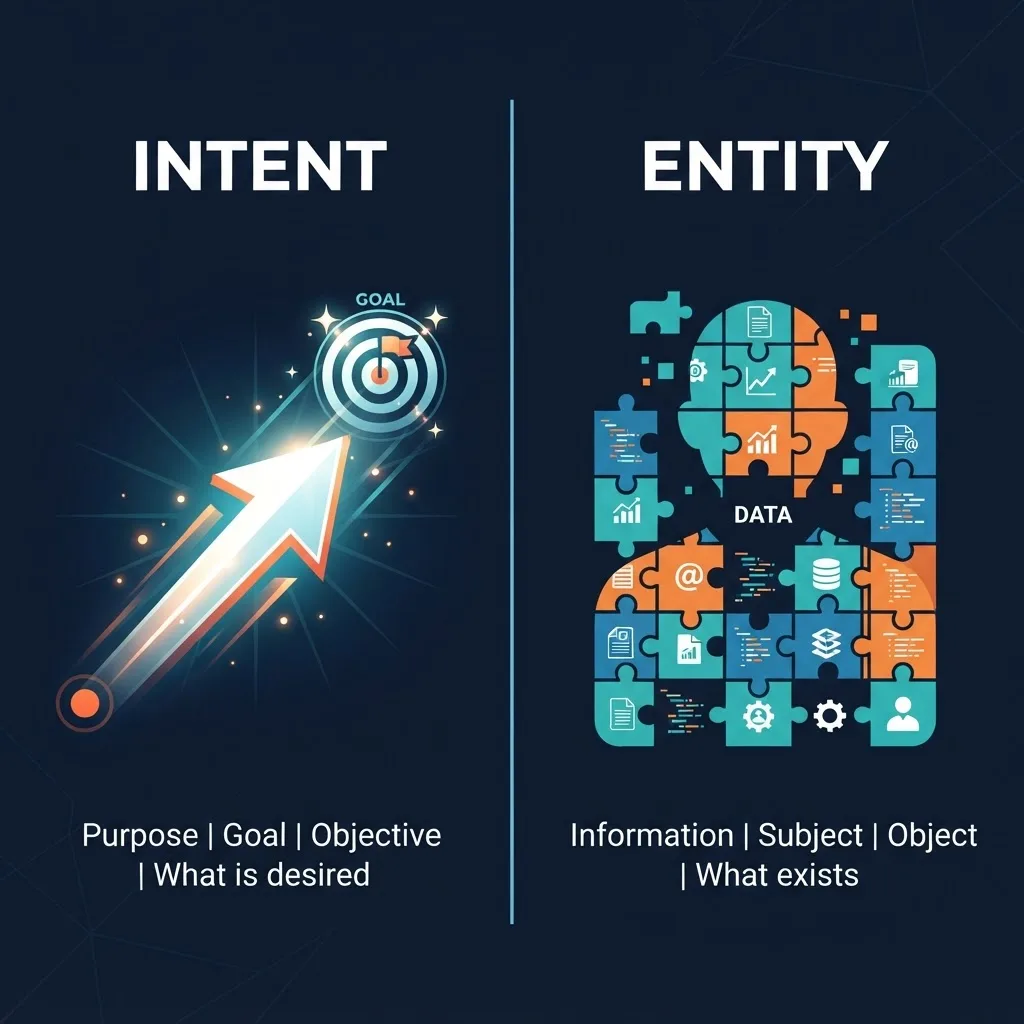
Consider the sentence: "Book a flight from New York to Paris on Friday." The intent is book flight. The entities are the departure city (New York), destination (Paris), and date (Friday). The intent chooses the action; the entities fill in the blanks.
| Aspect | Intent | Entity |
|---|---|---|
| Question answered | What does the user want? | Which details are involved? |
| Example | Book flight | New York, Paris, Friday |
| Role | Chooses the action | Fills the parameters |
| Count per sentence | Usually one | Zero, one, or many |
| Analogy | The verb of the request | The nouns and values |
Understanding this split makes systems far easier to build and debug. When a chatbot fails, it is usually either misreading the intent or missing an entity, and knowing which one saves hours of troubleshooting.
How Chatbots Detect Intent
Chatbots detect intent by passing every incoming message through a trained NLP model that returns the most likely goal along with a confidence score. This happens in milliseconds, which is why modern assistants feel instant.
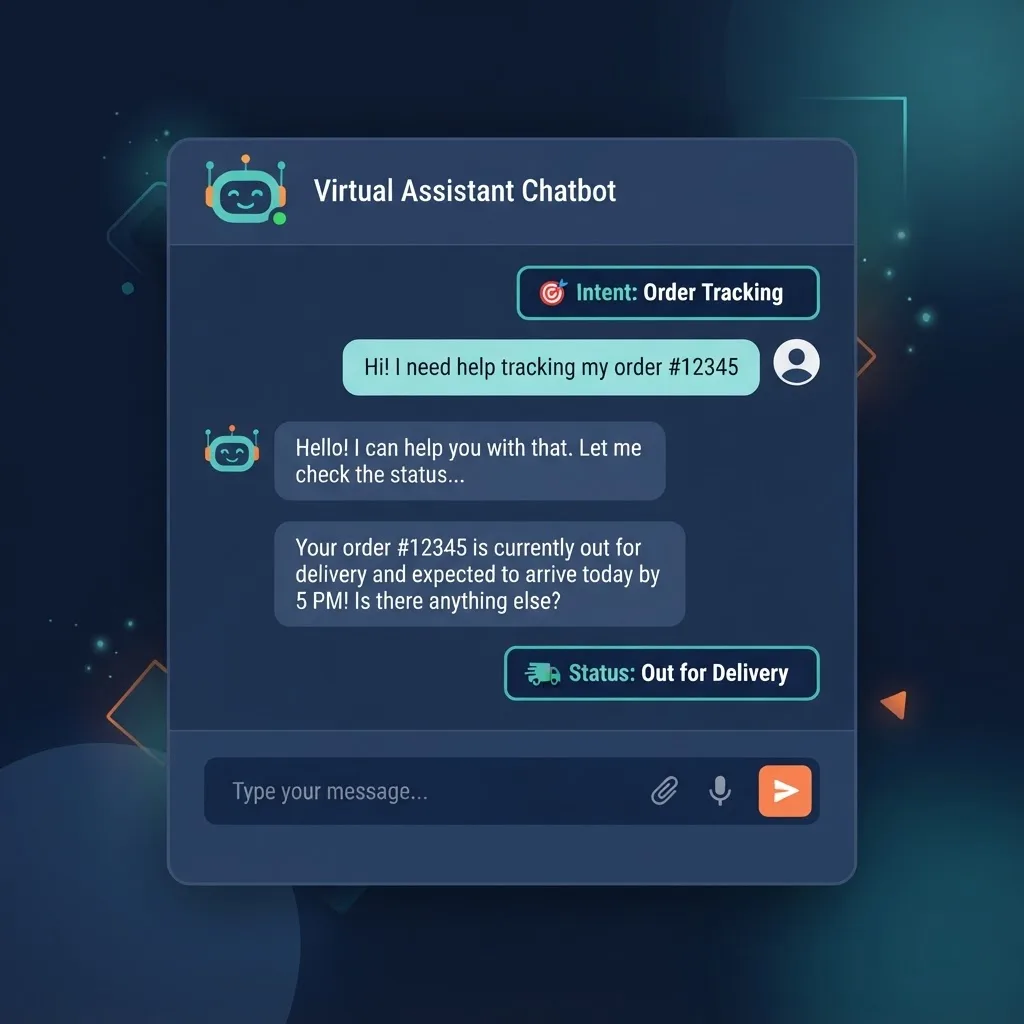
When a user types "my payment failed, help," the chatbot does not search for those exact words. It recognizes the intent as billing issue and routes the conversation accordingly, perhaps offering troubleshooting steps or connecting a human agent. According to Gartner, chatbots and virtual assistants are on track to become a primary customer service channel for a growing share of organizations, precisely because intent detection now handles routine requests without human involvement.
The difference between a helpful bot and an infuriating one almost always comes down to intent coverage. A common failure we see is the "fallback loop," where the bot keeps replying "I did not understand" because it lacks an intent for a common request. The fix is not a smarter model; it is expanding the intent catalog to match how real customers actually speak.
How to Train an AI Intent Model
Training an intent model is a repeatable, structured process. You do not need to reinvent it for every project, but you do need discipline at each step.
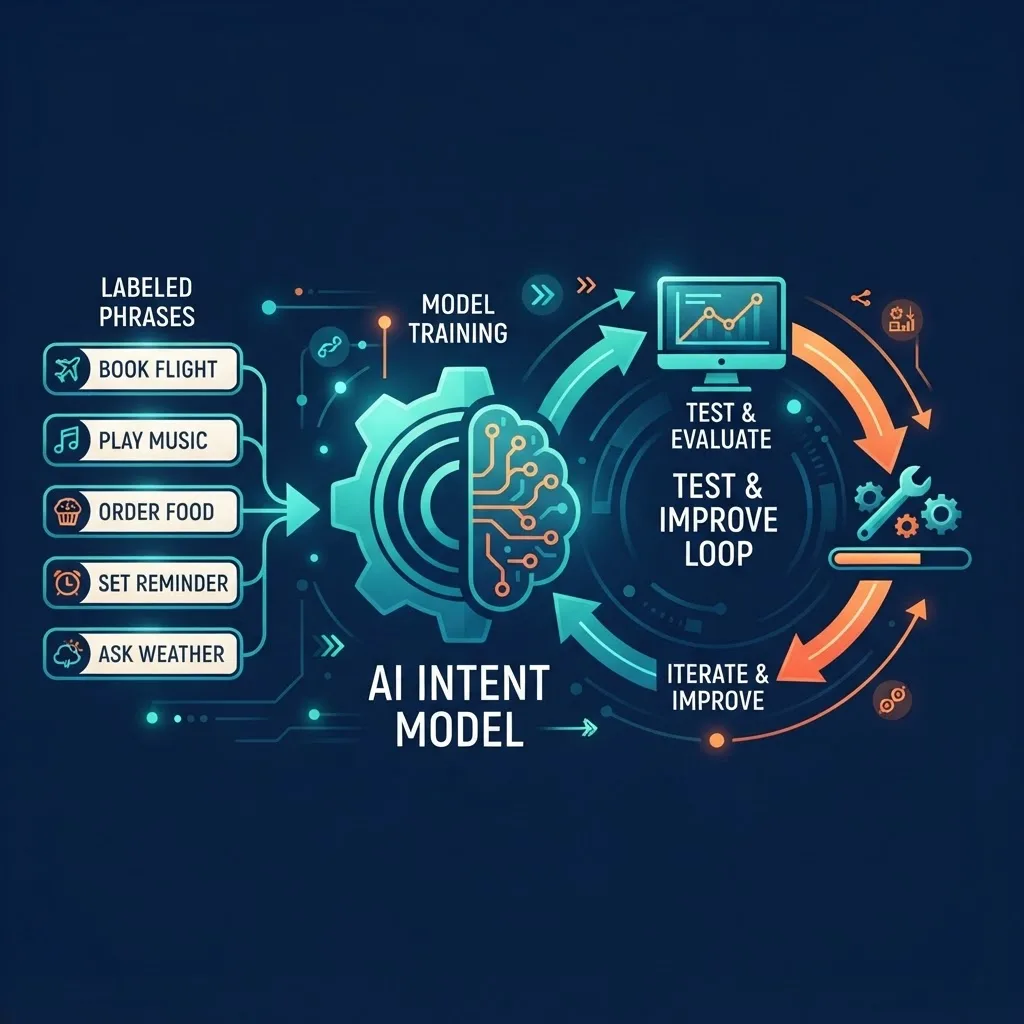
Follow these steps:
- Define your intents: List every distinct goal your users have. Keep them specific but not overlapping.
- Collect real utterances: Gather genuine examples from chat logs, support tickets, and search queries. Real language beats invented phrases.
- Label the data: Tag each utterance with its correct intent and mark any entities.
- Train the model: Feed the labeled data into your NLP framework so it learns the patterns.
- Test with unseen inputs: Evaluate accuracy on phrases the model never saw during training.
- Monitor and refine: Review misclassifications in production and add new examples to close the gaps.
The last step is where most teams underinvest. Intent models are living systems, not one-time builds. Language, products, and customer needs shift, so a model that was 95% accurate at launch will drift without ongoing maintenance. Teams that schedule monthly review cycles consistently outperform those that treat training as a finished task.
Real-World Applications of AI Intent Detection
Intent detection powers many everyday tools, often invisibly. Once you understand the concept, you start noticing it everywhere.
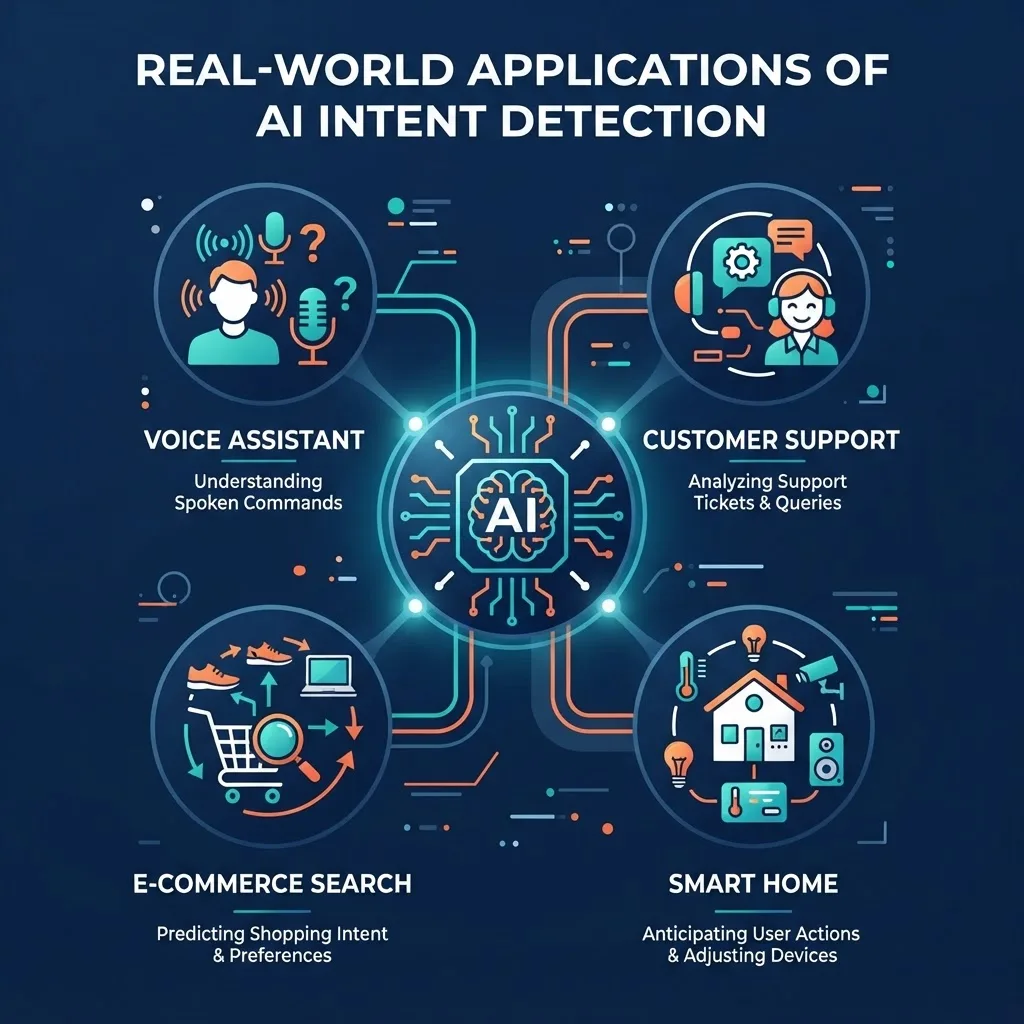
- Voice assistants: Alexa, Siri, and Google Assistant map spoken commands to intents like play music, set timer, or get directions.
- Customer support: Help desks route tickets automatically by detecting whether a message is a refund request, technical issue, or general question.
- E-commerce search: Search bars interpret "cheap waterproof running shoes" as a filtered product intent rather than a literal string match.
- Smart home devices: Thermostats and lighting systems act on intents like adjust temperature or turn off lights.
- Healthcare triage bots: Symptom checkers classify patient descriptions into intents that guide next steps.
Businesses adopting these systems report measurable gains in response speed and lower support costs, because routine intents get resolved without a human touching them. If you are exploring how to bring this capability into your own product, WebPeak offers dedicated AI services that cover intent design, model training, and deployment end to end.
Key Takeaways
- An intent in artificial intelligence is the goal or purpose behind a user's input, expressed as a machine-readable label.
- Intent recognition uses embeddings and classification to map varied phrasing to a single goal, far surpassing keyword matching.
- Intents answer what the user wants; entities provide the specific details needed to act.
- Unstructured text and speech make up an estimated 80% to 90% of generated data, which makes intent classification essential.
- Intent models require ongoing monitoring and retraining because language and user needs change over time.
Frequently Asked Questions (FAQ)
What is an intent in artificial intelligence?
An intent is the goal behind a user's input, the thing they are trying to accomplish. AI systems map different phrasings to one intent label, such as book flight or check balance, so they can trigger the correct response or action instead of matching literal keywords.
What is the difference between intent and entity?
An intent is what the user wants to do, while an entity is a specific detail needed to complete that action. In "book a flight to Paris," the intent is book flight and Paris is the destination entity. Intents choose the action; entities fill in the parameters.
How does a chatbot know what I mean?
A chatbot passes your message through a trained NLP model that predicts the most likely intent plus a confidence score in milliseconds. It recognizes your goal from patterns learned during training, then routes your request accordingly rather than reacting to exact words.
How many training examples does an intent need?
There is no fixed number, but quality and variety matter more than volume. In practice, a few dozen realistic, diverse example phrases per intent often outperform hundreds of near-duplicate sentences, because the model learns to generalize across how real users actually speak.
Why does intent recognition sometimes fail?
Intent recognition usually fails for two reasons: the request uses phrasing not covered in training data, or two intents overlap and confuse the model. The fix is expanding your intent catalog and adding real user utterances, then retraining and monitoring results continuously.
Final Thoughts
Understanding the intents definition in artificial intelligence is the foundation for building genuinely useful AI tools. Intent recognition turns messy human language into clear, actionable goals, and it powers everything from voice assistants to support bots. Master intents, keep your models trained on real language, and your AI will feel less like a machine and more like a helpful assistant. To build intent-driven systems the right way, explore the teams at ZoneTechify and WebPeak.