
A practical, expert breakdown of Francesco Sapio's Hands-On Artificial Intelligence with Unreal Engine, covering behavior trees, navigation, EQS, perception, and crowd AI.
Francesco Sapio Hands on Artificial Intelligence with Unreal Engine
Game AI decides whether players feel challenged or bored, immersed or frustrated. That is exactly why Hands-On Artificial Intelligence with Unreal Engine by Francesco Sapio remains one of the most referenced practical guides for building believable non-player characters (NPCs) inside Unreal Engine. This article breaks down what the book actually teaches, who it is for, and how its lessons apply to modern game development in 2026.
After years of building interactive experiences and reviewing game AI tooling, I have found that most developers do not struggle with the theory of artificial intelligence, they struggle with implementation. Sapio's book closes that gap by pairing clear explanations with real Unreal Engine systems you can build immediately.

Quick Answer: Hands-On Artificial Intelligence with Unreal Engine by Francesco Sapio is a practical guide teaching how to build game AI using behavior trees, navigation meshes, the Environment Query System, AI perception, and crowd behavior in Unreal Engine. It suits developers who want applied, project-based AI skills rather than pure theory.
Who Is Francesco Sapio?
Francesco Sapio is an Italian game developer, author, and educator with a strong academic background in computer science and engineering. He has written multiple technical books on Unreal Engine and Unity, and he is widely recognized in the game development community for explaining complex systems in an approachable, hands-on way.
His credibility matters here because game AI is a field full of shortcuts and misinformation. Sapio grounds his teaching in the actual tools shipped inside Unreal Engine rather than fragile custom hacks, which is why studios and solo developers alike trust his material as a reliable starting point.
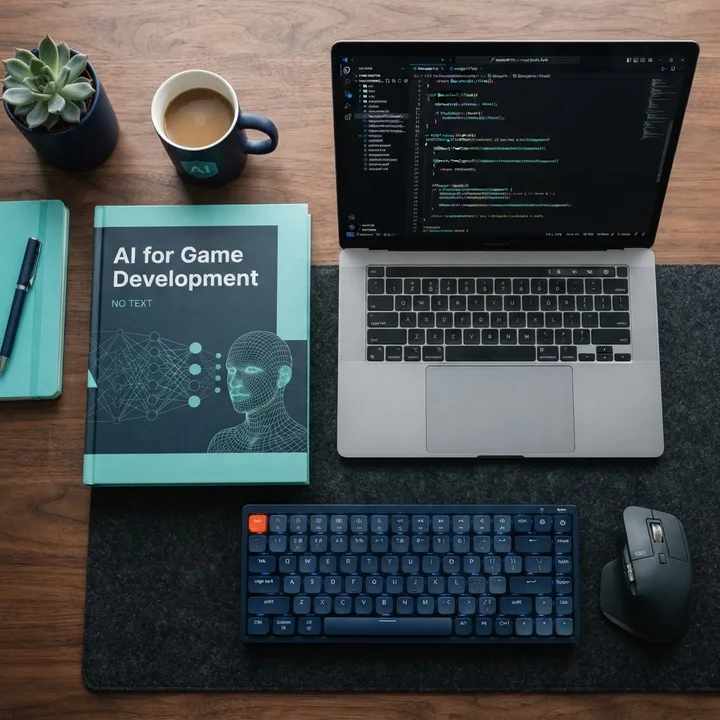
What Does the Book Cover?
The book is structured as a progressive project. Rather than dumping isolated concepts, it builds a functioning AI system step by step. Key topics include:
- Behavior Trees for decision-making
- Navigation and pathfinding using NavMesh
- The Environment Query System (EQS) for spatial reasoning
- AI Perception for sight, hearing, and awareness
- Crowd simulation and group behavior
- Debugging tools for diagnosing AI logic
This progression mirrors how professional teams actually build AI: start with a decision framework, give agents the ability to move, then layer perception and refinement on top.
Behavior Trees: The Brain of Your NPCs
A behavior tree is a hierarchical model that controls how an AI agent chooses actions based on conditions in the game world. In Unreal Engine, behavior trees work alongside a Blackboard, which acts as the AI's memory, storing values like target location, health, or alert state.
Sapio's treatment of behavior trees is one of the strongest parts of the book. He explains selectors, sequences, decorators, and services clearly, then shows how to wire them into a Blackboard so decisions stay data-driven. In my experience, this data-driven approach is what separates maintainable AI from spaghetti logic that breaks the moment you add a new enemy type.
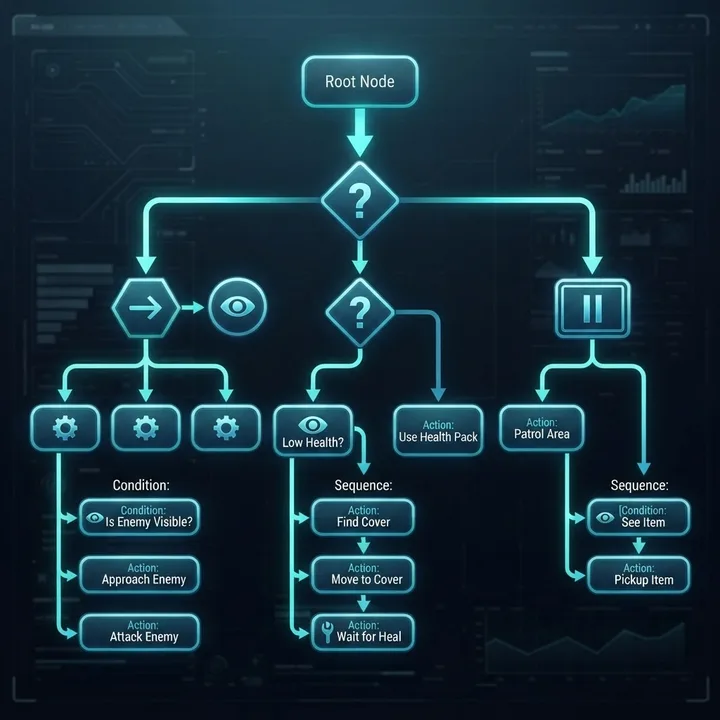
The practical takeaway is simple: keep your behavior trees shallow and readable, and push complexity into services and the Blackboard. This keeps designers able to tweak AI without touching code.
Navigation and Pathfinding
Navigation determines how AI agents move intelligently through a level while avoiding obstacles. Unreal Engine uses a Navigation Mesh (NavMesh), a simplified walkable surface generated over your geometry, combined with recast-based pathfinding.
Sapio walks readers through generating a NavMesh, tuning agent radius and step height, and handling dynamic obstacles. He also covers Nav Links, which let agents jump gaps or climb ledges, features that many tutorials skip entirely.
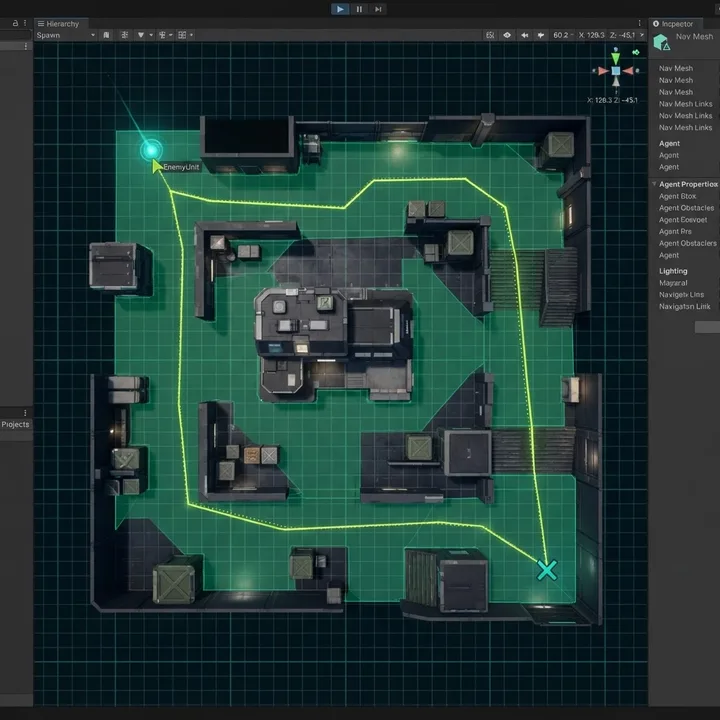
A common real-world issue is agents getting stuck at doorways or on uneven terrain. The book addresses this directly by teaching how to adjust NavMesh resolution and use runtime navigation updates, which saves hours of frustrating debugging on production projects.
The Environment Query System (EQS)
The Environment Query System is an Unreal Engine tool that lets AI evaluate the world spatially and pick the best location based on scoring rules. Instead of hardcoding where an enemy should take cover, EQS scores nearby points against tests like distance, line of sight, and proximity to the player.
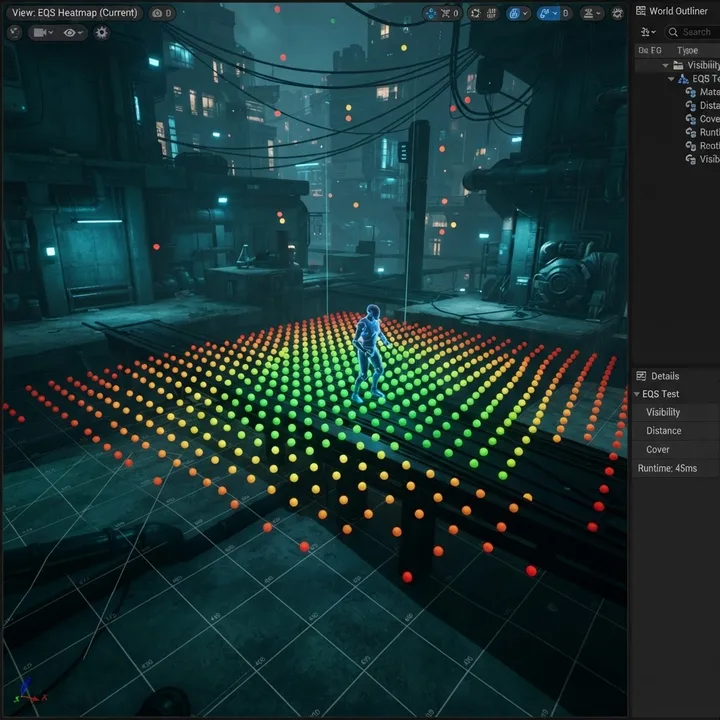
This is where Sapio's book shifts from basic to genuinely advanced. EQS is underused because it looks intimidating, yet it is the difference between an enemy that blindly rushes you and one that flanks, finds cover, and feels intelligent. The book demystifies generators, tests, and scoring, giving you a repeatable pattern for tactical AI decisions.
AI Perception: Making Agents Aware
AI Perception gives agents senses such as sight, hearing, and damage detection so they can react to the player and environment. Unreal Engine's AIPerception component handles this through configurable senses with adjustable range, angle, and forgetting time.
Sapio demonstrates how to connect perception events to the Blackboard, so a sound or a glimpse of the player updates the behavior tree instantly. He also explains stimuli sources, the objects that AI can actually perceive, which is a detail beginners routinely miss.
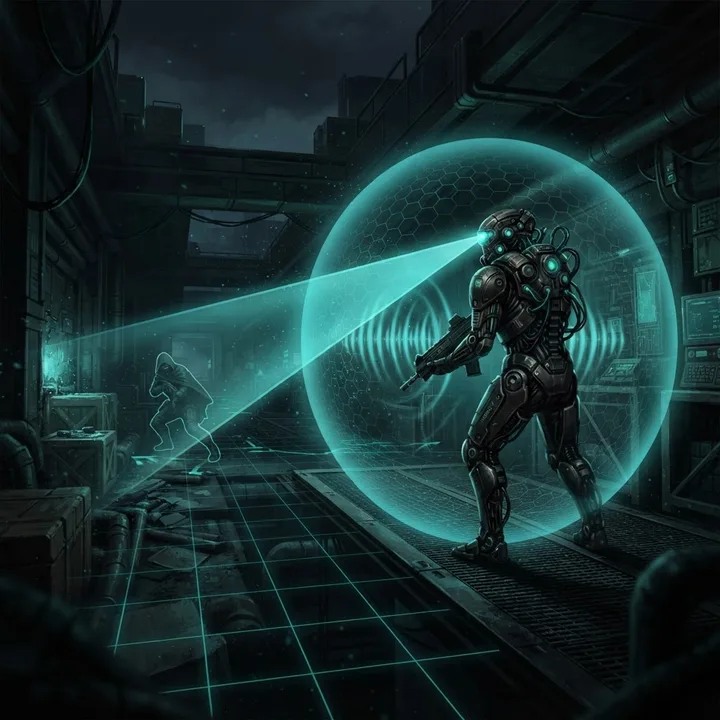
The expert insight here is tuning. Perception that is too sharp makes enemies feel unfair, while perception that is too dull makes them feel dumb. The book encourages iterative playtesting to find that balance, a principle that applies to every AI system you ship.
Crowd Simulation and Group Behavior
Crowd simulation manages many AI agents at once so they move naturally without colliding or clumping. Unreal Engine offers detour crowd avoidance and RVO (Reciprocal Velocity Obstacles) to keep groups fluid.
Sapio covers how to scale AI from a single enemy to dozens of agents while maintaining performance. This section is valuable because crowd behavior exposes performance bottlenecks fast, and the book offers concrete guidance on avoidance settings and agent grouping.

Debugging and Diagnosing AI
The final major strength is debugging. Unreal Engine ships a Gameplay Debugger that visualizes behavior tree states, Blackboard values, perception, and navigation in real time. Sapio teaches readers to actually use these tools instead of guessing.
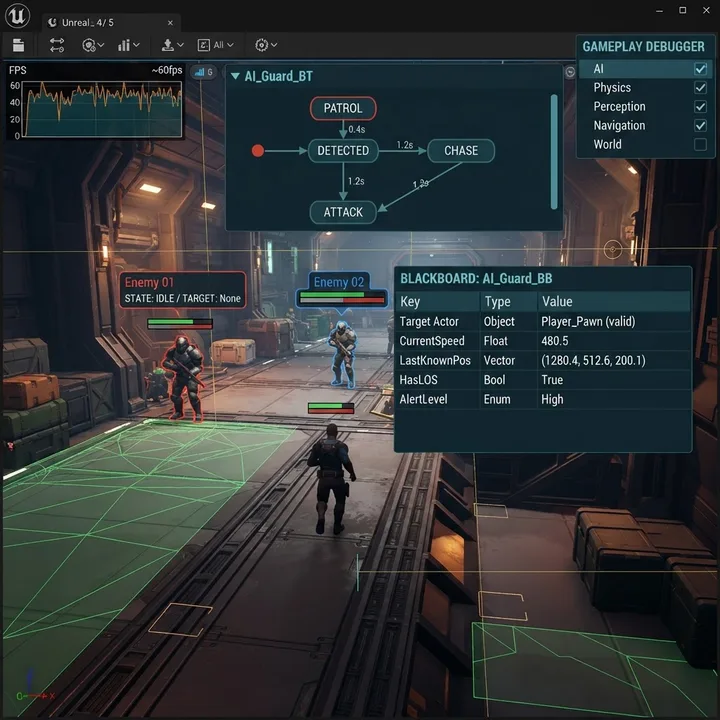
In practice, mastering the Gameplay Debugger is the single highest-leverage skill for game AI work. It turns invisible logic into something you can observe and correct, dramatically shortening iteration time.
Book vs. Official Documentation: A Comparison
Many developers ask whether they should buy the book or just read Epic's documentation. Both have value, but they serve different purposes.
| Factor | Sapio's Book | Official Docs |
|---|---|---|
| Learning path | Guided, project-based | Reference-based |
| Best for beginners | Yes | Partial |
| Depth on EQS | High | Medium |
| Up-to-date engine features | Depends on edition | Always current |
| Practical examples | Many | Fewer |
| Cost | Paid | Free |
The honest recommendation: use the book to build a mental model and a working project, then rely on the official documentation to stay current with the latest engine version. If you are building AI-driven products commercially, expert artificial intelligence services can accelerate implementation beyond what any single book covers.
Is the Book Still Relevant in 2026?
Unreal Engine has evolved significantly, and later versions introduced systems like State Trees and Mass AI for large-scale simulation. However, the fundamentals Sapio teaches, behavior trees, navigation, EQS, and perception, remain core to Unreal Engine AI. Concepts transfer even as the interface changes.
According to Epic Games, Unreal Engine powers a large share of AAA and indie titles, and the demand for competent game AI developers continues to grow. Learning these foundations is a durable investment, not a passing trend.
Key Takeaways
- Hands-On Artificial Intelligence with Unreal Engine by Francesco Sapio is a practical, project-based guide to Unreal Engine game AI.
- Behavior trees paired with a Blackboard form the decision-making core of NPC logic.
- The Environment Query System (EQS) enables tactical, spatial AI decisions like cover and flanking.
- AI Perception adds sight and hearing, while crowd systems handle group movement.
- The Gameplay Debugger is the fastest way to diagnose and fix AI behavior.
- Core concepts remain relevant in 2026 even as State Trees and Mass AI expand the toolset.
Frequently Asked Questions (FAQ)
Who should read Hands-On Artificial Intelligence with Unreal Engine?
The book suits intermediate developers who already know basic Unreal Engine navigation and Blueprints and want to build real game AI. Beginners can follow along, but some prior familiarity with the editor makes the behavior tree and EQS chapters far easier to absorb and apply.
Does the book require C++ or only Blueprints?
The book covers both approaches, but many core AI systems in Unreal Engine, including behavior trees and EQS, are built visually. You can complete most concepts with Blueprints, while C++ knowledge helps you extend and optimize AI logic for larger, performance-sensitive production projects.
Is Francesco Sapio's Unreal Engine AI book still useful today?
Yes. While newer Unreal Engine versions added State Trees and Mass AI, the fundamentals of behavior trees, navigation, perception, and EQS remain essential. The book builds transferable mental models that continue to apply, even if certain menus or interfaces have changed across engine updates.
What is the Environment Query System in Unreal Engine?
The Environment Query System (EQS) lets AI evaluate the game world spatially and choose the best position based on scoring tests like distance, cover, and line of sight. It powers intelligent behaviors such as flanking, hiding, and tactical positioning that make enemies feel genuinely smart.
Can I build commercial game AI after reading this book?
Yes, the book gives you a solid, production-ready foundation for building believable NPCs. For complex, large-scale, or AI-driven commercial products, teams often combine these skills with specialized expertise. You can learn more about applied solutions at ZoneTechify and WebPeak.
Final Thoughts
Francesco Sapio's Hands-On Artificial Intelligence with Unreal Engine remains a trustworthy, hands-on entry point into game AI. It teaches the systems that actually ship in real games, behavior trees, navigation, EQS, perception, crowds, and debugging, in a logical order that builds genuine competence. Pair it with the current official documentation, practice inside the editor, and you will develop AI that makes your games feel alive.