A clear, expert breakdown of the latest federal AI policy news, key regulations, agency actions, and what U.S. businesses must do to stay compliant.
Federal AI Policy News
Federal AI policy is moving faster than almost any other area of U.S. technology regulation. In the span of a few years, artificial intelligence went from a niche research topic to a headline priority for the White House, Congress, and nearly every federal agency. If you run a business, build software, or simply want to understand where the rules are heading, keeping up with federal AI policy news is no longer optional.
This guide breaks down what has actually happened, what it means in practice, and how to prepare. We focus on verifiable actions, dates, and agency decisions rather than speculation, so you can make informed choices instead of reacting to hype. For teams that want hands-on help turning policy into practice, ZoneTechify and WebPeak both work with organizations navigating AI adoption and compliance.
Quick Answer: Federal AI policy news covers U.S. government actions shaping artificial intelligence, including executive orders, agency rules, and safety standards. The current focus is on innovation, national security, transparency, and risk management, with agencies like NIST and OMB leading implementation across the federal government.

What Does Federal AI Policy Actually Mean?
Federal AI policy refers to the collection of executive orders, laws, agency rules, and voluntary frameworks the U.S. government uses to guide how artificial intelligence is developed and deployed. Unlike the European Union, the United States does not yet have a single, comprehensive AI law. Instead, it relies on a patchwork of directives, sector-specific rules, and standards.
This distinction matters. Because there is no single statute, compliance obligations depend heavily on your industry, whether you sell to the government, and how your AI system is used. A healthcare chatbot and a hiring algorithm face very different scrutiny, even though both are "AI."
Understanding this fragmented structure is the first step to reading federal AI policy news accurately. When a new announcement appears, the key question is always: which agency issued it, and who does it bind?
The Executive Orders That Shaped the Landscape
Executive orders have been the single biggest driver of federal AI direction. In October 2023, the White House issued Executive Order 14110 on the "Safe, Secure, and Trustworthy Development and Use of Artificial Intelligence." It directed agencies to set safety testing expectations, address AI bias, and protect privacy, and it became the foundation for dozens of follow-on actions.
In January 2025, that order was rescinded and replaced with a new executive order focused on removing barriers to American leadership in AI. The shift signaled a stronger emphasis on innovation, competitiveness, and reducing regulatory friction, while retaining attention on national security risks.
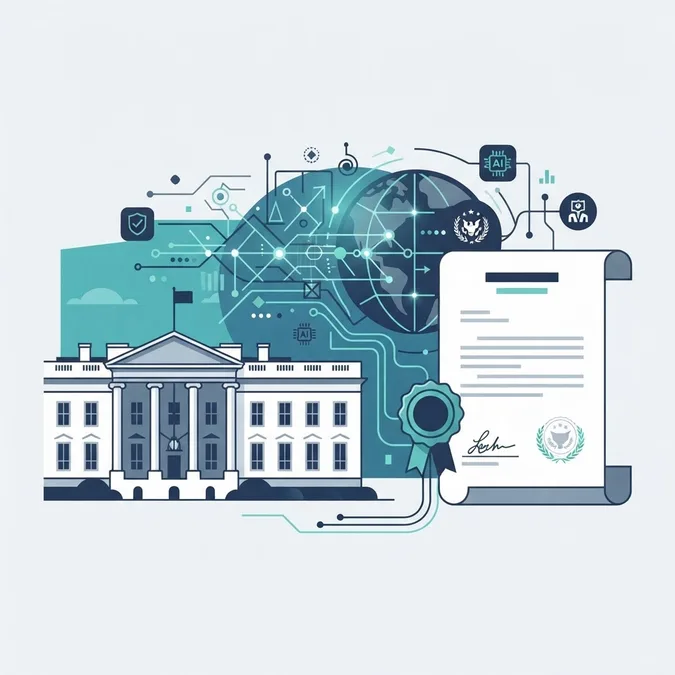
The practical takeaway for readers is that executive orders can change quickly with each administration. Building your AI strategy on durable fundamentals, such as strong data governance and clear documentation, protects you regardless of which order is in force.
Which Federal Agencies Are Driving AI Rules?
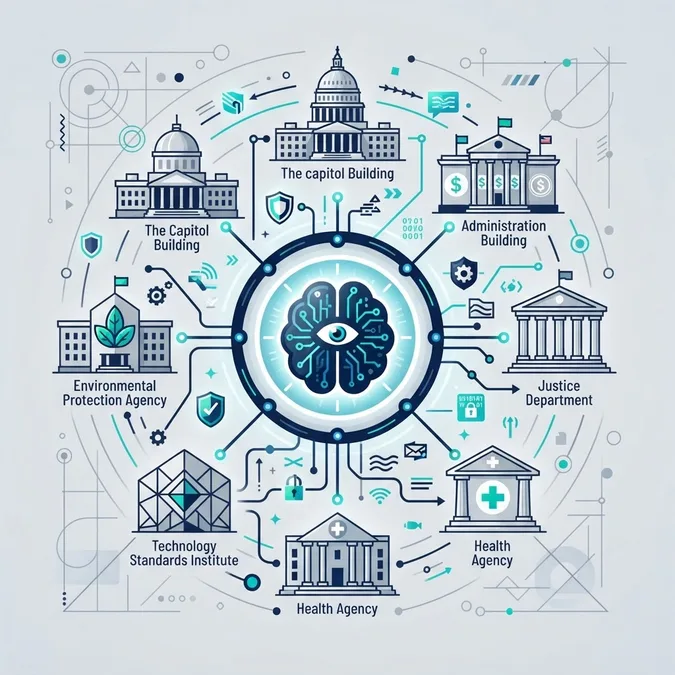
Several agencies now share responsibility for AI oversight, and knowing their roles helps you interpret the news correctly.
- NIST (National Institute of Standards and Technology): Publishes the AI Risk Management Framework, the de facto standard for identifying and reducing AI risk. It is voluntary but widely referenced.
- OMB (Office of Management and Budget): Sets rules for how federal agencies buy and use AI. Its memo M-24-10 required agencies to appoint Chief AI Officers and inventory their AI systems.
- FTC (Federal Trade Commission): Enforces against deceptive or unfair AI practices, including misleading claims and biased outcomes.
- Copyright Office and USPTO: Address AI and intellectual property questions, such as whether AI-generated work can be protected.
According to Stanford University's AI Index, U.S. federal agencies introduced 59 AI-related regulations in 2023, more than double the count from the previous year. That pace tells you oversight is expanding across the entire government, not concentrated in one office.
Key Data Points You Should Know
Numbers give federal AI policy news context. Two figures stand out for anyone tracking the field.
First, according to Stanford's AI Index, the number of federal AI regulations rose sharply year over year, reflecting a government-wide response rather than a single initiative. Second, the number of AI-related bills mentioned at the state and federal legislative level has climbed steadily, showing lawmakers are treating AI as a permanent policy category.
The insight here is simple: regulation is trending upward and diversifying. Even if a specific executive order is repealed, the underlying momentum toward accountability, transparency, and safety standards continues across agencies and legislatures.
A Simple Timeline of Federal AI Milestones
A short timeline makes the trajectory easier to follow.
- January 2023 — NIST releases the AI Risk Management Framework, giving organizations a structured way to assess AI risk.
- October 2023 — Executive Order 14110 establishes broad safety, privacy, and civil-rights expectations.
- March 2024 — OMB issues M-24-10, requiring federal agencies to govern their own AI use.
- January 2025 — A new executive order replaces 14110, prioritizing innovation and U.S. AI leadership.
- 2025 onward — Agencies continue publishing sector guidance, procurement rules, and safety expectations.
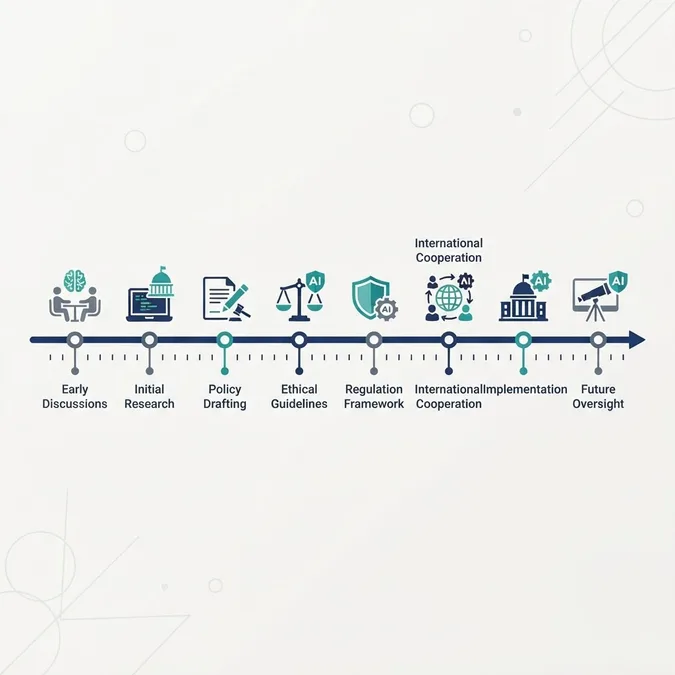
The pattern is clear: standards first, sweeping executive action second, then agency-level implementation. Expect future milestones to follow a similar rhythm of framework, directive, and enforcement.
How Federal AI Policy Compares to Other Approaches
Comparing the U.S. approach with alternatives clarifies what makes it distinctive.
| Feature | U.S. Federal Approach | EU AI Act | Voluntary Frameworks |
|---|---|---|---|
| Single unified law | No | Yes | No |
| Legally binding | Partially | Yes | No |
| Risk-based tiers | Emerging | Yes | Yes |
| Speed to change | Fast (executive orders) | Slow | Fast |
| Primary focus | Innovation and security | Consumer protection | Best practices |
The U.S. model favors flexibility and speed, which helps innovation but creates uncertainty for businesses that want clear, stable rules. The EU model offers predictability at the cost of agility. Most global companies end up aligning to the strictest standard they face, then applying it everywhere.
What This Means for Businesses
For most organizations, the practical impact of federal AI policy shows up in three areas: procurement, documentation, and risk management. If you sell AI tools to the federal government, expect requirements around transparency, testing, and inventory reporting. If you use AI internally, expect growing pressure to document how systems make decisions.

The smartest move is to adopt the NIST AI Risk Management Framework now, even though it is voluntary. It maps closely to where most federal rules are heading, so early adoption reduces future rework. Businesses that want structured support can explore professional artificial intelligence services from ZoneTechify or WebPeak's AI services to build governance into their systems from the start.
Start with an AI inventory: list every system that uses AI, what data it touches, and who is accountable for it. That single step satisfies the spirit of most federal requirements and gives leadership real visibility.
AI Safety Standards and Testing
Safety standards are the connective tissue of federal AI policy. Rather than banning technologies outright, U.S. policy leans on testing, red-teaming, and documentation to manage risk. NIST's frameworks encourage organizations to evaluate models for reliability, security, and bias before deployment.
For high-impact uses, such as systems affecting employment, credit, or healthcare, expect the strongest scrutiny. The defining principle is proportionality: the higher the potential harm, the more rigorous the testing and oversight should be. Treat safety testing as a product requirement, not a legal afterthought.
The Future Outlook for Federal AI Policy
Federal AI policy will keep evolving, but the direction is becoming predictable. Expect continued emphasis on national security, domestic AI leadership, transparency for consumers, and standards-driven safety. Bipartisan interest in child safety, deepfakes, and election integrity suggests targeted laws may arrive even without a single comprehensive statute.
The organizations that thrive will treat policy as a design input, not a compliance burden. By building transparency and risk management into products early, you stay ready no matter how the rules shift.
Key Takeaways
- The U.S. has no single AI law; it relies on executive orders, agency rules, and voluntary frameworks.
- NIST and OMB are the most influential agencies for practical AI governance.
- Executive Order 14110 (2023) was replaced in January 2025 by an innovation-focused order.
- Stanford's AI Index reported 59 federal AI regulations in 2023, more than double the prior year.
- Adopting the NIST AI Risk Management Framework now is the best hedge against future rules.
- Safety, transparency, and national security remain the durable themes across administrations.
Frequently Asked Questions (FAQ)
What is federal AI policy in simple terms?
Federal AI policy is the set of U.S. government rules, executive orders, and standards guiding how artificial intelligence is built and used. It is not one single law but a mix of directives from agencies like NIST, OMB, and the FTC, each covering different aspects of AI safety and accountability.
Is there a single federal AI law in the United States?
No, the United States does not have one comprehensive AI law like the EU AI Act. Instead, it uses executive orders, agency-specific rules, and voluntary frameworks. Your exact obligations depend on your industry, how you use AI, and whether you sell products or services to the federal government.
Which agency regulates artificial intelligence federally?
Several agencies share responsibility. NIST sets risk and safety standards, OMB governs federal AI use, and the FTC enforces against deceptive or unfair AI practices. The Copyright Office and USPTO handle intellectual property questions. No single agency controls all AI regulation across the government.
How does federal AI policy affect my business?
It affects procurement, documentation, and risk management. If you sell AI to the government, expect transparency and testing requirements. If you use AI internally, expect pressure to document decisions and inventory systems. Adopting the NIST AI Risk Management Framework early keeps you prepared for evolving rules.
Will federal AI regulations get stricter over time?
Most likely yes, though the form will keep shifting. While specific executive orders change with each administration, the overall trend points toward more oversight, especially around safety, transparency, deepfakes, and national security. Building strong governance now protects your organization regardless of future political changes.
Final Thoughts
Federal AI policy news can feel chaotic, but a clear pattern emerges once you focus on agencies, standards, and durable themes rather than headlines. Adopt proven frameworks, keep an AI inventory, and treat safety as a product feature. Do that, and you will stay ahead of the rules instead of chasing them.