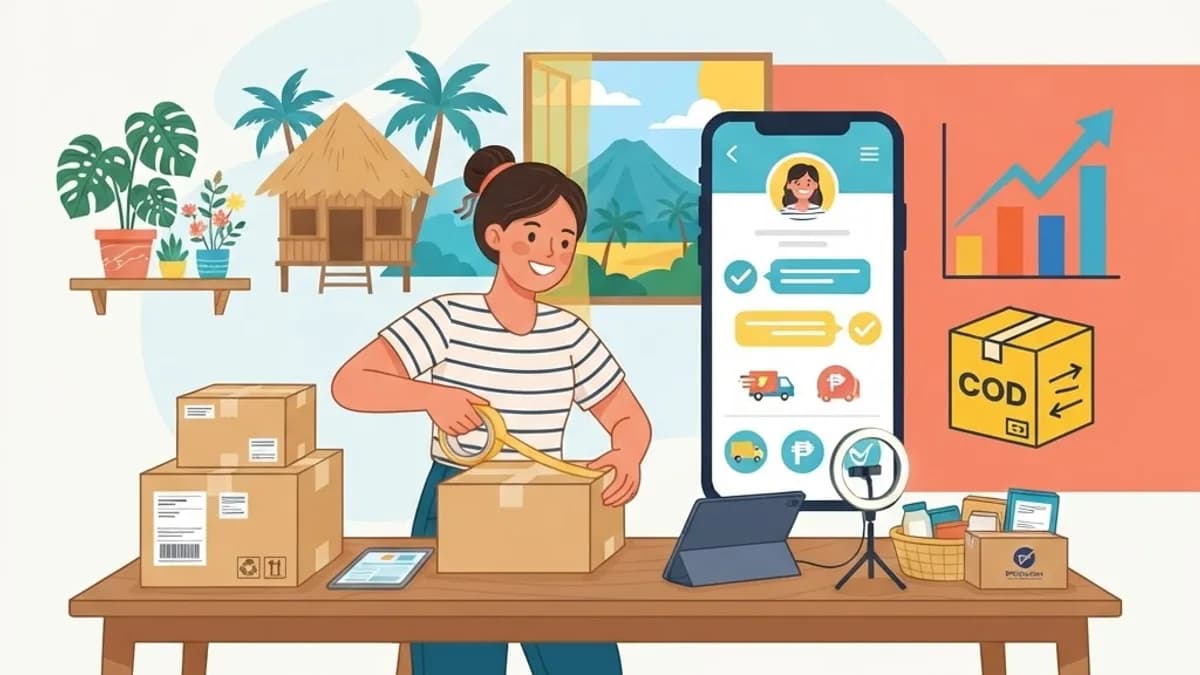
A practical measurement guide to digital marketing effectiveness for local online sellers in the Philippines, covering social commerce, COD economics, and the metrics that matter.
Digital Marketing Effectiveness for Local Online Sellers Philippines
The Philippine online selling market runs on a different engine than the Western ecommerce playbook assumes. Most local sellers do not start with a website. They start with a Facebook page, a Messenger inbox, a TikTok account, and a Shopee or Lazada storefront. Orders arrive as chat messages. Payment happens through GCash, Maya, bank transfer, or cash on delivery. Delivery runs through J and T, Lalamove, Grab, or a local rider. In that environment, measuring digital marketing effectiveness with standard ecommerce dashboards produces numbers that look impressive and mean almost nothing.
This guide explains how local online sellers in the Philippines should actually measure whether their marketing works, which channels convert, and how cash on delivery quietly distorts every performance report a seller reads.
Quick Answer: For local online sellers in the Philippines, digital marketing effectiveness is measured by cost per confirmed and delivered order, not by reach, likes, or add to cart events. Because cash on delivery carries high refusal rates, sellers must track delivered revenue after returns, chat response speed, and repeat buyer rate to know what is truly profitable.
Why Standard Ecommerce Metrics Mislead Filipino Sellers
The core problem is that a large share of Philippine online transactions close inside a chat thread rather than a checkout page. When the sale happens in Messenger, the platform pixel never records a purchase. Ad dashboards then credit conversions to the wrong campaigns, or record no conversions at all while the seller is genuinely making money.
The second distortion is cash on delivery. The Philippines remains one of the highest cash on delivery markets in Southeast Asia, with COD historically accounting for a majority share of ecommerce payments in the region according to repeated e-Conomy SEA reporting by Google, Temasek, and Bain. A COD order is not revenue. It is a request. Refused and undelivered parcels return to the seller, who still pays shipping both ways in many arrangements. A seller who reports a two hundred peso cost per order on prepaid logic may be paying three hundred pesos per order that actually gets accepted.
Effectiveness measurement therefore needs one anchor metric: cost per delivered and paid order.
The Three Numbers Every Seller Should Know Weekly
- Cost per confirmed order. Total ad and boosting spend divided by orders the buyer verbally or textually confirmed.
- Delivery acceptance rate. Delivered and paid parcels divided by shipped parcels.
- Net cost per delivered order. Total spend divided by delivered and paid orders, including return shipping losses.
If acceptance rate is seventy percent, the true cost per order is roughly forty three percent higher than the dashboard figure. That single correction changes which products are worth advertising.
Channel by Channel: What Actually Converts Locally
Effectiveness varies sharply by channel, and the ranking is not the same as in markets where checkout pages dominate.
| Channel | Typical Strength | Main Weakness | Best Measured By |
|---|---|---|---|
| Facebook and Messenger | Highest intent chat volume, strong trust | Conversions invisible to pixel | Confirmed orders logged manually per campaign |
| TikTok Shop and live selling | Fast discovery, impulse purchase | Thin margins, heavy discount dependence | Gross merchandise value minus returns and vouchers |
| Shopee and Lazada ads | Buyers already ready to pay | Platform fees and price competition | Return on ad spend inside platform reporting |
| Google Search | Highest intent for services and niche goods | Low volume for commodity resale items | Calls and form leads per keyword group |
| Viber and SMS broadcast | Strong repeat purchase driver | Low new customer acquisition | Repeat orders per campaign blast |
The practical implication is that most local sellers should run a two channel core. One discovery channel that creates demand, usually TikTok or Facebook, and one closing channel where price shoppers convert, usually Shopee or Lazada. Adding a third channel before either of the first two is profitable almost always dilutes results.
Measuring Chat Commerce Without a Pixel
Chat sales are trackable, they just require a light manual system. The cheapest reliable approach uses distinct entry points.
- Create a separate Messenger reference link or unique landing message for each campaign.
- Tag every incoming conversation with the campaign label inside the page inbox.
- Log confirmed orders in a simple spreadsheet with campaign, product, and payment type columns.
- Reconcile weekly against delivered parcels from the courier report.
A seller doing thirty to two hundred orders a month can run this in under an hour weekly. Above that volume, a lightweight CRM or order management tool pays for itself. Agencies that build custom order dashboards for chat first sellers, such as the team behind scalable web solutions, typically replace the spreadsheet once the seller crosses a few hundred monthly orders and manual reconciliation starts breaking.
Response Speed Is a Conversion Lever, Not a Courtesy
In chat commerce, reply latency behaves like page speed in traditional ecommerce. Buyers messaging three sellers at once generally buy from whoever answers first with a clear price and delivery estimate. Sellers who move from hour long reply gaps to under fifteen minute replies during peak evening hours routinely report double digit percentage gains in confirmed orders with zero additional ad spend. This is the single highest return improvement available to most small sellers, and it costs nothing but scheduling.
Cash on Delivery Economics in Plain Numbers
Consider a seller pricing a product at 799 pesos with a 350 peso landed cost and 120 pesos shipping.
On a prepaid order, contribution margin is roughly 329 pesos before ad spend. On a COD order with an eighty percent acceptance rate, the math changes. For every ten shipped parcels, eight are paid and two return. The two returns cost shipping out and back, often around 200 pesos combined each. Total contribution across ten parcels falls from 3,290 pesos to roughly 2,232 pesos, which is a 32 percent reduction in profit per shipped parcel.
That is why acceptance rate deserves the same attention as ad targeting. Three tactics reliably raise it:
- Confirm every COD order by call or chat before dispatch, not after.
- Send a delivery day reminder with the rider window.
- Blacklist repeat refusers and require partial prepayment from them.
Sellers who apply all three commonly lift acceptance from the low seventies into the high eighties, which is a larger profit gain than most ad optimizations deliver.
Content That Works for Philippine Local Audiences
Effectiveness is partly a creative problem. Three content patterns consistently outperform polished brand advertising in this market.
First, real usage demonstrations shot on a phone in a recognizable local setting. Production polish reduces trust when the seller is a small business, because buyers read high gloss as either a scam or an overpriced reseller.
Second, price and inclusion transparency stated early. Showing the total price including shipping in the first three seconds filters out non buyers and raises confirmed order rate even when it lowers message volume.
Third, proof of delivery. Photos of packed parcels, courier receipts, and customer unboxing replies are the local equivalent of review schema. They answer the buyer's actual fear, which is not product quality but whether the seller is real.
Sellers building long term organic visibility alongside paid reach often pair this with a proper site so they own an asset outside the platforms. A useful perspective on that transition is published by ZoneTechify Team, which frames the website as an order management and trust layer rather than a brochure.
Building a Simple Effectiveness Dashboard
A seller does not need enterprise analytics. A single weekly sheet with these columns answers nearly every decision:
- Week ending date
- Total spend across all channels
- Messages or clicks received
- Confirmed orders
- Shipped parcels
- Delivered and paid parcels
- Returned parcels and return cost
- Net revenue collected
- Net cost per delivered order
- Repeat buyers within the period
Reviewed weekly, this exposes the two failure patterns that kill small sellers: spending that grows faster than delivered revenue, and a repeat rate near zero, which means the business is renting customers rather than building a base.
Key Takeaways
- Cost per delivered and paid order is the only reliable effectiveness metric for Philippine sellers using cash on delivery.
- COD remains dominant across Southeast Asian ecommerce, and refusal rates can cut real profit per shipped parcel by around a third at eighty percent acceptance.
- Chat based sales are invisible to ad pixels, so campaign tagging inside the page inbox is mandatory for attribution.
- Reply speed under fifteen minutes during evening peak hours is the cheapest available conversion improvement.
- Confirming COD orders before dispatch, sending delivery reminders, and blacklisting repeat refusers together lift acceptance rates significantly.
- Two focused channels outperform five shallow ones for sellers under a few hundred orders per month.
Frequently Asked Questions (FAQ)
How do I know if my Facebook ads are actually making money?
Compare total ad spend for the week against orders that were delivered and paid, not messages or add to cart events. Tag each conversation with its campaign in your page inbox, then reconcile against courier delivery reports. If net cost per delivered order exceeds your product margin, the campaign is losing money.
Is cash on delivery worth offering for a small online seller?
Usually yes, because removing COD sharply reduces order volume in the Philippines. The correct approach is keeping COD while managing refusal risk through pre dispatch confirmation calls, delivery day reminders, and partial prepayment for buyers who previously refused parcels. Measure acceptance rate monthly and price products to absorb realistic return losses.
Should I sell on my own website or stay on Shopee and Lazada?
Do both, but sequence them. Marketplaces give immediate buyer traffic and payment trust, while your own site gives better margins, direct customer data, and independence from platform fee increases. Most sellers should validate demand on marketplaces first, then launch an owned site once repeat buyers appear consistently.
What is a good cost per order for a small Philippine seller?
There is no universal figure, because it depends entirely on margin. A workable rule is keeping net cost per delivered order below one third of your contribution margin. That leaves room for returns, payment fees, and packaging while still producing profit at scale rather than only on paper.
How much should I spend on ads when starting out?
Start with an amount you can lose for three consecutive weeks without harming inventory purchasing, often one thousand to three thousand pesos weekly. Run one product and one clear offer, measure delivered orders, then scale only the specific creative and audience combination that produced profitable delivered revenue twice in a row.
Why do I get many messages but few actual orders?
High message volume with low conversion usually means price and shipping details are unclear in the ad, or replies are too slow. Stating total landed price in the creative filters casual inquiries, and replying within fifteen minutes during evenings captures buyers before they purchase from a competing seller.