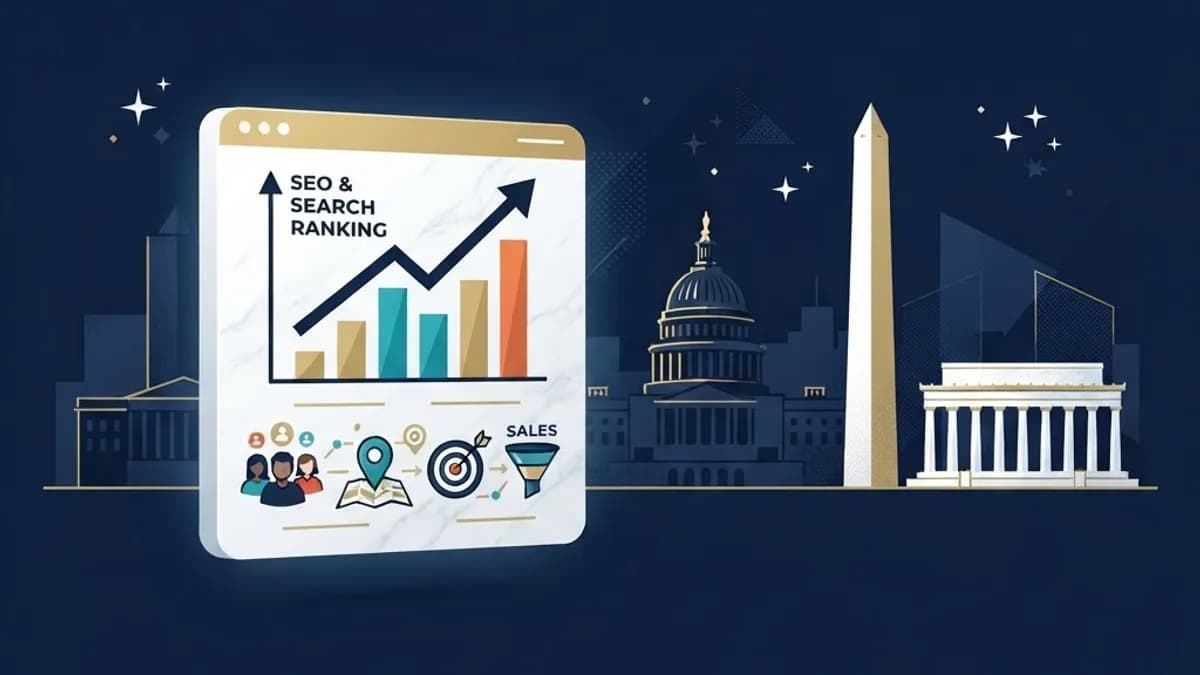
What DC digital marketing services actually involve, from association and government-adjacent audiences to local SEO, compliance constraints, and realistic agency pricing.
DC Digital Marketing Services
Washington DC is not a typical local market. Within roughly 68 square miles sit federal agencies, trade associations, advocacy groups, government contractors, universities, hospitality clusters, and a dense residential base that behaves like any other metro consumer market. A marketing approach built for a single suburb will misfire here, because the region contains at least four distinct buyer economies operating side by side.
Quick Answer: DC digital marketing services cover local SEO, paid search, content, and analytics for businesses across the District, Maryland, and Virginia. The market is unusual because it mixes consumer demand with association, nonprofit, and government contractor audiences, each requiring different messaging, compliance care, and measurement.
The Four Audience Economies in the DC Market
Understanding which economy you sell into determines almost every downstream decision.
The consumer economy behaves like any dense metro: restaurants, dentists, home services, fitness, and retail competing on map pack visibility and reviews across Capitol Hill, Shaw, Navy Yard, and the surrounding neighborhoods.
The association and nonprofit economy is enormous. DC hosts one of the highest concentrations of trade associations and advocacy organizations in the country, and their marketing needs center on membership growth, event registration, and policy content rather than ecommerce transactions.
The government contractor economy sells to agencies and to prime contractors. Buying cycles run long, decision committees are large, and marketing functions mostly as credibility infrastructure supporting a business development team.
The regional professional services economy covers law firms, consultancies, accounting practices, and staffing firms serving all three groups above. Competition on search terms here is among the most expensive in the country.
Local SEO Across a Three-Jurisdiction Market
The DMV region spans the District, Maryland, and Virginia, and a business in Dupont Circle may serve customers in Arlington, Bethesda, and Alexandria. That creates a specific technical challenge: you need geographic coverage without creating duplicate thin pages.
The practical approach is one strong page per real service location and a small set of genuinely differentiated area pages that include distinct parking notes, transit access, licensing differences, and local proof. DC, Maryland, and Virginia have different professional licensing and consumer protection rules in several industries, so area pages written honestly will naturally differ from one another.
Transit intent matters more here than in car-dependent metros. Including the nearest Metro station and line on location pages is not decoration; it answers a question the buyer is actively asking.
Paid Media in an Expensive, Crowded Auction
DC search auctions are competitive because the local buyer pool skews toward high income and high-value B2B services. Cost per click for legal, government contracting, cybersecurity, and professional services terms regularly ranks among the highest in the United States.
Three adjustments protect budget:
- Narrow geography aggressively. A Bethesda-only radius often outperforms a DMV-wide campaign at a fraction of the cost.
- Use audience exclusions for federal employees or contractors when the offer is irrelevant to them, since a large share of regional traffic will otherwise be wasted.
- Bid on problem language, not category language. Terms describing a specific compliance or operational problem convert better and cost less than broad category keywords.
| Service Type | Primary Channel | Realistic Timeline | Main Constraint |
|---|---|---|---|
| Local consumer services | Google Business Profile plus reviews | 1 to 3 months | Review volume |
| Associations and nonprofits | Content, email, event campaigns | 3 to 6 months | Board approval cycles |
| Government contractors | LinkedIn, content, SEO for capability terms | 6 to 18 months | Long procurement cycles |
| Professional services | Search ads plus authority content | 3 to 9 months | High cost per click |
| Hospitality and events | Local SEO, maps, seasonal paid | 1 to 4 months | Seasonality and tourism swings |
Compliance and Sensitivity Considerations
DC marketing carries constraints that many agencies outside the region underestimate.
Advocacy and political content faces platform-specific rules. Meta and Google both require authorization and disclaimers for content classified as social issues, elections, or politics, and campaigns get paused without warning when this is missed.
Government-adjacent claims need care. Implying endorsement by a federal agency, or using agency seals and imagery, creates real legal exposure.
Professional services advertising, especially legal and financial, is bound by bar and regulatory rules that differ between DC, Maryland, and Virginia. An ad that is compliant in one jurisdiction may not be in the next.
Data handling expectations are higher. Many DC organizations require vendors to answer security questionnaires before granting analytics access, and agencies that cannot complete them lose the engagement.
Content That Works With a Policy-Literate Audience
The DC reader is unusually informed and unusually skeptical of marketing language. Content that performs here shares three traits: it is specific, it cites sources, and it takes a defensible position.
Write from primary documents when possible. Referencing an actual rule, a published report, or a procurement notice gives content authority that a generic industry post cannot match.
Publish on a cadence tied to the policy calendar. Fiscal year end in September, appropriations cycles, and association conference seasons create predictable attention spikes. Content shipped three weeks before those moments outperforms the same content shipped after.
Respect the reader's time. Executive summaries at the top, clear headings, and downloadable one-pagers match how this audience actually consumes material.
Choosing Among DC Digital Marketing Services Providers
The region has an unusually high agency density, which is good for choice and bad for signal. Use a short vetting sequence.
Ask which of the four economies they have actually worked in, and request the specific account, not the sector. Ask how they handle three-jurisdiction geography. Ask what they do when a campaign is flagged under issue advertising rules. Ask for a reporting sample that connects spend to pipeline rather than impressions.
Pricing in the region tends to run above national averages. Retainers for meaningful multi-channel work commonly start in the mid four figures monthly, and anything dramatically below that is usually a single junior operator or an offshore template process. That is not automatically disqualifying, but it should match your expectations. Firms positioned as a best SEO agency should be able to show ranking movement tied to revenue, not just position reports.
Measurement in Long-Cycle Markets
The hardest part of DC marketing is that the most valuable outcomes take a year or more to appear. Measuring only on last-click conversions will cause you to cancel the programs that eventually produce the largest contracts.
Build a measurement model with three layers. Leading indicators cover qualified traffic from target organizations, content downloads, and meeting requests. Mid-funnel indicators cover proposal invitations, RFI responses, and shortlist appearances. Lagging indicators cover awarded contracts and renewal value.
Reviewing only the lagging layer monthly creates panic. Reviewing only the leading layer creates false confidence. Reporting all three together is what lets a marketing budget survive a procurement dry spell, and a disciplined partner like this agency will insist on that structure before the first campaign launches.
Key Takeaways
- The DC market contains at least four distinct buyer economies: consumer, association and nonprofit, government contractor, and professional services.
- The region spans three jurisdictions with different licensing and advertising rules, so location pages and ad copy must genuinely differ.
- DC search auctions rank among the most expensive nationally, making tight geography and problem-specific keywords essential.
- Issue and political advertising requires platform authorization and disclaimers, and unauthorized campaigns get paused.
- Government contractor marketing operates on 6 to 18 month cycles and must be measured with leading, mid-funnel, and lagging indicators.
- Content tied to the policy and fiscal calendar, especially the September fiscal year end, outperforms evergreen posting.
Frequently Asked Questions (FAQ)
How much do digital marketing services cost in Washington DC?
Meaningful multi-channel retainers in the DC region commonly start in the mid four figures per month and rise with paid media budget. Pricing runs above national averages because talent costs and auction prices are higher. Project-based work such as a site rebuild is quoted separately from ongoing management.
Do I need an agency physically located in DC?
Location matters less than market fluency. What matters is whether the team understands three-jurisdiction geography, issue advertising rules, and long procurement cycles. A remote team with real DC account experience usually outperforms a local generalist agency with none.
What works best for government contractor marketing?
Authority content mapped to capability areas, LinkedIn targeting by agency and prime contractor, and search visibility for specific capability language. Marketing supports business development rather than replacing it, and success is measured by shortlist appearances and proposal invitations rather than form fills.
How long before DC local SEO shows results?
Consumer businesses often see map pack movement within one to three months once the Google Business Profile is complete and reviews are flowing. Competitive professional service terms across the DMV typically take six to nine months of consistent content and technical work.
Can nonprofits run paid ads in DC affordably?
Yes. Many nonprofits qualify for the Google Ad Grants program, which provides monthly search advertising credit subject to account quality rules. It works best for event registration, membership, and awareness content rather than aggressive conversion campaigns, and it requires ongoing management to stay compliant.