
Understand Crucible artificial intelligence, its specialist model workflow, business uses, evaluation metrics, risks, governance, and pilot steps today.
Crucible Artificial Intelligence
Crucible artificial intelligence is best understood as a specialist AI engineering approach and platform: teams describe an operational task, train a focused model, evaluate its behavior, deploy it, and improve it with production evidence. That focus matters because many organizations need reliable classifications or structured fields, not an open-ended chatbot. This guide explains what Crucible does, where it fits, how to assess it, and how to run a defensible pilot.
Quick Answer: Crucible artificial intelligence helps teams create, evaluate, deploy, and continuously improve specialist machine learning models for defined business tasks. It is most useful when outputs need a schema, measurable accuracy, confidence thresholds, monitoring, and human review. Buyers should validate performance on representative data before committing production workflows.
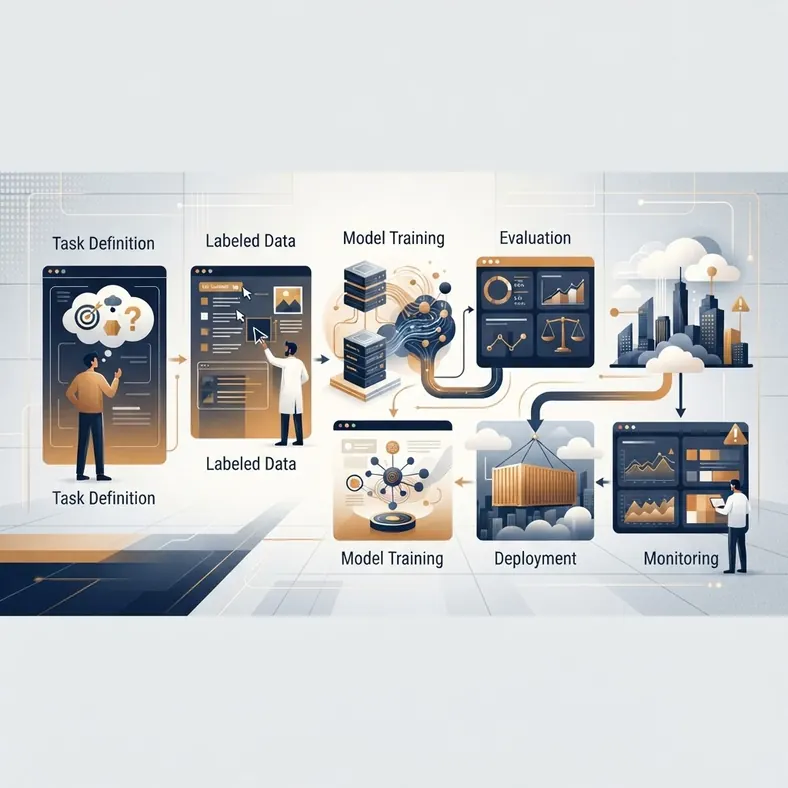
What Is Crucible Artificial Intelligence?
Crucible AI refers here to the machine learning engineering platform presented at usecrucible.ai, not every unrelated product using the word Crucible. Its stated proposition is turning plain-language requirements into production-ready specialist models, supported by evaluation, diagnostics, monitoring, and retraining. A specialist model is a model optimized for one bounded outcome, such as classifying a document, extracting contract fields, or routing a customer request.
That definition separates the platform from a general assistant. A general large language model can discuss many topics, but its flexibility can create unpredictable wording, cost, latency, and validation challenges. A specialist workflow narrows the accepted inputs, expected outputs, policies, and failure handling. This constraint makes quality easier to measure and operational ownership easier to assign.
How Does the Crucible AI Workflow Work?
A practical Crucible workflow converts a business requirement into a measurable model lifecycle. Teams should expect six stages:
- Define the decision. State the input, allowed output schema, business owner, excluded uses, and consequence of an error.
- Prepare representative examples. Include ordinary cases, rare cases, noisy records, policy boundaries, and known failure patterns.
- Train and compare candidates. Evaluate alternatives against a locked test set rather than selecting an impressive demonstration.
- Set acceptance thresholds. Choose minimum quality, latency, cost, and confidence requirements for deployment.
- Route uncertainty safely. Send low-confidence, novel, or sensitive cases to qualified reviewers instead of forcing automation.
- Monitor production evidence. Measure drift, corrections, downstream outcomes, and subgroup performance; retrain only after controlled review.
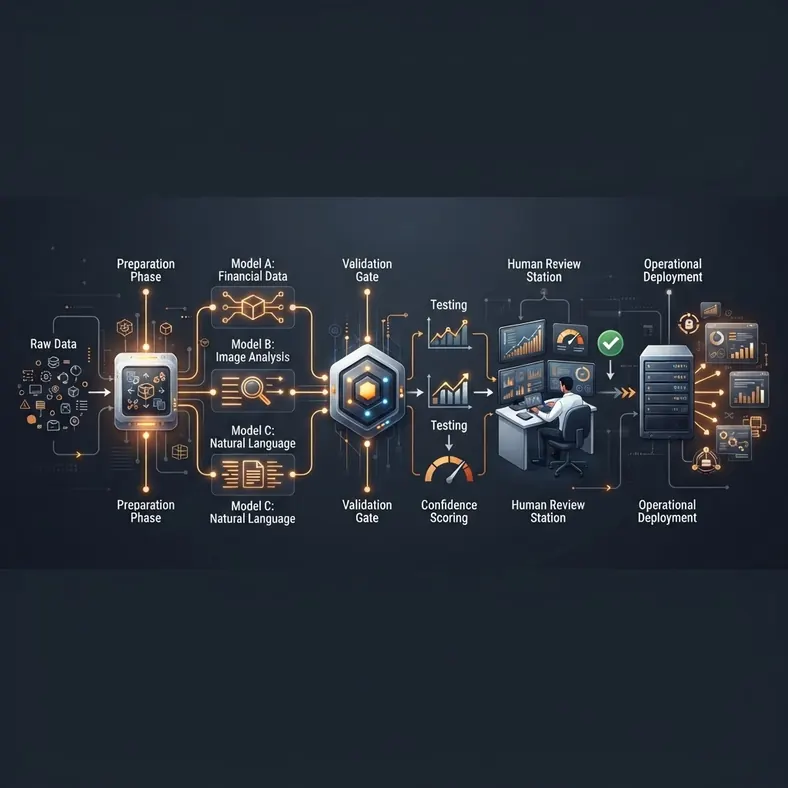
The important insight is that model creation is only one stage. Production reliability comes from the surrounding evaluation system. Google's Machine Learning Crash Course warns that training and test data must represent real-world data; otherwise measured quality may not predict deployment behavior. Keep a time-stamped test set, version every model and policy, and preserve reviewer decisions so changes remain auditable.
Which Business Problems Fit Crucible AI Best?
Crucible is most credible for high-volume, repeatable tasks with observable correct answers. Strong candidates include document classification, customer-intent routing, contract extraction, support-resolution prediction, and compliance screening. These tasks provide structured outcomes that teams can label, score, and review.

Use a simple suitability test. A project is promising when the organization can answer yes to these questions:
- Is the decision repeated often enough to justify automation?
- Can domain experts identify acceptable outputs and serious errors?
- Is representative historical or newly labeled data available lawfully?
- Can uncertain cases reach a human without blocking the entire process?
- Can the team measure a downstream result, not merely model confidence?
Avoid starting with rare, subjective, or irreversible decisions. Hiring, credit, medical, and legal determinations require specialized governance and may trigger regulation. In those settings, use AI to organize evidence or prioritize review only after counsel and domain experts approve the design. Never treat a model score as an explanation of a person.
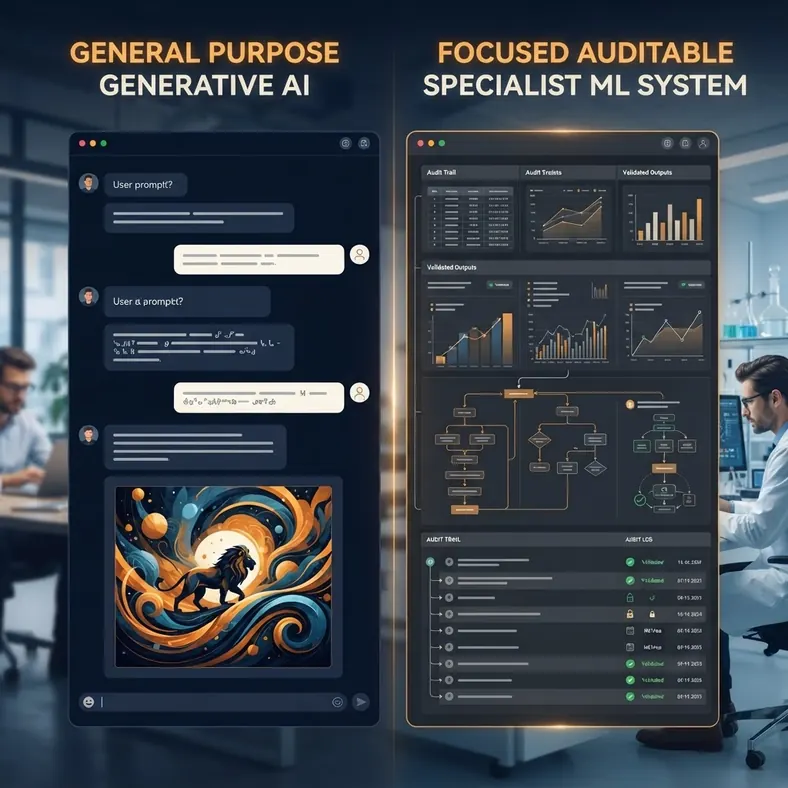
How Does Crucible Compare With General-Purpose AI?
The central tradeoff is breadth versus control. General AI is useful for exploration and drafting; specialist AI is better suited to repeatable decisions with stable interfaces.
| Evaluation factor | Crucible-style specialist model | General-purpose AI assistant |
|---|---|---|
| Primary goal | One defined operational task | Broad conversation and generation |
| Output shape | Enforced schema or labels | Flexible natural language |
| Evaluation | Task-specific test set | Broad benchmarks and sampling |
| Uncertainty handling | Thresholds and review queues | Prompt-dependent disclaimers |
| Improvement loop | Production corrections and retraining | Provider updates or prompt changes |
| Best fit | Routing, extraction, classification | Research, ideation, drafting |
What Metrics Should You Use to Evaluate Crucible AI?
Accuracy alone can hide expensive failures. For imbalanced classifications, report precision, recall, and an error matrix by class. For extraction, score exact matches at field level and separately track missing, malformed, and unsupported values. For routing, measure successful resolution, transfer rate, and time saved after deployment.
The National Institute of Standards and Technology AI Risk Management Framework organizes work around four functions: govern, map, measure, and manage. Use that structure to connect technical metrics with ownership and risk. For each model, document the intended use, affected users, data source, approval authority, monitoring frequency, incident process, and retirement trigger.

Set thresholds from business costs. If a false compliance clearance is ten times more costly than an unnecessary manual review, optimize and test for that asymmetry. Publish results with sample sizes and confidence intervals where appropriate. A 95% accuracy claim based on 40 convenient examples is less trustworthy than 92% measured across thousands of representative, independently reviewed cases.
How Should a Team Implement Crucible AI?
A controlled pilot should prove one decision before scaling. Follow this roadmap:
- Select a bounded, reversible workflow with an accountable business owner.
- Write an evaluation plan before training, including baseline, test data, thresholds, and stop conditions.
- Create a data inventory covering provenance, consent, retention, sensitive fields, and deletion obligations.
- Run the model in shadow mode, where it predicts outcomes without controlling live decisions.
- Review errors by category and consequence, not just aggregate score.
- Launch to a limited traffic segment with human fallback and rollback controls.
- Expand only after production outcomes satisfy the agreed threshold for a defined observation window.

Do not let the vendor define success alone. Your operations, security, privacy, legal, and domain teams should approve evidence relevant to their responsibilities. If external help is appropriate, an experienced artificial intelligence service can support use-case selection, evaluation design, integration, and governance. Compare that support against internal capability and retain ownership of data, tests, and acceptance criteria.
Teams researching implementation patterns can also consult ZoneTechify and WebPeak as starting points, then verify recommendations against primary vendor documentation and applicable law. No agency article should replace technical testing or legal advice.
What Risks and Governance Controls Matter?

Require these safeguards:
- Role-based access for data, models, prompts, policies, and exports.
- Encryption in transit and at rest, with documented key ownership.
- Data minimization, retention limits, deletion workflows, and vendor-subprocessor review.
- Versioned test sets, model cards, approval records, and reproducible releases.
- Drift alerts tied to an owner and a tested rollback procedure.
- Human review for low-confidence or high-impact outcomes.
- Incident logging that captures input lineage, model version, output, and final human action.
Ask the vendor where data is processed, whether customer data trains shared models, how deletion is verified, and what happens when dependencies fail. Request security reports and contractual commitments rather than relying on marketing claims. For regulated processing, involve counsel early and map controls to the jurisdiction and sector involved.
Key Takeaways
- Crucible AI is designed around specialist models for bounded, measurable business tasks.
- Its value depends on evaluation, monitoring, human fallback, and controlled improvement, not model training alone.
- Structured tasks such as classification, extraction, routing, and screening offer the clearest fit.
- Buyers should compare workflow outcomes, including error cost, latency, reviewer effort, and reliability.
- A defensible pilot uses representative test data, shadow deployment, documented thresholds, rollback controls, and accountable owners.
- Because several products use Crucible branding, verify the exact vendor and domain before procurement.
Frequently Asked Questions (FAQ)
Is Crucible AI the same as ChatGPT?
No. Crucible AI, in the meaning covered here, focuses on building and operating specialist models for defined tasks. ChatGPT is a general conversational assistant. A company may use both: a specialist model for structured routing or extraction and a general model for drafting language, with separate evaluation and controls.
What can I automate with Crucible artificial intelligence?
Good candidates include document classification, contract-field extraction, support-intent routing, compliance triage, and other repetitive tasks with measurable outputs. Start where experts can label examples and review uncertain cases. Avoid fully automating irreversible, high-impact decisions until legal, domain, security, and risk teams approve robust safeguards.
How much training data does a Crucible model need?
There is no universal minimum because requirements depend on task complexity, class balance, data quality, and acceptable error rates. Begin with representative examples, reserve an untouched test set, and plot performance as data increases. Rare but costly cases often need deliberate collection, expert review, or synthetic testing.
How do I know whether Crucible AI is accurate enough?
Define enough using business consequences before testing. Measure precision, recall, field-level errors, latency, cost, and downstream outcomes on representative held-out data. Break results down by important classes and groups. Then run shadow deployment and compare performance with the existing process before allowing the model to influence live decisions.
Does Crucible AI remove the need for human reviewers?
Usually not. Human review remains valuable for uncertain, novel, sensitive, and high-impact cases. The better objective is allocating expert attention intelligently, not eliminating oversight. Set confidence thresholds, provide reviewers with source evidence, record corrections, and audit whether automation creates new errors or merely moves work elsewhere.
What should I ask during a Crucible AI vendor demo?
Ask the vendor to use representative samples and show failures, confidence handling, monitoring, rollback, access controls, retention, deletion, and model-version history. Request measured results instead of curated examples. Confirm integration effort, pricing units, support boundaries, data-training terms, subprocessors, export options, and ownership of models, labels, and evaluation artifacts.
Final Assessment
Crucible artificial intelligence can be valuable when a team needs a narrow model that behaves like an accountable production component rather than an unrestricted assistant. The purchasing decision should rest on evidence from your data, workflow, users, and risk profile. Define the decision, quantify failure costs, test representative cases, preserve human fallback, and monitor real outcomes. If those disciplines are unavailable, improve the operating process before adding AI; automation magnifies unclear rules as readily as it scales sound ones. Treat every deployment as evidence-based operational change, not a technology purchase.