
A practical, expert guide to becoming an artificial intelligence entrepreneur, covering skills, business models, funding, tools, and market trends for 2026.
Artificial Intelligence Entrepreneur

Becoming an artificial intelligence entrepreneur is no longer reserved for PhD researchers in Silicon Valley labs. Today, a solo founder with a laptop, a clear problem to solve, and access to affordable models can build a company that competes with businesses ten times its size. The barrier to entry has collapsed, but the barrier to success has quietly risen. Anyone can call an API now, which means your edge comes from strategy, execution, and trust, not from the technology itself.
This guide is written from hands-on experience helping founders launch and scale AI products. It walks you through what an AI entrepreneur actually does, the skills you need, the business models that work, how funding and tooling fit together, and where the market is heading. Every section is built to answer a real question so you leave with a concrete plan, not vague inspiration.
Quick Answer: An artificial intelligence entrepreneur builds and scales businesses that use AI to solve real problems. Success comes from identifying a valuable problem, choosing the right business model, combining technical and commercial skills, and shipping trustworthy products faster than competitors can copy them.
What Is an Artificial Intelligence Entrepreneur?
An artificial intelligence entrepreneur is a founder who builds a business where AI is central to the value delivered, not just a feature bolted on afterward. That value can come from automating expensive manual work, generating content or predictions at scale, or surfacing insights humans cannot reach alone.
The defining trait is not coding ability. It is problem selection. The best AI founders obsess over a narrow, painful, expensive problem and then apply AI as the sharpest available tool. According to McKinsey research, generative AI could add between 2.6 and 4.4 trillion dollars in annual value across the global economy, and most of that value will be captured by operators who apply AI to specific workflows rather than those who build foundational models.
In short, you do not need to invent the next large language model. You need to deploy existing intelligence where it creates measurable outcomes for a customer willing to pay.
Why Now Is the Best Time to Start

The timing has never been better, and the data supports it. According to a 2024 Stanford AI Index report, the cost of running inference on a system performing at GPT-3.5 level dropped more than 280-fold in roughly 18 months. That collapse means margins that were impossible two years ago are now realistic for a bootstrapped founder.
Three forces make this moment unique:
- Cheap intelligence: Model access is now a metered utility, like electricity, priced per token rather than per hire.
- Distribution is open: App stores, marketplaces, and social platforms let a small team reach millions without a sales force.
- Buyer readiness: Businesses now expect AI features and actively budget for them, shortening your sales cycle.
An expert observation from the field: the winners of this cycle are rarely first movers. They are the founders who watch which AI use cases get real traction, then execute with better design, onboarding, and reliability. Patience paired with speed beats raw novelty.
Core Skills Every AI Entrepreneur Needs
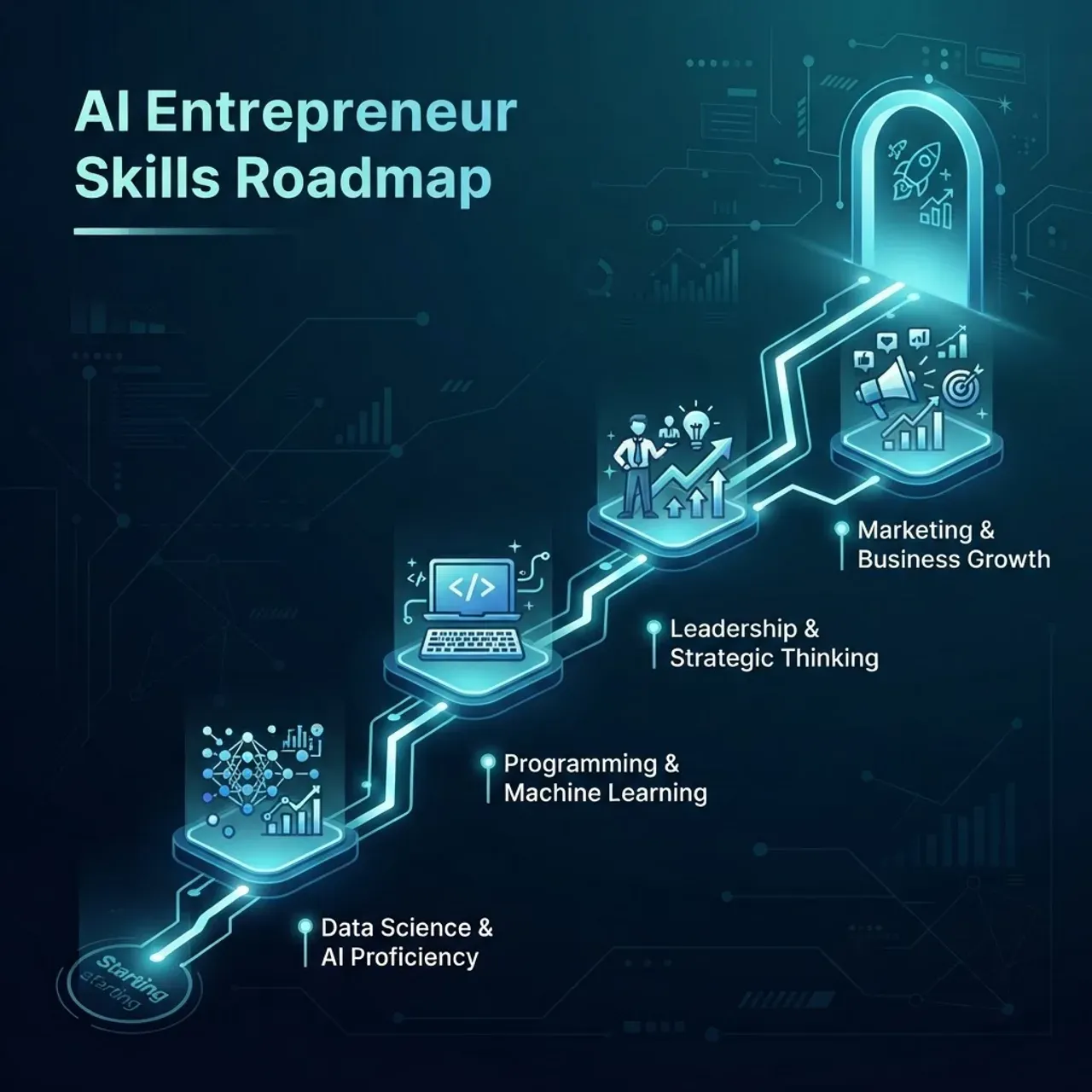
You do not need to master every discipline, but you must be conversant in each and excellent in at least one. Think of these as a T-shaped skill set: broad awareness across the board, deep expertise in your chosen edge.
- Problem framing: The ability to translate a fuzzy business pain into a well-defined task an AI system can perform reliably.
- Technical fluency: You should understand prompts, context windows, fine-tuning, retrieval, and evaluation, even if you hire engineers to implement them.
- Data literacy: Knowing where your data comes from, how clean it is, and what it legally permits is often the difference between a defensible business and a lawsuit.
- Distribution and marketing: Building is the easy part now. Reaching customers profitably is the moat.
- Financial discipline: Token costs, infrastructure, and churn can quietly erode margins if you do not track unit economics from day one.
If you want to strengthen the technical and deployment side of your venture, professional support such as WebPeak's artificial intelligence services can help you ship faster while you focus on customers and strategy.
Proven Business Models for AI Startups

Choosing the wrong business model is the fastest way to stall a promising AI product. The model determines your pricing, your defensibility, and how quickly you can grow. Below is a comparison of the four models that consistently produce sustainable AI companies.
| Business Model | How It Makes Money | Best For | Defensibility |
|---|---|---|---|
| AI SaaS | Recurring subscription for software | Repeatable B2B workflows | Medium to High |
| Vertical AI Agent | Fee per task or seat in one industry | Niche, high-value professions | High |
| API or Infrastructure | Usage-based pricing per call | Developer-focused tooling | Medium |
| AI-Enabled Services | Retainer or project fees | Agencies and consultancies | Low to Medium |
My recommendation for most first-time founders is a vertical AI agent or focused AI SaaS product. Serving one industry deeply, such as legal intake, dental scheduling, or construction estimating, lets you accumulate proprietary data and domain trust that generic horizontal tools cannot match. Depth beats breadth when you are starting out.
How AI Entrepreneurs Fund and Grow

Funding an AI business today follows two divergent paths, and choosing consciously matters. The first is the classic venture route, where you raise capital to grow quickly and capture a large market. The second is bootstrapping, where cheap models and lean teams let you reach profitability without dilution.
Here is a simple framework for deciding:
- Bootstrap when your product serves a clear niche, has fast payback, and you value control.
- Raise venture capital when the market is winner-take-most, speed is critical, and capital is a genuine advantage.
- Blend both by bootstrapping to early revenue, then raising from a position of strength to accelerate.
Growth for AI companies increasingly hinges on retention rather than acquisition. Because AI products can feel magical in a demo but disappoint in daily use, the founders who win invest heavily in reliability, onboarding, and measurable outcomes. A product that consistently saves a customer three hours a week will always outgrow one that dazzles once and frustrates later.
The Tools and Workflow That Power Modern AI Founders
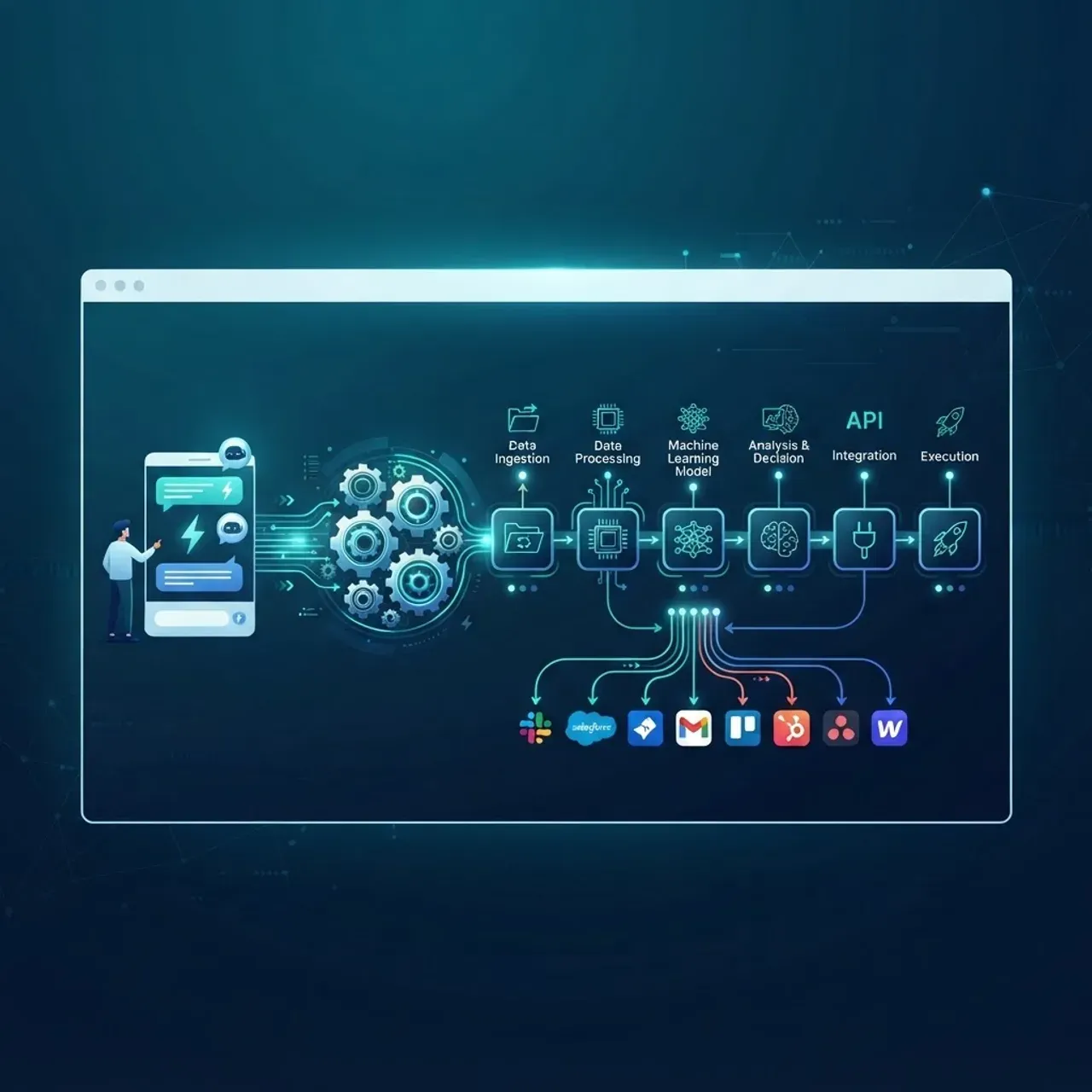
Modern AI entrepreneurs operate with a lean, composable stack. You no longer build everything from scratch; you orchestrate best-in-class components and add your unique layer on top.
A typical starting stack includes a model provider or gateway for intelligence, a vector database for retrieval, an automation layer to connect apps, and an analytics tool to monitor usage and cost. The goal is to spend your scarce engineering time on the parts that differentiate you, such as your data pipeline and user experience, and to rent everything else.
Automation is your force multiplier. Repetitive tasks like customer onboarding emails, data cleaning, and reporting should be automated early so your small team can focus on judgment-heavy work. Teams at agencies like ZoneTechify and platforms like WebPeak increasingly treat automation not as a nice-to-have but as the operating backbone that lets tiny teams deliver enterprise-scale output.
Common Mistakes to Avoid
Experience teaches that most AI startups fail for predictable, avoidable reasons. Watch for these traps:
- Building a solution looking for a problem: Falling in love with a clever model instead of a painful customer need.
- Ignoring unit economics: Token and infrastructure costs can quietly exceed revenue if you never measure cost per user.
- Neglecting trust: Hallucinations, data leaks, and unclear privacy policies destroy adoption faster than any bug.
- Over-engineering: Shipping a fine-tuned custom model when a well-prompted off-the-shelf model would have validated the idea in a week.
The antidote to all four is customer proximity. Talk to users constantly, ship small, and let real feedback, not internal excitement, guide your roadmap.
Market Trends Shaping the Next Wave

The frontier is shifting from chat interfaces toward autonomous agents that complete multi-step tasks with minimal supervision. This unlocks entirely new business categories, especially in operations-heavy industries where the value is measured in hours reclaimed rather than words generated.
Two trends deserve special attention. First, vertical specialization is accelerating as generic assistants commoditize; the money is moving toward tools that understand one industry deeply. Second, regulation and trust are becoming competitive advantages. Founders who build transparent, compliant, and auditable systems will win enterprise contracts that skeptical buyers refuse to give to opaque competitors.
Key Takeaways
- An artificial intelligence entrepreneur builds businesses where AI solves a specific, valuable problem, not where AI is a gimmick.
- Model inference costs fell more than 280-fold in about 18 months, making profitable AI products realistic for bootstrappers.
- Generative AI could add 2.6 to 4.4 trillion dollars annually, with most value captured by applied operators, not model builders.
- Vertical AI agents and focused SaaS offer the strongest defensibility for first-time founders.
- Retention, trust, and unit economics matter more than flashy demos or being first to market.
The Future of AI Entrepreneurship

The next decade will reward founders who treat AI as a means, not an end. Technology will keep getting cheaper and more capable, which paradoxically makes human judgment, taste, and trustworthiness more valuable, not less. The winning artificial intelligence entrepreneur will be the one who pairs genuine domain expertise with the discipline to ship reliable, honest products.
Start small, solve one real problem completely, and let compounding trust and data build your moat. The tools are ready and the market is willing. What remains is the founder willing to execute with focus and integrity.
Frequently Asked Questions (FAQ)
What does an artificial intelligence entrepreneur actually do?
An artificial intelligence entrepreneur identifies a valuable problem, builds a product that uses AI to solve it, and grows a business around that solution. Their core work is problem selection, product design, distribution, and customer trust, with AI serving as the primary tool that delivers measurable value.
Do I need to be a programmer to start an AI business?
No, you do not need to be an expert programmer. You need technical fluency to understand what AI can and cannot do, plus strong skills in problem framing, marketing, and finance. Many successful founders partner with engineers or use professional services to handle implementation while they lead strategy.
How much money do I need to launch an AI startup?
You can launch a focused AI product for a few thousand dollars because model access is now priced per use. Costs scale with your customers rather than upfront. Many founders reach revenue by bootstrapping, then raise venture capital later only if their market rewards rapid, winner-take-most growth.
Which AI business model is most profitable for beginners?
Vertical AI agents and focused AI SaaS products tend to be most profitable for beginners. Serving one industry deeply lets you gather proprietary data, build domain trust, and charge premium prices. This depth creates defensibility that broad, generic AI tools competing on price cannot easily replicate.
What is the biggest mistake new AI entrepreneurs make?
The biggest mistake is building a clever solution before confirming a painful, paid problem exists. Founders fall in love with technology instead of customers. The fix is constant customer conversation, shipping small experiments, and letting real usage data, not internal enthusiasm, guide every product decision.