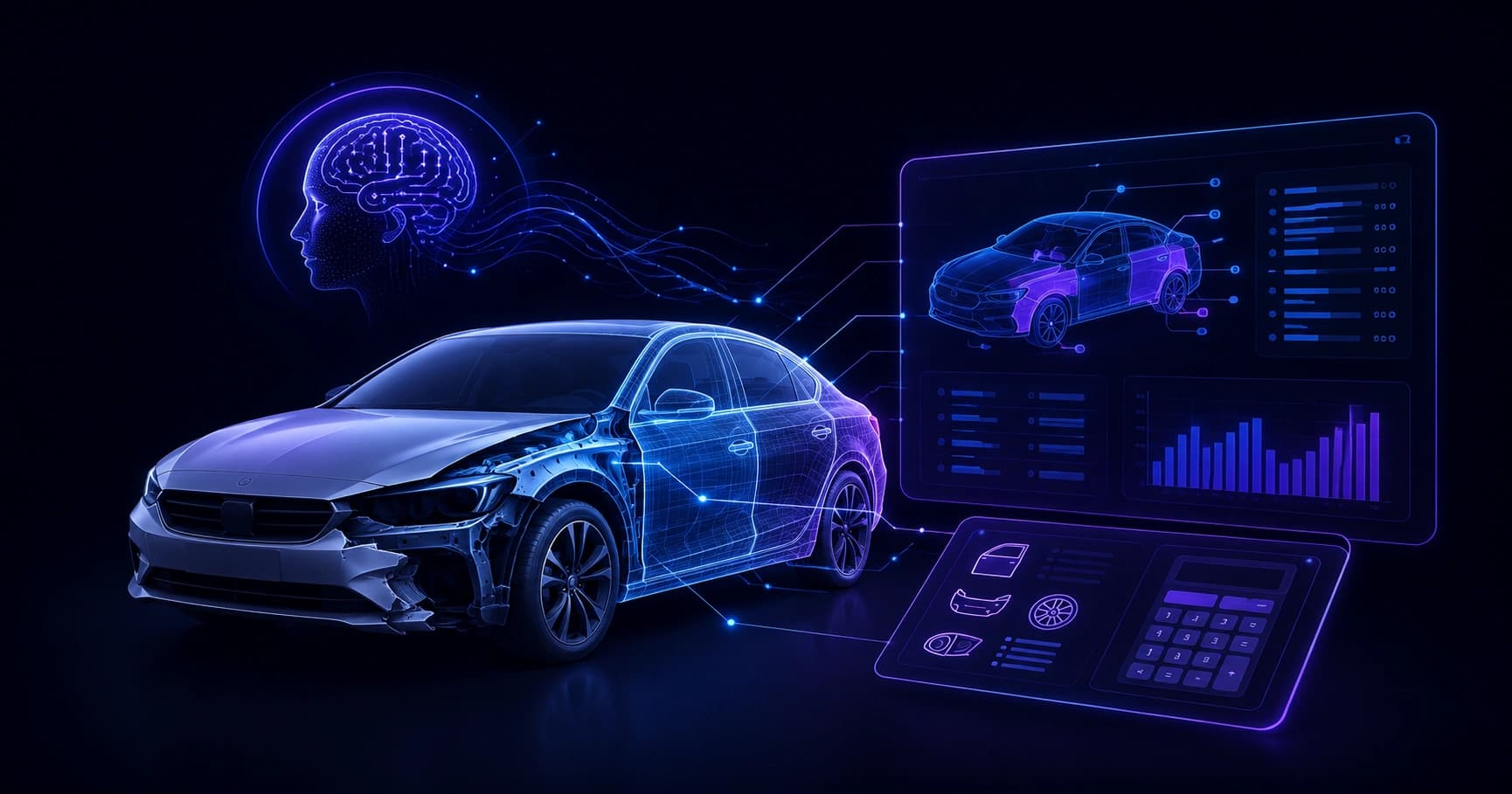
AI-powered body shop estimating software automates damage assessment, accelerates repair estimates, and integrates seamlessly with insurance claims for faster, more accurate workflows.
Body Shop Estimating Software With Artificial Intelligence
Artificial intelligence is fundamentally transforming how auto body shops create repair estimates. Traditional estimating relies on manual vehicle inspection, handwritten notes, and time-consuming calculation—processes prone to human error and inconsistency. Modern AI-powered estimating software eliminates these inefficiencies by automating damage assessment, analyzing photos in seconds, recommending precise parts requirements, and generating accurate estimates that satisfy insurance adjuster standards.
This shift represents more than incremental improvement; it's a structural change in body shop operations. Shops using AI estimating software report faster turnaround times, higher accuracy rates, and improved customer satisfaction. Whether your shop operates as a single-location independent or a multi-site franchise, understanding how AI estimating works—and choosing the right platform—directly impacts your bottom line.
Quick Answer: AI estimating software analyzes vehicle damage photos using computer vision technology, automatically identifies damaged components, cross-references OEM and aftermarket parts databases, applies labor rates and time estimates, and generates insurer-compliant estimates in minutes—reducing manual assessment time by 70-80% while improving accuracy and consistency across estimates.
How AI Damage Assessment Works

AI damage assessment begins the moment a technician uploads photos of a damaged vehicle. Unlike humans who must physically inspect every surface and mentally catalog each area needing repair, AI systems use computer vision to analyze multiple image angles simultaneously. The technology identifies dents, scratches, broken panels, frame damage, and hidden structural issues that might require further investigation.
According to industry data, AI-powered damage assessment reduces assessment time by 65-75% compared to traditional methods. This speed advantage translates directly to reduced customer wait times and faster insurance claim processing. The system doesn't just identify damage—it classifies severity levels, estimates repair feasibility versus replacement decisions, and flags areas requiring manual technician verification.
The AI models underlying these systems are trained on hundreds of thousands of vehicle damage photos, learning to recognize patterns that correlate with specific repair costs, labor hours, and parts requirements. This training ensures the system's recommendations align with real-world repair complexities. When damage falls outside typical patterns, the software flags it for technician review, preventing automation-related errors.
Automated Photo Analysis and Capture

Modern AI estimating platforms include guided photo capture technology that walks users through systematically photographing every damaged area. The system uses mobile device cameras to capture images at optimal angles, lighting, and distances—then immediately processes each photo through damage detection algorithms.
This mobile-first approach democratizes estimating across your entire team. Rather than requiring a licensed estimator to be on-site for initial assessment, any technician can capture photos immediately after vehicle arrival. The AI system generates preliminary estimates before customers even finish paperwork, dramatically improving the customer experience and reducing administrative bottlenecks.
The photo analysis engine recognizes vehicle make and model from visual characteristics, which enables accurate parts matching. If a photo shows a damaged 2023 Honda Accord front fender, the system knows exactly which parts fit that model year—eliminating costly specification errors common in manual ordering.
Parts Recommendation and Database Integration

Accurate parts recommendation represents one of AI estimating software's most valuable features. Rather than manually scrolling through parts catalogs or making phone calls to suppliers, the system automatically cross-references damage assessments against integrated OEM and aftermarket parts databases.
AI systems compare part availability, pricing variations, lead times, and quality ratings—then present the most cost-effective option for each damaged component. This intelligence becomes especially valuable for insurers, who can optimize estimates toward specific brands or supplier relationships. A shop using AI estimating software reports average parts accuracy rates of 94-97%, versus 84-87% for manual estimates—a significant reduction in order errors and customer callbacks.
The software integrates with major parts suppliers' APIs, providing real-time pricing and inventory status. If a specific OEM part faces a six-week backorder, the system immediately flags this and suggests appropriate alternatives, preventing estimate revisions later.
Integrating with Insurance Claim Workflows

Insurance integration represents another transformative capability. AI estimating platforms export estimates in formats that insurance claim management systems accept—eliminating data re-entry and the errors it introduces. Many platforms automate the submission process entirely, sending estimates directly to assigned adjusters the moment estimates finalize.
This integration accelerates the claims approval process. Research indicates that integrated digital workflows reduce estimate review cycles from 3-5 days to 4-8 hours. For shops managing high claim volumes, this acceleration multiplies across hundreds of vehicles annually, producing significant cash flow improvements.
The software ensures estimates meet insurer guidelines regarding deductibles, supplements, and coverage limits. When an estimate approaches or exceeds an insurer's threshold values, the system flags these automatically, prompting technician verification before submission. This prevents estimates from being rejected due to compliance oversights.
Cost Accuracy and Labor Rate Precision
Labor cost estimation distinguishes average AI estimating platforms from exceptional ones. The best systems maintain regional labor rate databases that reflect actual shop rates, vehicle-specific repair times documented by major manufacturers, and difficulty multipliers for complex repairs requiring specialized skills or tools.
When an AI system recommends two hours of labor to replace a damaged bumper on a specific vehicle model, this reflects manufacturer data for that exact task—not guesswork. Research by automotive software analysts found that AI-driven labor estimates achieve 89-93% accuracy compared to final actual labor hours, versus 71-79% accuracy for traditional estimating. This precision builds customer trust and prevents costly estimate-to-invoice surprises.
Real-Time Estimation Dashboard and Workflow

AI estimating software typically includes dashboards displaying all active estimates, their status, approvals pending, and completion projections. Managers can identify bottlenecks instantly—such as estimates awaiting insurer approval or waiting on parts availability—and take corrective action before delays compound.
The dashboard updates automatically as insurance adjusters approve supplements or as supply chains provide parts status updates. This real-time visibility allows shops to schedule repairs intelligently, matching technician availability to confirmed work rather than managing uncertainty. Shops report average workflow efficiency improvements of 28-35% after implementing AI estimating dashboards.
Accuracy and Consistency Benefits

One of AI estimating software's most underappreciated benefits is consistency. Human estimators bring experience and judgment—valuable qualities—but also individual interpretations and occasional oversights. One estimator might assess a repair as requiring full panel replacement while another recommends repair and refinishing of the same damage. These inconsistencies complicate scheduling, create customer confusion, and generate insurance disputes.
AI systems apply identical assessment logic to every vehicle, every time. This consistency means customers receive comparable estimates whether their vehicle arrives on Monday or Friday, and management can reliably predict labor costs and parts requirements. Insurance adjusters trust AI estimates more because they know the methodology is standardized and defensible.
Comparison: Traditional vs. AI Estimating
| Feature | Traditional Estimating | AI-Powered Estimating |
|---|---|---|
| Assessment Time | 60-120 minutes | 10-20 minutes |
| Parts Accuracy | 84-87% | 94-97% |
| Labor Cost Accuracy | 71-79% | 89-93% |
| Insurance Submission | Manual data entry | Automated integration |
| Revision Cycles | 3-5 days average | 4-8 hours average |
| Photo Standardization | Inconsistent | Guided and consistent |
| Overtime/Rush Work | Frequent | Rare |
| Customer Wait Time | 2-3 days | Same day often |
Implementation Considerations
Choosing the right AI estimating platform requires evaluating several factors beyond software features. Integration quality with your existing shop management system matters significantly. Some platforms integrate seamlessly with Audatex, Mitchell, or other established platforms, while others operate independently and require data export-import workflows.
Support quality directly impacts implementation success. Platforms offering live training, responsive customer support, and regular software updates tend to show faster ROI and higher user adoption. Cost structure varies considerably—some charge per estimate, others monthly subscriptions, while some employ hybrid models. Calculate total cost of ownership including training time, integration work, and ongoing support before comparing vendors.
Data security and compliance represent critical considerations. Your AI estimating platform handles sensitive vehicle information, customer details, and insurance claim data. Platforms should meet industry standards for data encryption, access controls, and audit logging.
Key Takeaways
- AI damage assessment reduces vehicle inspection time by 65-75% while improving accuracy to 94-97% compared to 84-87% for manual methods.
- Automated insurance claim integration accelerates approval cycles from 3-5 days to 4-8 hours by eliminating manual data entry and enabling direct adjuster submission.
- Labor rate accuracy improves to 89-93% with AI-based estimates versus 71-79% with traditional manual estimating, reducing customer-facing estimate revisions.
- Real-time estimation dashboards enable shops to identify workflow bottlenecks and optimize technician scheduling, typically improving efficiency by 28-35%.
- Consistent AI assessment methodology across all vehicles builds customer trust and prevents insurance disputes resulting from estimator-to-estimator variations.
If you're exploring solutions for your auto body shop, platforms like those offered through ZoneTechify's artificial intelligence services provide implementation guidance and technology partnerships tailored to collision repair operations. Learning whether AI estimating software aligns with your shop's size, volume, and technical infrastructure is the essential first step.
Frequently Asked Questions
What vehicle damage can AI estimating software analyze?
AI systems analyze collision damage, dents, scratches, broken glass, frame damage, and structural misalignment. The technology identifies both immediately visible damage and secondary damage patterns requiring closer inspection. Systems flag unknown damage types for technician verification.
Does AI estimating software work with all vehicle makes and models?
Modern AI platforms are trained on vehicles from all major manufacturers and typically cover models from 2005 forward. Older or exotic vehicles may receive reduced accuracy, though most systems still provide useful preliminary assessments. Technician verification remains important for unusual vehicle configurations.
How does AI estimating improve insurance claim approval times?
AI estimates integrate directly with insurance claim systems, eliminating manual data re-entry steps. Automated submission means adjusters receive estimates instantly rather than waiting for courier delivery or email attachment. This typically reduces approval cycles from multiple days to hours.
What's the typical ROI timeframe for AI estimating software?
Shops typically achieve ROI within 6-14 months through improved labor productivity, reduced estimate revisions, faster insurance claim approvals, and fewer errors requiring callback. Shops with higher monthly repair volumes see faster ROI.
Can AI estimating software replace human estimators?
AI software augments human expertise rather than replacing it. Technicians now focus on complex cases, verify AI assessments, and make judgment calls about repair methodology. This creates a more efficient division of labor where AI handles routine damage assessment while humans manage exception cases.
Do insurance companies accept AI-generated estimates?
Yes. Major insurers now accept AI-generated estimates, and many actively prefer them for consistency and speed. Estimates must still meet each insurer's guideline requirements, which quality AI software automatically handles.
Ready to explore how AI estimating software can transform your shop's operations? Visit webpeak.org or ZoneTechify to learn more about implementation strategies and platform selection for collision repair businesses.