Explore how Berkeley Haas approaches mitigating bias in artificial intelligence, with practical frameworks, fairness testing methods, and governance strategies for building trustworthy AI.
Berkeley Haas Mitigating Bias in Artificial Intelligence
Artificial intelligence now decides who gets a loan, which resumes reach a recruiter, and what medical alerts a doctor sees first. When those systems inherit human prejudice, the damage scales instantly across millions of decisions. This is exactly the problem the University of California, Berkeley Haas School of Business set out to confront through its research, teaching, and its widely used Equity Fluent Leadership Playbook on mitigating bias in AI.
This guide breaks down what Berkeley Haas teaches about bias in machine learning, why it happens, and the concrete steps teams can take to reduce it. Whether you build models or buy them, understanding these principles helps you deploy AI that is fairer, more defensible, and more trusted by the people it affects.
Quick Answer: Berkeley Haas approaches mitigating bias in artificial intelligence by treating fairness as a leadership and design responsibility, not just a technical fix. Its playbook guides teams to define fairness, audit training data, test models across groups, involve diverse stakeholders, and monitor systems continuously after deployment.
Who Is Berkeley Haas and Why Its AI Bias Research Matters
The Haas School of Business is the business school of UC Berkeley, one of the world's leading public research universities. Through its Center for Equity, Gender, and Leadership (EGAL), Haas published a practical playbook titled Mitigating Bias in Artificial Intelligence aimed at business leaders rather than only data scientists.
What makes the Haas contribution distinct is its audience. Most bias research targets engineers with mathematical fairness metrics. Haas reframes bias as a leadership problem: executives who commission, fund, and deploy AI carry responsibility for its outcomes. This shift matters because most harmful AI is not built by the companies that use it, so leaders need judgment, not just code, to act responsibly.
What Is Bias in Artificial Intelligence?
Bias in artificial intelligence is a systematic error that produces unfair outcomes, such as privileging one group of people over another. It typically arises when a model learns patterns from historical data that reflect existing social inequalities, then reproduces or amplifies those patterns at scale.
A useful distinction: statistical bias refers to a model's error relative to reality, while societal bias refers to outcomes that harm or disadvantage protected groups. AI systems can be statistically accurate and still be socially harmful, because the data they learned from encoded discrimination that the model now treats as ground truth.

The Main Types of AI Bias
Berkeley Haas and the broader research community identify several recurring sources of bias. Recognizing which type you face determines how you fix it.
- Training data bias: The dataset underrepresents or misrepresents certain groups, so the model performs worse for them.
- Historical bias: The data accurately reflects a world that was already unequal, teaching the model to continue past discrimination.
- Labeling bias: Human annotators inject their own assumptions when tagging data used for supervised learning.
- Proxy bias: A model uses a seemingly neutral variable (like zip code) that correlates strongly with a protected attribute (like race).
- Aggregation bias: A single model is applied to distinct populations that actually need different treatment.
According to research summarized by the National Institute of Standards and Technology (NIST), bias in AI extends well beyond data and algorithms into human and systemic factors, which is why purely technical fixes often fall short.
Real-World Example: Algorithmic Bias in Hiring
Hiring algorithms are the clearest illustration of AI bias in action. One widely reported case involved a large technology company that scrapped an experimental recruiting tool after discovering it penalized resumes containing the word women's and downgraded graduates of certain all-women colleges. The model had learned from a decade of resumes submitted mostly by men, so it concluded that male candidates were preferable.
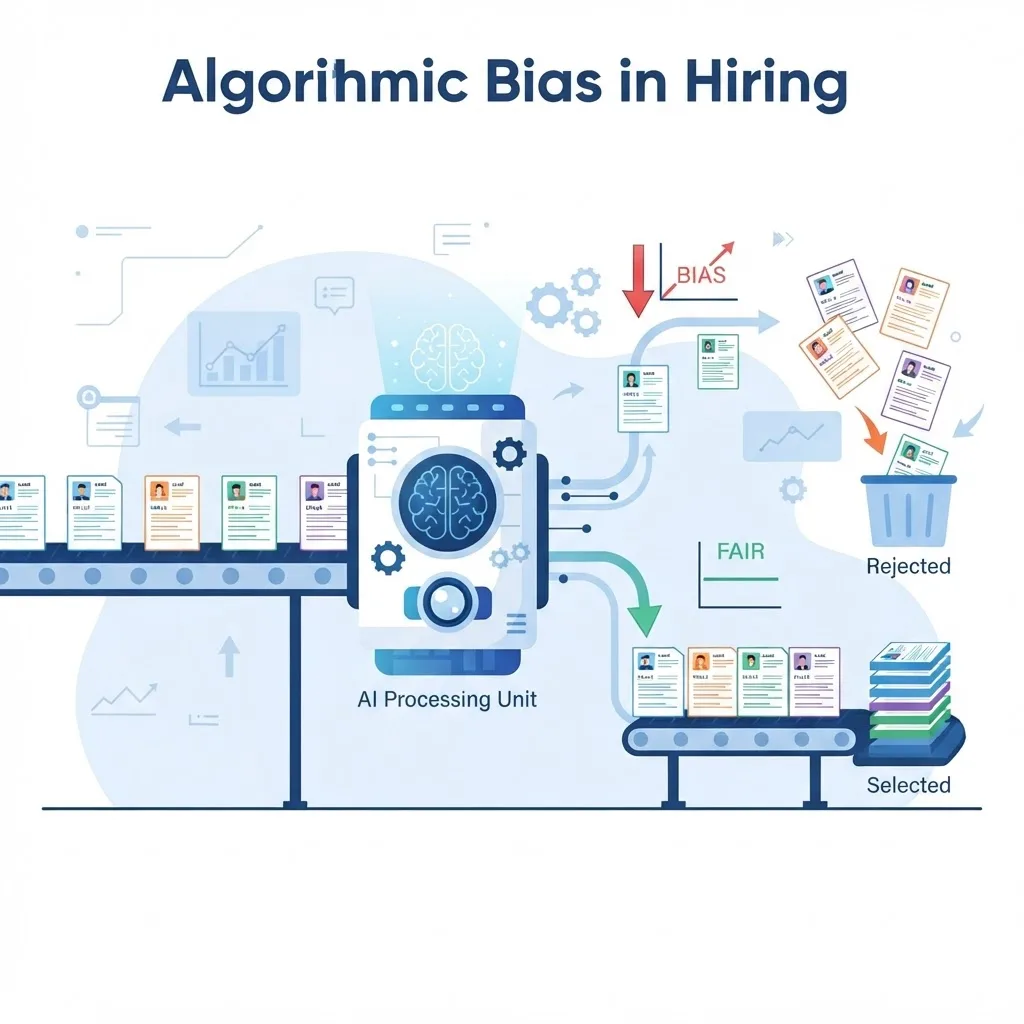
The lesson Berkeley Haas draws from cases like this is that intent does not matter to outcomes. No engineer set out to discriminate. The bias emerged silently from historical data, which is precisely why proactive auditing must be built into the process rather than added after harm occurs. Companies investing in responsible AI often partner with specialized teams such as WebPeak's artificial intelligence services to audit and de-bias models before deployment.
The Berkeley Haas Framework for Mitigating Bias
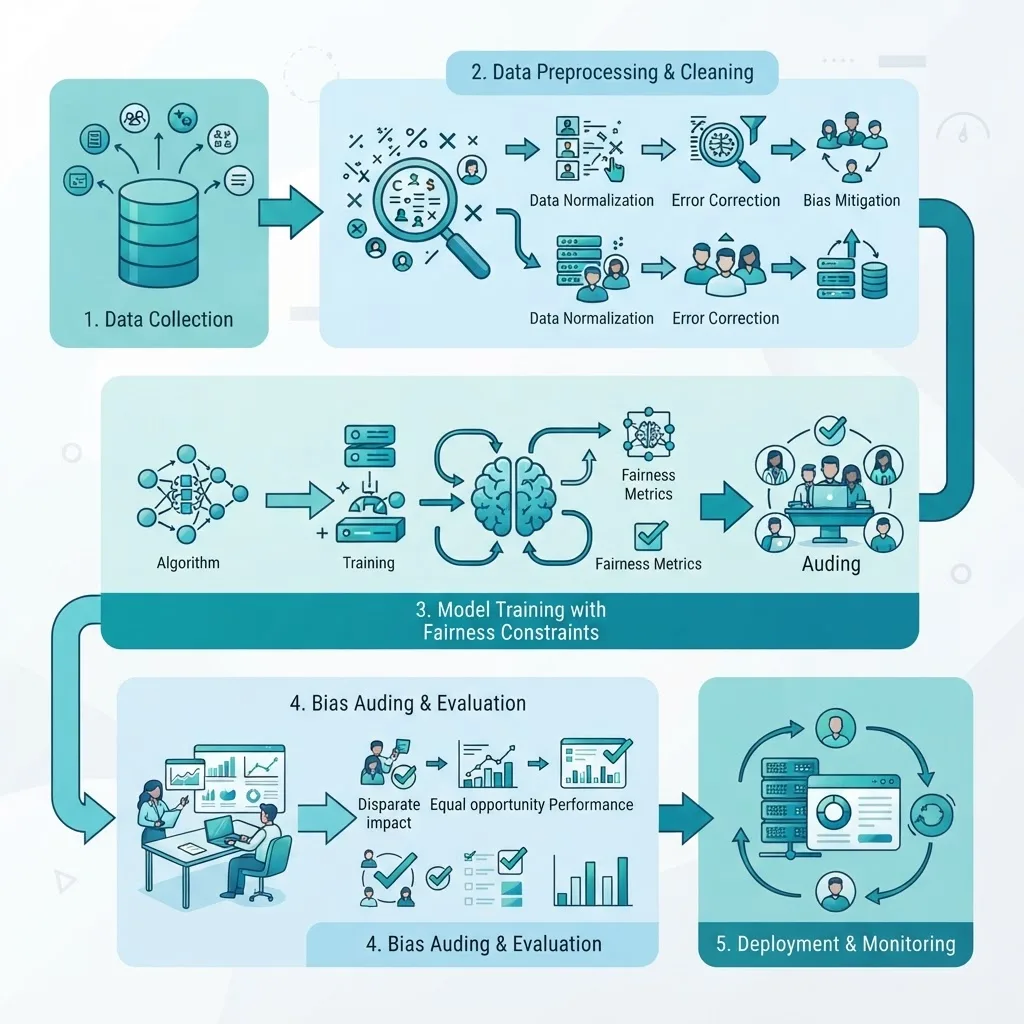
The Haas playbook organizes bias mitigation around the AI lifecycle rather than a single checkpoint. The core idea is that fairness must be considered from problem definition through post-deployment monitoring, because bias can enter at any stage.
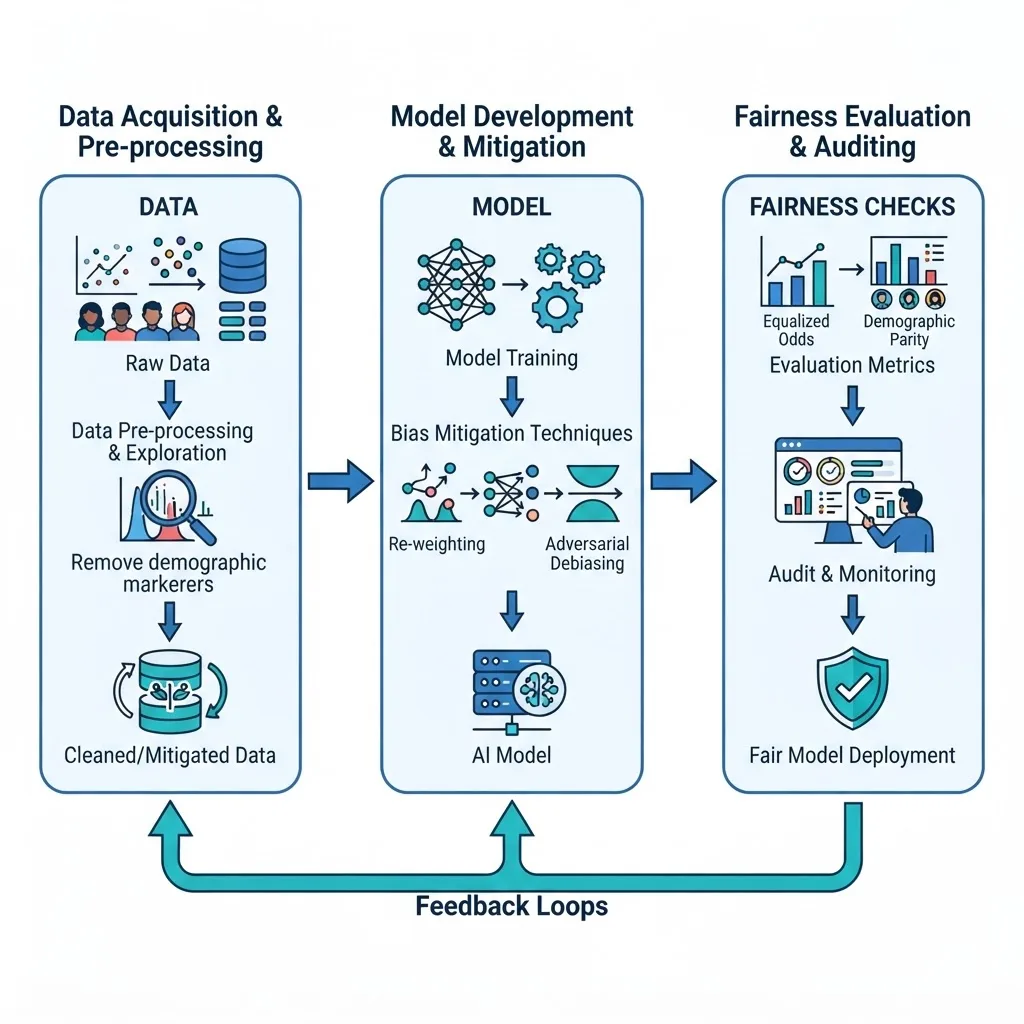
Here is a practical adaptation of the framework in a sequence any team can follow:
- Define fairness explicitly. Decide what a fair outcome means for your specific use case before building anything. Different definitions of fairness are mathematically incompatible, so you must choose deliberately.
- Interrogate the training data. Examine who is represented, who is missing, and what historical inequalities the data may encode.
- Choose and document the model. Favor interpretable models where the stakes are high, and record design decisions for accountability.
- Test across subgroups. Measure performance separately for different demographic groups, not just overall accuracy.
- Involve diverse stakeholders. Include people who will be affected by the system, especially from marginalized groups.
- Monitor continuously. Track outcomes after launch, because model performance and fairness drift as real-world data changes.
How to Test AI Systems for Fairness
Testing for fairness means going beyond a single accuracy score. A model that is 95 percent accurate overall can still be 80 percent accurate for one group and 99 percent for another, hiding serious disparities behind an impressive headline number.

Several fairness metrics are commonly used, and they trade off against each other. The table below compares the most practical approaches teams evaluate during audits.
| Fairness Approach | What It Measures | Best For | Limitation |
|---|---|---|---|
| Demographic parity | Equal positive rates across groups | Broad access decisions | Ignores real differences in outcomes |
| Equal opportunity | Equal true positive rates across groups | High-stakes selection like lending | Needs reliable labeled outcomes |
| Predictive parity | Equal accuracy of positive predictions | Risk scoring | Can conflict with equal opportunity |
| Individual fairness | Similar people get similar outcomes | Personalized decisions | Hard to define similarity objectively |
The key takeaway is that no single metric guarantees fairness. Teams must select the metric that matches the ethical priorities of the specific decision, then document why they chose it.
Building Responsible AI Governance
Technical fixes fail without organizational structure to support them. Berkeley Haas stresses that governance, the policies and accountability that surround AI, is what makes bias mitigation durable rather than a one-time project.

Effective governance includes clear ownership of AI outcomes at the executive level, diverse teams that can spot blind spots others miss, documented model cards that explain how each system works and its limitations, and an escalation path for people harmed by automated decisions. Research from McKinsey and other analysts has repeatedly found that diverse teams make better, less biased decisions, which reinforces why representation is a technical asset and not only a moral one.
Organizations that lack in-house expertise can accelerate responsible adoption by working with experienced partners. Agencies like ZoneTechify and WebPeak help businesses build AI systems with fairness and governance baked in from the start rather than retrofitted after problems surface.
The Future of Ethical AI
Regulation is catching up fast. The European Union's AI Act, the first comprehensive AI law, imposes strict requirements on high-risk systems including obligations around data quality and bias testing. In the United States, the NIST AI Risk Management Framework gives organizations a voluntary but increasingly expected standard for managing bias and other risks.

The direction is clear: fairness is moving from a nice-to-have to a compliance requirement and a competitive differentiator. Companies that treat bias mitigation as core engineering, the way Berkeley Haas advocates, will be positioned to earn trust, avoid legal exposure, and deploy AI that genuinely serves everyone it touches.
Key Takeaways
- Berkeley Haas, through its Center for Equity, Gender, and Leadership, frames mitigating AI bias as a leadership responsibility, not only a technical task.
- Bias enters AI through data, labeling, proxies, historical inequality, and aggregation, so mitigation must span the entire model lifecycle.
- A model can be highly accurate overall while performing poorly for specific groups, which is why subgroup testing is essential.
- Fairness metrics trade off against each other, so teams must consciously choose the definition that fits their use case.
- Strong governance, diverse teams, documentation, and continuous monitoring make bias mitigation durable and defensible.
Frequently Asked Questions (FAQ)
What is Berkeley Haas known for in AI bias research?
Berkeley Haas is known for its Center for Equity, Gender, and Leadership and its playbook on mitigating bias in artificial intelligence. It reframes bias as a business leadership issue, giving executives practical guidance to audit data, test models, and govern AI responsibly across the full lifecycle.
Why does AI become biased in the first place?
AI becomes biased mainly because it learns from historical data that reflects existing social inequalities. When training data underrepresents certain groups or encodes past discrimination, the model reproduces those patterns at scale. Labeling choices, proxy variables, and applying one model to diverse populations also introduce bias.
Can AI bias be completely eliminated?
AI bias usually cannot be eliminated entirely, but it can be measured, reduced, and managed. Different fairness definitions are mathematically incompatible, so trade-offs are unavoidable. The realistic goal is to identify harms, minimize them deliberately, document decisions, and continuously monitor systems for drift after deployment.
How do you test an AI model for fairness?
You test an AI model for fairness by measuring performance separately across demographic groups instead of relying on overall accuracy. Teams apply metrics like demographic parity or equal opportunity, compare outcomes between groups, involve affected stakeholders, and audit results regularly to catch disparities that aggregate numbers hide.
Who is responsible for biased AI decisions?
Responsibility for biased AI decisions rests with the organization that deploys the system, including its executives, not just the engineers who built it. Berkeley Haas emphasizes that leaders who fund and approve AI must ensure proper auditing, governance, and accountability for the outcomes their systems produce.