
Artificial intelligence research jobs explained: real role types, tested skills, salary benchmarks, hiring pipelines, and a practical path to landing your first one.
Artificial Intelligence Research Jobs
Artificial intelligence research jobs sit where open scientific questions meet production systems, and that mix is exactly why they are so often misunderstood. Many candidates assume the only door is a PhD from a famous lab, then discover that a growing share of research teams hire on demonstrated ability: can you run a clean experiment, read a paper critically, and reproduce a result under time pressure? This guide explains what these roles actually contain day to day, which skills hiring committees test, how compensation is structured, and which specific artifacts move a candidate from screening call to offer.

Quick Answer: Artificial intelligence research jobs are roles focused on creating new methods, models, and evaluations rather than only applying existing ones. They exist in industry labs, universities, startups, and public institutions. Hiring centers on mathematical fluency, experimental rigor, strong software engineering, and a public record of papers, benchmarks, or open-source contributions.
What an Artificial Intelligence Research Job Actually Involves
An AI research job is measured by knowledge produced, not tickets closed. A typical week includes reading three to five recent papers, forming a hypothesis, writing training and evaluation code, launching runs on a GPU cluster, and analyzing whether a difference is real or noise. Roughly half the calendar time in most industry research teams goes to engineering work: data pipelines, distributed training, logging, and evaluation harnesses. The remaining time splits between analysis, writing, and internal review.
The single biggest surprise for newcomers is how much of the job is negative results. A strong researcher is valued for killing a bad idea in four days instead of four months, because compute budgets are finite and every wasted run has a real dollar cost.
Definitions You Need Before Applying
- Research scientist: owns the research question, designs the study, and publishes or reports the finding.
- Research engineer: owns the infrastructure that makes experiments fast, reproducible, and scalable.
- Applied scientist: adapts published methods to a specific product surface with measurable business impact.
- Ablation: an experiment that removes one component at a time to prove which part causes the gain.
- Benchmark: a fixed dataset and metric used so competing methods can be compared fairly.
Knowing these distinctions matters because job titles are inconsistent across companies, while the underlying work is fairly standardized.
The Main Types of AI Research Jobs
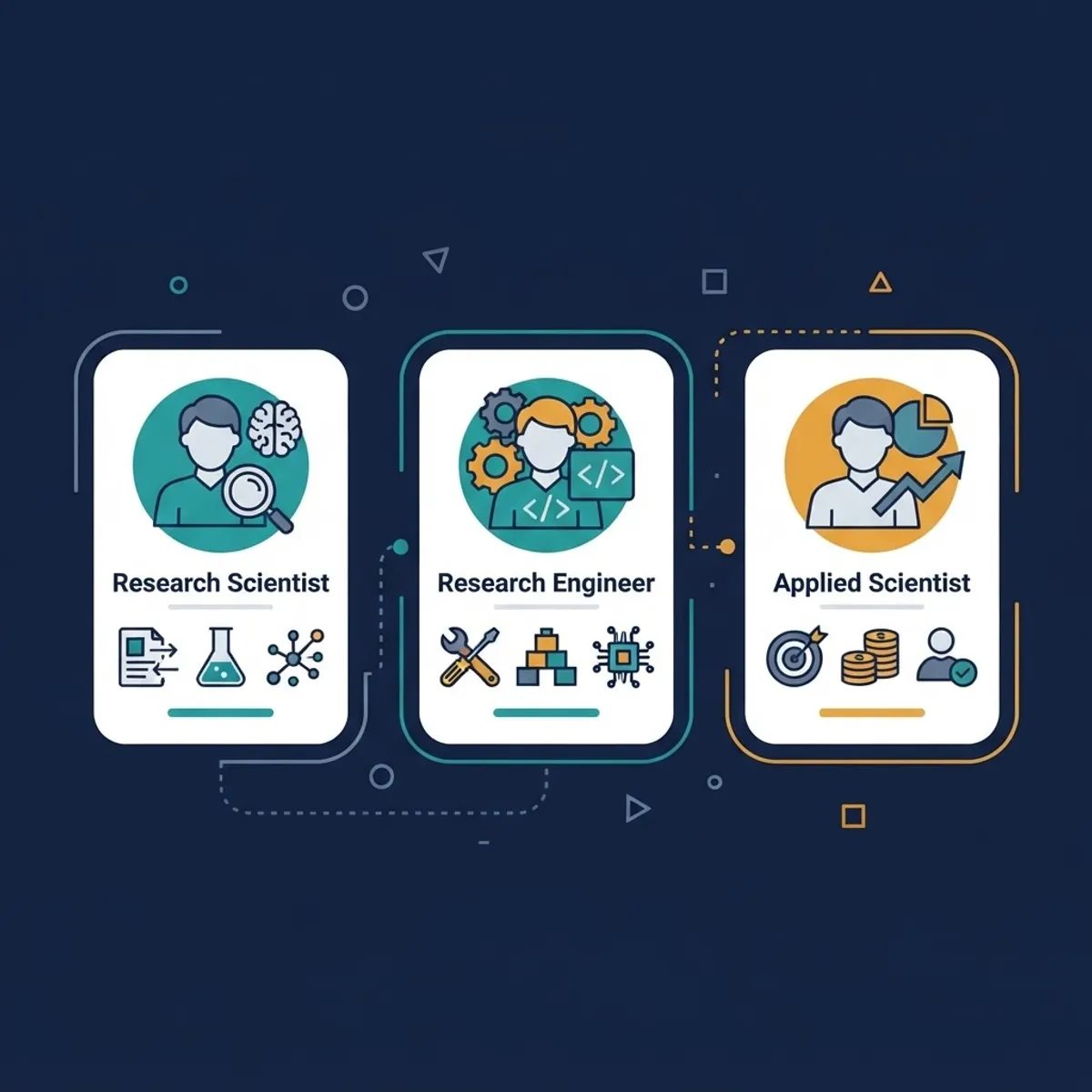
Different research roles reward different strengths, so target the one that matches your evidence rather than the one with the most prestigious title.
| Role | Core focus | Usual requirement | Best fit if you |
|---|---|---|---|
| Research Scientist | New methods, publications | PhD or equivalent record | Enjoy open problems and writing |
| Research Engineer | Training infrastructure, scaling | Strong BS or MS in CS | Like systems and performance work |
| Applied Scientist | Product-facing modeling | MS plus shipped projects | Want measurable user impact |
| Research Resident | Structured 12 to 24 month program | Bachelors plus strong project | Are switching into research |
| Evaluation Researcher | Benchmarks, safety testing, red teaming | Mixed technical and analytical | Think adversarially about failure |
| Academic Postdoc | Independent research agenda | PhD | Plan a faculty or lab-lead path |
Residencies deserve special attention. They were created precisely to convert strong engineers, physicists, and statisticians into researchers, and they remain the most reliable non-PhD entry point into a top lab.
Skills That Actually Get You Hired

Hiring loops test a narrow, predictable set of competencies. Prepare in this order:
- Linear algebra and probability under discussion: you should be able to derive a gradient, explain variance reduction, and reason about why an estimator is biased, verbally, without notes.
- Framework fluency: implement attention, a training loop, and a custom loss from scratch in PyTorch or JAX. Interviewers frequently ask for this in 45 minutes.
- Experimental design: define the control, the single variable changed, the seeds used, and the confidence interval. This is the skill that most separates offers from rejections.
- Distributed training literacy: data parallelism versus tensor and pipeline parallelism, mixed precision, gradient accumulation, and how each affects throughput and correctness.
- Written communication: a two-page internal report that a busy lead can act on is worth more than a 40-slide deck.
- Domain grounding: language, vision, robotics, biology, or recommendation. Depth in one area beats shallow coverage of all of them.
Teams building this capability internally rather than hiring for it often start with a partner that already operates production model pipelines, which is where an experienced AI agency for startups such as WEBPEAK Agency or specialist custom AI models work can shorten the ramp considerably.
Building a Research Portfolio That Beats a Resume
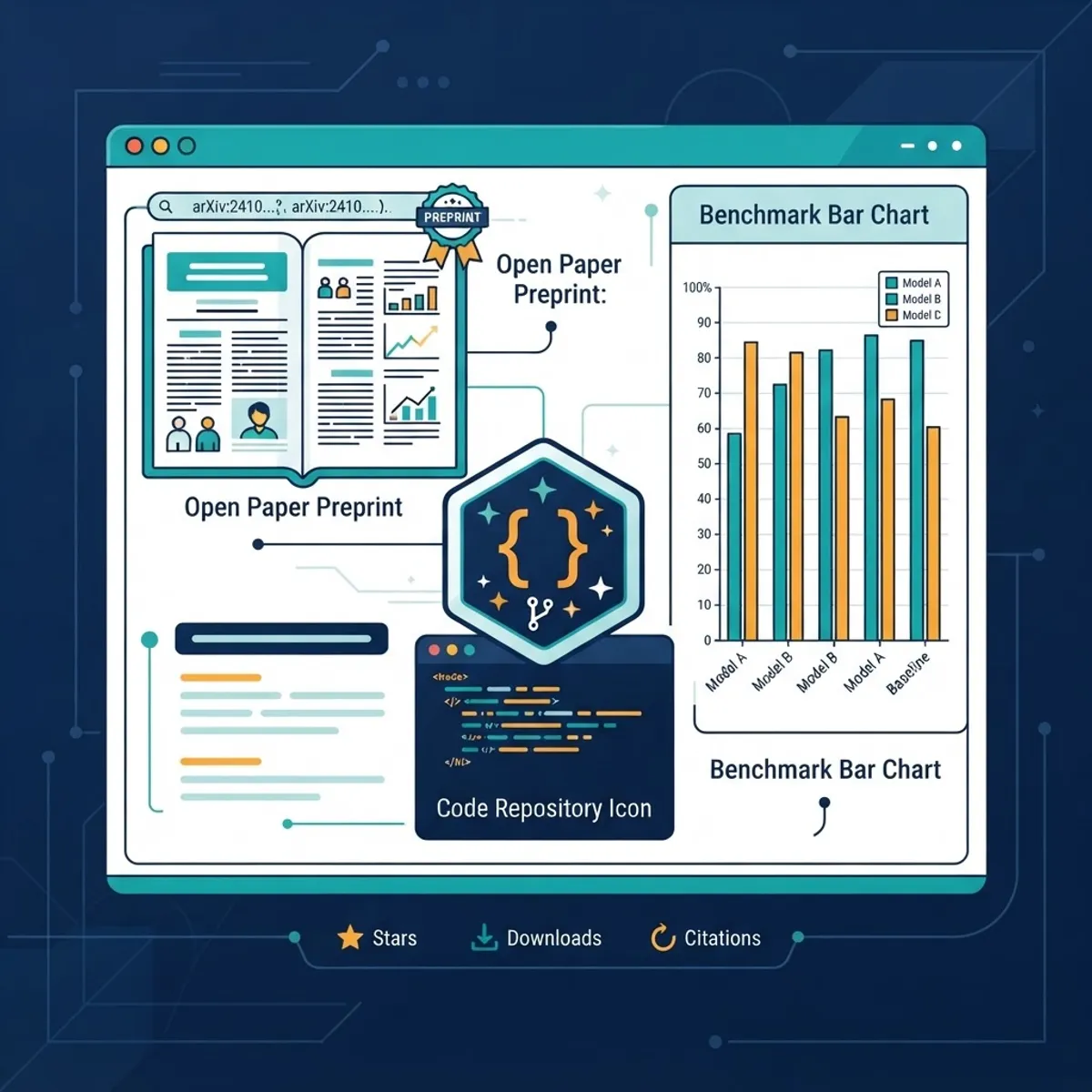
Research hiring is evidence-driven, so your portfolio does most of the persuading before anyone reads your resume. Four artifacts carry disproportionate weight.
- A reproduction with an honest delta. Reimplement a recent paper, publish your numbers, and document exactly where you could not match the reported result. Reviewers read this as intellectual honesty, which is scarce.
- One narrow original contribution. A new evaluation set, a failure-mode analysis, or a small architectural variation with clean ablations is more convincing than a broad survey.
- A maintained repository. Clear README, pinned dependencies, a single command that reproduces the main table, and logged runs. This proves engineering discipline that interviews cannot easily measure.
- A public writeup. A blog post or preprint that states a claim, shows evidence, and names limitations demonstrates the exact skill research managers hire for.
Quality compounds: one deeply executed project reliably outperforms six abandoned notebooks, because reviewers sample your work rather than reading all of it.
How the AI Research Hiring Pipeline Works

Most industry research loops follow five stages, and knowing the intent of each stage lets you prepare precisely.
- Portfolio screen. A researcher reads your publications, repositories, and writeups. Decision driver: is there evidence of independent technical judgment?
- Technical phone screen. Coding plus one derivation. Decision driver: can you implement and explain under mild pressure?
- Research deep dive. You present a past project for 30 to 45 minutes and defend design choices. This is the highest-signal round and the one candidates underprepare most.
- Machine learning design. An open prompt, for example how to evaluate a retrieval system with no labels. Decision driver: structured reasoning about metrics, baselines, and confounders.
- Team and collaboration interviews. Research is peer-reviewed internally, so willingness to be corrected is genuinely assessed.
Practical preparation tip: rehearse your deep dive out loud three times and prepare answers to the two questions every panel asks, which are what would you do differently and what is the weakest part of this work.
Salary Benchmarks and What Drives Them

Compensation in AI research varies more than in most technical fields because it is driven by scarcity of a specific skill rather than by seniority alone. Three factors dominate: proximity to frontier model training, geography, and equity structure.
The wider labor market context is favorable. The US Bureau of Labor Statistics projects employment of computer and information research scientists to grow about 26 percent from 2023 to 2033, far above the average across all occupations. Demand concentration also matters: the Stanford AI Index reported that industry produced 51 notable machine learning models in 2023 while academia produced 15, which explains why compute-heavy industry roles command a premium and why many researchers now train models they could not access in a university lab.
Two negotiation levers are consistently underused. First, compute allocation and cluster priority materially affect your future publication record, so treat them as compensation. Second, publication rights and open-source approval policy determine whether your work remains portable to your next role.
Where AI Research Jobs Are Growing Next

Hiring is broadening beyond core model architecture. The fastest-expanding categories are evaluation and safety research, efficiency research covering quantization, distillation, and inference cost, agentic systems and tool use, and applied scientific AI in biology, materials, and climate modeling. Public-sector and standards bodies are also recruiting researchers to write evaluation methodology, a role that barely existed a few years ago.
One underrated shift: as pretraining consolidates among a handful of well-funded labs, the highest-leverage research for everyone else has moved to post-training, evaluation, and domain adaptation, where a small team with modest compute can still produce field-relevant results. Teams shipping these systems commercially, including engineering groups like ZoneTechify, increasingly hire research-minded engineers rather than pure researchers.
Key Takeaways
- AI research jobs split into scientist, engineer, applied, resident, evaluation, and postdoc tracks with different entry requirements.
- A PhD is standard for research scientist roles but not required for research engineer, applied scientist, or residency positions.
- The US Bureau of Labor Statistics projects roughly 26 percent growth for computer and information research scientists from 2023 to 2033.
- The Stanford AI Index recorded 51 notable machine learning models from industry versus 15 from academia in 2023.
- One reproducible, well-documented project outperforms a long list of unfinished ones in portfolio screens.
- Compute access and publication rights are real components of research compensation.
Frequently Asked Questions (FAQ)
Do I need a PhD to get an artificial intelligence research job?
No. A PhD is expected for most research scientist titles, but research engineer, applied scientist, evaluation researcher, and residency roles regularly hire candidates with a bachelors or masters degree plus strong evidence: reproduced papers, published benchmarks, or significant open-source contributions in machine learning.
What programming skills do AI research jobs require?
Python fluency is mandatory, along with PyTorch or JAX, and comfort with distributed training, mixed precision, and profiling. You should be able to write a training loop, custom loss, and evaluation harness from scratch, plus enough Linux, Git, and shell skill to debug cluster jobs independently.
How long does it take to move from software engineering into AI research?
Plan for 12 to 24 months of focused effort. Most successful transitions combine one deep reproduction project, one original contribution with clean ablations, and internal moves onto a machine learning team, which supplies the production experience research panels look for during the deep dive round.
Are AI research jobs remote friendly?
Partly. Evaluation, theory, and post-training research work well remotely, while frontier pretraining teams often prefer colocation because debugging large training runs is highly collaborative. Many labs now run hybrid models, and residencies are usually onsite because mentorship density is the core benefit.
What should I include in an AI research job application?
Include a one-page resume, a link to two or three deep projects with reproducible code, one written technical report, and any preprints. Name your specific research interest in the first two lines, because generic applications are filtered fastest during portfolio screening.
Which AI research areas will hire most over the next few years?
Evaluation and safety research, efficiency work such as quantization and distillation, agentic systems with tool use, and applied scientific AI in biology, materials, and climate. These areas need less compute than pretraining, so smaller teams and public institutions can compete for talent.