
A practical guide to acing artificial intelligence in 2026, covering the four-stage adoption framework, data readiness, model selection, ROI measurement, governance, and the skills that matter.
Ace Artificial Intelligence
Most teams do not fail at artificial intelligence because the models are weak. They fail because they treat AI as a product to buy instead of a capability to build. After reviewing dozens of AI rollouts across SaaS, ecommerce, and services businesses, the pattern is consistent: the winners start with one measurable workflow, instrument it, and only then expand. The losers start with a tool subscription and hope a use case appears.
This guide shows you how to ace artificial intelligence as an operator, not a spectator. You will get the exact adoption framework, the data checks that must pass before you train or fine-tune anything, a cost comparison of the main implementation paths, and the metrics that prove value to a finance team.
Quick Answer: To ace artificial intelligence, pick one high-frequency workflow with a measurable baseline, clean the data that feeds it, start with a hosted model before building custom ones, and instrument accuracy, cost per task, and time saved from day one. Expand only after one use case proves positive ROI.

What Does It Actually Mean to Ace Artificial Intelligence?
Acing artificial intelligence means turning model capability into a repeatable business outcome you can measure in currency or hours. It is not prompt fluency and it is not tool collection.
Three definitions you need before going further:
- Artificial intelligence is the broad field of systems that perform tasks requiring human-like inference, including rules engines, machine learning, and generative models.
- Machine learning is the subset where a system learns patterns from data rather than following hand-written rules.
- Generative AI is the subset of machine learning that produces new content such as text, images, code, or audio from learned distributions.
Mixing these terms causes real budget damage. A team that asks for generative AI when it needs a classifier will overpay for inference and get less accuracy. Classification, extraction, and ranking problems are usually solved better and cheaper by smaller specialised models than by a large general one.
The 2024 Stanford AI Index reported that 78 percent of surveyed organisations said they used AI in at least one business function, up sharply from 55 percent the year prior. Meanwhile McKinsey's global AI survey has repeatedly found that only a minority of adopters attribute more than 10 percent of earnings to AI. That gap between usage and value is the entire problem this article addresses.
The Four-Stage AI Adoption Framework
Use this sequence. Skipping a stage is the most common cause of stalled projects.
Stage 1: Identify a High-Frequency, Low-Ambiguity Task
Choose a task that happens at least 50 times per week and has a clear correct answer. Support ticket triage, invoice field extraction, lead scoring, and product description drafting all qualify. Strategy writing does not, because you cannot score it.
Write down the current baseline before touching any model: average handling time, error rate, and cost per task. Without a baseline you cannot prove improvement later, and you will end up defending the project with anecdotes.
Stage 2: Audit the Data That Feeds the Task
Run these five checks before you commit engineering time:
- Volume: do you have at least a few hundred labelled examples for evaluation, even if you are not training?
- Freshness: is the data representative of the last 90 days of reality?
- Access: can a service account read it programmatically, or is it locked in someone's spreadsheet?
- Sensitivity: does it contain personal or payment data that restricts which providers you may use?
- Label quality: if two experienced staff members labelled the same 30 records, would they agree? Low human agreement caps model accuracy.
That last check is the one teams skip most often. If your own experts disagree 30 percent of the time, no model will exceed roughly 70 percent perceived accuracy, and chasing higher numbers is wasted spend.
Stage 3: Choose the Cheapest Path That Can Work
Default to a hosted general-purpose model with good prompting and retrieval. Move up in complexity only when evaluation shows the simple path failing on a specific, describable subset of cases.
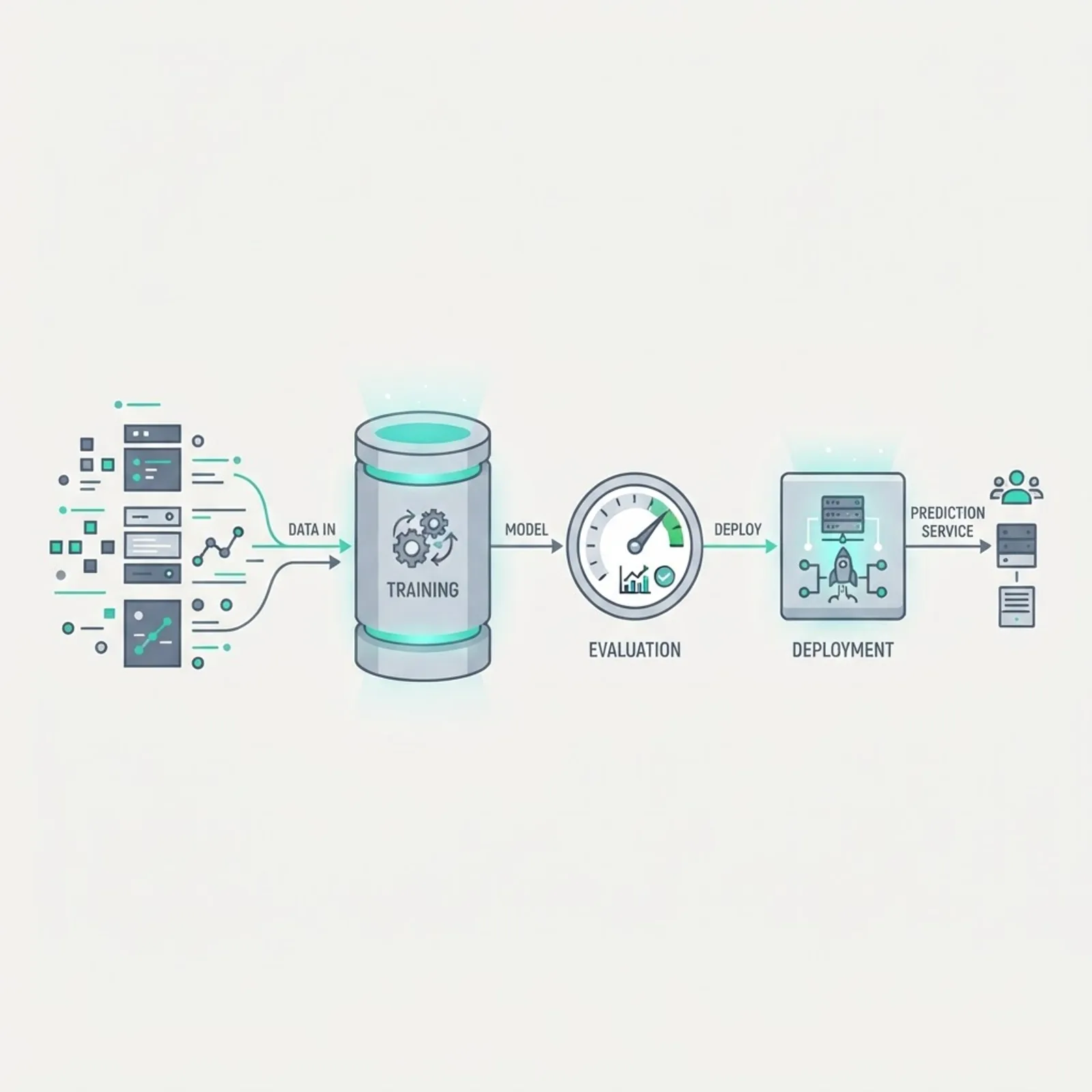
| Implementation Path | Best For | Setup Effort | Typical Cost Profile | Main Risk |
|---|---|---|---|---|
| Prompted hosted model | Drafting, summarising, classification with clear rules | Days | Pay per token, low fixed cost | Output variance between runs |
| Retrieval augmented generation | Answers grounded in your own documents | 2 to 6 weeks | Token cost plus vector storage | Poor retrieval quality is mistaken for model failure |
| Fine-tuned smaller model | Repetitive narrow tasks at high volume | 4 to 10 weeks | Higher upfront, much lower per call | Data drift needs periodic retraining |
| Custom trained model | Proprietary signals, regulated scoring | Months | High fixed engineering cost | Rarely justified below large data volumes |
The honest guidance most vendors will not give you: fewer than one in five business use cases needs anything beyond the first two rows. Retrieval quality, not model size, is the deciding factor in the majority of internal knowledge projects.
Stage 4: Instrument, Then Expand
Ship to a small user group with logging on every request and response. Review 50 outputs manually per week for the first month. You are looking for failure clusters, not individual mistakes, because clusters point to fixable causes such as missing context, ambiguous instructions, or a document set that was never indexed.
Where AI Automation Delivers Fastest

The fastest returns come from workflows that are already documented, already repetitive, and already annoying to the people doing them. In practice that means:
- Intake and routing: classifying inbound tickets, emails, or applications and assigning them to the right queue.
- Document extraction: pulling structured fields from invoices, contracts, and forms into a database.
- First-draft production: product copy, meeting summaries, release notes, and internal reports that a human then edits.
- Quality checks: flagging outliers in data entry, pricing, or code review before they reach production.
One rule protects you from expensive mistakes: keep a human in the loop wherever an error is irreversible or customer-visible. Automate the draft, not the send. Teams that need architecture help here often bring in specialists such as an AI-augmented development team to build the pipeline and hand back ownership, which is faster than hiring a full internal ML function for a single workflow.
Measuring AI Return on Investment Honestly
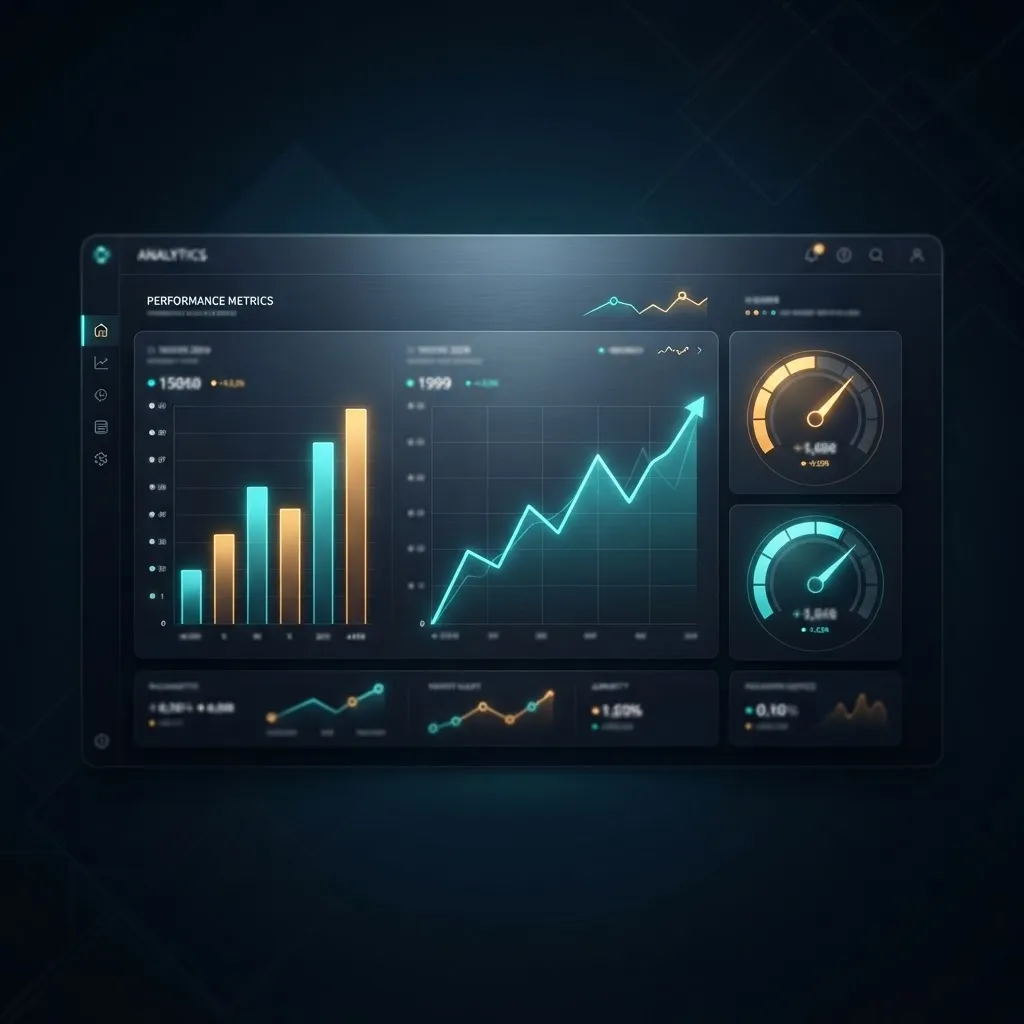
Track four numbers and ignore vanity metrics such as prompts sent or seats activated.
- Task accuracy against a frozen test set. Freeze 200 real examples with agreed correct answers. Every change gets scored against the same set so improvements are comparable.
- Cost per completed task. Include inference cost, retrieval infrastructure, and the human review minutes. Compare it directly to the Stage 1 baseline.
- Cycle time. Median minutes from task arrival to task completion, measured end to end rather than model latency alone.
- Escalation rate. The share of AI outputs a human had to substantially rewrite. Rising escalation is the earliest signal of data drift.
A realistic first-year outcome for a well-scoped internal workflow is a 20 to 40 percent reduction in handling time, not the 10x figures marketing decks promise. Present those honest numbers and you will get budget for the second use case. Promise 10x and you will lose credibility in the first quarterly review.
Governance, Privacy, and Risk Controls

Governance is not paperwork that slows delivery. It is what lets you deploy in regulated contexts without rework. Put these controls in place while the project is small, because retrofitting them later means rebuilding the data layer.
- Data minimisation: send the model only the fields the task requires. Strip identifiers before the request leaves your systems.
- Retention terms: confirm in writing whether your provider trains on your inputs and how long prompts are stored.
- Output logging: keep an immutable record of inputs, outputs, model version, and the reviewing user for every consequential decision.
- Human override: every automated decision that affects a person needs a documented appeal path.
- Evaluation on protected groups: measure accuracy separately across relevant segments. Aggregate accuracy hides discriminatory failure modes.
The EU AI Act, which entered into force in August 2024, phases obligations by risk tier through 2026 and 2027, with transparency duties for general-purpose models arriving before high-risk system requirements. If you operate in or sell into the EU, classify your use case now rather than after launch.
Skills That Separate Practitioners From Spectators

The highest-leverage skill in 2026 is not prompt writing. It is evaluation design, the ability to define what correct looks like and build a test that measures it. Everything else compounds from there.
A practical learning order that respects how the work actually happens:
- Evaluation and measurement. Learn to build test sets, score outputs, and read confusion matrices.
- Retrieval and data plumbing. Chunking strategy, embedding choice, and index hygiene decide most project outcomes.
- Systems integration. Queues, retries, timeouts, and idempotency. AI features fail in production for ordinary engineering reasons.
- Cost engineering. Caching, model routing, and knowing when a smaller model is sufficient.
- Domain depth. The person who understands the workflow beats the person who only understands the model.
For teams that would rather ship than staff up, working with an established partner shortens the loop considerably. Reviewing case work from a group like WebPeak Digital is a reasonable way to benchmark what a delivered AI feature should include, from evaluation harness to monitoring, before you sign anything.
Key Takeaways
- Stanford's AI Index found 78 percent of surveyed organisations used AI in at least one function in 2024, while McKinsey surveys show only a minority credit AI with over 10 percent of earnings.
- Human labelling agreement sets the practical accuracy ceiling for any model, so measure inter-rater agreement before training.
- Most business use cases are solved by prompting or retrieval augmented generation; fine-tuning is justified mainly by high volume and narrow scope.
- Track task accuracy on a frozen test set, cost per completed task, cycle time, and escalation rate. Ignore seat counts and prompt volume.
- A 20 to 40 percent handling-time reduction is a credible first-year target for a well-scoped internal workflow.
- The EU AI Act entered into force in August 2024 and phases obligations by risk tier, so classify use cases before launch.
Frequently Asked Questions (FAQ)
How do I start with artificial intelligence if my company has no AI experience?
Start with one repetitive workflow that happens at least 50 times a week and has a clear correct answer, such as ticket triage. Record the current handling time and error rate, then test a hosted model on 200 real examples. Expand only after that single use case shows measurable improvement.
Do I need to train my own AI model?
Usually no. Most business problems are solved with a hosted general model plus good prompting and retrieval over your own documents. Training or fine-tuning makes financial sense only when you have high, steady volume on a narrow task and clear evidence that the simpler approach fails on specific cases.
How much data do I need before using AI?
For evaluation you need a few hundred labelled examples that reflect the last 90 days of real work. For fine-tuning, plan on thousands. Data quality matters more than quantity, so check whether two experienced staff would label the same records identically before scaling anything up.
What is the biggest mistake companies make with AI projects?
Buying tools before defining a measurable task. Without a recorded baseline for handling time, error rate, and cost per task, you cannot prove value and the project dies at the first budget review. The second biggest mistake is automating irreversible, customer-facing decisions with no human review.
How do I measure whether AI is actually saving money?
Compare cost per completed task before and after, including inference spend, infrastructure, and human review minutes. Then track median cycle time and the share of outputs humans had to rewrite. Rising rewrite rates mean the model is drifting away from your current data and needs attention.
Which AI skills should I learn first in 2026?
Learn evaluation design first: defining what correct means and building a test set that measures it. Next learn retrieval and data preparation, then production engineering concerns such as retries and caching. Domain expertise in your own workflow remains the strongest advantage over general model knowledge.