
A practical guide to artificial intelligence intelligent category management, covering taxonomy design, automated product classification, attribute enrichment, and measurable retail results.
Artificial Intelligence Intelligent Category Management
Category management used to be a spreadsheet job. A merchandiser reviewed sales reports, argued about shelf space, adjusted a few assortment decisions, and moved on to the next quarter. That model breaks the moment a catalog crosses a few thousand SKUs, sells across three channels, and refreshes assortments monthly. Artificial intelligence intelligent category management replaces periodic manual review with continuous, data-driven decisions about how products are classified, grouped, priced, promoted, and retired.
This guide explains what intelligent category management actually is, which parts of it AI genuinely improves, which parts still need human judgment, and how to implement it without breaking a live catalog.
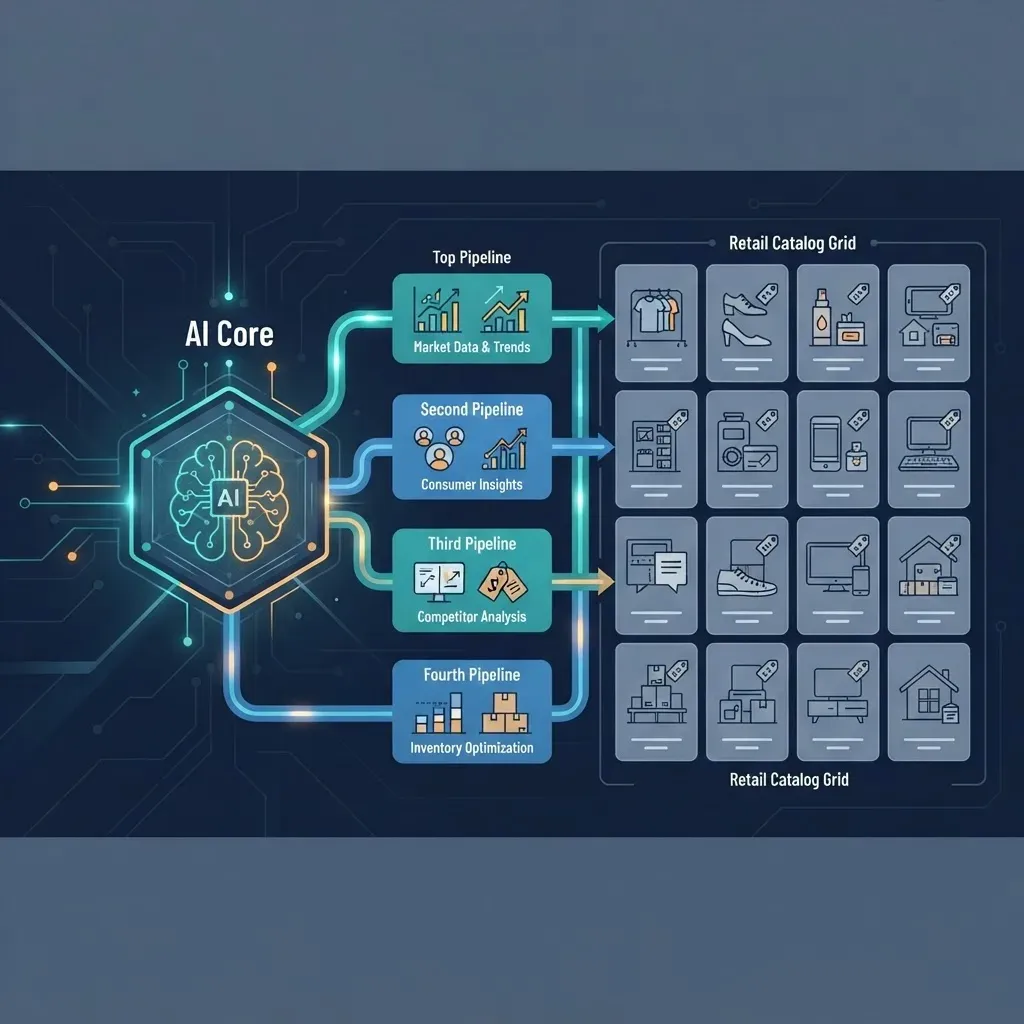
Quick Answer: Artificial intelligence intelligent category management uses machine learning to automate product classification, attribute enrichment, taxonomy optimization, and assortment decisions. Instead of merchandisers manually tagging products and reviewing categories quarterly, AI models continuously analyze sales, search, and behavioral data to keep categories accurate, discoverable, and profitable.
What Is Intelligent Category Management?
Intelligent category management is the practice of treating a product category as a continuously optimized system rather than a static folder. Three definitions matter before going further.
Category management is the discipline of managing groups of related products as individual business units, each with its own assortment, pricing, promotion, and profitability targets.
Product taxonomy is the hierarchical structure that organizes those products, typically department to category to subcategory to product type, plus the attributes attached at each level.
Intelligent category management adds a machine learning layer that ingests transactional data, search queries, browsing behavior, returns, and competitor signals, then recommends or automatically applies changes to classification, attribute values, and assortment composition.
The difference is cadence and coverage. Human teams review the top 10 percent of a catalog well and neglect the long tail. Models review 100 percent of the catalog every time data refreshes.
Why Manual Category Management Fails at Scale
The failure is arithmetic, not effort. A merchandiser can carefully maintain roughly 300 to 500 SKUs, including attributes, imagery checks, and placement logic. A mid-size retailer with 40,000 SKUs would need 80 to 130 full-time merchandisers to maintain the same quality. Nobody staffs that, so quality degrades silently.
The symptoms are consistent across catalogs:
- Products land in a generic catch-all category because no one had time to place them properly.
- Attribute coverage is strong on new arrivals and thin on anything older than a year.
- Duplicate or near-duplicate categories accumulate as different teams create their own paths.
- Filters return empty result sets because the attribute powering them is only populated on 30 percent of items.
- Seasonal categories stay live months after relevance ends.
Each symptom directly suppresses revenue. Research consistently shows that roughly 30 percent of ecommerce visitors use site search, and searchers convert at meaningfully higher rates than browsers, which means classification and attribute quality sit directly on the highest-intent path in the store. Baymard Institute usability research has also repeatedly found that a majority of ecommerce sites fail basic category and filtering expectations, with faceted navigation among the most commonly mishandled areas.

How AI Actually Improves Category Management
AI is not one capability here. It is four distinct jobs, and they mature in a specific order.
1. Automated Product Classification
A supervised classification model learns from your existing well-categorized products, then assigns new or misplaced items to the correct node in your taxonomy. Modern implementations combine text signals from titles and descriptions with image embeddings, because a product photo often resolves ambiguity that text cannot.
The critical design decision is confidence thresholding. Route high-confidence predictions straight to publish, send mid-confidence predictions to a human review queue, and flag low-confidence items as taxonomy gaps. That single pattern is what makes automation safe.

2. Attribute Extraction and Enrichment
Large language models extract structured attributes from unstructured supplier copy. Material, fit, capacity, compatibility, and dimensions can be pulled from a paragraph of vendor text and written into normalized fields.
This is the highest-return use case for most retailers because attributes power filters, comparison tables, structured data, and recommendation relevance simultaneously. Fixing attributes fixes several downstream systems at once.

3. Taxonomy Optimization
Unsupervised clustering on customer behavior reveals how shoppers actually group products, which is frequently not how internal teams group them. If a cluster of items is consistently viewed together but sits across four separate categories, that is evidence for a new category or a cross-listing rule.
This is where AI generates insight rather than efficiency. It surfaces category structures nobody thought to propose.

4. Assortment and Performance Intelligence
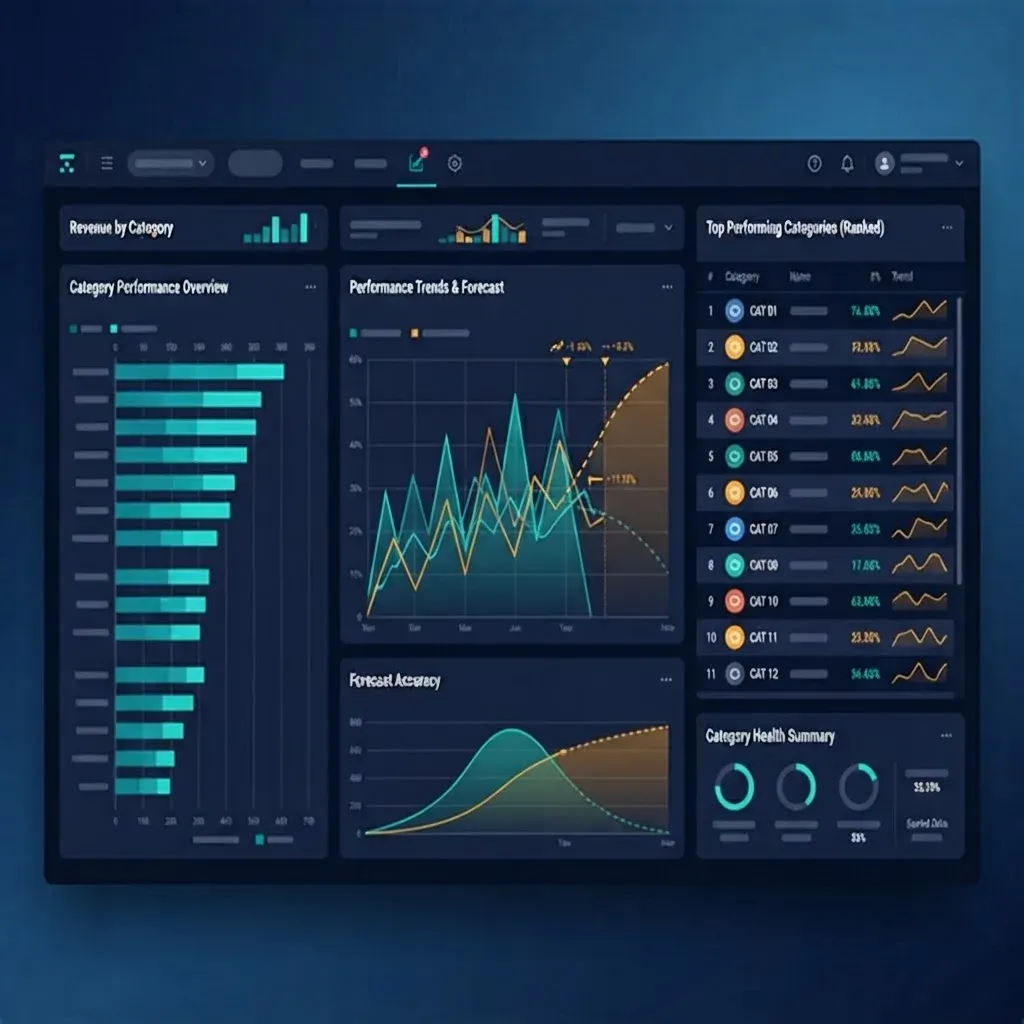
Forecasting models score each category on demand trend, margin contribution, cannibalization risk, and stock-out probability. The output is a prioritized action list: expand this subcategory, delist these nine SKUs, reorder early on this seasonal line.
Manual vs AI-Assisted Category Management
| Dimension | Manual Category Management | AI-Assisted Category Management |
|---|---|---|
| Catalog coverage | Top-selling 10 to 20 percent | Full catalog, every refresh cycle |
| Classification speed | Minutes per SKU | Sub-second per SKU at scale |
| Attribute completeness | Typically 40 to 70 percent | 85 to 95 percent achievable |
| Review cadence | Quarterly or seasonal | Continuous or daily |
| Consistency | Varies by individual reviewer | Uniform rules, auditable logic |
| Long-tail handling | Routinely neglected | Treated identically to bestsellers |
| Human role | Data entry plus decisions | Exception handling plus strategy |
| Failure mode | Silent quality decay | Visible confidence scores and drift alerts |
The last row matters most. Manual systems fail quietly. AI systems fail loudly, with measurable confidence drops, which makes problems fixable.
A Practical Implementation Roadmap
Skipping straight to model deployment is the most common and most expensive mistake. Follow this order.
Step 1: Audit the current taxonomy. Export every category path with SKU counts, attribute fill rates, revenue, and conversion rate. Categories with fewer than five products or zero conversions in 12 months are candidates for consolidation before any AI touches them.
Step 2: Fix your ground truth. A classification model trained on a messy taxonomy learns the mess. Hand-correct a representative sample of 2,000 to 5,000 products across every branch. This is unglamorous and non-negotiable.
Step 3: Define attribute schemas per category. Footwear needs size, width, material, and closure type. Monitors need panel type, refresh rate, and resolution. Generic schemas produce generic filters.
Step 4: Pilot on one category. Choose a category with high SKU volume and clear attributes. Measure classification accuracy, attribute precision, filter usage, and category conversion rate against a control category.
Step 5: Add human-in-the-loop review. Build the confidence-based review queue before scaling, not after an incident.
Step 6: Scale with monitoring. Track model drift, override rates, and category-level revenue weekly. A rising override rate is the earliest signal that your taxonomy or model needs retraining.
Teams that need this built into a live storefront usually pair a data layer with production engineering, which is why implementations often run alongside AI automation services rather than as a standalone data science project. Similar architecture and delivery patterns are documented by WebPeak Digital for retailers moving from manual merchandising to automated pipelines.

Mistakes That Undermine AI Category Management
- Full automation with no review queue. One bad batch can miscategorize thousands of products and tank category traffic before anyone notices.
- Optimizing classification accuracy alone. A model can be 96 percent accurate and still hurt revenue if it collapses useful subcategories.
- Ignoring URL and SEO implications. Restructuring a taxonomy changes URLs. Without proper redirects, organic traffic to category pages disappears.
- Training on supplier taxonomies. Vendor categories reflect manufacturing logic, not shopper intent.
- Treating it as a one-time project. Catalogs change constantly. A model deployed once and never retrained decays within months.
Key Takeaways
- Intelligent category management applies machine learning to classification, attribute enrichment, taxonomy structure, and assortment decisions on a continuous cycle.
- Manual merchandising realistically covers 300 to 500 SKUs per person, which is why large catalogs degrade in quality rather than through lack of effort.
- Attribute extraction usually delivers the fastest measurable return because filters, structured data, and recommendations all depend on the same fields.
- Confidence thresholding with a human review queue is the single most important safety mechanism in any automated classification pipeline.
- Clean training data matters more than model sophistication. Correct 2,000 to 5,000 products by hand before training.
- Taxonomy changes are SEO changes. Plan redirects before restructuring category URLs.
Frequently Asked Questions (FAQ)
What is AI category management in simple terms?
It is using machine learning to keep product categories accurate and profitable automatically. Instead of merchandisers manually sorting products and reviewing categories every quarter, models classify items, fill in missing attributes, and flag underperforming categories continuously across the entire catalog.
Can AI fully replace human category managers?
No. AI handles classification, enrichment, and pattern detection at scale, but humans still own strategy, vendor negotiation, brand positioning, and edge-case judgment. The realistic outcome is that merchandisers stop doing data entry and spend their time on decisions that actually require commercial context.
How much product data do I need before starting?
Plan for at least 2,000 to 5,000 correctly categorized products spread across every branch of your taxonomy. Coverage across branches matters more than raw volume. A model trained only on your top sellers will misclassify long-tail items where the biggest quality gaps exist.
Will restructuring my categories hurt SEO?
It can, if handled carelessly. Category URL changes require 301 redirects, updated internal links, and a refreshed sitemap. Done properly, better taxonomy usually improves organic performance because category pages become more topically focused and filters generate genuinely useful landing pages.
How do I measure whether it is working?
Track four metrics per category: classification accuracy against human review, attribute completeness percentage, filter usage rate, and category-level conversion rate. Compare pilot categories against untouched control categories. Revenue per category visitor is the metric that ultimately settles the argument.
How long does implementation usually take?
A single-category pilot typically runs four to eight weeks including audit, data cleanup, and measurement. Full catalog rollout depends on SKU count and taxonomy complexity, but most retailers reach broad coverage within one to two quarters when data cleanup is done properly first.