
Learn how artificial intelligence transforms knowledge management, why PDF research still matters, and how to build an AI knowledge system that works.
Artificial Intelligence and Knowledge Management Filetype:PDF
The search query "artificial intelligence and knowledge management filetype:pdf" is a research shortcut. The filetype operator tells a search engine to return only PDF documents, which is where academic papers, whitepapers, standards drafts, and enterprise research reports usually live. People who type it are not looking for a blog roundup. They want primary source material on how AI changes the way organizations capture, store, retrieve, and reuse knowledge. This article explains what that operator does, what the PDF literature actually covers, and how to translate that research into a working system.
Quick Answer: Adding filetype:pdf to a search for artificial intelligence and knowledge management restricts results to PDF files, surfacing academic papers, whitepapers, and standards documents instead of blog posts. It is the fastest way to find primary research on AI-driven knowledge capture, retrieval, classification, and governance inside organizations.
Table of Contents
- What Filetype:PDF Means and Why Researchers Use It
- What Knowledge Management Actually Is
- Where AI Fits Into the Knowledge Lifecycle
- How AI Reads PDF Knowledge Assets
- Traditional Versus AI-Assisted Knowledge Management
- How to Build an AI Knowledge System in Seven Steps
- Governance, Security, and Known Limitations
- Measuring Whether the System Works
- Key Takeaways
- Frequently Asked Questions
What Filetype:PDF Means and Why Researchers Use It
Filetype is a search operator supported by Google and Bing that filters results by document format. Typing artificial intelligence and knowledge management filetype:pdf returns only files served with a PDF extension. The operator has existed in Google since the early 2000s and remains one of the few advanced operators that still works reliably.
Researchers use it for three practical reasons. PDFs carry stable pagination, which makes them citable. They are the default publishing format for peer-reviewed journals, university theses, and consultancy whitepapers. And they are rarely rewritten after publication, so a citation stays accurate.
Better Search Variations to Try
- Combine with a domain filter:
site:.edu artificial intelligence knowledge management filetype:pdf - Target a framework:
knowledge management maturity model filetype:pdf - Target a mechanism:
retrieval augmented generation enterprise filetype:pdf - Add a year range using the search tools panel rather than typing a year, since many PDFs list multiple dates
One limitation is worth knowing. The operator finds documents but says nothing about quality. A vendor whitepaper and a peer-reviewed study both match. Check the author, the publishing institution, and whether the methodology section exists before citing anything.

What Knowledge Management Actually Is
Knowledge management, commonly abbreviated KM, is the discipline of creating, capturing, organizing, sharing, and applying an organization's collective knowledge. It is not the same as document storage. Storage is where files sit. Knowledge management is whether a person can find the right answer at the moment of need.
The field distinguishes two categories that shape every AI decision downstream. Explicit knowledge is recorded and transferable, such as a written policy, a design specification, or a signed contract. Tacit knowledge lives in experience and judgment, such as knowing which client dislikes phone calls or which deployment step tends to fail on Fridays.
AI handles explicit knowledge well because explicit knowledge is already text. Tacit knowledge is harder. AI can only reach it once someone converts it into a written form, which is why meeting transcription and support ticket summarization have become common entry points.
The Cost of Poor Knowledge Management
The widely cited International Data Corporation estimate that knowledge workers spend roughly a quarter of their working time searching for information is more than two decades old and predates modern search. Treat it as directional rather than current. The useful version of that claim is measurable inside your own organization. Log how long support agents take to resolve a first-contact question, then measure the same figure after deployment. Internal baselines beat borrowed statistics.
Where AI Fits Into the Knowledge Lifecycle
AI contributes at four distinct stages, and confusing them is the most common planning mistake.
- Capture. Speech-to-text converts calls and meetings into searchable text. Optical character recognition extracts text from scanned PDFs and images.
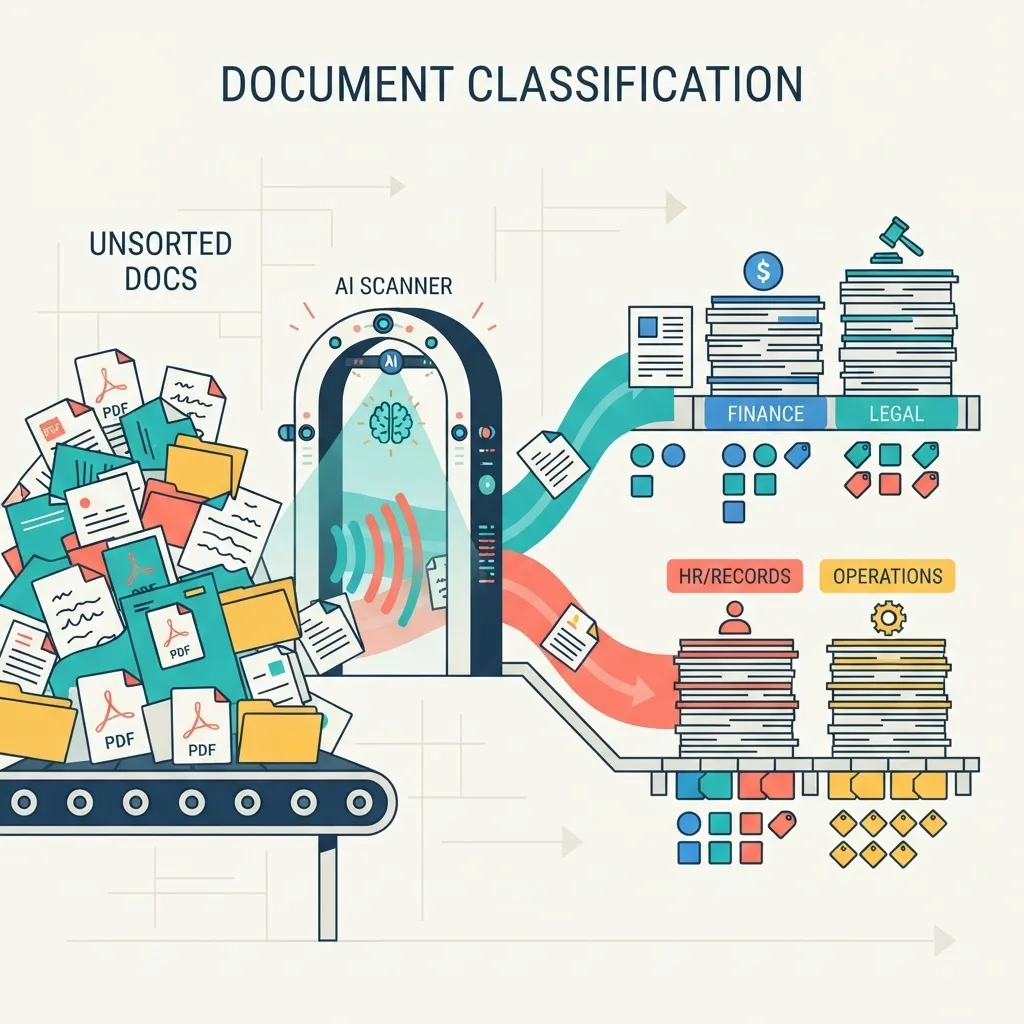
- Organize. Classification models assign categories, extract entities such as client names and dates, and detect near-duplicate documents.
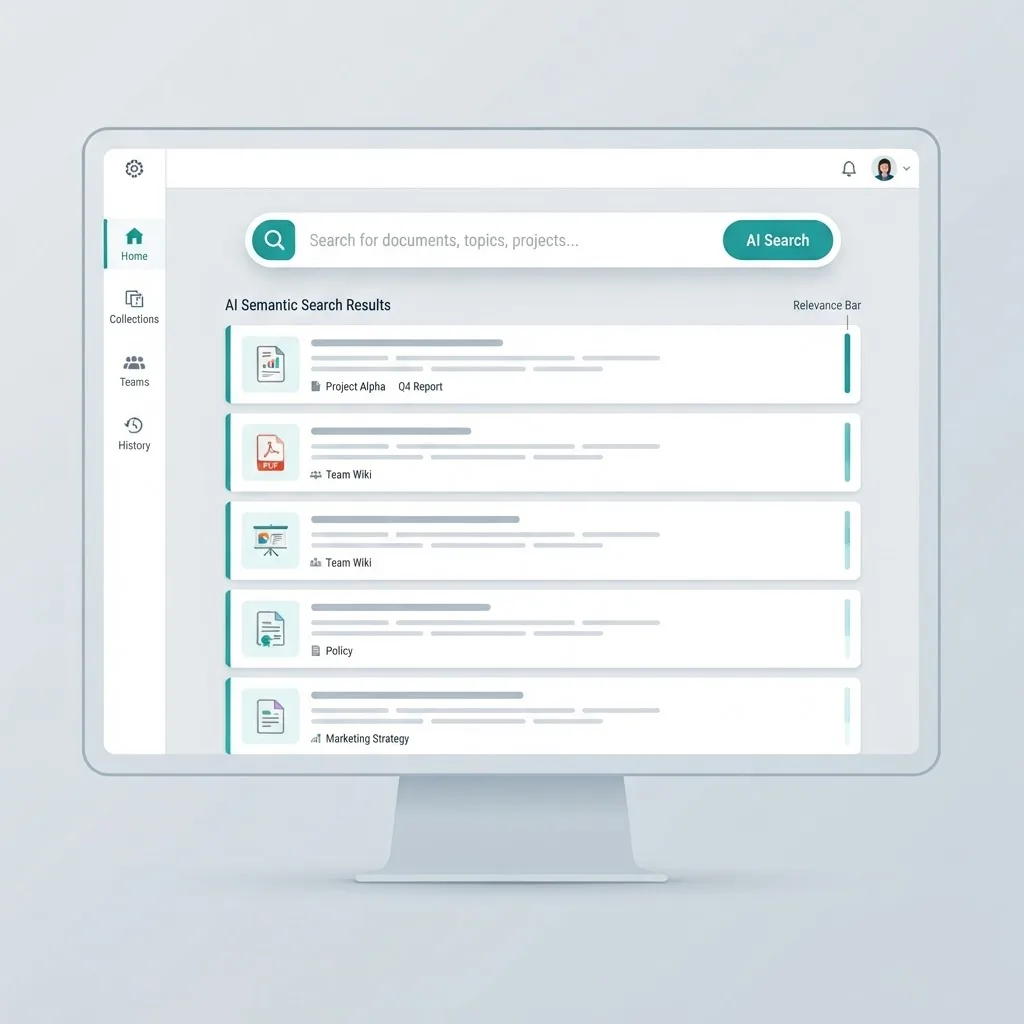
- Retrieve. Embedding models convert text into numeric vectors so a query matches meaning rather than exact keywords. A search for "time off policy" finds a document titled "Annual Leave Guidelines."
- Apply. Language models draft answers, summaries, and comparisons grounded in retrieved passages.
Only stage four is generative. Stages one through three are the unglamorous work that determines whether stage four produces something trustworthy. Teams that skip straight to a chatbot on top of a messy repository get fluent answers built on stale documents.
How AI Reads PDF Knowledge Assets
PDF is a layout format, not a data format. It describes where characters appear on a page, not what those characters mean. That distinction causes most extraction failures.
Three PDF varieties behave differently:
- Digital text PDFs contain a real text layer and extract cleanly.
- Scanned PDFs are images of pages and require OCR, which introduces character errors, especially in tables and footnotes.
- Hybrid PDFs mix both, so a single file can extract perfectly for ten pages and return nothing for the eleventh.
The Retrieval Augmented Generation Pipeline
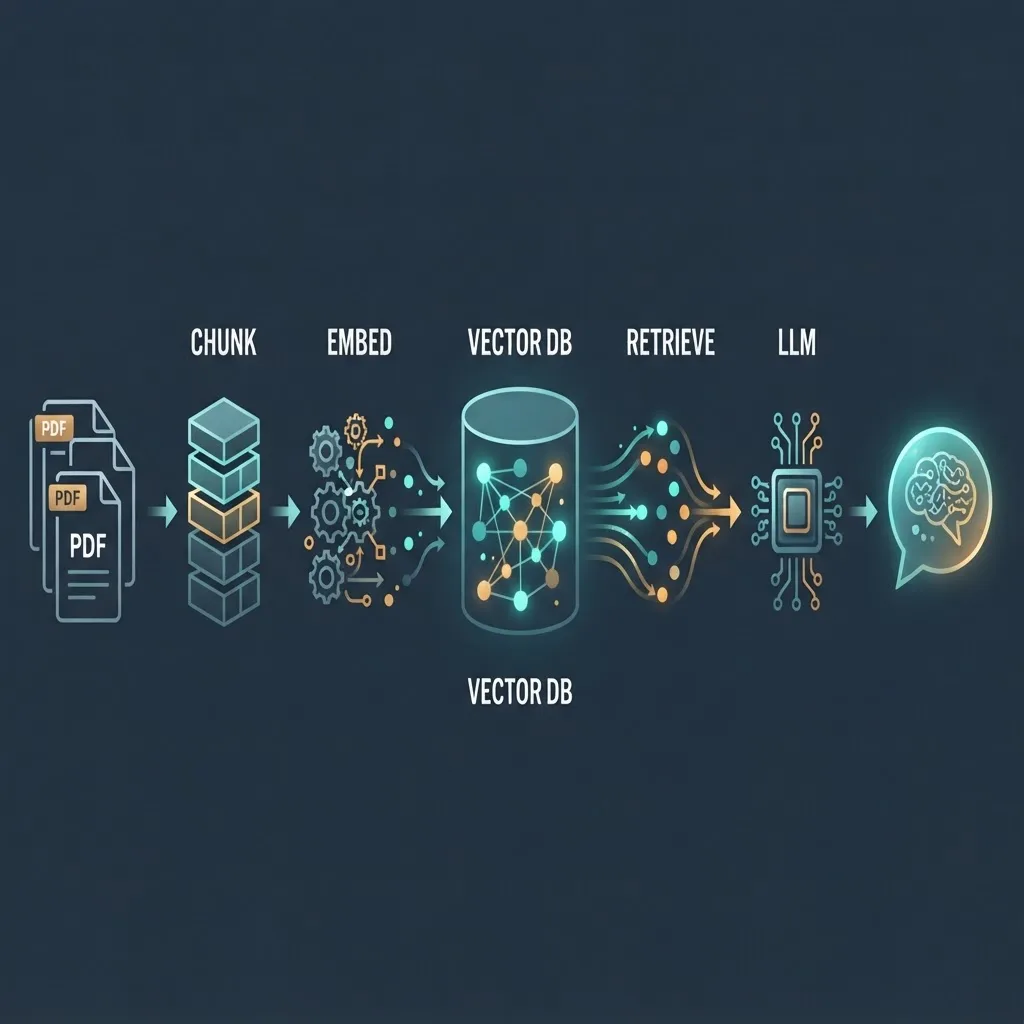
Retrieval augmented generation, or RAG, is the standard architecture for making documents answerable. The pipeline runs in five steps. Text is extracted from each file. The text is split into chunks, typically a few hundred words with overlap so sentences are not cut mid-idea. Each chunk is converted into an embedding vector. Vectors are stored in a vector database. At query time the system retrieves the closest chunks and passes them to a language model as context.
RAG matters because it constrains the model to your material and lets every answer carry a citation back to a source page. That citation is the difference between a tool people trust and a tool they quietly stop using.
Why Chunking Strategy Changes Results
Chunk size is a real trade-off rather than a setting to guess. Small chunks retrieve precisely but lose surrounding context. Large chunks preserve context but dilute relevance and consume more of the model's context window. Structure-aware chunking that respects headings and tables generally outperforms fixed character counts on technical PDFs, because a table split across two chunks becomes meaningless in both.
Traditional Versus AI-Assisted Knowledge Management
| Dimension | Traditional KM | AI-Assisted KM |
|---|---|---|
| Search method | Keyword and Boolean matching | Semantic and vector similarity |
| Tagging | Manual, by authors or librarians | Model-generated, human-reviewed |
| Answer format | A list of document links | A drafted answer with citations |
| Setup effort | Taxonomy design upfront | Data cleanup plus pipeline build |
| Main failure mode | Content nobody can find | Confident answers from outdated sources |
| Ongoing cost | Staff time for curation | Compute, storage, and evaluation |
| Handles scanned PDFs | Only if manually transcribed | Yes, through OCR with error risk |
Neither column wins outright. Traditional taxonomies remain valuable because a clean category structure improves AI retrieval filtering. The realistic goal is a hybrid: human-defined structure with machine-assisted population.

How to Build an AI Knowledge System in Seven Steps
- Pick one high-frequency question set. Onboarding questions or support escalations work well because volume makes improvement visible.
- Inventory your sources. List every repository and mark which files are digital text, scanned, or hybrid.
- Fix authority before automation. Delete superseded versions and name a single owner per document. AI cannot decide which of four conflicting policies is current.
- Build the extraction and chunking layer. Test extraction on your ten most awkward PDFs before scaling.
- Add retrieval with mandatory citations. Every answer must link to a source and page.
- Create an evaluation set. Write fifty real questions with verified correct answers and score the system on them after every change.
- Ship to a small group, then widen. Collect the questions the system answered badly and treat them as content gaps rather than model failures.
Teams without in-house machine learning capacity often pair internal subject matter experts with an external build partner. Studios such as the ZoneTechify Team approach this as a systems problem, and dedicated AI automation services typically cover pipeline design, evaluation, and access control rather than only the chat interface.
Governance, Security, and Known Limitations
Permissions must be enforced at retrieval time, not at display time. If a vector store contains chunks from a confidential salary review, the retrieval query itself has to filter by the requesting user's access rights. Filtering after generation is too late, because the model has already read the text.
Three limitations deserve honest acknowledgment. Language models can produce fluent statements unsupported by the retrieved sources, which is why citations must be checked rather than assumed. OCR accuracy drops sharply on low-resolution scans, handwriting, and multi-column layouts. And regulated sectors may require data residency or retention controls that rule out certain hosted model providers, so verify contractual terms before uploading anything sensitive.

Measuring Whether the System Works
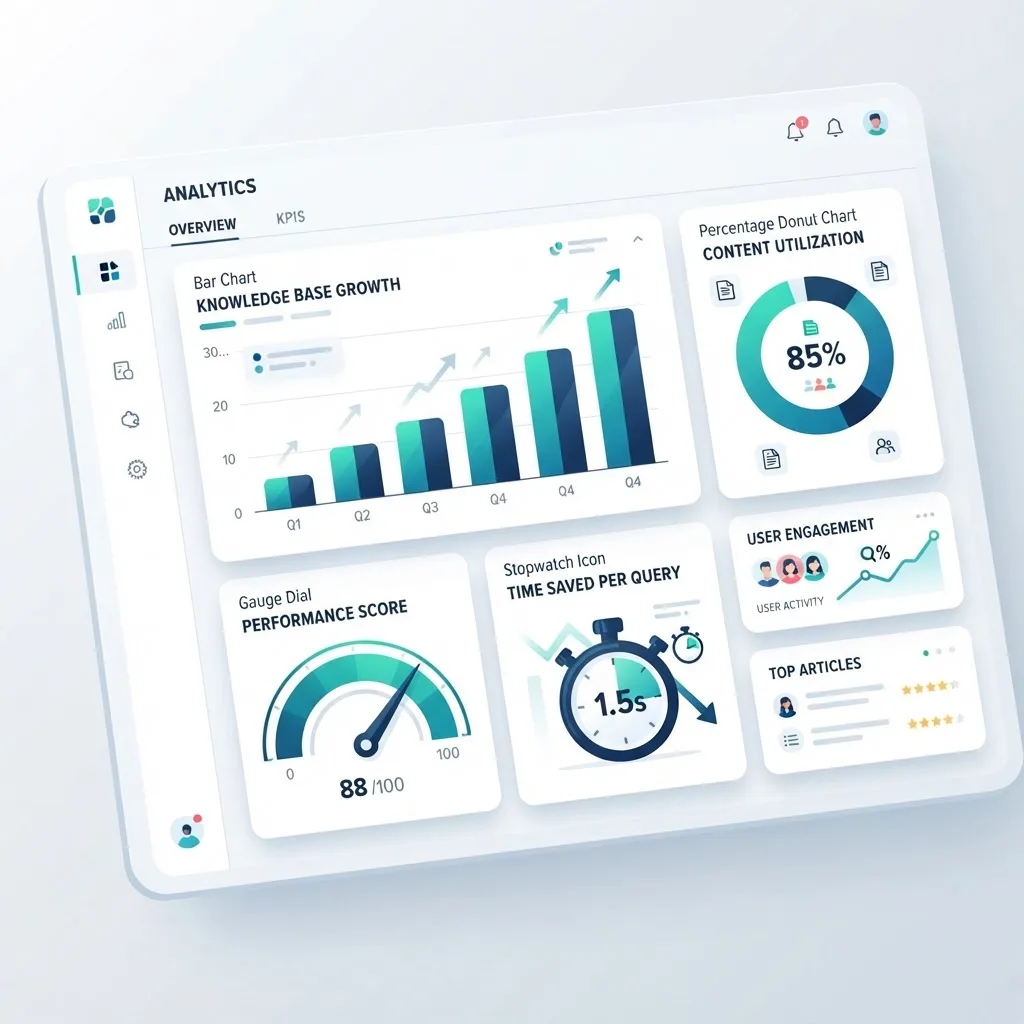
Usage counts are vanity metrics. Track outcomes instead.
- Answer accuracy on your fifty-question evaluation set, rescored monthly
- Citation validity, meaning the percentage of answers whose cited passage genuinely supports the claim
- Time to resolution for the workflow you targeted, compared against a pre-launch baseline
- Deflection rate, the share of questions resolved without escalating to a colleague
- Content gap volume, the number of questions failing because no document exists
The last metric is the most underrated. A rising gap count is not a system failure. It is a precise list of the documentation your organization has never written.
Key Takeaways
- Filetype:pdf is a search operator supported by Google and Bing that restricts results to PDF files, useful for finding peer-reviewed and institutional research.
- Knowledge management covers explicit knowledge, which is recorded, and tacit knowledge, which lives in experience. AI reaches tacit knowledge only after it is written down.
- AI contributes at four lifecycle stages: capture, organize, retrieve, and apply. Only the last is generative.
- PDF is a layout format, so extraction quality depends on whether a file has a real text layer or requires OCR.
- Retrieval augmented generation grounds answers in your own documents and enables source citations.
- Access control must be applied during retrieval, before the model reads restricted text.
- Evaluate with a fixed question set and citation validity checks rather than usage volume.
Frequently Asked Questions (FAQ)
What does filetype:pdf do in a Google search?
It restricts results to documents published in PDF format. Typing artificial intelligence and knowledge management filetype:pdf returns only PDF files, which surfaces academic papers, theses, and whitepapers instead of blog articles. The operator filters format only and does not assess source quality, so verify the publisher.
Can AI replace a knowledge manager?
No. AI automates extraction, tagging, and retrieval, but it cannot decide which policy version is authoritative, resolve contradictions between departments, or identify undocumented knowledge. Those judgment calls require a human owner. In practice AI shifts the role from filing and tagging toward curation, governance, and quality control.
Why does my AI tool fail to read some PDF files?
Most likely those files are scanned images with no embedded text layer. Extraction tools find nothing to read and return blank output. Running optical character recognition converts the page image into text, though accuracy falls on low-resolution scans, handwriting, and complex multi-column or tabular layouts.
What is retrieval augmented generation in simple terms?
Retrieval augmented generation searches your own documents for relevant passages, then gives those passages to a language model as context before it answers. The model responds using your material rather than general training data, which improves accuracy and allows every answer to cite a specific source document.
How do I keep confidential documents out of AI answers?
Enforce permissions at the retrieval stage so the search only ever returns chunks the requesting user is authorized to see. Store access metadata alongside every chunk and filter by it in the query. Filtering after generation fails, because the model has already processed the restricted text.
How long does it take to see results from AI knowledge management?
A scoped pilot covering one question set can produce measurable results within weeks, provided source documents are already clean. Timelines extend considerably when files are scattered, duplicated, or scanned, because data cleanup and ownership decisions consume more effort than building the retrieval pipeline itself.