
AI companies are raising record funding but cannot hire enterprise sellers fast enough. Here is why great sales recruiters are in demand, and exactly how to get hired into one of these teams.
Why AI Companies Are Desperate for Great Sales Recruiters (And How to Get Hired)

AI companies are not short on capital, engineers, or product demand. They are short on people who can sell a product the buyer does not fully understand yet. That single gap has quietly turned sales recruiting into one of the highest-leverage roles inside AI startups, and most recruiters have not noticed the shift.
The pattern is consistent. A company raises a large round, signs a handful of design-partner customers, then discovers that revenue will not scale until it hires eight to twenty quota-carrying sellers who can navigate technical evaluations, procurement, and security reviews. Engineering hiring is a known problem with known playbooks. Sales hiring at that speed, for a category that did not exist three years ago, is not.
Quick Answer: AI companies are desperate for great sales recruiters because they scale revenue teams faster than sales talent exists for brand-new categories, where sellers must handle technical buyers, unclear ROI, and long security reviews. To get hired, specialise in technical or AI sales hiring, learn the product deeply, and prove your results with hard pipeline and retention metrics.
The Real Reason Demand Exploded
AI hiring demand is driven by funding velocity, not headcount planning. Global venture funding for AI companies reached roughly 100 billion dollars in 2024, according to Crunchbase data, close to a third of all global venture dollars that year. Money raised on an eighteen-month growth thesis converts almost immediately into a go-to-market hiring mandate.

That mandate lands on recruiters with unusually tight constraints. A Series B AI company that must triple revenue in four quarters cannot wait two quarters to fill an enterprise account executive role. Meanwhile the World Economic Forum Future of Jobs Report 2025 found that 86 percent of surveyed employers expect AI to transform their business by 2030, which means the buying side is also new to this, and sellers must educate as much as they close.
A useful definition here. AI sales recruiting is the practice of sourcing and assessing revenue talent for products where the buyer's evaluation criteria, budget owner, and success metrics are still being invented. It is closer to founding-team recruiting than to volume sales hiring.
Where AI Sales Hiring Actually Breaks
Most failed AI sales hires are not sourcing failures. They are calibration failures. The company hires an impressive seller from a mature category, that seller cannot operate without an established playbook, and eleven months later the role reopens.

Four specific breakpoints show up repeatedly:
- No repeatable pitch. The messaging changes monthly, so sellers who need polished collateral stall out.
- Technical buyers. Deals get evaluated by engineering leads and data teams who ask about latency, evals, hallucination rates, and data residency.
- Undefined ideal customer profile. Sellers are asked to help discover the segment, not just work it.
- Procurement friction. AI purchases trigger security, legal, and model-governance review cycles that stretch deals well beyond forecast.
A recruiter who can name these breakpoints in a hiring manager conversation instantly separates from the field. That is the whole opportunity.
What Great Sales Recruiters Do Differently
Great sales recruiters in AI act as commercial advisors who happen to hire. They shape the scorecard before sourcing a single candidate, and they push back when a role definition guarantees failure.

The concrete behaviours that separate strong from average:
- They intake for stage, not title. A seller who thrived at a 400-person company with an SDR team and marketing pipeline is a different hire from one who prospects their own book at a 40-person startup.
- They screen for ambiguity tolerance. Ask candidates to describe selling something with no case studies. Weak answers describe the product. Strong answers describe how they built proof.
- They test technical curiosity. The candidate does not need to code. They do need to explain the product's value to a sceptical engineer without reciting marketing copy.
- They protect the offer. Strong sellers hold multiple processes. Recruiters who do not manage compensation expectations and close timing lose finalists at the last step.
- They measure post-hire. Ramp-to-first-deal and twelve-month quota attainment are the only numbers that prove recruiting quality.
The same discipline applies when companies build their go-to-market function alongside their product. Teams that treat hiring, positioning, and digital presence as one system move noticeably faster, which is why an increasing number of AI startups pair internal recruiting with an outside AI digital agency to keep messaging and market presence aligned while the sales team is still forming.
The Numbers That Frame the Market
Data helps you argue for a better process and a better offer. Two figures are worth memorising.
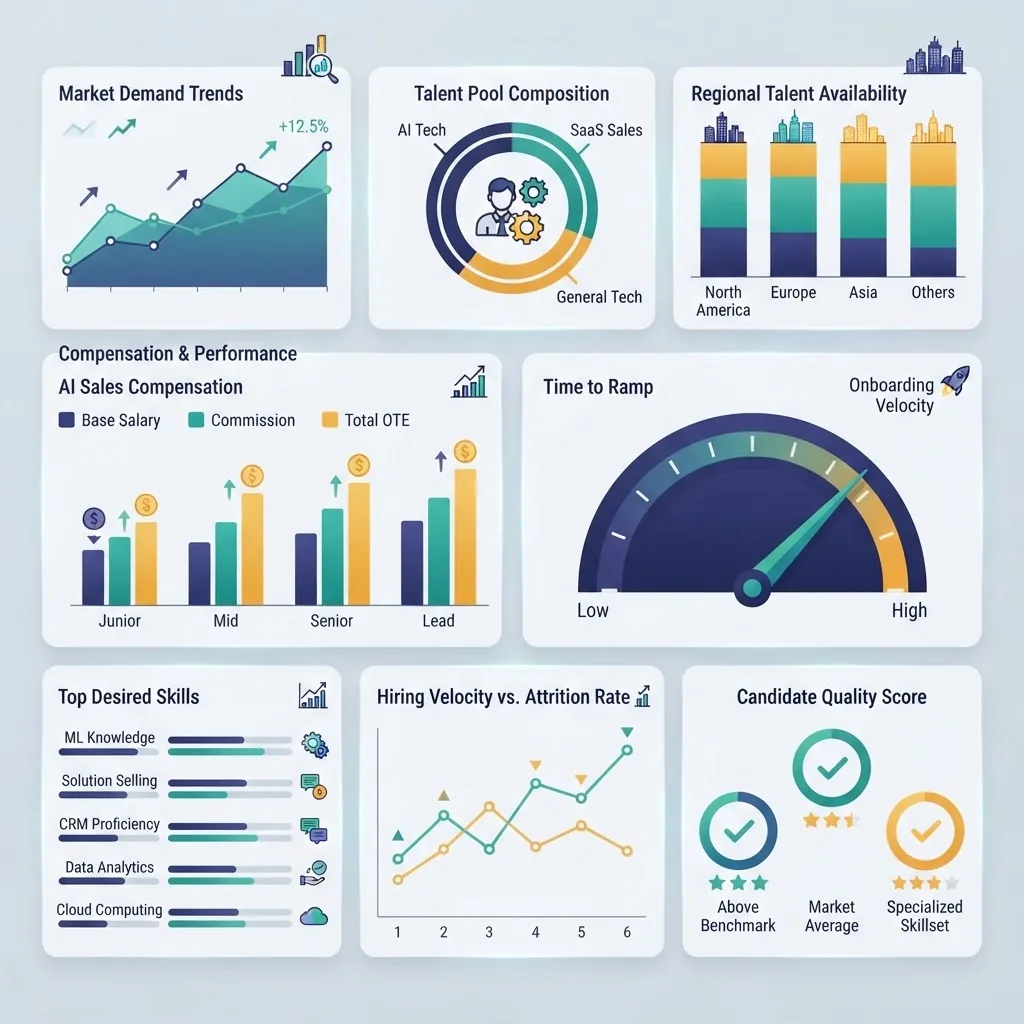
First, LinkedIn's Emerging Jobs and Jobs on the Rise reporting has repeatedly placed AI-related roles among the fastest-growing job categories globally, with AI-skill demand growing far faster than the supply of candidates who list those skills. Second, Bureau of Labor Statistics projections show overall sales occupations growing slowly, roughly in line with or below average across the decade. Fast-growing AI demand plus flat general sales supply is precisely why a specialist recruiter has pricing power.
Here is how AI sales recruiting compares with traditional SaaS sales recruiting:
| Factor | Traditional SaaS Sales Recruiting | AI Company Sales Recruiting |
|---|---|---|
| Role definition | Established scorecard and playbook | Scorecard co-created with founders |
| Candidate pool | Deep, well mapped | Shallow, mostly adjacent talent |
| Key screen | Quota history and territory fit | Ambiguity tolerance and technical fluency |
| Buyer of the product | Business function owner | Engineering, data, and security stakeholders |
| Typical time to fill | Predictable, process driven | Compressed, founder-led urgency |
| Biggest failure mode | Weak sourcing volume | Wrong stage calibration |
| Recruiter leverage | Moderate | High, tied directly to revenue plan |
How to Get Hired as a Sales Recruiter at an AI Company
The hiring bar is specific, which is good news. You can prepare for it deliberately.
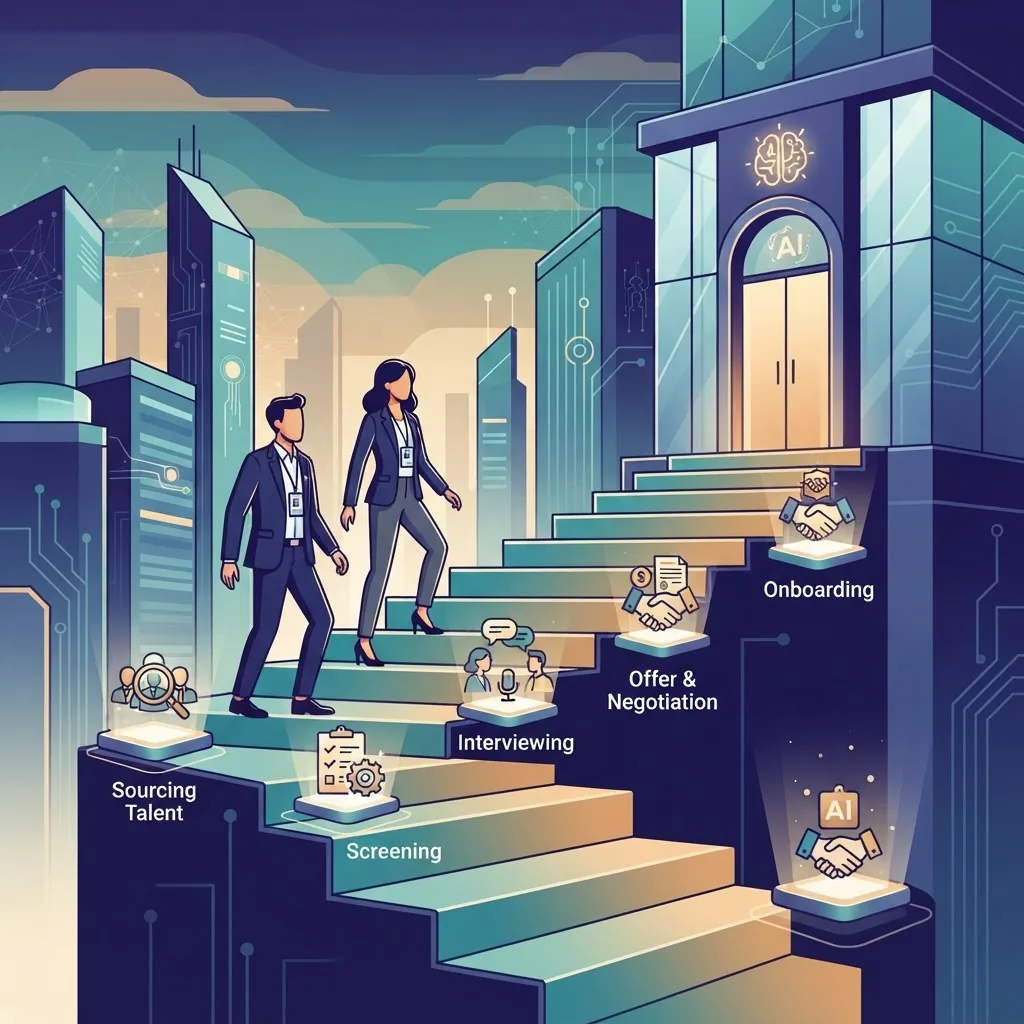
- Pick a narrow lane. Choose something like enterprise AI sellers for developer-tools companies, or founding account executives at seed-stage AI startups. Narrow beats broad because founders search for specialists.
- Learn the product layer. Spend a few weekends actually using AI tools, reading model documentation, and following one or two technical newsletters. You need to hold a credible ten-minute conversation about how the product works.
- Rebuild your resume around outcomes. Replace duties with numbers: roles filled, average time to fill, offer acceptance rate, and how many hires hit quota.
- Publish your point of view. Two or three short posts analysing why AI sales hires fail will generate more inbound than a year of cold applications.
- Map fifty target companies. Track recent funding, current open sales roles, and who owns revenue. Companies that just raised and have three or more open sales roles are your warmest targets.
- Reach out with a diagnosis, not a pitch. Send the hiring manager a short note naming a specific problem in their current job posting and how you would fix the scorecard.
- Ask for a paid trial search. Fractional or contract-to-hire engagements are the fastest realistic entry point into a hot AI company.
Build a Metrics Portfolio Before You Apply
Treat your track record as a product. One page, five numbers, three short case stories.
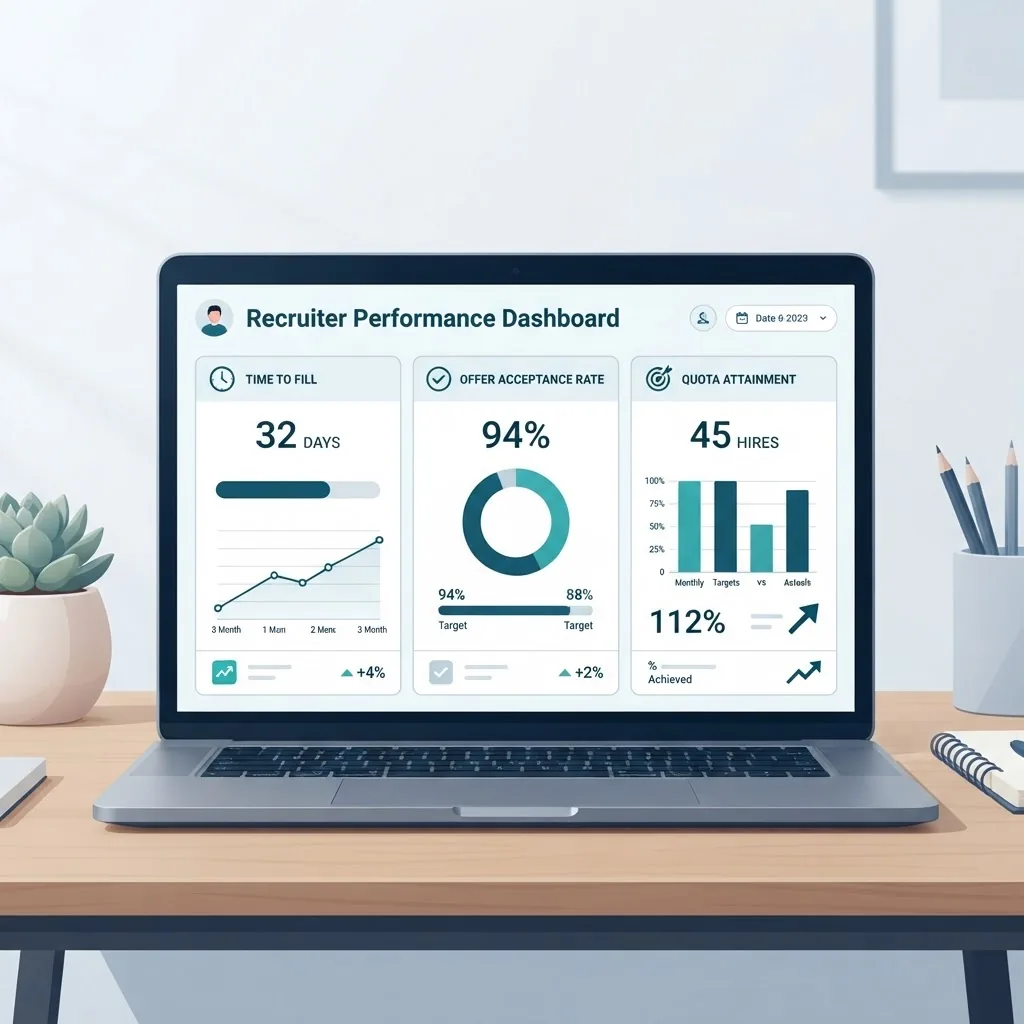
Include time to first submit, submit-to-interview ratio, offer acceptance rate, ninety-day retention, and first-year quota attainment of your hires. If you have never tracked quota attainment, start now with your current or most recent placements. That single metric is what separates a recruiter who fills seats from one who builds revenue teams, and it is the number founders remember.
Each case story should follow the same shape: the constraint, what you changed in the process, and the measurable result. Two paragraphs each is plenty.
Prepare for the Interview Itself
AI companies interview recruiters the way they interview sellers, with live scenarios rather than resume walkthroughs.

Expect four things. A live intake roleplay where you must interrogate a vague role brief. A sourcing exercise where you name real target companies and explain why. A pitch test where you sell their company to a candidate in ninety seconds. And a metrics deep dive where every number you claimed gets questioned. Rehearse the ninety-second pitch out loud until it is smooth, because it is the single clearest signal of whether you understand the business.
One underrated move: arrive with three named candidate profiles you would approach in week one. It converts an interview into a working session and is the closest thing to a guaranteed advantage.
Key Takeaways
- AI companies raised roughly 100 billion dollars in venture funding in 2024, which converts directly into aggressive go-to-market hiring mandates.
- The World Economic Forum reports 86 percent of employers expect AI to transform their business by 2030, meaning sellers must educate buyers, not just close them.
- Most failed AI sales hires are calibration failures, not sourcing failures, usually caused by hiring for the wrong company stage.
- Screening priorities shift from quota history to ambiguity tolerance, technical fluency, and self-generated pipeline.
- Recruiters should track ramp-to-first-deal, ninety-day retention, and first-year quota attainment, because those numbers prove revenue impact.
- Fractional or contract trial searches are the fastest realistic entry route into a well-funded AI company.
Frequently Asked Questions (FAQ)
Why do AI companies struggle to hire good salespeople?
Because their category is new, there is no proven playbook, and buyers include engineers and security teams. Sellers must create their own proof, educate technical stakeholders, and survive long procurement reviews. Candidates from mature markets often depend on existing collateral and stall without it.
Do I need a technical background to recruit AI sales talent?
No, but you need working fluency. You should be able to explain what the product does, who it replaces, and why a technical buyer would care. Spend time using AI tools and reading product documentation. Credibility comes from understanding the value, not from writing code.
What metrics should a sales recruiter track to get hired?
Track time to fill, submit-to-interview ratio, offer acceptance rate, ninety-day retention, and first-year quota attainment of your hires. The last two matter most to founders because they prove your placements produced revenue rather than simply filling an open seat on the org chart.
How do I get my first AI company recruiting role with no AI experience?
Start with a narrow specialisation, publish two or three analytical posts on AI sales hiring, and target companies that recently raised funding with several open sales roles. Offer a paid trial search or fractional engagement. Contract work converts into full-time offers far more reliably than cold applications.
Is sales recruiting at an AI startup better paid than traditional recruiting?
Often yes, because the role sits directly on the revenue plan and demand outpaces qualified supply. Compensation frequently combines base salary with equity and performance bonuses tied to hires who reach quota. Negotiate on measurable business impact rather than on the number of roles filled.
What is the biggest mistake recruiters make with AI sales roles?
Accepting a vague job brief without challenging it. If the scorecard does not specify company stage, buyer persona, deal size, and whether the seller must self-source pipeline, the search will produce impressive candidates who fail within a year. Fix the brief before sourcing anyone.