
A clear, practical guide to what artificial intelligence actually is, how it learns, where it works today, and how to evaluate it for real business use.
What Is AI? A Complete Guide to Understanding Artificial Intelligence
Artificial intelligence has moved from research labs into the ordinary tools people use every day, and most explanations still leave readers unsure what it actually does. This guide fixes that. It defines AI precisely, shows how the learning process works, separates the terms that get used interchangeably, and gives you a practical way to judge whether AI belongs in a specific project. Everything here is written for someone who has to make a real decision, not memorize a definition.
Quick Answer: AI, or artificial intelligence, is software that performs tasks normally requiring human judgment by finding statistical patterns in data instead of following hand-written rules. It powers recommendations, translation, fraud detection, and chat assistants. Modern AI predicts likely outputs from examples, so it improves with better data rather than more code.
What AI Actually Means
AI is the field of building systems that produce useful decisions or outputs without a developer specifying every rule in advance. The clearest way to understand it is by contrast. Traditional software is deterministic: a developer writes the rule "flag any transaction above 10,000 dollars," and the program executes it identically forever. An AI system is probabilistic: you show it a hundred thousand transactions labeled fraudulent or legitimate, and it derives its own weighted signals, some of which no human would have thought to write down.
That difference has one practical consequence worth internalizing. AI systems have accuracy rates, not correctness. A model that classifies invoices with 96 percent accuracy is genuinely useful, but it will be wrong four times in a hundred, and your process has to absorb those four. Teams that skip this framing tend to deploy AI where errors are unacceptable and then blame the technology.
John McCarthy coined the term artificial intelligence in 1955 for the Dartmouth workshop proposal, which means the field is roughly seventy years old. What changed recently was not the idea but the inputs: large labeled datasets, GPU-based parallel computing, and the transformer architecture introduced in the 2017 paper "Attention Is All You Need," which underpins nearly every large language model in use today.
Key Terms Defined
- Model: the trained artifact, essentially a large set of numeric weights that maps inputs to outputs.
- Training: the process of adjusting those weights by measuring error against known examples.
- Inference: using a finished model to produce an answer for new input. This is what happens each time you send a prompt.
- Parameters: the individual weights inside the model. Count correlates loosely with capability, not with quality.
- Token: the unit of text a language model processes, usually a word fragment of about four characters in English.
The Three Layers: AI, Machine Learning, and Deep Learning

These three terms are nested, not synonymous, and using them precisely makes vendor conversations far easier. Artificial intelligence is the broad goal. Machine learning is the dominant method for reaching it, where systems learn from data. Deep learning is a subset of machine learning that uses multi-layered neural networks, and it is what made image recognition and natural language generation practical.
| Concept | Scope | How It Works | Typical Use Case | Data Needed |
|---|---|---|---|---|
| Artificial Intelligence | Broadest field | Any technique producing intelligent behavior, including rules | Chess engines, expert systems | Varies widely |
| Machine Learning | Subset of AI | Learns patterns from labeled or unlabeled data | Churn prediction, spam filtering | Thousands of rows |
| Deep Learning | Subset of ML | Stacked neural network layers extract features automatically | Image recognition, speech to text | Hundreds of thousands of examples |
| Generative AI | Application of deep learning | Predicts the next token or pixel to create new content | Text drafting, image generation, code | Billions of tokens, pretrained |
The practical takeaway is that you rarely need the most advanced layer. A gradient-boosted decision tree, which is classic machine learning, still outperforms deep learning on most structured tabular business data, trains in minutes on a laptop, and can explain which features drove a prediction. Reaching for a large language model when a simple classifier fits the problem is the most common and most expensive mistake we see.
How AI Systems Learn
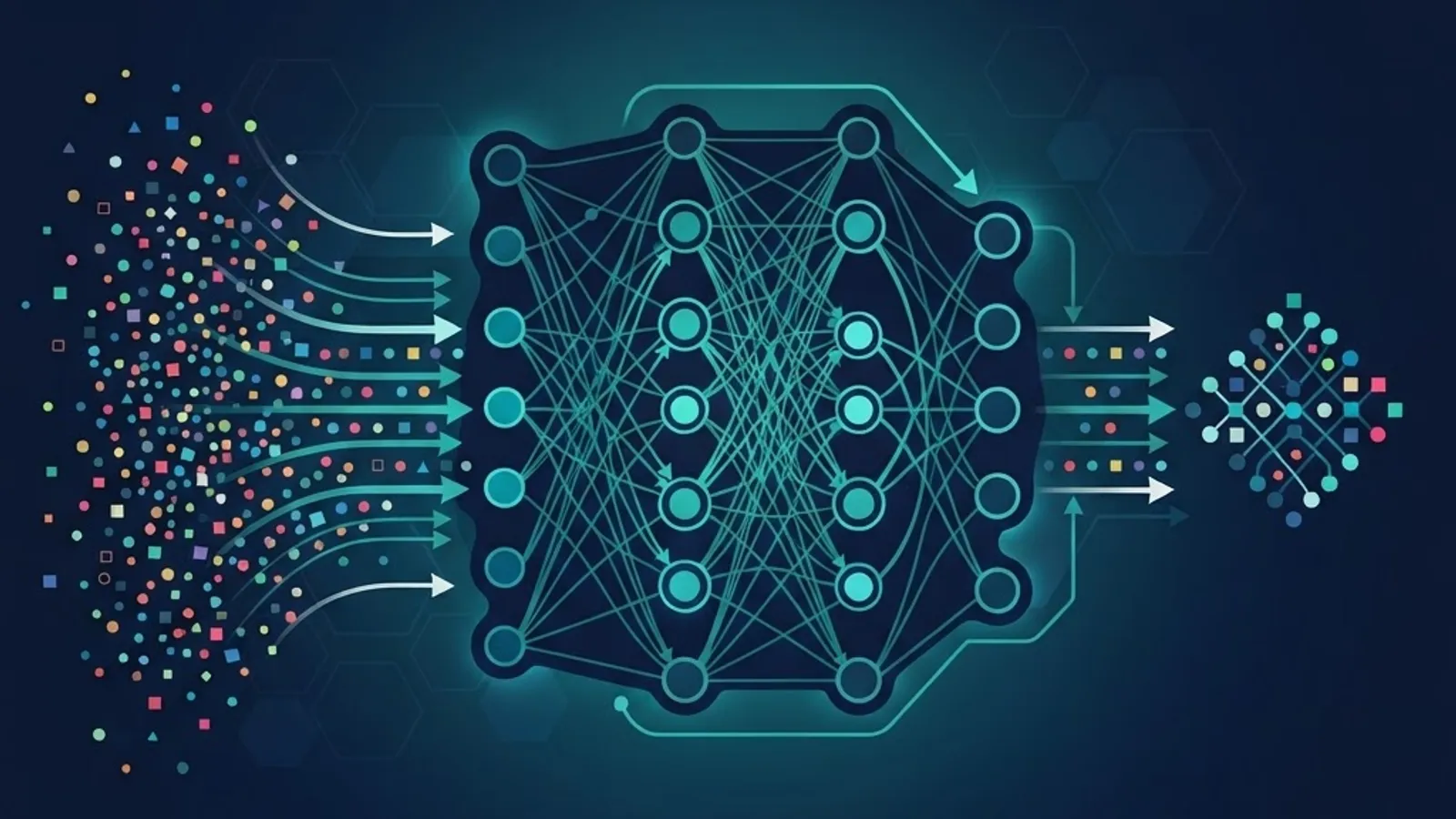
Every supervised AI system follows the same five-step loop, and understanding it tells you exactly where projects fail.
- Data collection and labeling. Examples are gathered and tagged with correct answers. This step consumes the majority of project time in practice, and label quality caps final accuracy.
- Feature representation. Raw input becomes numbers. In deep learning the network learns this representation itself rather than relying on manual engineering.
- Training. The model predicts, a loss function measures how wrong the prediction was, and backpropagation nudges every weight slightly toward a better answer. This repeats millions of times.
- Validation. Performance is measured on data the model never saw. A model scoring 99 percent on training data and 71 percent on held-out data is overfitting, meaning it memorized instead of generalizing.
- Deployment and monitoring. The model serves live traffic while accuracy is tracked, because real-world data drifts away from training data over time.
The Three Learning Styles
- Supervised learning uses labeled examples and covers most commercial applications, including credit scoring and medical image triage.
- Unsupervised learning finds structure in unlabeled data, useful for customer segmentation and anomaly detection.
- Reinforcement learning learns through reward signals from trial and error, used in robotics, logistics routing, and the human-feedback tuning that makes chat assistants follow instructions.
Types of AI by Capability

Capability tiers cut through a lot of marketing noise. Narrow AI performs one class of task and is the only kind that exists commercially today. Every system you have used, including the most capable language models, is narrow AI: extremely broad in surface area but still bounded to pattern completion over its training distribution.
General AI, sometimes called AGI, would transfer understanding across arbitrary domains the way a person moves from cooking to accounting. It does not exist, and credible researchers disagree sharply on timelines. Superintelligent AI, exceeding human ability across all domains, remains entirely theoretical. When a vendor implies their product is anything other than narrow AI, treat it as a signal about their marketing rather than their engineering.
Where AI Delivers Measurable Value Today

AI works best on high-volume, pattern-heavy, tolerant-of-error tasks. Here is where that condition is genuinely met.
- Customer support triage. Classifying and routing tickets by intent, then drafting replies a human approves. Deflection of repetitive queries is the reliable win, not full automation.
- Search and recommendation. Embedding-based semantic search understands meaning rather than keywords, which lifts product discovery on catalogs too large to browse.
- Fraud and anomaly detection. Models score transactions in milliseconds against thousands of behavioral signals, a task no rule set can match at scale.
- Document processing. Extracting structured fields from invoices, contracts, and forms, with confidence thresholds routing uncertain cases to a reviewer.
- Content and code assistance. Drafting first versions, writing tests, and translating between formats, where a knowledgeable human edits the output.
- Forecasting. Demand and inventory prediction using seasonality and external signals, typically outperforming spreadsheet baselines once several years of history exist.
A useful benchmark for scoping: Stanford's AI Index has repeatedly documented that organizations reporting the strongest returns concentrate AI on a small number of well-defined processes rather than spreading pilots thinly across departments. Focus beats breadth. Teams building production systems on this principle often work with an experienced partner such as ZoneTechify Team for the AI automation services layer that connects a model to real business workflows.
How to Evaluate an AI Use Case
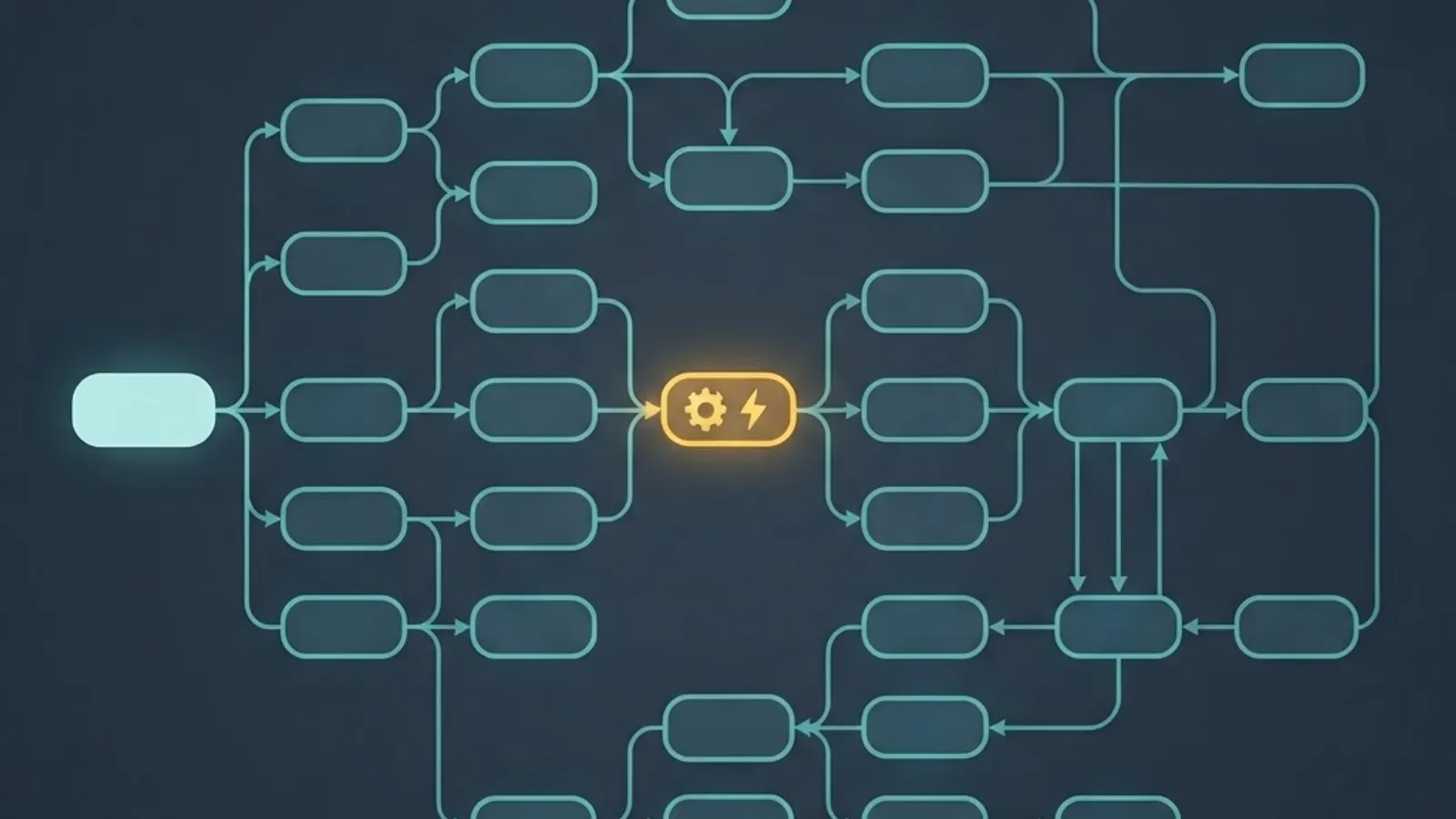
Before committing budget, run the task through five questions. If any answer is no, fix that first.
- Is the output measurable? You need a numeric definition of success, such as reduced handling time or lifted conversion rate. "Feels smarter" is not measurable.
- Do you have historical data? Supervised models generally need thousands of clean labeled examples. No data means no model, regardless of budget.
- Is an occasional wrong answer survivable? If a single error triggers legal or safety consequences, keep a human in the decision path.
- Would a simpler solution work? A lookup table, a filter, or a well-written rule often solves the problem with zero maintenance cost.
- Who owns the output? Someone must monitor accuracy after launch, because unmonitored models silently degrade as inputs shift.
Cost realism matters too. Inference is priced per token or per request, so a feature that runs on every page view carries very different economics than one triggered by a deliberate user action. Estimate volume before you estimate value. Agencies that publish transparent implementation practices, including smart digital experiences built around measurable KPIs, tend to surface these constraints during scoping instead of after launch.
Real Limitations You Should Plan Around
AI limitations are structural, not temporary bugs, and designing around them is what separates working products from demos.
- Hallucination. Generative models produce fluent, confident text that can be factually wrong, because they optimize for plausible continuation rather than truth. Grounding responses in retrieved documents reduces this substantially but never eliminates it.
- Bias inheritance. A model trained on historical decisions reproduces the patterns in those decisions, including discriminatory ones. Audit outputs across demographic slices, not just in aggregate.
- Opacity. Deep networks cannot fully explain their reasoning, which creates compliance friction in lending, hiring, and healthcare.
- Knowledge cutoffs. A model knows nothing after its training data ends unless you supply current information at inference time.
- Data privacy. Sending sensitive records to a third-party API is a data transfer decision that needs the same review as any other vendor relationship.
The Direction of Travel

Three shifts are worth tracking. First, small specialized models are closing the gap with large general ones on narrow tasks while costing a fraction to run, which makes on-device and on-premise deployment realistic. Second, retrieval-augmented generation is becoming the default architecture because grounding a model in your own verified documents is more reliable and cheaper than retraining it. Third, regulation is arriving: the EU AI Act entered into force in August 2024 with obligations phasing in through 2026, tiered by risk level, and it applies to providers serving EU users regardless of where they are based.
The strategic implication is that durable advantage comes from proprietary data and well-designed workflows, not from model access. Everyone can call the same frontier model. Only you have your customer history, your labeled edge cases, and your process knowledge.
Key Takeaways
- AI is software that learns statistical patterns from data instead of following hand-written rules, producing probabilistic outputs with accuracy rates rather than guaranteed correctness.
- The terms nest: deep learning sits inside machine learning, which sits inside artificial intelligence. Generative AI is an application of deep learning.
- The term artificial intelligence dates to 1955; the transformer architecture behind modern language models was published in 2017.
- All commercially available AI is narrow AI. General AI and superintelligence do not exist today.
- Classic machine learning still beats deep learning on most structured tabular business data, and it trains faster and explains itself better.
- Label quality sets the ceiling on model accuracy, and data preparation typically consumes most of a project timeline.
- The EU AI Act entered into force in August 2024 with risk-tiered obligations phasing in through 2026.
- Good AI use cases are measurable, data-rich, and tolerant of occasional error. If a rule solves it, use the rule.
Frequently Asked Questions (FAQ)
What is AI in simple words?
AI is computer software that learns from examples instead of being told exactly what to do. You show it thousands of correct cases, it finds the patterns, then it applies those patterns to new situations. That is how spam filters, translation apps, and chat assistants all work underneath.
Is ChatGPT considered real artificial intelligence?
Yes. ChatGPT is a large language model, a form of deep learning trained to predict the next token in a sequence. It is genuine AI but narrow AI, meaning it excels at language patterns without understanding the world the way a person does. It has no awareness or intent.
What is the difference between AI and automation?
Automation executes fixed steps you defined in advance and behaves identically every time. AI decides what the steps should be by learning from data, so it handles variation and unseen inputs. Most effective business systems combine both: AI makes the judgment, automation carries out the action.
How much data do I need to build an AI model?
It depends on the method. Classic machine learning on structured data often works with a few thousand clean labeled rows. Deep learning usually needs hundreds of thousands of examples. Using a pretrained model with your own documents at inference time can work with only dozens.
Will AI replace jobs or change them?
Evidence so far points to task-level change rather than wholesale replacement. AI absorbs repetitive, pattern-based portions of a role, such as first-draft writing or data extraction, while judgment, accountability, and client relationships remain human. Roles shift toward reviewing, directing, and verifying AI output.
Can AI be wrong, and how do I catch it?
Yes, routinely. Generative models produce confident, fluent answers that are sometimes false. Catch errors by grounding responses in verified source documents, showing citations, setting confidence thresholds that route uncertain cases to a human, and continuously sampling live outputs for accuracy after launch.
Final Thoughts
Understanding AI is less about tracking model releases and more about knowing what kind of problem the technology actually solves. It converts large volumes of examples into probabilistic judgments. When your task fits that shape, is measurable, and can absorb occasional error, AI produces real leverage. When it does not, a clear rule and a good interface will beat any model. Start with the problem, verify you have the data, define what success looks like numerically, and keep a human accountable for the output.