
An honest, detailed review of UConn CSE 4705 Artificial Intelligence covering the syllabus, workload, exams, grading, and how to prepare before day one.
UConn CSE 4705 Artificial Intelligence – Full Course Review & What to Expect
CSE 4705 is the University of Connecticut's undergraduate introduction to artificial intelligence, and it is one of the few CSE electives that changes how students think rather than just what they know. It sits at the intersection of discrete math, algorithms, and probability, and it rewards students who can translate a messy real-world problem into a formal model. This review breaks down what the course actually covers, how hard it is, how the grade is usually distributed, and the preparation that separates students who thrive from students who scramble.
Quick Answer: UConn CSE 4705 is a three-credit upper-level AI elective covering search, constraint satisfaction, adversarial games, logic, probabilistic reasoning, and core machine learning. Expect several Python programming assignments, two exams, and heavy reliance on algorithms and probability. Most students rate it moderately hard but highly rewarding.

What Is CSE 4705 and Who Should Take It?
CSE 4705 is a lecture-based course that introduces the classical and statistical foundations of AI. It is typically taken by juniors and seniors in Computer Science, Computer Science and Engineering, and Computer Engineering, and it commonly requires CSE 3500 (Algorithms and Complexity) as a prerequisite, with CSE 2500 (Discrete Systems) and a probability or statistics course as strong practical dependencies.
The course is a good fit if you want to work in machine learning, robotics, data science, or research and you want the vocabulary that sits underneath modern systems. It is a poor fit if you expect a hands-on deep learning bootcamp. CSE 4705 is deliberately broader and more mathematical than a course focused only on neural networks, and that breadth is the point: the ideas transfer.
Key Terms Defined Early
- Agent: any system that perceives an environment and acts to maximize a performance measure.
- Admissible heuristic: an estimate that never overstates the true remaining cost, which is what guarantees A-star finds an optimal path.
- Constraint satisfaction problem (CSP): a problem defined by variables, domains, and constraints rather than by a step-by-step procedure.
- Inference: computing what follows from what you already know, either logically or probabilistically.
The Syllabus: Module by Module
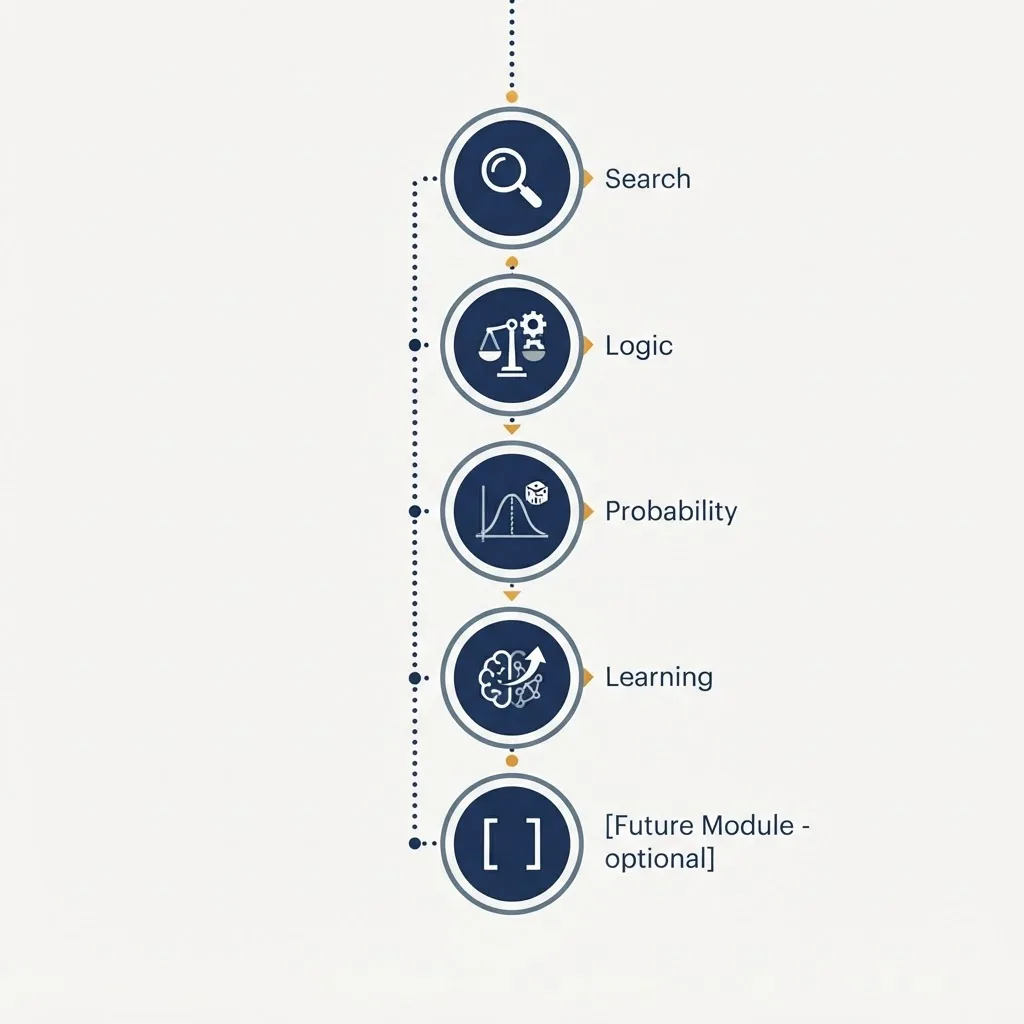
The course follows the structure of Russell and Norvig's Artificial Intelligence: A Modern Approach, the textbook used by the majority of university AI courses worldwide and now in its fourth edition. Sections vary by instructor, but the topic arc is consistent.
- Intelligent agents and problem formulation. How to convert a vague goal into states, actions, transitions, and costs. This week looks easy and is quietly the most important.
- Uninformed search. Breadth-first, depth-first, uniform-cost, and iterative deepening, with completeness and complexity analysis for each.
- Informed search. Greedy best-first and A-star, plus heuristic design, admissibility, and consistency.
- Local search and optimization. Hill climbing, simulated annealing, and genetic algorithms for problems where the path does not matter.
- Constraint satisfaction. Backtracking search, forward checking, arc consistency (AC-3), and variable ordering heuristics.
- Adversarial search. Minimax, alpha-beta pruning, evaluation functions, and depth-limited play for games.
- Logical agents. Propositional logic, CNF conversion, resolution, and an introduction to first-order logic.
- Probabilistic reasoning. Bayes rule, conditional independence, Bayesian networks, and exact inference.
- Machine learning foundations. Decision trees and information gain, naive Bayes, linear models, k-nearest neighbors, and an overview of neural networks.
Search Algorithms: The Section That Sets the Tone
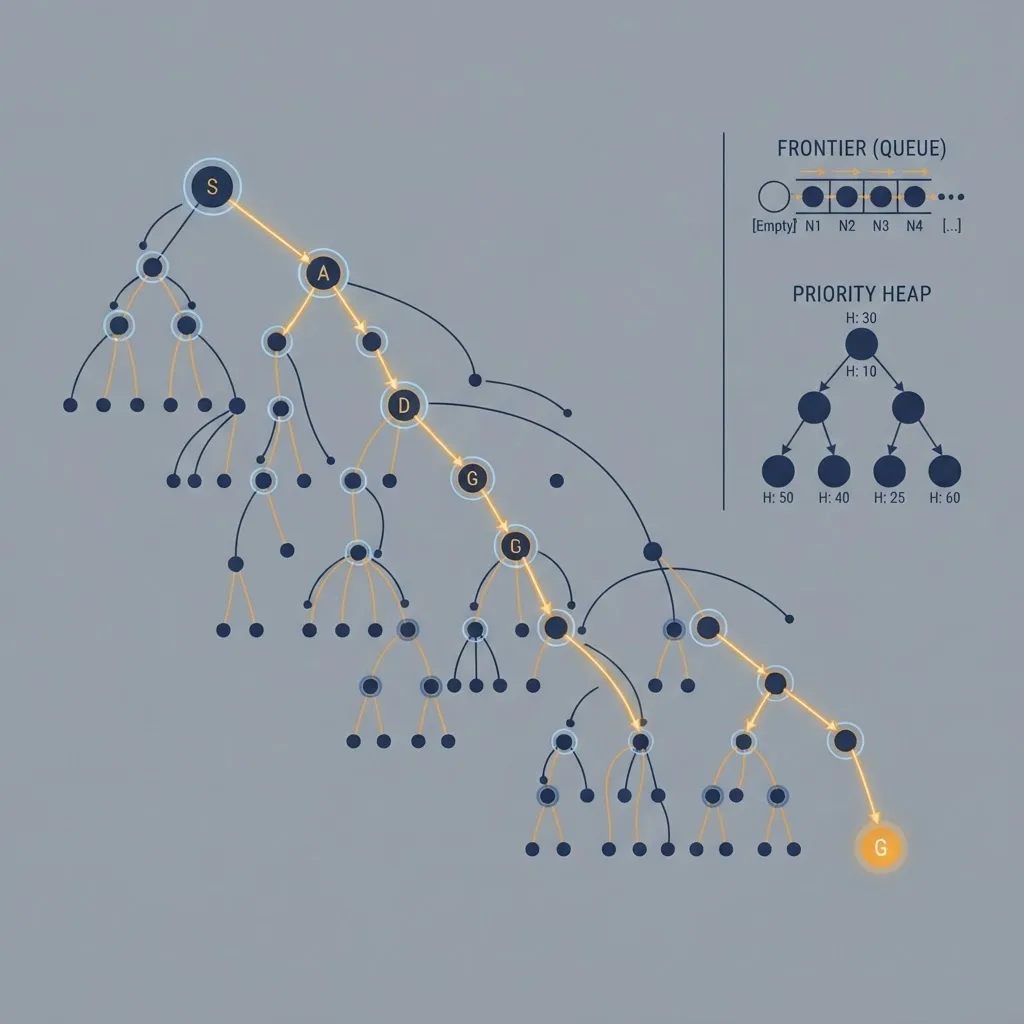
Search is roughly the first third of the semester and the strongest predictor of your final grade. Exam questions rarely ask you to recite a definition; they hand you a graph and ask which nodes A-star expands, in what order, and why. That requires mechanical fluency, not familiarity.
The practical insight most students miss is that heuristic quality matters more than implementation cleverness. Alpha-beta pruning cuts the effective branching factor of minimax, which in the best case lets you search roughly twice as deep in the same time budget. Similarly, a dominant admissible heuristic can reduce expanded nodes by an order of magnitude on the same puzzle. When an assignment is timing out, tighten the heuristic before you optimize the loop.
A concrete study habit that works: hand-trace every algorithm on a five-node graph before you write a line of code. Students who can produce the frontier contents step by step on paper almost never lose points on the search portion of the midterm.
Machine Learning Coverage: Broad, Not Deep

The final third of CSE 4705 introduces learning, but it is a survey rather than a specialization. You will derive information gain for a decision tree split, compute a naive Bayes posterior by hand, and reason about bias, variance, overfitting, and train/test discipline. Neural networks usually get a conceptual treatment with backpropagation presented at the intuition and chain-rule level.
This is where students who plan to work professionally in AI should extend the course on their own. The classroom material explains why a model generalizes; production work is mostly about data pipelines, evaluation, and deployment. Teams that ship AI features commercially, such as the engineers behind AI automation services at ZoneTechify, spend far more time on data quality and monitoring than on model selection, which is exactly the gap a survey course cannot fill.
If you want a deeper track afterward, UConn's graduate machine learning and data mining electives are the natural continuation, and CSE 4705 is the course that makes them readable.
Workload, Assignments, and Time Commitment

Expect four to six programming assignments in Python, plus written problem sets. Typical assignments include a pathfinding or puzzle solver using A-star, a game-playing agent using minimax with alpha-beta, a CSP solver such as Sudoku or map coloring, and a classifier built from scratch.
Realistic time budget, based on how students commonly describe the course:
| Component | Typical weight | Time per item | Difficulty |
|---|---|---|---|
| Programming assignments | 30 to 40 percent | 8 to 15 hours | Moderate to hard |
| Written problem sets | 10 to 15 percent | 2 to 4 hours | Moderate |
| Midterm exam | 20 to 25 percent | Study 10 to 12 hours | Hard |
| Final exam | 25 to 30 percent | Study 15 to 20 hours | Hard |
| Participation or quizzes | 0 to 10 percent | Ongoing | Easy |
Plan for six to nine hours per week outside lecture. The distribution is uneven: assignment weeks spike hard, and the game-playing agent is usually the single largest time sink because debugging a search tree is slower than debugging ordinary code. Start assignments the day they are released and commit a working brute-force version before optimizing.
Three Debugging Habits That Save Hours
- Print the frontier. Most A-star bugs are ordering bugs, and they are invisible until you log the priority queue.
- Test on tiny inputs. A three-by-three board reveals the same logic error as a fifteen-puzzle in one second instead of ten minutes.
- Separate the model from the solver. If your state representation and your search are tangled, every bug becomes two bugs.
Exams: What They Actually Test

Exams are closed-book, computation-heavy, and time-pressured. The recurring format is: trace an algorithm, prove or disprove a property, and apply a formula. Common question types include node expansion order for a given heuristic, alpha-beta pruning on a supplied game tree, AC-3 domain reduction, resolution proofs in CNF, Bayes network independence queries, and a decision tree split calculation.
The highest-yield preparation is redoing textbook exercises by hand rather than rereading slides. Students who complete ten traced problems per topic consistently outperform students who make summary sheets, because the exam measures execution speed on procedures you already recognize.
Is CSE 4705 Worth It? An Honest Verdict
Yes, for most CS students, and especially for anyone considering graduate study. The course delivers three durable assets: the ability to formalize a problem, fluency in probabilistic reasoning, and a mental map of AI that makes new research papers approachable. Employers rarely ask about minimax directly, but interview questions about state spaces, tradeoffs, and evaluation criteria are constant.
The honest caveat is fit. If you are already comfortable with algorithms and probability, this is one of the most satisfying electives at UConn. If CSE 3500 was a struggle, take it in a lighter semester. Development teams hiring junior engineers, including AI-augmented development team builders at WebPeak, tend to value the modeling discipline this course teaches far more than familiarity with any single framework.
Key Takeaways
- CSE 4705 is a three-credit upper-level elective built on Russell and Norvig's Artificial Intelligence: A Modern Approach, fourth edition.
- Roughly the first third of the course is search, and it typically carries the heaviest exam weight.
- Alpha-beta pruning can approximately double the reachable search depth compared with plain minimax under the same time budget.
- Expect four to six Python assignments and six to nine hours of outside work per week.
- Machine learning coverage is a survey, so pair it with a graduate ML elective or self-study for depth.
- CSE 3500 plus a probability course is the practical prerequisite combination for comfort in this class.
Frequently Asked Questions (FAQ)
Is UConn CSE 4705 hard?
Most students describe CSE 4705 as moderately hard rather than brutal. The programming is manageable, but exams are computation-heavy and time-pressured. Difficulty depends almost entirely on your comfort with algorithm tracing and probability. Students who did well in CSE 3500 usually find the workload predictable and fair.
What programming language does CSE 4705 use?
Python is the standard language for CSE 4705 assignments because it keeps the focus on algorithms rather than syntax. You will build search agents, CSP solvers, and simple classifiers, often with limited external libraries so the logic is genuinely yours. Comfort with recursion and data structures matters more than language expertise.
What are the prerequisites for CSE 4705?
The formal prerequisite is normally CSE 3500, Algorithms and Complexity. In practice you also want CSE 2500 discrete math and a probability or statistics course, since Bayesian reasoning appears midway through the semester. Verify the current requirement in the UConn course catalog, because prerequisites are occasionally revised between academic years.
Does CSE 4705 cover deep learning and neural networks?
CSE 4705 introduces neural networks conceptually, including perceptrons and the intuition behind backpropagation, but it is not a deep learning course. The emphasis stays on classical AI and statistical foundations. For transformers, convolutional networks, and modern training practice, take a dedicated machine learning or deep learning elective afterward.
How should I prepare before the semester starts?
Review graph traversal, recursion, big-O analysis, and conditional probability including Bayes rule. Skim the first three chapters of Russell and Norvig, and hand-trace breadth-first and depth-first search on a small graph. Two focused weekends of this preparation removes most of the early-semester friction students report.
Is CSE 4705 useful for AI jobs?
Yes, indirectly but meaningfully. It teaches problem formalization, search, and probabilistic reasoning, which underpin interview questions and real system design. It will not by itself qualify you for a machine learning engineer role, so combine it with portfolio projects, a data-focused elective, and practical experience with real datasets and deployment.