
A practical breakdown of the Itero Lumina AI feature set, what each capability actually does, and how teams should evaluate it against traditional automation before buying.
Itero Lumina AI Features Artificial Intelligence
Itero Lumina belongs to a fast-growing category of applied artificial intelligence platforms that promise reasoning, automation, and analysis inside one workspace. The problem for buyers is that almost every vendor in this category describes itself with the same words. This guide breaks the feature conversation down into checkable capabilities, explains what each one means in engineering terms, and gives you an evaluation framework you can apply on a trial account in a single afternoon.
Quick Answer: Itero Lumina AI features center on multimodal input handling, retrieval-grounded reasoning, agentic workflow automation, and governed enterprise integration. The practical value comes from how those four layers connect, not from raw model quality. Evaluate it by testing grounding accuracy, integration depth, audit logging, and cost per completed task on your own data.

What Itero Lumina Actually Is
Itero Lumina is best understood as an orchestration layer rather than a model. In modern AI product architecture there are three distinct tiers: the foundation model that generates output, the orchestration layer that decides what context reaches the model and what happens with the response, and the interface layer users touch. Platforms in the Lumina class compete almost entirely in tier two.
This distinction matters commercially. If a platform is a thin wrapper on a public model, its defensibility and your switching cost are both low. If it owns retrieval, memory, tool execution, and governance, it becomes genuinely embedded in your operations. Before you evaluate any single feature, ask the vendor which tier each capability lives in. The answer changes how you negotiate and how you plan for migration.
Key Terms Defined
- Multimodal: the system accepts more than one input type, typically text, images, documents, audio, and structured data.
- Grounding: attaching model output to a verifiable source document so answers can be cited rather than guessed.
- Agentic workflow: a chain in which the AI selects and calls tools across multiple steps toward a goal, instead of returning one response.
- Inference cost: the compute charge per request, usually measured in tokens, which becomes the dominant line item at scale.
The Core Feature Layers Explained
AI feature lists are marketing artifacts. Feature layers are architecture. Group everything a platform like Itero Lumina claims into these four layers and the evaluation becomes far simpler.

1. Input and Multimodal Handling
The first layer determines what the system can even see. Strong implementations parse scanned PDFs, spreadsheets, screenshots, and audio into structured representations before reasoning begins. Weak implementations accept the file and quietly degrade it into low-quality text.
Test this directly. Upload a messy multi-column PDF with a table and ask for a specific cell value. Accurate table extraction is one of the clearest signals of engineering depth, because it requires document layout analysis rather than model access alone.
2. Retrieval and Grounding
The second layer decides what context the model receives. Retrieval-augmented generation reduces unsupported answers substantially in published evaluations, which is why grounding has become the default architecture for enterprise assistants. Stanford's 2024 AI Index reported that model performance on knowledge benchmarks continues to improve while factual reliability remains highly dependent on retrieval quality, not model size.
The feature you want here is citation with source spans, so a reviewer can click a claim and see the paragraph it came from. Without that, human verification cost cancels out the productivity gain.
3. Reasoning and Task Execution
The third layer handles the actual work: summarizing, classifying, drafting, extracting, comparing, and calling tools. Look for explicit step visibility. A platform that shows the plan it intends to execute before executing it is dramatically safer to deploy than one that returns a finished action with no trace.

4. Governance and Observability
The fourth layer is the one buyers skip and later regret. It covers role-based access, data residency, retention settings, prompt and output logging, and the ability to answer a simple question: which user asked what, and which documents did the system read to answer it. The EU AI Act, which entered into force in August 2024 with obligations phasing in through 2026, makes traceability a compliance requirement rather than a nice-to-have for many use cases.
Automated Workflows: Where Value Concentrates
Most measurable return does not come from chat. It comes from repeatable pipelines that run without a human initiating them. A support triage flow that reads an inbound ticket, classifies intent, pulls the relevant account record, drafts a reply, and routes anything low-confidence to a person will outperform an equally capable chat assistant, because it removes the human trigger step entirely.

When assessing workflow features, insist on four specifics:
- Trigger variety. Webhooks, scheduled runs, inbox events, and database changes, not just manual clicks.
- Confidence thresholds. The ability to route uncertain outputs to human review automatically.
- Retry and idempotency. A failed step must be safe to repeat without duplicating downstream side effects.
- Versioning. Workflows are code. If you cannot roll back a prompt change, you cannot operate it responsibly.
Teams that need these pipelines wired into an existing product usually pair the platform with an engineering partner. Specialist AI automation services help translate a proof of concept into something that survives production traffic, error handling, and audit review.
Itero Lumina AI Compared With Traditional Automation
Rule-based automation is not obsolete. It is deterministic, cheap, and auditable. AI platforms win on unstructured input and ambiguity. The correct architecture in most organizations is a hybrid, and the table below shows why.

| Dimension | Itero Lumina Style AI Platform | Traditional Rule Based Automation |
|---|---|---|
| Unstructured input | Handles documents, images, free text | Requires clean structured fields |
| Setup effort | Low initial, higher tuning effort | High initial, stable afterward |
| Output predictability | Probabilistic, needs evaluation | Deterministic and repeatable |
| Cost model | Per token or per task inference cost | Fixed infrastructure cost |
| Failure mode | Confident but wrong output | Hard stop or explicit error |
| Auditability | Depends on logging and grounding | Fully traceable by design |
| Best fit | Triage, drafting, extraction, analysis | Billing, compliance rules, calculations |
The practical rule: use AI where the input is messy and the cost of an occasional error is recoverable. Use deterministic logic where the output must be exactly right every time.
Integration Depth Is the Real Differentiator
An AI platform is only as useful as the systems it can read from and write to. Integration depth has three levels, and vendors rarely distinguish between them.
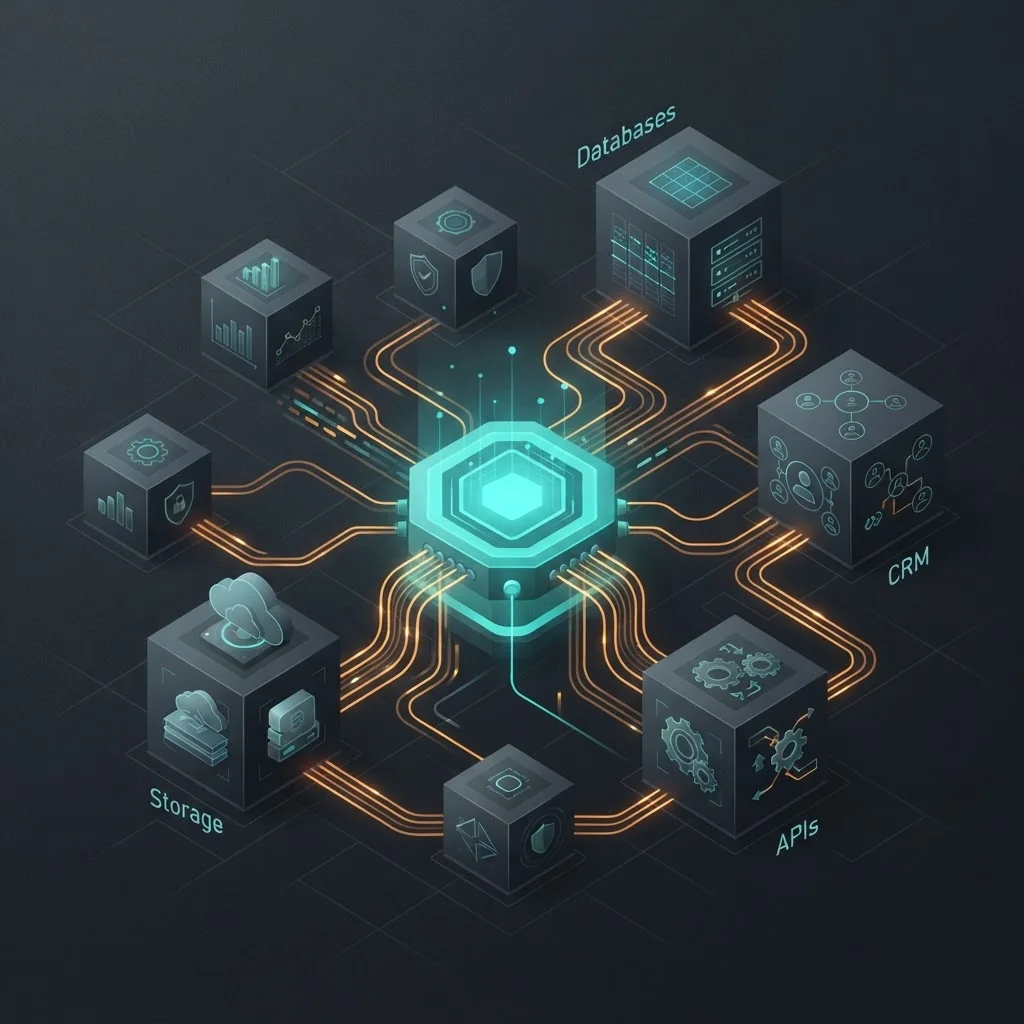
- Read-only connectors let the AI reference your data. Useful, low risk, limited leverage.
- Write-back connectors let it update records, create tickets, or send messages. This is where measurable time savings appear.
- Native event subscription lets your systems push changes to the AI in real time, which is what makes automation feel instant rather than batched.
Ask for the specific authentication model too. Short-lived scoped tokens are meaningfully safer than long-lived API keys stored in a vendor dashboard. If your team is building the surrounding application, an experienced Next.js development agency can own the integration layer, authentication boundaries, and interface while the AI platform handles inference.
A Realistic Evaluation and Rollout Plan
Most failed AI deployments fail at scoping, not at technology. Use a staged rollout with an exit criterion at every stage.

- Pick one measurable task. Something with a current baseline, such as average ticket handling time or hours spent on document review.
- Build a 50-example gold set. Real inputs with known correct outputs. This is your only defense against vibe-based decisions.
- Run a scored trial. Measure accuracy, unsupported claim rate, and cost per completed task, not impressions.
- Deploy with a human in the loop. Keep review on every output until accuracy is stable across two weeks of live volume.
- Automate the confident band. Let high-confidence outputs pass through and keep the rest under review.
- Instrument continuously. Model updates change behavior. Rerun your gold set monthly.
One experience-based caution worth stating plainly: the pilot that impresses everyone in week one often stalls in week six, because nobody assigned ownership of prompt maintenance, evaluation, and exception handling. Budget for that role explicitly.
Key Takeaways
- Itero Lumina style platforms compete on orchestration, grounding, and governance, not on model quality alone.
- Grounded retrieval with clickable source citations is the single highest-value feature for factual reliability.
- Workflow automation with event triggers and confidence routing produces more measurable return than chat interfaces.
- The EU AI Act, in force since August 2024 with staged obligations through 2026, makes traceability and logging a compliance concern.
- Write-back and event-driven integrations, not read-only connectors, are where time savings actually materialize.
- A 50-example gold set plus cost per completed task is a sufficient evaluation method for most teams.
- Hybrid architecture wins: AI for ambiguous input, deterministic rules for outputs that must be exact.
Frequently Asked Questions (FAQ)
What are the main Itero Lumina AI features?
The feature set clusters into four layers: multimodal input handling for documents and images, retrieval-grounded reasoning with citations, agentic workflow automation with tool calling, and governance controls covering permissions, logging, and data retention. Evaluate all four together, because a weak governance layer limits how widely you can deploy the rest.
Is Itero Lumina AI worth it for a small business?
It is worth it when you have one repeatable, high-volume task involving unstructured input, such as invoice extraction or inbound enquiry triage. Small teams should measure cost per completed task against current labor hours. If the workload is low volume or highly variable, a simpler tool or targeted automation usually delivers better economics.
How is AI automation different from normal automation?
Normal automation follows explicit rules and always produces the same output for the same input. AI automation interprets ambiguous input like emails, images, and documents, then produces a probabilistic result. Use rules where correctness must be guaranteed, and AI where the input is messy and occasional errors are recoverable through review.
Can Itero Lumina AI connect to my existing systems?
Most platforms in this category offer connectors, but depth varies significantly. Ask specifically whether integrations are read-only, support write-back to your records, and allow real-time event subscriptions. Also confirm the authentication model, since short-lived scoped tokens are considerably safer than long-lived API keys held in a vendor dashboard.
How do I test whether an AI platform is accurate?
Build a set of about 50 real inputs with known correct answers, run them through the platform, and score accuracy plus the rate of unsupported claims. Repeat the same test monthly, because underlying model updates change behavior. This single practice prevents most costly misjudgments during procurement and after rollout.
What does grounding mean in an AI platform?
Grounding means the system retrieves your actual source documents and constrains its answer to that evidence, then shows the passage it used. It reduces fabricated output and, more importantly, makes verification fast. Without visible citations, reviewers must re-check every claim manually, which erases most of the expected productivity gain.