
A practical, expert guide to how artificial intelligence in media buying automates bidding, targeting, and budget decisions to cut waste and boost ad ROI.
Artificial Intelligence in Media Buying
Media buying used to be a game of spreadsheets, gut instinct, and manual insertion orders. Today, artificial intelligence in media buying decides which ad, on which platform, at which price, for which person, in the time it takes a webpage to load. If you still buy media the old way, you are competing against algorithms that learn from millions of impressions every hour. This guide explains exactly how AI changed the buying process, where it delivers measurable value, and how to adopt it without losing control of your budget.
At ZoneTechify and WebPeak, we work with advertisers who moved from manual campaign management to AI-assisted buying, and the pattern is consistent: less wasted spend, faster optimization, and clearer attribution. Below is what actually matters.

Quick Answer: Artificial intelligence in media buying uses machine learning to automate ad purchasing decisions, including real-time bidding, audience targeting, budget allocation, and creative optimization. It analyzes vast data in milliseconds to buy the right impression at the right price, reducing wasted spend and improving campaign return on investment.
What Is Artificial Intelligence in Media Buying?
Artificial intelligence in media buying is the use of machine learning models to automate and optimize the purchase of advertising inventory across digital channels. Instead of a human manually choosing placements and bids, algorithms evaluate signals such as user behavior, context, device, time of day, and historical conversion data to decide which impressions to buy and how much to pay.
The practice sits on top of programmatic advertising, the automated buying and selling of ad space through digital exchanges. AI is the intelligence layer that makes those automated transactions smart rather than merely fast. According to the Interactive Advertising Bureau, programmatic accounts for the vast majority of digital display spending in mature markets, and AI-driven optimization is now the default expectation rather than a premium add-on.

How AI Actually Buys Media
Understanding the mechanics helps you trust the outcomes. Here is the buying loop AI runs continuously:
- Ingest data. The system pulls first-party data, contextual signals, and exchange bid requests.
- Predict value. A model estimates the probability that a given impression leads to a click, install, or sale.
- Set the bid. It calculates the maximum price worth paying to hit your target cost per acquisition.
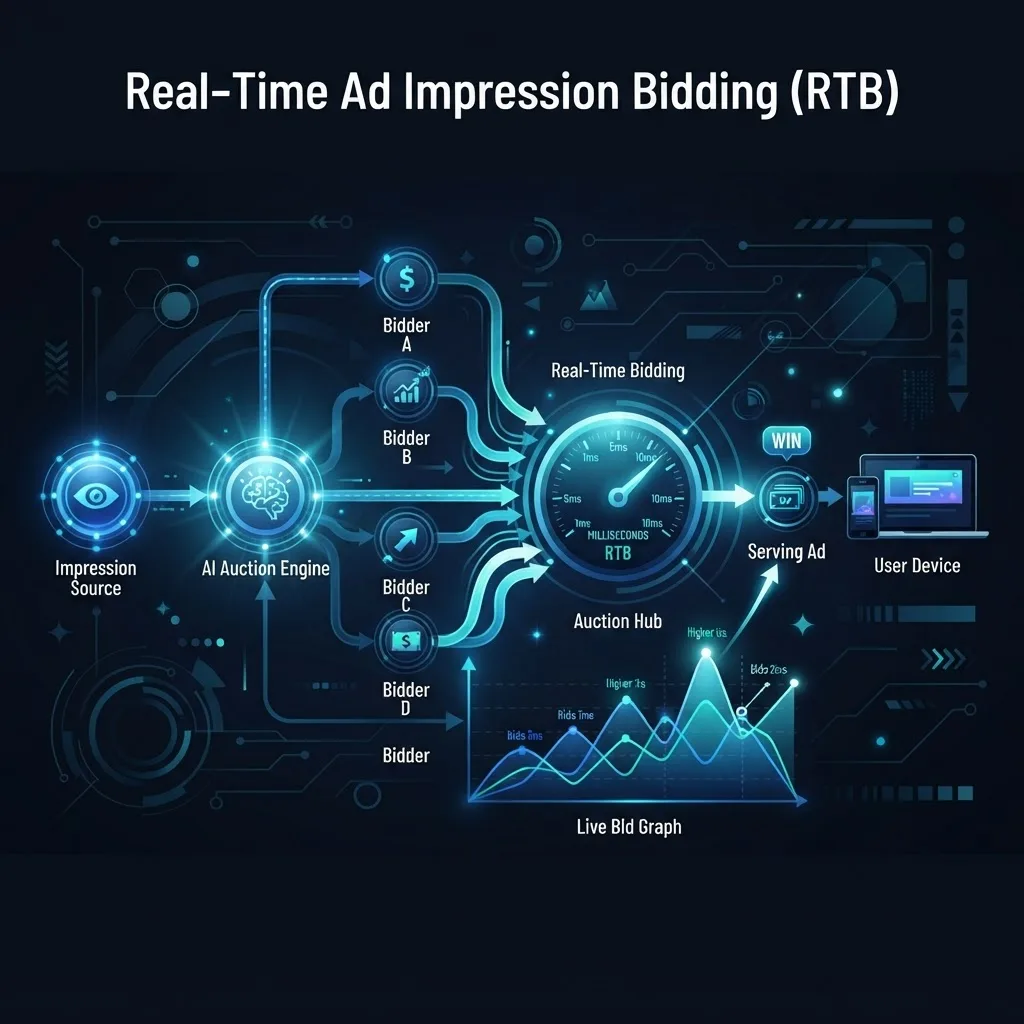
- Buy in real time. The bid enters an auction and wins or loses in roughly 100 milliseconds.
- Learn and adjust. Every outcome feeds back into the model, sharpening the next decision.
This cycle repeats billions of times across a large campaign, which is why manual management simply cannot match it at scale.
Real-Time Bidding and Machine Learning
Real-time bidding (RTB) is an auction in which individual ad impressions are bought and sold instantly as a page loads. AI improves RTB by predicting the true worth of each impression instead of applying flat bids. A model might bid aggressively for a returning cart-abandoner and pennies for a low-intent visitor, protecting your budget where it matters.
Where AI Delivers the Biggest Wins
Not every feature moves the needle equally. In our campaign work, the highest-impact applications are consistent across industries.
1. Programmatic Automation at Scale
AI removes the manual grind of managing hundreds of ad sets. It launches, pauses, and reallocates spend automatically based on performance thresholds you define. This frees your team to focus on strategy and creative rather than dashboard babysitting.

2. Precision Audience Targeting
Audience targeting is the process of showing ads only to people most likely to act. AI clusters users by behavioral patterns rather than broad demographics, uncovering high-value micro-segments a human would never spot. It also builds lookalike audiences from your best customers, extending reach without diluting quality.

3. Predictive Budget Allocation
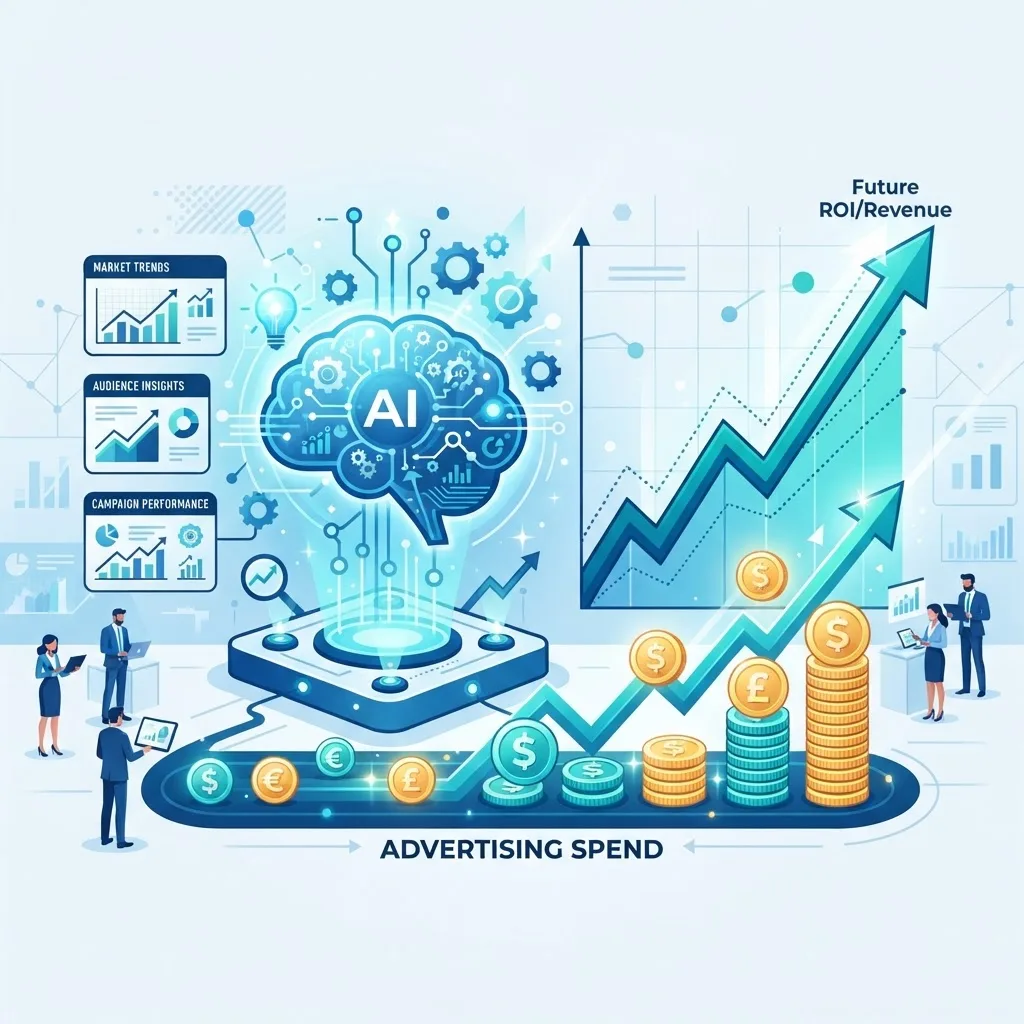
Instead of splitting budgets evenly, AI forecasts which channels and times will convert best and shifts money there before performance dips. Google reports that automated bidding strategies can meaningfully improve conversions compared with manual bidding when given clean conversion data and adequate learning time.
4. Creative Optimization
AI tests headlines, images, and calls to action automatically, promoting winners and retiring losers. Dynamic creative optimization assembles the best-performing combination for each viewer in real time, so one campaign effectively runs thousands of tailored variants.
AI vs. Traditional Media Buying
The difference is not subtle. The table below compares the two approaches on the factors that affect your results.
| Factor | AI Media Buying | Traditional Media Buying |
|---|---|---|
| Speed of decisions | Milliseconds | Hours to days |
| Optimization frequency | Continuous | Weekly or monthly |
| Bidding | Per-impression, predictive | Flat or manual |
| Scale | Millions of decisions | Limited by staff hours |
| Wasted spend | Low, auto-corrected | Higher, lag in fixes |
| Human role | Strategy and oversight | Hands-on execution |
| Reporting | Real-time dashboards | Periodic reports |
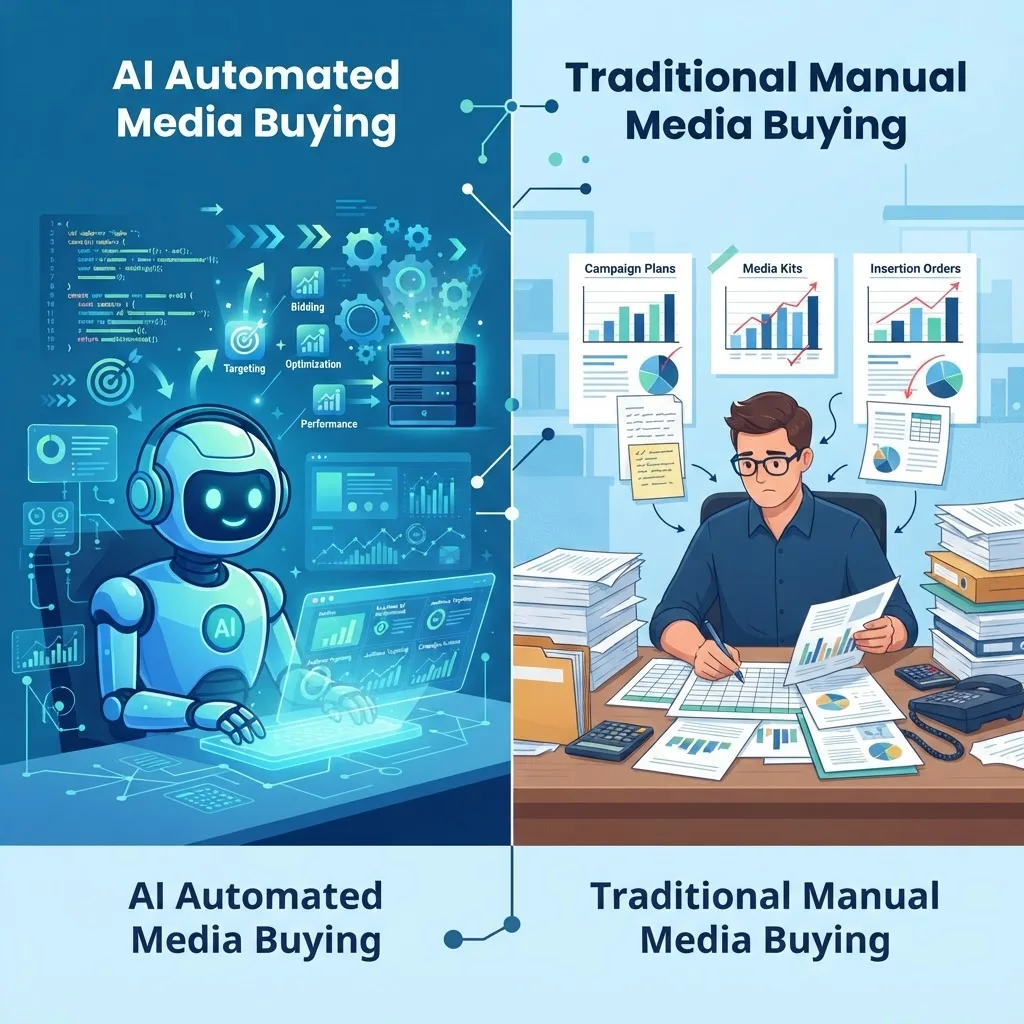
The honest takeaway: AI wins on speed, scale, and efficiency, but it needs a human to set goals, feed it quality data, and catch edge cases. The best results come from combining both, not replacing judgment entirely.
How to Adopt AI Media Buying Without Losing Control
Adopting AI is not about handing over your budget and hoping. Follow these steps to stay in command:
- Fix your data first. AI is only as good as your conversion tracking. Clean, accurate first-party data is non-negotiable.
- Set clear guardrails. Define target cost per acquisition, maximum bids, and brand-safety rules before you automate.
- Give it time to learn. Most bidding algorithms need one to two weeks and a minimum conversion volume to stabilize. Do not judge results on day two.
- Keep a human in the loop. Review anomalies, seasonal shifts, and creative fatigue that models can miss.
- Protect against fraud. Pair AI buying with verification tools to filter invalid traffic and bots.
If you want expert help building this stack, professional digital marketing services can set up tracking, guardrails, and reporting correctly the first time. For teams focused specifically on the machine-learning layer, WebPeak's artificial intelligence services help implement and tune the models behind these campaigns.

The Risks You Should Not Ignore
AI media buying is powerful, but real expertise means naming the downsides. Black-box decisions can make it hard to explain why spend went where it did, which complicates client reporting. Data privacy regulation, including the phase-out of third-party cookies, is reshaping the signals models rely on, pushing the industry toward first-party data and contextual targeting. And algorithmic bias can quietly exclude valuable audiences if training data is skewed.
The practical defense is transparency: choose platforms that expose their logic, audit performance by segment, and never automate a decision you could not justify to a client. Trustworthy AI buying is accountable AI buying.
The Future of AI in Media Buying
Three shifts are already underway. First, generative AI now produces and adapts ad creative on demand, closing the gap between targeting precision and creative volume. Second, privacy-first modeling is replacing individual tracking with aggregated and predictive signals. Third, cross-channel orchestration is unifying search, social, connected TV, and retail media into a single optimization brain rather than siloed campaigns.
The advertisers who win will not be those with the biggest budgets, but those who feed the cleanest data and pair it with sharp human strategy. AI levels the playing field for disciplined marketers.
Key Takeaways
- Artificial intelligence in media buying automates bidding, targeting, budgeting, and creative decisions using machine learning.
- It runs on programmatic advertising and real-time bidding, buying impressions in roughly 100 milliseconds.
- AI beats manual buying on speed, scale, and efficiency, but still needs human strategy and oversight.
- Google reports automated bidding can improve conversions when given clean data and learning time.
- Clean first-party data, clear guardrails, and fraud protection are prerequisites for success.
- Privacy regulation and the loss of third-party cookies are pushing the field toward first-party and contextual signals.
Frequently Asked Questions (FAQ)
What does AI do in media buying?
AI automates the decisions humans used to make manually. It predicts the value of each ad impression, sets bids in real time, targets the most likely buyers, allocates budget across channels, and optimizes creative. It learns from every outcome, improving campaign efficiency and reducing wasted ad spend continuously.
Is AI media buying better than manual media buying?
For scale, speed, and efficiency, yes. AI evaluates millions of impressions and adjusts instantly, which humans cannot match. However, it needs people to set goals, supply clean data, and handle edge cases. The strongest results combine AI automation with human strategy and oversight rather than replacing either.
How much does AI media buying cost?
Costs vary by platform and spend level. Many demand-side platforms charge a percentage of media spend, often five to twenty percent, plus data fees. Some tools are built into ad platforms at no extra charge. Factor in setup and management time when budgeting for your first campaigns.
Do I need clean data for AI to work?
Yes, absolutely. AI models are only as good as the conversion data you feed them. Broken tracking, duplicate events, or missing signals lead to poor bids and wasted budget. Fix your analytics, tagging, and first-party data collection before automating any significant portion of your media spend.
Will AI replace media buyers?
No, but it changes the job. AI handles repetitive execution like bidding and reallocation, while human buyers focus on strategy, creative direction, data quality, and oversight. Media buyers who learn to manage and audit AI systems become more valuable, not less, in the modern advertising landscape.
How long before AI media buying shows results?
Most automated bidding strategies need one to two weeks and a minimum volume of conversions to exit the learning phase. Avoid making major changes during this period, as it resets the model. Judge performance over a full optimization cycle rather than reacting to early daily fluctuations.