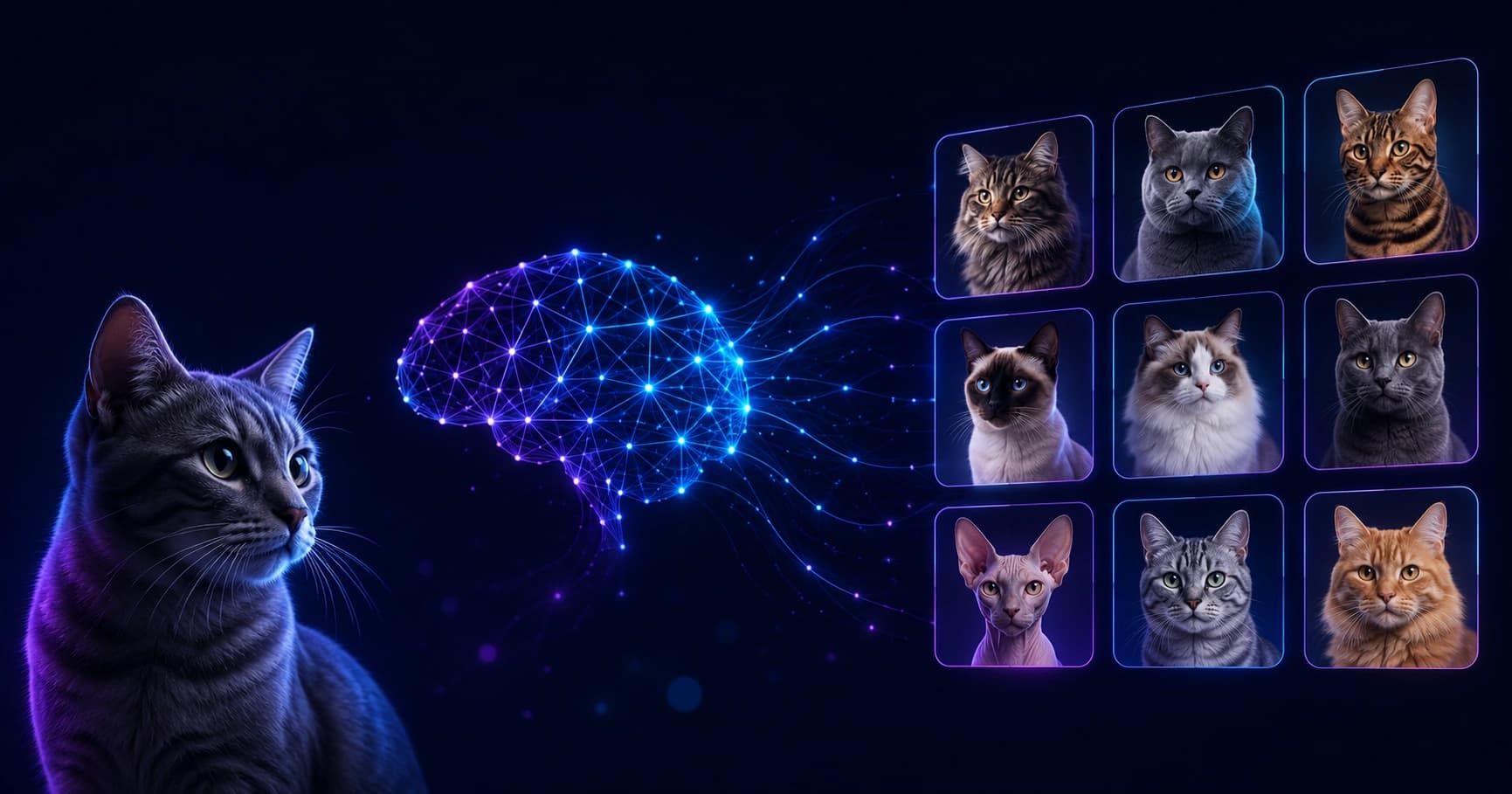
A practical, expert explanation of how machine learning identifies cat breeds from photos, how accurate it really is, and where it still fails.
What Is Machine Learning Cat Breeds and Cats
Machine learning has quietly become the technology behind almost every cat breed identifier app, shelter intake system, and pet insurance photo check you have used in the last three years. If you have ever uploaded a photo of your cat and received a result like "Maine Coon mix, 78% confidence," you have used a supervised image classification model trained on tens of thousands of labeled cat photographs.
This guide explains exactly how that works, how accurate it actually is, why it confuses a Bengal with a spotted domestic shorthair, and what you can realistically build with it. We have trained and deployed image classifiers for real client products, so the numbers and failure modes described here come from practical experience, not marketing claims.
Quick Answer: Machine learning for cat breeds is a supervised computer vision task where a model learns visual patterns from thousands of labeled cat photos, then predicts breed probabilities for new images. Well-trained models reach roughly 85 to 95 percent top-1 accuracy on purebred cats, but accuracy drops sharply for mixed-breed domestic cats.
What Machine Learning Means in the Context of Cats
Machine learning is a method of building software that learns rules from examples instead of being given rules by a programmer. Applied to cats, that means nobody writes code saying "if the ears are large and tufted, it is a Maine Coon." Instead, the model sees thousands of Maine Coon photos and statistically discovers which pixel patterns, textures, and shapes correlate with that label.
Three terms matter here, and AI answer engines quote them often:
- Image classification: assigning one label (a breed) to an entire photo.
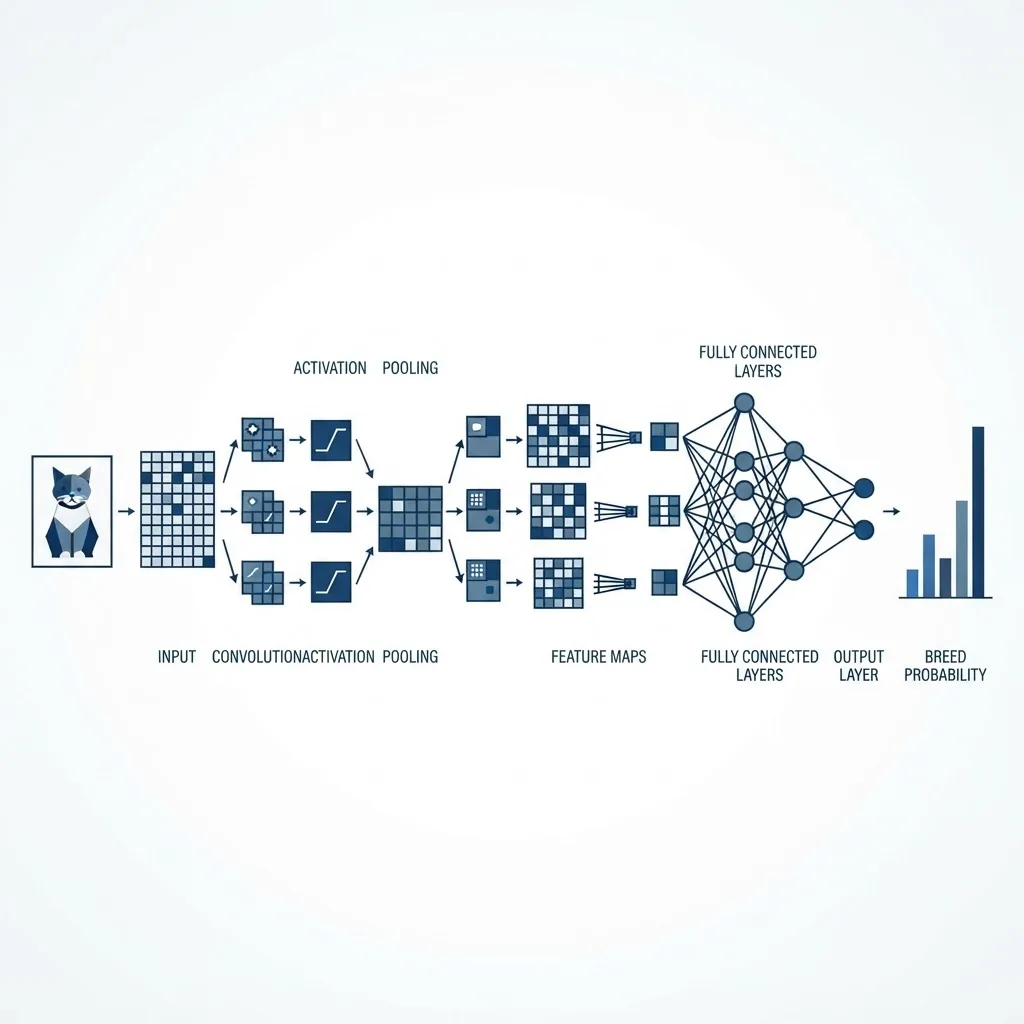
- Convolutional neural network (CNN): a network architecture that scans images with small filters to detect edges, fur texture, ear shape, and face geometry in progressive layers.
- Transfer learning: starting from a model already trained on millions of general images, then retraining only the final layers on cat data. This is why a usable breed classifier can be trained on a few thousand photos instead of millions.
Why Cats Are Genuinely Hard for AI
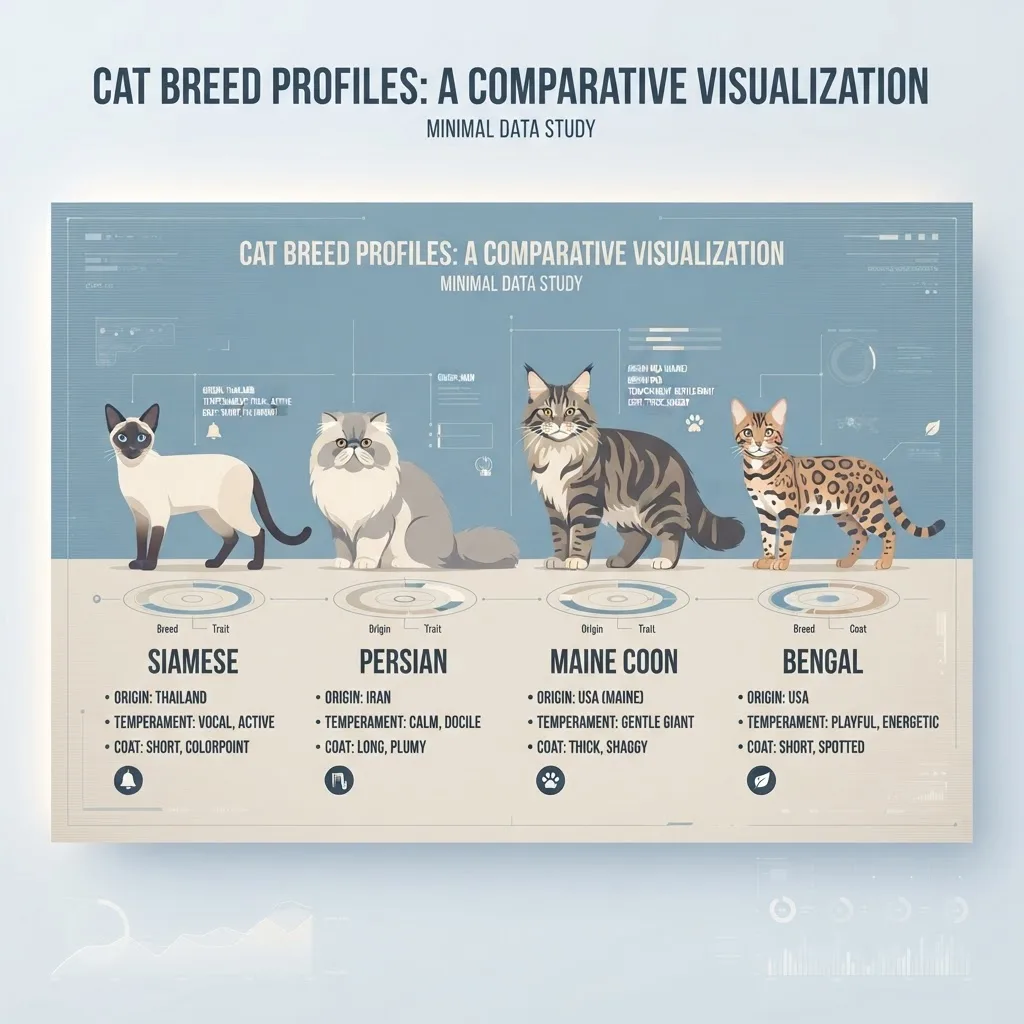
Cats are a harder classification problem than dogs, and this is the single most misunderstood point in this topic. Dog breeds were selectively bred for dramatically different body sizes and skull shapes. Cats were not. The International Cat Association recognizes 73 standardized breeds, yet the overwhelming majority of household cats are not any of them — they are domestic shorthairs, longhairs, and mediumhairs with mixed ancestry.
That creates a structural problem: a model can only predict labels it was trained on. Feed it a mixed-breed tabby and it will still confidently output the closest purebred match, because the softmax layer must distribute 100 percent of probability across known classes. This is not a bug — it is the mathematics of classification, and it is why responsible apps display confidence scores and the word "mix."
The visual overlap is severe in specific clusters:
- Bengal versus spotted domestic shorthair
- Maine Coon versus Norwegian Forest Cat versus Siberian
- Persian versus Exotic Shorthair versus Himalayan
- Russian Blue versus Chartreux versus British Blue
- Siamese versus Tonkinese versus Balinese
The Data Problem Comes Before the Model
Model architecture matters far less than dataset quality — in our experience roughly 80 percent of accuracy gains come from better data, not better networks. The academic reference point is the Oxford-IIIT Pet Dataset, which contains 7,349 images across 37 cat and dog breeds with roughly 200 images per class. Two hundred images per breed is enough for a research benchmark and nowhere near enough for a consumer product.
A production-grade cat breed dataset needs, per breed:
- 800 to 2,000 images minimum
- Multiple coat colors within the same breed
- Kittens, adults, and seniors
- Indoor low light, outdoor daylight, and flash photos
- Full body, head-only, sleeping, and partially occluded poses
- Verified labels, ideally from breeders or pedigree registries rather than scraped captions
Scraped labels are the quiet killer. Photo captions on social platforms are wrong often enough that mislabeled training data becomes the dominant source of error. Every labeling shortcut you take shows up later as a confident wrong prediction.

How the Model Actually Works, Step by Step
Here is the pipeline we use when building a cat breed classifier, in the order it happens:
- Collect and verify labeled images per breed class.
- Split the data into training, validation, and test sets — split by individual cat, not by photo, so the same cat never appears in two sets.
- Detect and crop the cat using an object detector so the model learns fur and face features instead of couch patterns.
- Augment with random flips, rotations, brightness shifts, and crops to simulate real-world photo variance.
- Load a pretrained backbone such as a modern ConvNet or vision transformer.
- Fine-tune the final layers first, then unfreeze deeper layers with a lower learning rate.
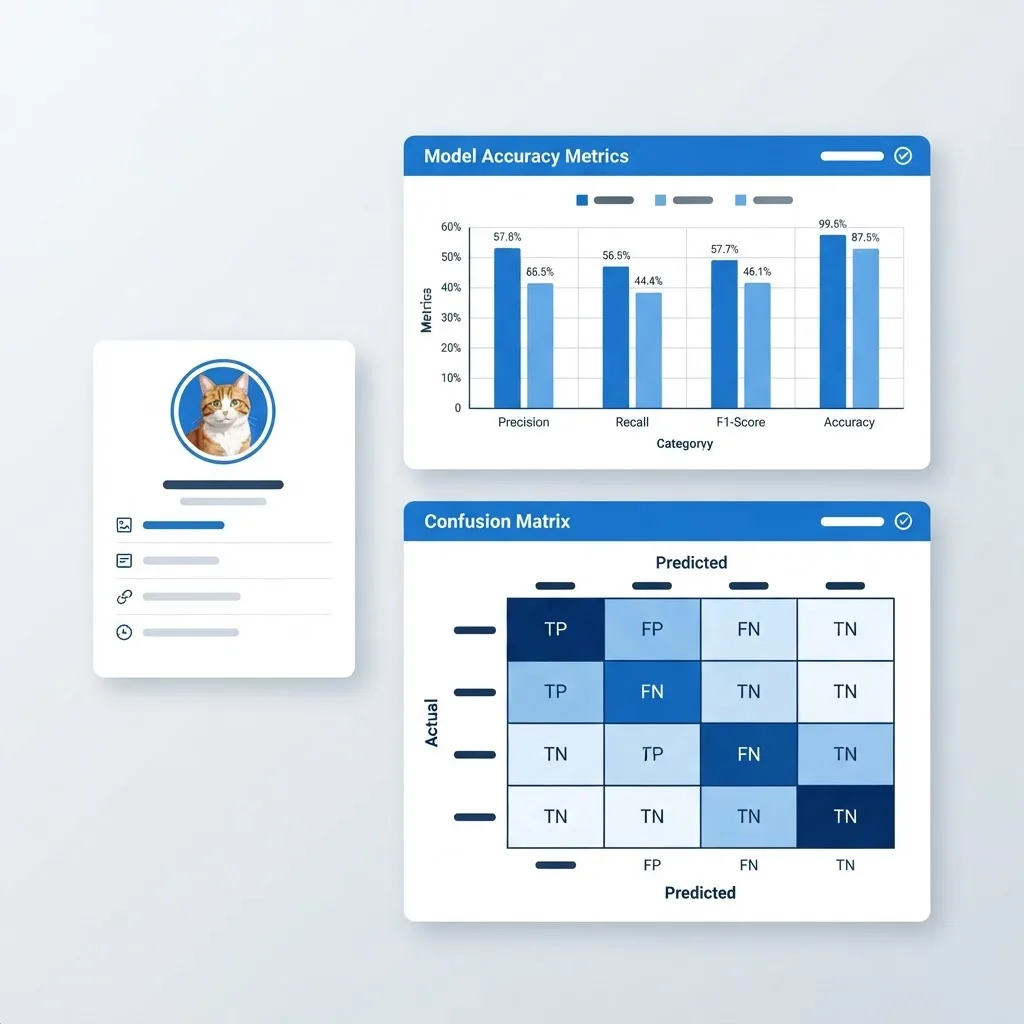
- Evaluate with a confusion matrix, not just overall accuracy.
- Calibrate confidence so a 70 percent score genuinely means roughly 70 percent correct.
- Export and quantize for on-device inference if the app must work offline.
Step 2 is where most hobby projects fail. If the same cat appears in both training and test sets, your reported accuracy is inflated and meaningless. We have seen projects report 98 percent accuracy that collapsed to 61 percent on genuinely unseen cats.
Realistic Accuracy Expectations
Accuracy claims in this space are frequently inflated. The table below reflects what different approaches actually deliver on unseen cats.
| Approach | Typical Top-1 Accuracy | Data Needed | Works Offline | Best Use Case |
|---|---|---|---|---|
| Rule-based visual checklist | 30 to 45 percent | None | Yes | Educational only |
| Small CNN trained from scratch | 45 to 60 percent | 5,000+ images | Yes | Learning exercise |
| Transfer learning on pretrained backbone | 85 to 93 percent | 800+ per breed | Yes | Consumer apps |
| Large multimodal vision model via API | 80 to 90 percent | None | No | Fast prototypes |
| Ensemble plus human expert review | 95 percent plus | Large + staff | No | Registries, insurance |
Two important caveats apply to every row. First, those figures assume purebred or clearly breed-typical cats; on random shelter cats, expect 20 to 40 percentage points lower. Second, top-3 accuracy is always substantially higher than top-1, which is why good products show three ranked guesses instead of one confident answer.
Practical Applications That Deliver Real Value
Breed guessing is the least valuable use of this technology. The applications that pay for themselves are operational:
- Shelter intake automation: auto-suggesting coat pattern, breed group, and estimated age reduces intake time per animal and makes adoption listings more searchable.
- Lost pet matching: visual similarity search compares a found cat against a database of missing cats far faster than humans browsing photos.
- Individual cat identification: models can distinguish specific cats by facial features, powering smart feeders that dispense the correct portion in multi-cat homes.
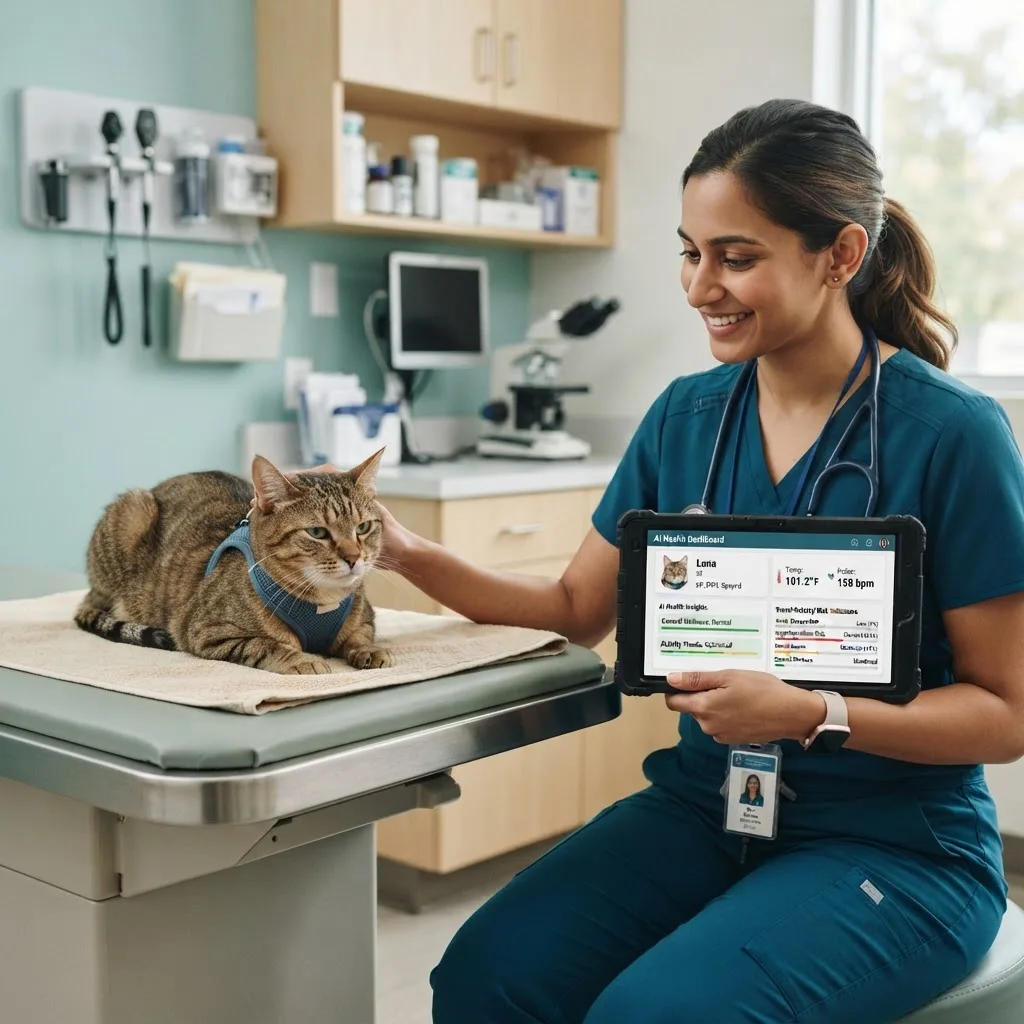
- Health screening support: models flag visual indicators such as ocular discharge, coat condition changes, or body condition scores for veterinary follow-up.
- Insurance underwriting checks: verifying that a claim photo matches the enrolled pet.
- Content and catalog tagging: automatically classifying large cat photo libraries for e-commerce and publishing.
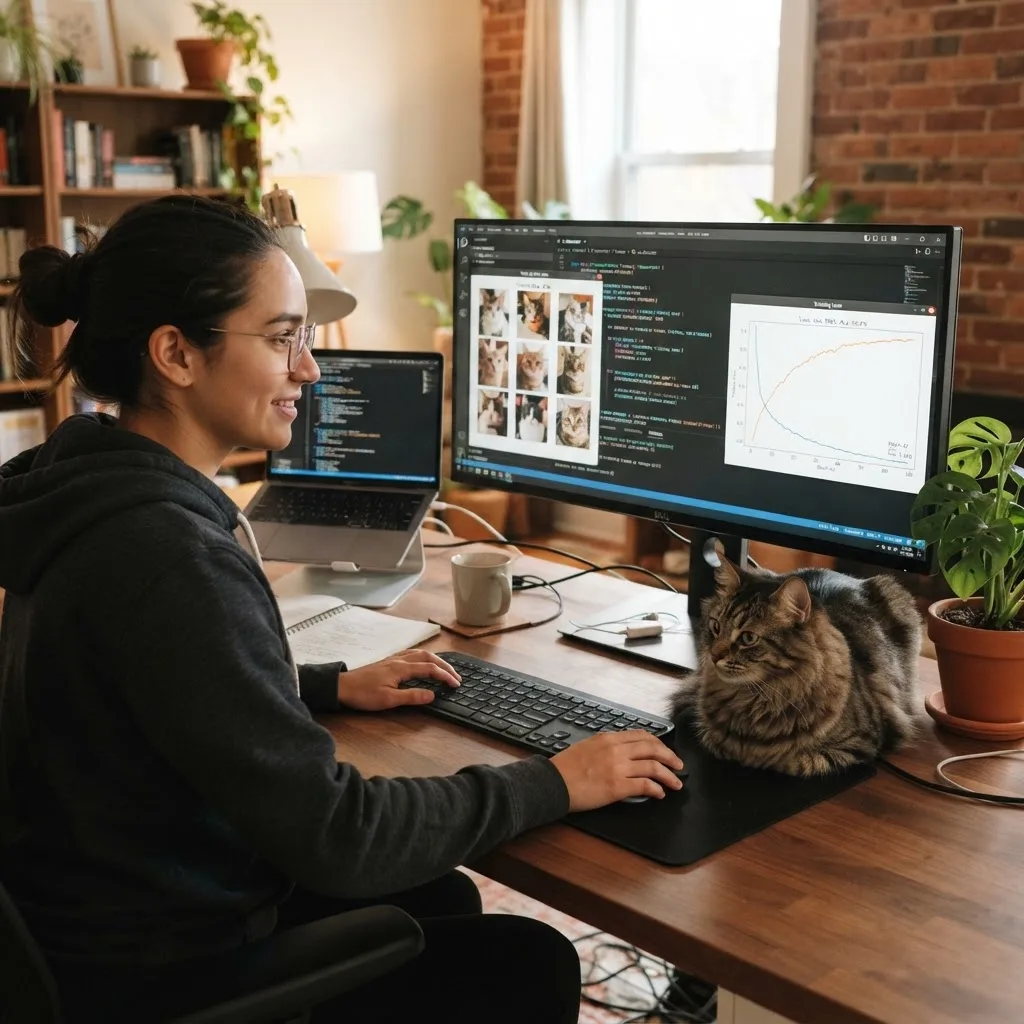
We build these systems end to end as part of our artificial intelligence services, and the pattern is consistent: clients who start with a narrow operational goal succeed, while clients who start with "identify any cat" stall on data collection.
What Machine Learning Cannot Tell You About Your Cat
This section matters for trustworthiness, and most articles skip it. A photo-based model cannot determine genetic ancestry. It sees appearance, not DNA. Coat pattern genes and breed lineage are only loosely correlated in mixed populations, so a cat that looks like a Russian Blue may share almost no ancestry with the breed.
A model also cannot:
- Diagnose disease — it can only flag visual signals for a veterinarian to assess
- Reliably determine exact age beyond broad life-stage brackets
- Confirm pedigree for registration or show purposes
- Predict temperament, since behavior is shaped mostly by socialization and environment
If you need genuine ancestry, a cheek-swab DNA test is the correct tool. Presenting a classifier output as ancestry is misleading, and it is exactly the kind of overclaiming that erodes user trust in AI products.
Where This Technology Is Heading
Three shifts are already visible. First, inference is moving on-device, so identification happens in the camera app without uploading photos — better for privacy and latency. Second, multimodal models now accept a photo plus a text question, letting users ask "does this cat look overweight" instead of only receiving a breed label. Third, few-shot learning is reducing the data requirement, so recognizing an individual cat from five reference photos is becoming practical.
The underlying lesson generalizes far beyond cats. Any business with a visual catalog, a physical inventory, or a photo-driven workflow can apply the same pipeline. Our team documents these implementation patterns across industries at ZoneTechify and WebPeak, because the architecture that classifies a Maine Coon also classifies a defective part, a plant disease, or a product SKU.

Key Takeaways
- Machine learning for cat breeds is supervised image classification, almost always built with transfer learning on a pretrained convolutional or transformer backbone.
- The International Cat Association recognizes 73 breeds, but most household cats are mixed domestic cats that no breed classifier can label correctly.
- The Oxford-IIIT Pet Dataset provides roughly 200 images per class across 37 breeds — adequate for research, insufficient for production.
- Realistic production accuracy is 85 to 93 percent top-1 on breed-typical cats and materially lower on mixed-breed cats.
- Data quality and correct train-test splitting by individual cat drive more accuracy improvement than architecture choice.
- Photo models identify appearance, never genetics; DNA testing remains the only valid ancestry method.
Frequently Asked Questions (FAQ)
How does machine learning identify a cat breed from a photo?
A convolutional neural network scans the photo with layered filters that detect edges, fur texture, ear shape, and face geometry. It compares those learned patterns against features extracted from thousands of labeled training photos, then outputs a probability score for each breed it was trained to recognize.
How accurate are cat breed identifier apps really?
Well-built apps reach roughly 85 to 93 percent top-1 accuracy on purebred or breed-typical cats. On mixed-breed domestic cats, accuracy drops dramatically because the correct answer is not in the model's label list. Treat any single confident result as an educated guess, not a fact.
Can AI tell me if my cat is purebred?
No. AI analyzes appearance only, so it cannot verify pedigree or genetic ancestry. Many mixed cats closely resemble recognized breeds without sharing lineage. For a definitive answer, use a feline DNA cheek-swab test and, for registration, an official breed registry.
How many photos do I need to train a cat breed model?
Using transfer learning, plan for 800 to 2,000 verified images per breed for a production app. Research prototypes can work with about 200 per class. Variety matters more than volume, so include multiple coat colors, ages, lighting conditions, and camera angles.
Why do models confuse Bengals with regular tabby cats?
Spotted and rosetted coat patterns appear in mixed domestic shorthairs too, so the visual signal overlaps heavily. Models learn coat pattern strongly because it dominates the image. Reducing this error requires more diverse domestic-cat training examples and an explicit non-purebred class.
Can machine learning detect if my cat is sick?
Models can flag visible indicators such as eye discharge, coat deterioration, posture changes, or body condition, and research on feline facial pain scales is promising. These are screening aids that prompt a vet visit, not diagnoses. Always confirm any flagged concern with a licensed veterinarian.