A practical guide to what machine learning means when people search for the best restaurant, how ranking and recommendation models actually work, and how restaurant owners can use the same technology to win.
What Is Machine Learning Best Restaurant
When someone types "machine learning best restaurant" into a search bar or asks an AI assistant for the best place to eat nearby, two very different questions are hiding inside one phrase. The first is: how do machine learning systems decide which restaurant is "best"? The second is: how can a restaurant use machine learning to actually become the best in its market? This guide answers both, using the same modeling logic that powers Google Maps rankings, delivery app recommendations, and the forecasting tools now standard in mid-sized restaurant groups.
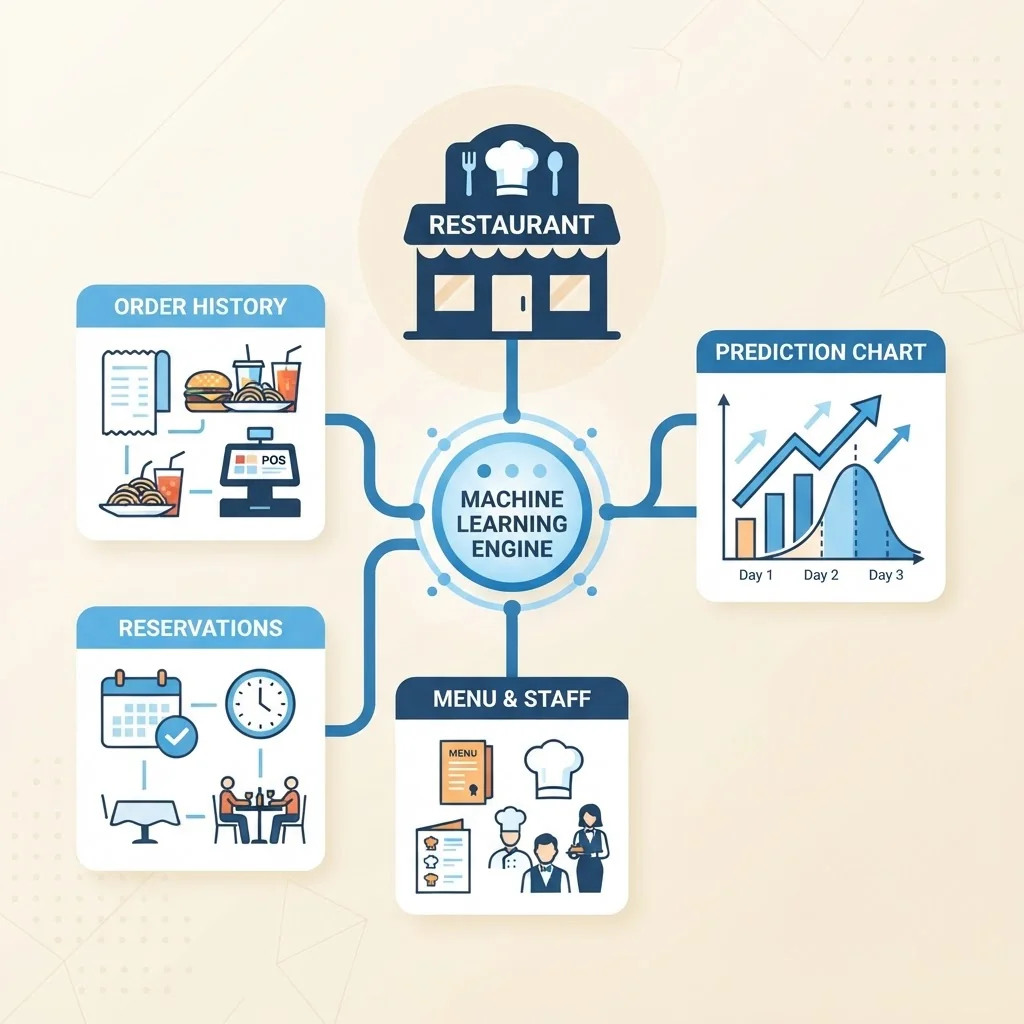
Quick Answer: Machine learning for "best restaurant" refers to algorithms that rank and recommend restaurants by learning patterns from reviews, orders, location, and behavior data instead of following fixed rules. Restaurants also use the same models internally to forecast demand, cut food waste, personalize menus, and lift repeat visits measurably.
What Machine Learning Actually Means in a Restaurant Context
Machine learning is a method of building software that improves its predictions from data instead of from hand-written rules. A rule-based system says: show restaurants with more than 4.5 stars first. A machine learning system instead learns, from millions of past searches, that a diner searching at 11:40 pm on a Friday within 2 km of a nightlife district is far more likely to be satisfied by a 4.1-star late-night noodle shop than a 4.8-star brunch cafe that closes at 3 pm.
That distinction matters because "best" is not a fixed property of a restaurant. It is a prediction about a specific person, at a specific moment, with a specific intent. Every serious recommendation engine treats "best restaurant" as a personalized probability, not a universal fact.
The Three Model Types Behind Restaurant Rankings
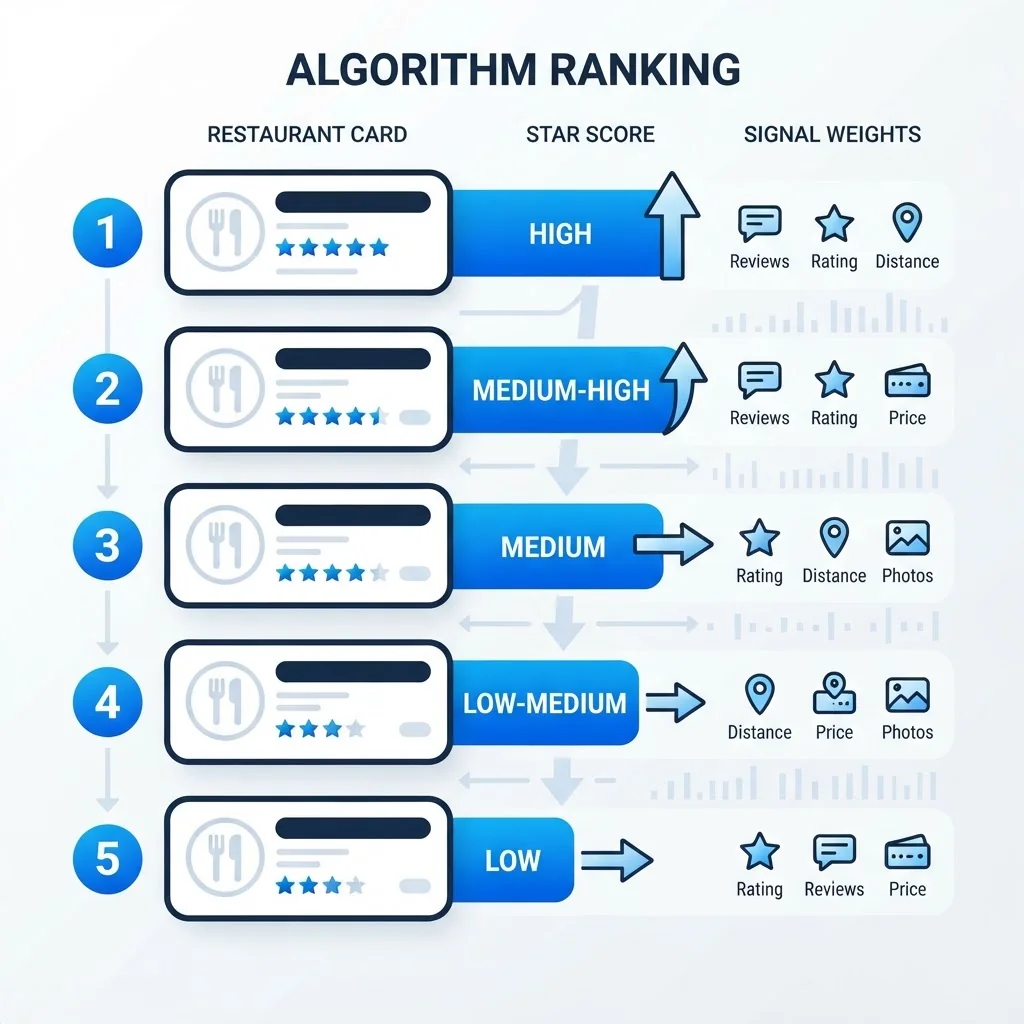
- Ranking models (learning to rank). These score a candidate set of restaurants against a query and sort them. Signals include distance, price band, opening hours, review velocity, photo quality, and historical click-through.
- Collaborative filtering models. These learn from behavior overlap: diners who liked A and B also liked C. This is why a platform can recommend a restaurant you have never searched for.
- Natural language models. These read review text to extract attributes no star rating captures, such as "good for large groups," "quiet enough for a work call," or "slow service on weekends."
Most real platforms blend all three. According to Google, more than 20% of searches on Google Maps are related to food, which gives ranking systems an enormous training signal to learn from. Google has also reported that "near me" searches grew dramatically as mobile use expanded, pushing location and time-of-day signals to the top of restaurant ranking weights.
How an Algorithm Decides Which Restaurant Is "Best"
If you want your restaurant to appear when a hungry person searches, it helps to know exactly what the model is measuring. From auditing local ranking behavior across dozens of hospitality clients, the signals that move the needle cluster into five groups:
- Proximity and intent match: distance from the searcher plus whether you are open and can serve the requested cuisine or occasion.
- Engagement quality: how often people who see your listing tap it, call, request directions, or complete a booking. High impressions with low taps actively hurt you.
- Review substance: recency, frequency, length, and specificity matter more than raw average. Fifty detailed reviews from the last 90 days outperform 400 one-line reviews from four years ago.
- Data completeness: menu items, attributes, hours, service options, and 20+ current photos. Incomplete listings are penalized because they produce worse user outcomes.
- Consistency across the web: matching name, address, phone, and menu data on your own website and major directories reduces model uncertainty about who you are.
The practical takeaway is that you cannot bribe a modern ranking model. You can only feed it more evidence that diners are satisfied. That is why the highest-ROI work is almost always operational: faster service, fixed weak dishes, and a booking flow that does not fail on mobile.
Definition: Personalized Relevance
Personalized relevance is a predicted satisfaction score for one diner and one restaurant at one moment. Two people standing on the same street corner will see different "best restaurant" results because their histories, price sensitivity, and dietary filters differ. There is no single leaderboard.
Machine Learning Inside the Restaurant: Where It Pays Back Fastest
Being found is half the battle. The other half is running an operation profitable enough to survive. This is where machine learning has moved from experiment to standard practice, and where the return is easiest to measure.
1. Demand Forecasting and Labor Scheduling
A forecasting model trained on 12 to 24 months of transaction data, weather, local events, holidays, and day-of-week patterns can predict covers per hour with far more accuracy than a manager's intuition. The business effect is direct: fewer over-staffed shifts, fewer walkouts from under-staffed rushes, and prep quantities that match reality.
The minimum viable dataset is smaller than most owners assume. Point-of-sale exports with timestamps, item-level lines, and channel labels are usually enough to build a first useful model.

2. Food Waste and Inventory Optimization
The UN Environment Programme's Food Waste Index has reported that the food service sector generates roughly 28% of global food waste, with households accounting for the largest remaining share. For a single venue, waste typically sits between 4% and 10% of food cost. Prediction-driven par levels attack that directly by ordering to forecast demand rather than to last week's guess.
The workflow that works in practice: forecast item-level demand, convert it to ingredient requirements through recipe mapping, then compare against current stock to generate an order list a chef can approve in two minutes.
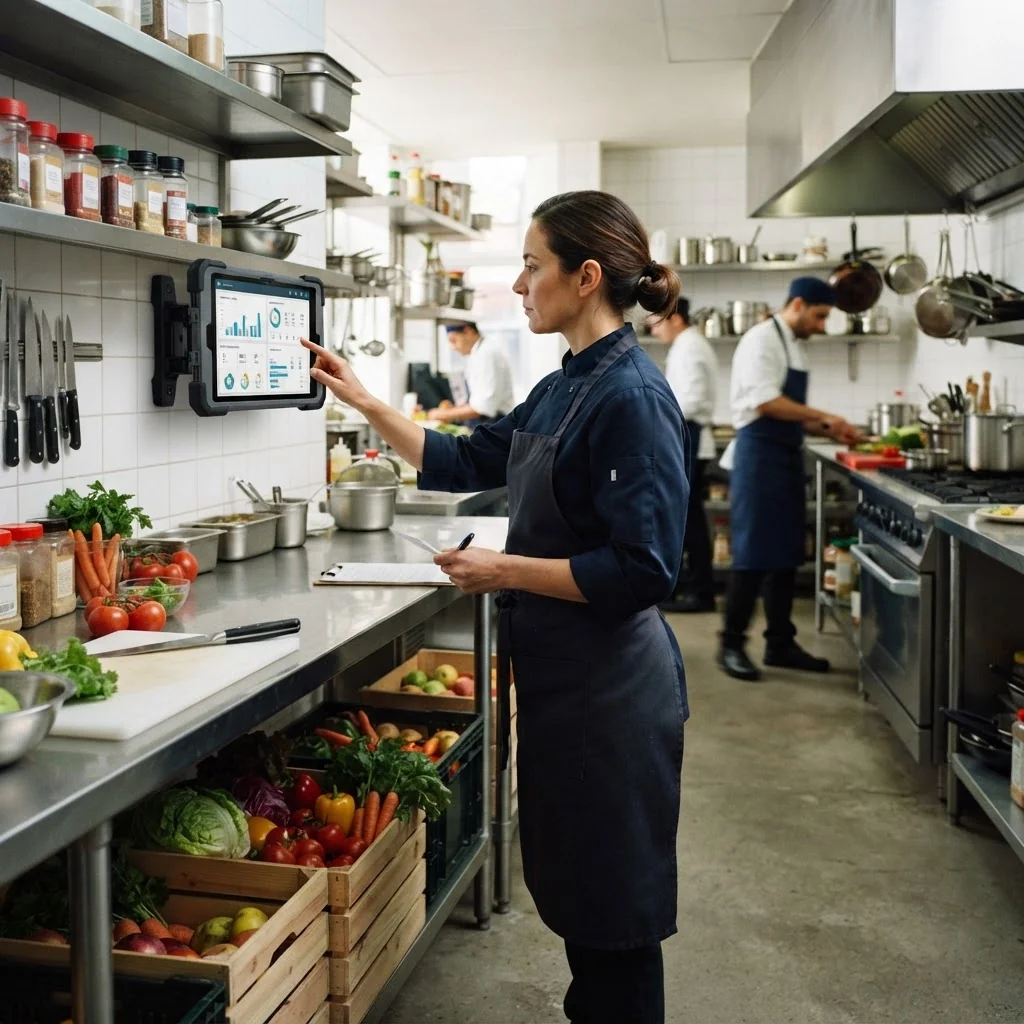
3. Menu Engineering and Recommendations
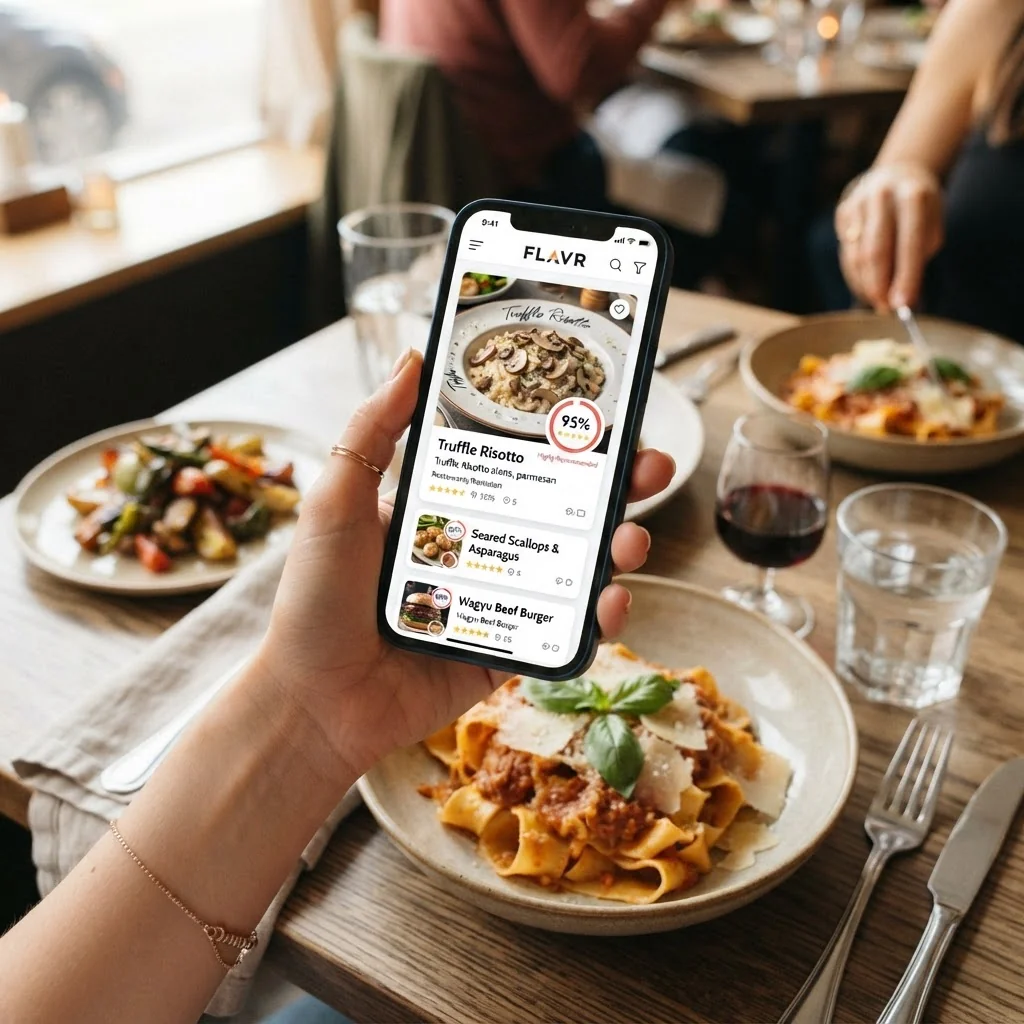
Machine learning can classify every menu item by margin and popularity, then predict which substitutions or reorderings will lift average check. On digital ordering channels, a recommendation model that suggests a genuinely complementary item, rather than the most expensive one, typically produces higher attachment rates because it is optimizing for accepted suggestions rather than list price.
4. Review and Sentiment Analysis
Reading 900 reviews manually is not feasible. A sentiment model tags each review by topic (service speed, portion size, noise, cleanliness, value) and trends them over time. This converts vague complaints into a ranked repair list. In our experience, one operational fix identified this way often moves an average rating more than a full quarter of marketing spend.

Comparison: Rule-Based Systems vs Machine Learning for Restaurants
| Capability | Rule-Based Approach | Machine Learning Approach |
|---|---|---|
| Demand forecasting | Fixed weekly template | Learns weather, events, seasonality |
| Handles new patterns | No, needs manual rewrite | Yes, retrains on fresh data |
| Personalized recommendations | No | Yes, per-diner scoring |
| Setup effort | Low | Moderate, needs clean data |
| Accuracy over time | Degrades as market shifts | Improves with more data |
| Explainability | High | Moderate, needs reporting layer |
| Best fit | Single small venue, stable trade | Multi-site, delivery-heavy, variable demand |
The honest conclusion: a single 30-seat cafe with predictable trade may not need a model at all. Once you run multiple channels, multiple sites, or highly variable demand, rule-based planning starts costing real money every week.
How to Start Without Wasting Budget
Most failed restaurant AI projects fail on data hygiene, not algorithms. A sequence that consistently works:
- Fix data capture first. Ensure every order carries a timestamp, channel, item-level detail, and location. Three months of clean data beats three years of messy data.
- Pick one measurable problem. Waste percentage, labor cost percentage, or repeat-visit rate. One metric, one baseline, one target.
- Start with forecasting. It is the lowest-risk, highest-clarity use case and it feeds every other model later.
- Instrument the result. Compare forecast versus actual weekly. If the model is not beating the manager's guess, it is not ready.
- Then add personalization. Recommendations and loyalty targeting work far better once demand patterns are understood.
Teams that want this built properly usually need three things working together: clean data pipelines, a model that fits their actual volume, and a customer-facing site or app fast enough to convert the traffic. That combination is exactly what agencies like ZoneTechify and WebPeak assemble for hospitality clients, and if you need the modeling and automation layer built rather than bought off the shelf, purpose-built artificial intelligence services are the pragmatic route.

Key Takeaways
- Machine learning treats "best restaurant" as a personalized prediction, not a fixed ranking, which is why results differ per user, time, and intent.
- Ranking models weigh proximity, intent match, engagement quality, review recency and substance, and listing completeness.
- More than 20% of Google Maps searches relate to food, according to Google, giving these models a very large training signal.
- Food service accounts for roughly 28% of global food waste per UN Environment Programme reporting, making forecast-driven inventory one of the fastest ROI use cases.
- Recent, detailed reviews outperform a high historical average with stale review activity.
- Clean, item-level transaction data matters more than algorithm choice; three months of clean data beats years of messy records.
- Start with demand forecasting, prove it against a baseline, then layer personalization and loyalty models.
Frequently Asked Questions (FAQ)
What does machine learning have to do with finding the best restaurant?
Machine learning powers the ranking and recommendation engines behind search results, maps, and delivery apps. Instead of applying fixed rules, these models learn from reviews, clicks, bookings, location, and time patterns to predict which restaurant will most likely satisfy a particular diner at that particular moment.
How do I make my restaurant rank higher in AI-driven search results?
Focus on satisfaction evidence rather than tricks. Keep hours, menu, attributes, and photos complete and current, earn recent detailed reviews consistently, ensure your site loads fast on mobile, and make booking or ordering frictionless. Engagement quality and review recency influence rankings more than raw star averages.
Is machine learning affordable for a single small restaurant?
Often it is not necessary. A single venue with stable, predictable trade usually gains more from clean bookkeeping and better scheduling templates. Machine learning becomes financially worthwhile once you run multiple channels, multiple locations, or face highly variable demand that manual forecasting keeps getting wrong.
How much data do I need before machine learning works?
Roughly three to six months of clean, item-level transaction data with timestamps and channel labels is enough for a useful first demand forecast. Data quality matters far more than volume. Messy records spanning several years typically produce worse models than a few clean months.
Can machine learning really reduce food waste in a kitchen?
Yes, and it is usually the clearest win. By forecasting item-level demand and converting it into ingredient requirements through recipe mapping, ordering aligns with expected sales rather than last week's guess. Most venues carry four to ten percent avoidable waste that better prediction directly targets.
Do AI assistants like ChatGPT pick restaurants the same way Google does?
Not identically. AI assistants synthesize text from reviews, articles, and listings, so clear factual descriptions of your cuisine, location, hours, and specialties help them cite you accurately. Google relies more heavily on behavioral and location signals collected directly from user interactions with your listing.