Explore Mexico's booming AI in workspace market: growth data, top tools, adoption trends, benefits, challenges, and how local businesses can deploy AI now.
Mexico Artificial Intelligence in Workspace Market
Mexico is quietly becoming one of Latin America's most dynamic hubs for workplace artificial intelligence. From Monterrey's manufacturing corridors to Mexico City's fast-growing tech startups, organizations are embedding AI into daily operations to cut costs, speed up decisions, and compete globally. This guide breaks down the real state of the Mexico artificial intelligence in workspace market, the data behind its growth, the tools driving adoption, and what business leaders should do next.
At ZoneTechify we work with companies navigating exactly this shift, and the pattern is clear: AI is no longer a pilot project reserved for large enterprises. It is becoming core infrastructure for teams of every size, in every region of the country.
Quick Answer: Mexico's AI workspace market is expanding rapidly as businesses adopt AI assistants, automation, and analytics to boost productivity. Fueled by nearshoring, a young digital workforce, and cloud access, adoption spans finance, manufacturing, and services, with strong double-digit annual growth expected through 2030.

What Is the AI Workspace Market?
The AI workspace market refers to the ecosystem of artificial intelligence tools, platforms, and services designed to support work inside organizations. This includes AI assistants, document automation, predictive analytics, customer-service chatbots, meeting transcription, and intelligent scheduling embedded directly into everyday software.
In the Mexican context, this market covers both locally built solutions and global platforms adapted for Spanish-language workflows, local tax rules, and regional business culture. The defining feature is practical application: technology that measurably improves how Mexican teams plan, communicate, and deliver work, rather than experimental technology with no clear return.
How Big Is Mexico's AI Market and How Fast Is It Growing?
Mexico's artificial intelligence market is on a steep upward curve. According to Statista projections, Mexico's AI market is expected to grow at a compound annual growth rate above 25% through the end of the decade, climbing into multi-billion-dollar value. Grand View Research and similar analysts consistently place Mexico among the top three AI markets in Latin America, alongside Brazil.
Two forces stand out. First, nearshoring: as global companies relocate operations closer to the United States, Mexico has attracted record foreign direct investment, and much of that capital flows into digitally advanced facilities that rely on AI. Second, cloud accessibility: with major providers operating regional infrastructure, even small firms can now access enterprise-grade AI without heavy upfront hardware costs.

Geography matters too. Industrial states such as Nuevo Leon, Jalisco, and the Bajio region concentrate manufacturing and tech talent, making them early hotspots for workplace AI. A relevant global benchmark adds context: according to McKinsey research, organizations that adopt AI in core functions report meaningful revenue gains and cost reductions, and Mexican firms are increasingly chasing those same returns.
Why Are Mexican Businesses Adopting AI in the Workspace?
Mexican businesses adopt workplace AI for four practical reasons: labor efficiency, competitiveness under nearshoring, a young digital-native workforce, and rising customer expectations for instant, personalized service.
The country's workforce skews young and tech-comfortable, and in many export sectors it is bilingual, which lowers the friction of introducing new tools. Meanwhile, competition from international entrants raises the bar. A logistics firm in Guadalajara or a fintech in Mexico City cannot afford slow manual processes when rivals answer customers in seconds and forecast demand with machine learning.

Cost pressure matters as well. AI lets lean teams accomplish more without proportional headcount growth, which is critical for the small and medium enterprises that make up the vast majority of Mexican businesses. For these owners, an AI tool that handles the work of an extra employee can be the difference between growing and stalling.
Which AI Tools Are Transforming Mexican Offices?
The most impactful workspace AI tools in Mexico fall into clear categories, each solving a specific bottleneck:
- AI assistants and copilots that draft emails, summarize documents, and generate reports in Spanish and English.
- Customer-service chatbots integrated with WhatsApp, the dominant communication channel in Mexico, to handle inquiries around the clock.
- Document and invoice automation that processes CFDI electronic invoices and extracts data automatically.
- Predictive analytics dashboards for demand forecasting, inventory, and financial planning.
- Meeting intelligence tools that transcribe, translate, and summarize calls for distributed teams.

WhatsApp integration deserves emphasis. With the platform used by the overwhelming majority of Mexican internet users, conversational AI built around it delivers immediate, culturally relevant impact that generic tools often miss. Businesses that want tailored solutions frequently partner with specialists such as ZoneTechify's artificial intelligence services to adapt these tools to local workflows and compliance needs.
How Is AI Automation Reshaping Mexican Enterprises?
AI automation is moving Mexican enterprises from manual, repetitive tasks toward continuous, self-optimizing workflows. In manufacturing hubs, computer vision inspects products on the line and predictive maintenance flags equipment failures before they halt production. In finance and retail, robotic process automation reconciles transactions and manages compliance reporting.
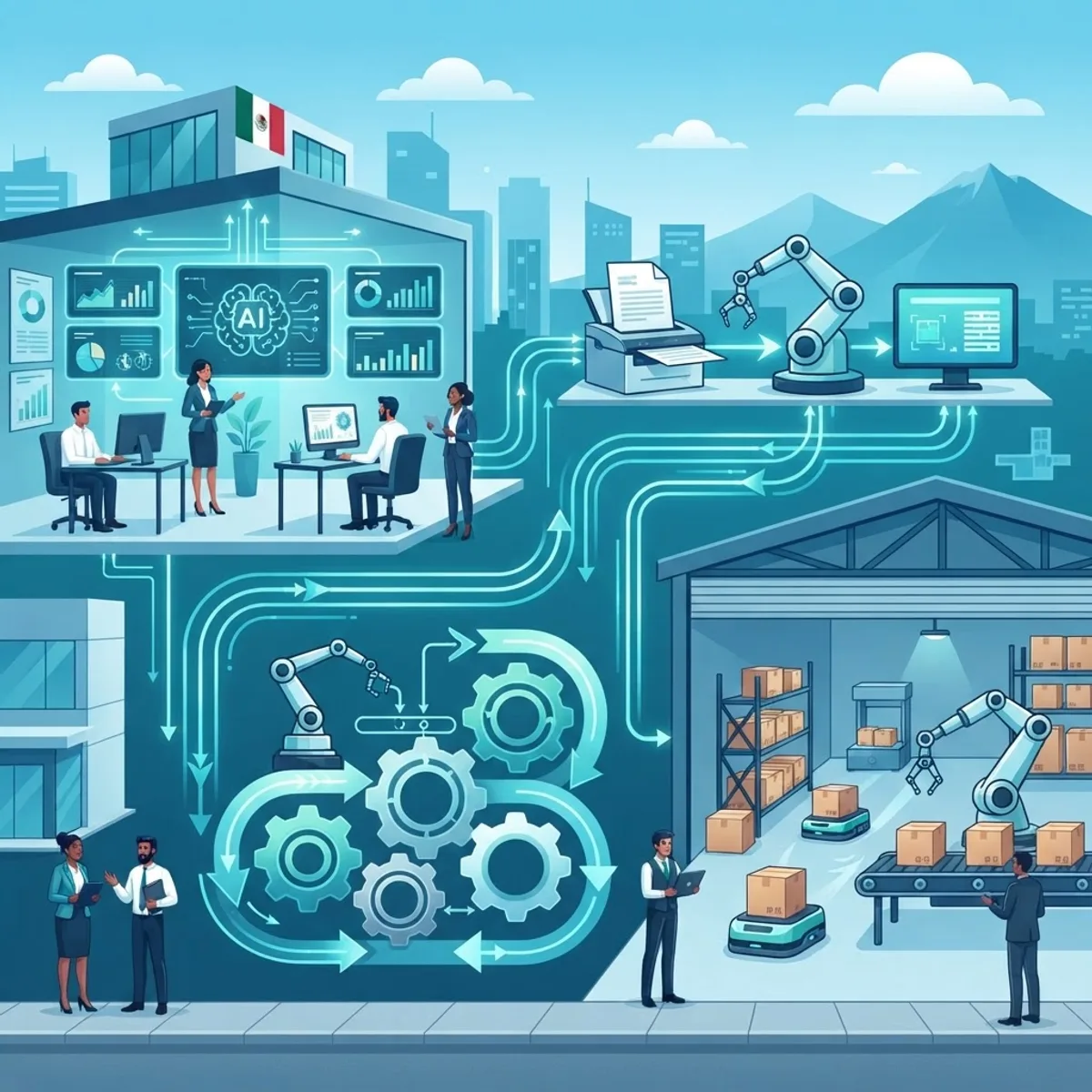
The strategic value is not simply speed. Automation frees skilled employees from low-value tasks so they can focus on judgment-heavy work, client relationships, and innovation. In our experience helping teams deploy these systems, the biggest wins come when automation is paired with clear process redesign rather than layered on top of broken workflows. Automating a bad process only makes the errors happen faster.
What Are the Productivity and Workforce Benefits?
Well-implemented AI raises output per employee while improving job quality. Teams report faster turnaround on documents, fewer errors in data entry, and more time for strategic work that actually moves the business forward.

Rather than replacing workers wholesale, most Mexican adopters use AI to augment their teams. This upskilling effect is important: employees who learn to direct AI tools become significantly more valuable, and organizations that invest in training capture far more value than those that simply buy software and hope for the best. The companies seeing the strongest results treat AI adoption as a people initiative, not only a technology purchase, and they celebrate early internal champions who help colleagues adapt.
Traditional vs AI-Powered Workspace in Mexico
The contrast between a traditional office and an AI-enabled one is stark across the metrics that matter most to Mexican decision-makers.
| Factor | Traditional Workspace | AI-Powered Workspace |
|---|---|---|
| Customer response time | Hours to next day | Seconds, 24/7 |
| Document processing | Manual, error-prone | Automated, high accuracy |
| Data-driven decisions | Limited, reactive | Continuous, predictive |
| Scaling cost | Grows with headcount | Grows slowly with software |
| Language support | Manual translation | Instant Spanish-English |
| Employee focus | Repetitive tasks | Strategic, creative work |
What Are the Challenges and Considerations?
Adoption is not frictionless. The main barriers in Mexico are data privacy compliance, talent gaps, integration complexity, and uneven digital maturity between large firms and smaller ones.
Data protection under Mexico's federal privacy law requires careful handling of personal information fed into AI systems. There is also a shortage of specialized AI engineers, which pushes many companies toward managed services and external partners. Finally, legacy systems can make integration slow and costly. The organizations that succeed start with a focused, high-value use case, measure results honestly, and expand from proven wins rather than chasing every trend at once. Realistic expectations and clean data are far more predictive of success than budget size alone.
What Does the Future of AI Workspaces in Mexico Look Like?
The future points toward deeper, more autonomous AI woven invisibly into everyday tools. Expect agentic AI that completes multi-step tasks with minimal supervision, wider Spanish-language large language models tuned for local business, and stronger government and academic investment in AI skills.

Nearshoring will continue accelerating this, since global companies expect Mexican partners to match international digital standards. Firms that build AI capability now will hold a durable advantage that latecomers struggle to close. For businesses exploring implementation, resources like WebPeak and its artificial intelligence services can help map a practical, compliant roadmap from first pilot to full deployment.
Key Takeaways
- Mexico's AI market is projected to grow at over 25% CAGR through 2030, ranking among Latin America's largest.
- Nearshoring and cloud access are the two biggest accelerators of workplace AI adoption.
- WhatsApp-integrated chatbots deliver outsized impact due to the platform's dominance in Mexico.
- AI automation frees employees for higher-value work rather than simply cutting jobs.
- Success depends on training people, ensuring data privacy compliance, and starting with focused use cases.
Frequently Asked Questions (FAQ)
What is the AI workspace market in Mexico?
It is the growing ecosystem of AI tools and services Mexican businesses use at work, including assistants, chatbots, automation, and analytics. These tools improve productivity, speed up customer service, and support data-driven decisions across industries such as manufacturing, finance, retail, and professional services.
How fast is Mexico's AI market growing?
Mexico's AI market is projected to grow at a compound annual rate above 25% through 2030, according to industry analysts. This growth is driven by nearshoring investment, expanding cloud infrastructure, and a young, digitally skilled workforce eager to adopt new productivity technologies across many sectors.
Which industries in Mexico use workplace AI the most?
Manufacturing, financial services, retail, logistics, and customer support lead AI adoption in Mexico. Manufacturers use computer vision and predictive maintenance, while service firms rely on chatbots and automation. Nearshoring has pushed many exporters to adopt AI to meet international quality and speed standards.
Will AI replace jobs in Mexican workplaces?
For most companies, AI augments rather than replaces workers. It automates repetitive tasks so employees can focus on strategy, creativity, and client relationships. Organizations that invest in training see the strongest results, because skilled workers who direct AI tools become far more productive and valuable.
How can a Mexican business start using AI at work?
Begin with one high-value problem, such as slow customer response or manual invoicing. Choose a proven tool, ensure it complies with data privacy law, train your team, and measure results. Then expand from that proven win, and partner with specialists when internal AI talent is limited.
Conclusion
Mexico's artificial intelligence in workspace market is at a genuine inflection point. The combination of nearshoring capital, accessible cloud AI, and a young digital workforce has created ideal conditions for rapid, practical adoption. Businesses that treat AI as core infrastructure, invest in their people, and start with focused, measurable use cases will lead their industries in the years ahead. The opportunity is real, the tools are ready, and the moment to act is now.