
Explore how Marriott uses artificial intelligence for personalization, dynamic pricing, chatbots, and smart rooms, and what its AI strategy means for the future of hospitality.
Marriott Artificial Intelligence

Marriott International, the world's largest hotel company with more than 30 brands and over 9,000 properties, has quietly become one of hospitality's most aggressive adopters of artificial intelligence. From predicting what room a returning guest prefers to setting nightly rates across millions of rooms, AI now touches nearly every part of the Marriott guest journey. This article breaks down exactly how Marriott uses artificial intelligence, why it matters, and what travelers and hoteliers can learn from its approach.
Quick Answer: Marriott uses artificial intelligence to personalize guest experiences, power chatbots and virtual concierges, optimize room pricing through demand forecasting, automate operations, and analyze loyalty data. These AI systems help Marriott increase revenue, cut costs, and deliver faster, more tailored service across its global portfolio of hotels.
What Does Artificial Intelligence Mean for Marriott?
Artificial intelligence, in the context of Marriott, refers to machine learning systems that analyze guest data, predict behavior, and automate decisions that once required human staff. Rather than a single product, it is a layer of technology woven across booking engines, revenue management, customer service, and in-room technology.
Marriott's scale makes AI uniquely valuable. With over 200 million Marriott Bonvoy loyalty members, the company sits on one of the richest guest datasets in travel. AI turns that raw data into action: knowing when to offer a suite upgrade, which email to send, and what price will fill a room without leaving money on the table. For a global operator, small percentage gains multiply into hundreds of millions in value.

How Marriott Uses AI for Guest Personalization
Personalization is where Marriott's AI investment is most visible to travelers. The company uses machine learning to build detailed guest profiles based on past stays, spending patterns, room preferences, and even the amenities a guest tends to use.
When a Bonvoy member books, AI can surface relevant offers, recommend on-property dining, and pre-configure preferences such as high-floor rooms or extra pillows. The goal is a stay that feels tailored without the guest ever filling out a form.
This matters because personalization drives loyalty and spend. According to McKinsey, personalization can lift revenue by 10 to 15 percent and significantly improve customer retention. For a hospitality giant, an AI system that nudges even a fraction of guests toward a higher-value room or an extra dinner reservation produces enormous cumulative returns. If you run a smaller brand and want similar tailoring, expert content writing paired with data can replicate much of this personalized feel.
AI Chatbots and Virtual Concierge Services
Marriott has invested heavily in conversational AI to handle guest requests around the clock. Its chatbots and virtual assistants field common questions, help with bookings, process room-service orders, and route complex issues to human staff.
Marriott was an early experimenter here, launching AI-powered chatbots on Facebook Messenger and Slack years ago to help members book and manage stays. Today those tools have matured into more capable virtual concierges that understand natural language and integrate with the Bonvoy app.
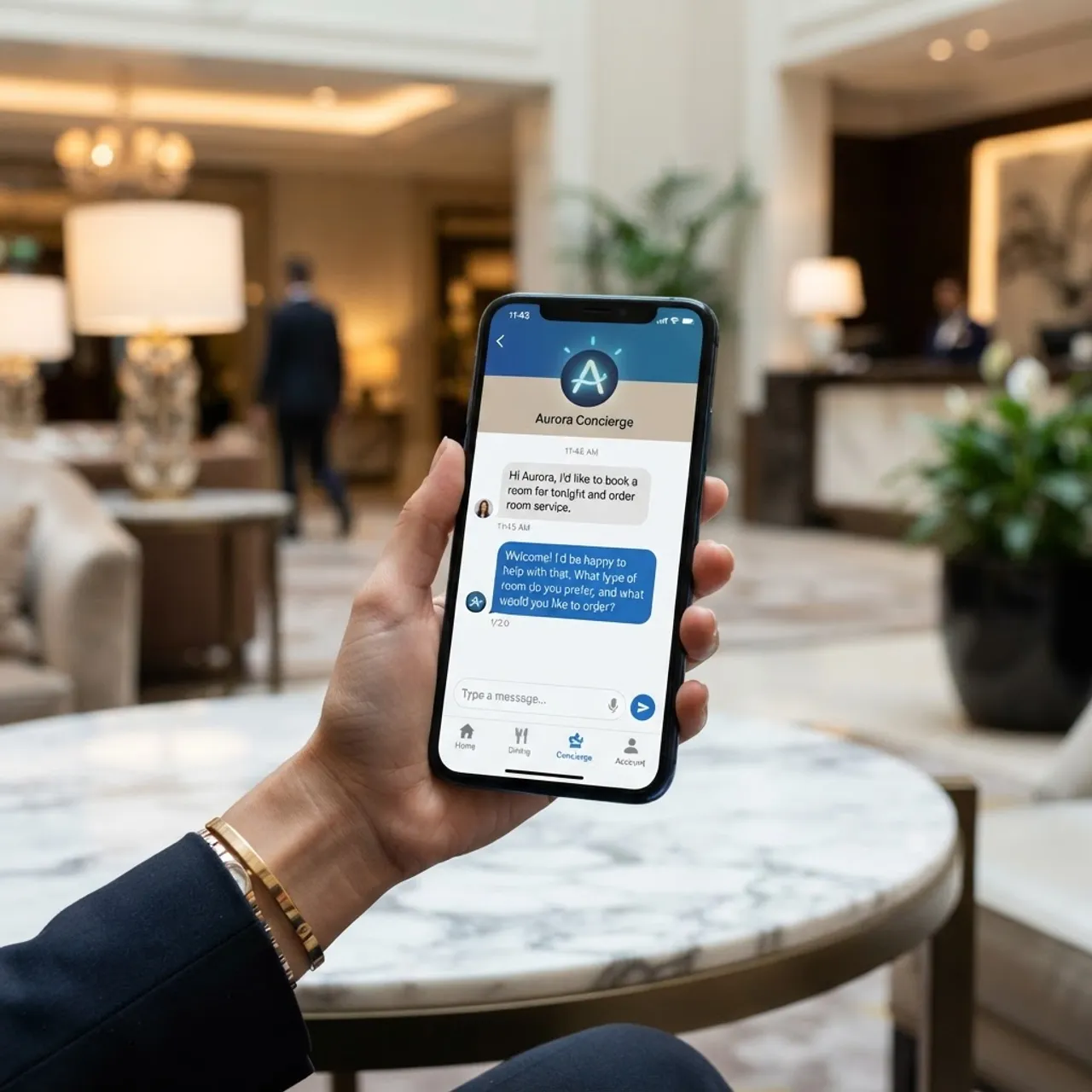
The business logic is straightforward. Chatbots resolve high-volume, repetitive queries instantly, freeing front-desk teams for high-touch service. According to Gartner, AI-driven conversational tools can automate a substantial share of routine customer interactions, cutting service costs while improving response times. For guests, it means no waiting on hold at midnight to request extra towels or confirm a late checkout.
AI-Powered Revenue Management and Dynamic Pricing
Revenue management is arguably where AI delivers Marriott its biggest financial impact. The company uses machine learning to forecast demand and set room rates dynamically, adjusting prices in near real time based on hundreds of variables.
These variables include local events, seasonality, competitor pricing, booking pace, weather, and historical occupancy. Instead of a revenue manager manually updating rates, AI recommends optimal pricing for each room type at each property, every day.

The payoff is measurable. Well-tuned AI revenue systems routinely lift revenue per available room (RevPAR), the industry's key profitability metric, by capturing demand that static pricing would miss. During high-demand windows, AI raises rates before humans could react; during soft periods, it protects occupancy with smarter discounts. Multiplied across Marriott's global inventory, these micro-optimizations translate into significant top-line growth.
Why Dynamic Pricing Beats Fixed Rates
Fixed pricing leaves money on the table in peak periods and empty rooms during slow ones. AI-driven dynamic pricing constantly balances the two. It treats every night as a fresh optimization problem, ensuring that a room facing a sold-out weekend is priced very differently from the same room on a quiet Tuesday.
Smart Rooms and In-Stay AI Technology
Marriott has piloted AI-enabled smart rooms designed to give guests voice-controlled command over their environment. Through voice assistants and connected devices, guests can adjust lighting, temperature, and entertainment, or request services hands-free.
Marriott's "IoT Guestroom Lab" explored exactly this vision, testing how connected devices and AI could anticipate guest needs, such as automatically setting a preferred room temperature on arrival. These experiments feed directly into how the company rolls out in-room technology across brands.

Smart rooms also generate operational data. When systems learn usage patterns, they help hotels optimize energy consumption, one of the largest controllable costs in hospitality. AI can dim lights and adjust HVAC in unoccupied rooms, cutting utility bills while supporting sustainability commitments that increasingly influence corporate travel decisions.
AI in Marriott's Operations and Loyalty Program
Behind the scenes, AI streamlines the operations that keep thousands of hotels running. Machine learning helps forecast staffing needs, optimize housekeeping schedules, predict maintenance issues before equipment fails, and manage inventory across food, beverage, and supplies.

On the loyalty side, AI is the engine that keeps Marriott Bonvoy relevant. It segments members, predicts churn risk, and personalizes rewards to encourage repeat bookings. Because acquiring a new guest costs far more than retaining an existing one, AI-driven retention is a direct profit lever. The system learns which incentives move which members, so a points bonus goes to the guest most likely to respond rather than being sprayed across the entire base.

This data-driven discipline is exactly what modern businesses across every industry are adopting. Companies wanting to build similar intelligent systems often turn to specialized artificial intelligence services to design models tailored to their own customer data.
Marriott AI vs Traditional Hotel Operations
The table below compares how core hotel functions work with and without AI, based on publicly documented industry practices.
| Function | Traditional Approach | Marriott AI Approach |
|---|---|---|
| Room pricing | Manual, updated periodically | Dynamic, updated in near real time |
| Guest service | Staff-dependent, business hours | 24/7 chatbots plus human staff |
| Personalization | Generic offers | Data-driven, individual profiles |
| Demand forecasting | Historical averages | Machine learning predictions |
| Loyalty rewards | One-size-fits-all | Predictive, member-specific |
| Maintenance | Reactive repairs | Predictive, pre-failure alerts |
Challenges and Ethical Considerations
Marriott's AI ambitions are not without risk. Data privacy is the biggest concern: managing profiles for hundreds of millions of members demands strict security and transparency. Marriott has faced high-profile data breaches in the past, which raises the stakes for how it collects and protects AI training data.
There is also the human element. Over-automating service risks stripping away the warmth that defines hospitality. The smartest operators, including Marriott, position AI as a tool that frees staff for meaningful guest interaction, not a replacement for it. Getting that balance right is an ongoing challenge, not a solved problem.

The Future of AI at Marriott
Expect Marriott to push AI deeper into predictive and generative territory. Generative AI is poised to transform trip planning, marketing content, and real-time guest communication, letting the company create tailored itineraries and responses at scale.
The likely trajectory includes more sophisticated virtual concierges, AI that anticipates needs before guests ask, and tighter integration between the Bonvoy app and on-property technology. For businesses watching this evolution, the lesson is clear: AI is no longer optional infrastructure in customer-facing industries. Brands looking to modernize can explore practical guidance and services at ZoneTechify and WebPeak.
Key Takeaways
- Marriott uses AI across personalization, chatbots, dynamic pricing, smart rooms, operations, and loyalty.
- With 200 million-plus Bonvoy members, Marriott's data scale makes AI exceptionally powerful.
- According to McKinsey, personalization can lift revenue by 10 to 15 percent.
- AI-driven dynamic pricing raises RevPAR by capturing demand static pricing misses.
- Data privacy and preserving human hospitality remain Marriott's key AI challenges.
- Generative AI is the next frontier for trip planning and guest communication.
Frequently Asked Questions (FAQ)
How does Marriott use artificial intelligence?
Marriott uses AI to personalize guest experiences, power chatbots and virtual concierges, set dynamic room prices through demand forecasting, automate hotel operations, and analyze Bonvoy loyalty data. These systems help the company increase revenue, reduce costs, and deliver faster, more tailored service across its global network of hotels.
Does Marriott use AI for pricing hotel rooms?
Yes. Marriott uses machine learning-based revenue management to set room rates dynamically. The system analyzes demand, seasonality, local events, competitor rates, and booking pace to recommend optimal prices in near real time. This helps Marriott maximize revenue per available room while protecting occupancy during slower periods.
Does Marriott have an AI chatbot?
Yes. Marriott was an early adopter of AI chatbots, launching them on platforms like Facebook Messenger and Slack. These conversational tools have evolved into virtual concierges within the Bonvoy app that answer questions, assist with bookings, and handle routine requests around the clock while routing complex issues to staff.
Is artificial intelligence replacing hotel staff at Marriott?
No. Marriott positions AI as a tool that handles repetitive tasks so staff can focus on meaningful, high-touch guest service. AI resolves common queries and automates back-end operations, but human employees remain central to delivering the warmth and personal care that define the Marriott hospitality experience.
What are the benefits of AI for Marriott guests?
Guests benefit from faster service, personalized offers, smoother bookings, 24/7 support through chatbots, and smart rooms that adjust to their preferences. AI reduces friction throughout the stay, from check-in to checkout, and tailors rewards and recommendations so each guest feels recognized rather than treated as an anonymous booking.
What is the future of AI in Marriott hotels?
Marriott is expected to expand generative AI for trip planning, marketing, and real-time communication, plus smarter virtual concierges that anticipate needs. Future systems will tie the Bonvoy app more closely to in-room technology, creating predictive, seamless stays while the company continues addressing data privacy and preserving genuine human hospitality.