Learn how to develop a healthcare app: compliance, EHR integration, cost, tech stack, testing and launch steps explained by experienced product engineers.
How to Develop a Healthcare App
Healthcare apps rarely fail because of bad code. They fail because a clinical workflow was misunderstood, because a data-sharing agreement was signed too late, or because nobody decided whether the product was a wellness tool or a regulated medical device until it was already in beta. Learning how to develop a healthcare app is therefore less about choosing React Native over Flutter and much more about sequencing decisions in the correct order.
This guide walks through that sequence the way an experienced product team actually runs it: problem validation, regulatory positioning, architecture, interoperability, security, testing, and launch. Every step lists the specific artifact you should have in hand before you move to the next one.
Quick Answer: To develop a healthcare app, validate one specific clinical problem, decide whether your product is a wellness tool or a regulated medical device, design a HIPAA-ready architecture, integrate patient data through FHIR APIs, encrypt data in transit and at rest, then test with real clinicians and patients before launch.
What Counts as a Healthcare App, and Why the Category Matters
A healthcare app is any software product that collects, transmits, stores, or acts on health information. That definition is deliberately broad, because the category you land in decides your legal obligations, your release cadence, your QA budget, and your liability insurance.
The Four Practical Tiers
- Wellness and fitness apps. Step counters, hydration trackers, meditation tools. Generally outside medical device regulation, but still subject to privacy law once identifiable data is stored.
- Patient engagement and administrative apps. Booking, intake forms, billing, secure messaging, care reminders. Usually covered by HIPAA in the United States when built for or with a covered entity.
- Clinical decision support. Tools that surface guidance to clinicians. Regulated depending on whether the clinician can independently review the basis of the recommendation.
- Software as a Medical Device (SaMD). Software that diagnoses, treats, or drives treatment decisions. Requires formal regulatory clearance, a documented quality management system, and clinical evidence.
Most founders assume they are in tier one and discover during due diligence that a single feature, often an automated risk score, pushed them into tier three or four.
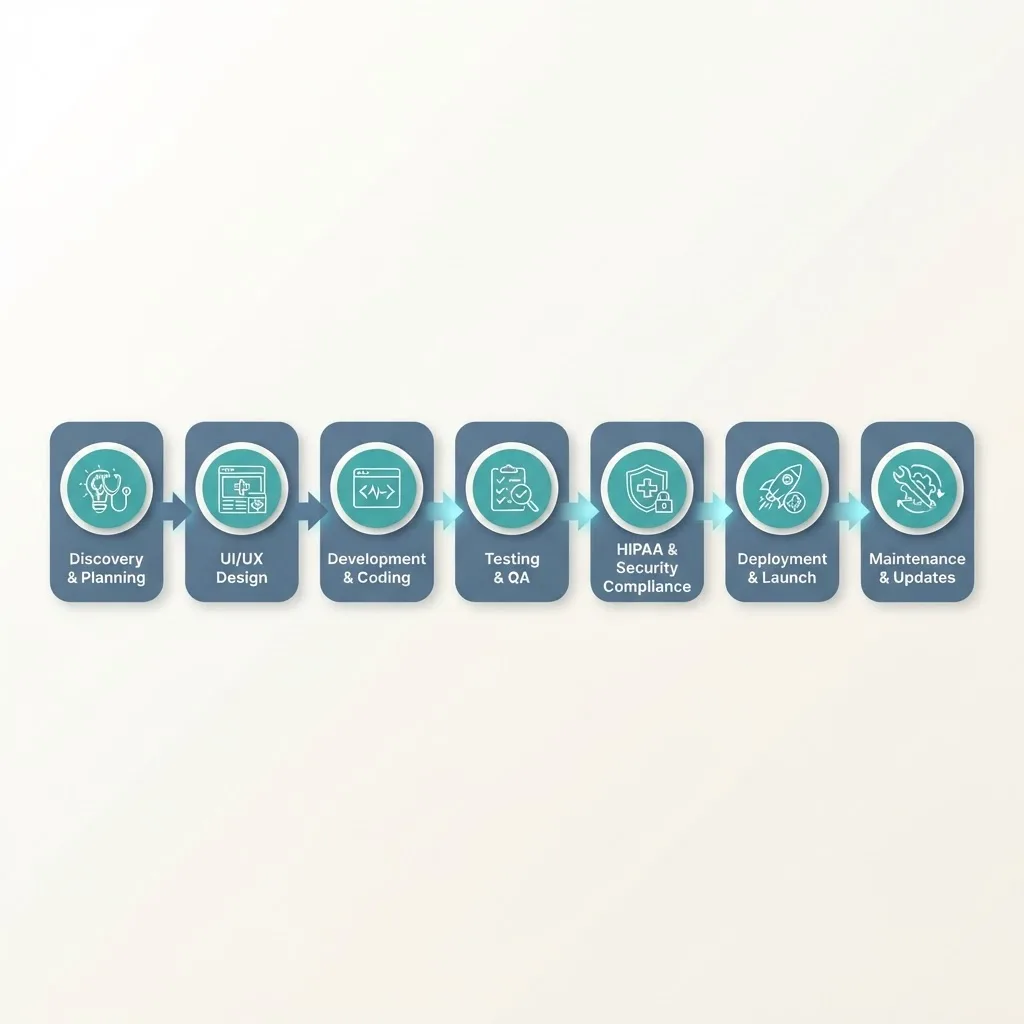
Step 1: Validate the Clinical Problem Before the Product
Start with a measurable clinical or operational problem, not a feature list. The strongest healthcare products remove friction that someone is currently paying staff to absorb: no-show rates, manual prior authorisation, medication non-adherence, referral leakage.
Run at least eight to ten structured interviews split across three groups: the patient, the clinician who will use or recommend the app, and the person who signs the contract. These are almost never the same individual, and each one has a different definition of success. Ask what they do today, how long it takes, and what breaks when it goes wrong.
The market rewards this rigour. Grand View Research valued the global mHealth apps market at roughly 32.4 billion US dollars in 2023, with growth projected at a double-digit compound annual rate through 2030. That growth is concentrated in products tied to reimbursable outcomes, not in generic symptom checkers.
Your exit artifact for this step is a one-page problem statement with a baseline metric and a target metric.
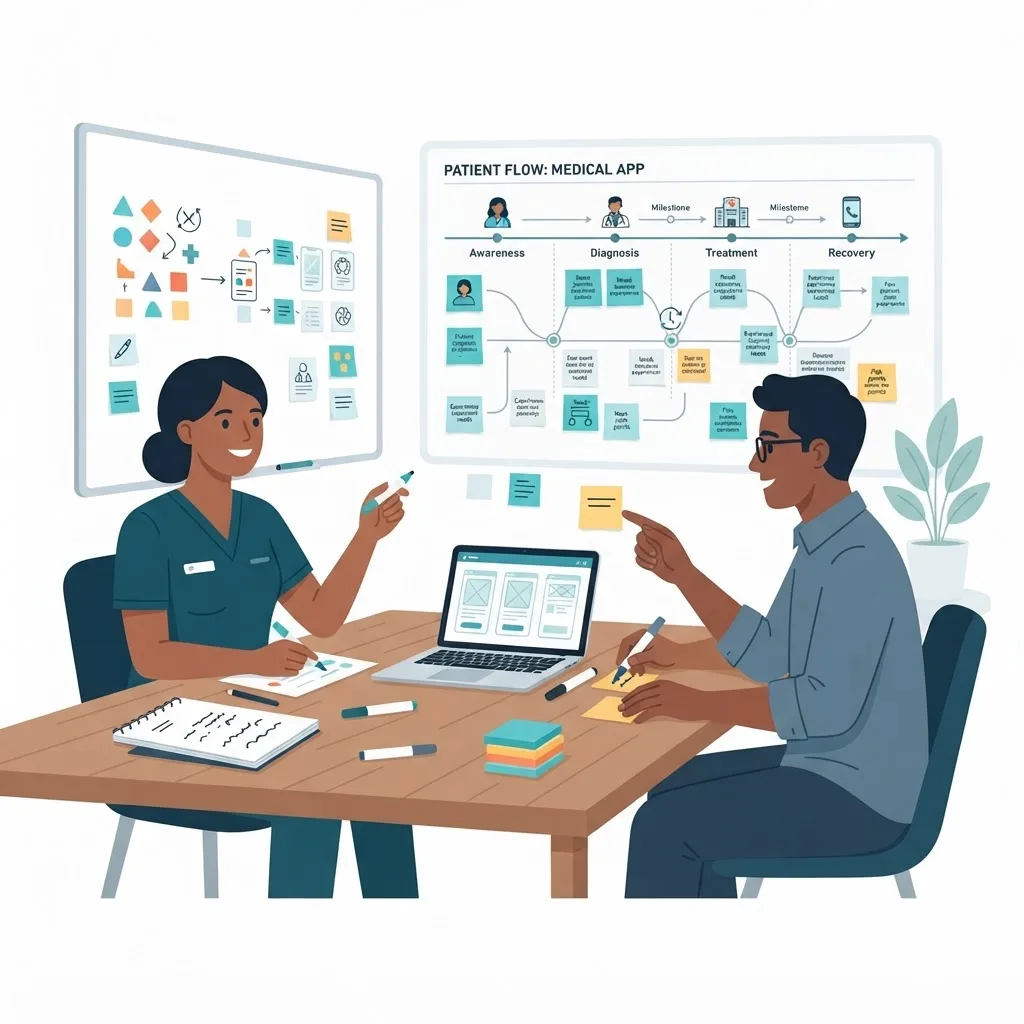
Step 2: Decide Your Regulatory Position Early
Write down, in plain language, what your app claims to do. Claims determine classification. A product that says it helps users log blood glucose is different from one that says it recommends an insulin dose, even if the underlying code is nearly identical.
| Product type | Typical regulation | Evidence needed | Release cadence |
|---|---|---|---|
| Wellness tracker | Privacy law only | None clinical | Weekly |
| Patient portal or booking app | HIPAA, GDPR | Security assessment | Every two weeks |
| Clinical decision support | HIPAA plus device review | Validation study | Monthly, controlled |
| SaMD diagnostic tool | FDA or MDR clearance | Clinical trial data | Versioned, audited |
If you are unsure of your tier, build the tier-two version first and keep the higher-risk logic behind a feature flag until classification is confirmed. Teams that plan for a regulated future often benefit from the same discipline used in b2b web application development, where audit trails and role separation are requirements rather than refinements.
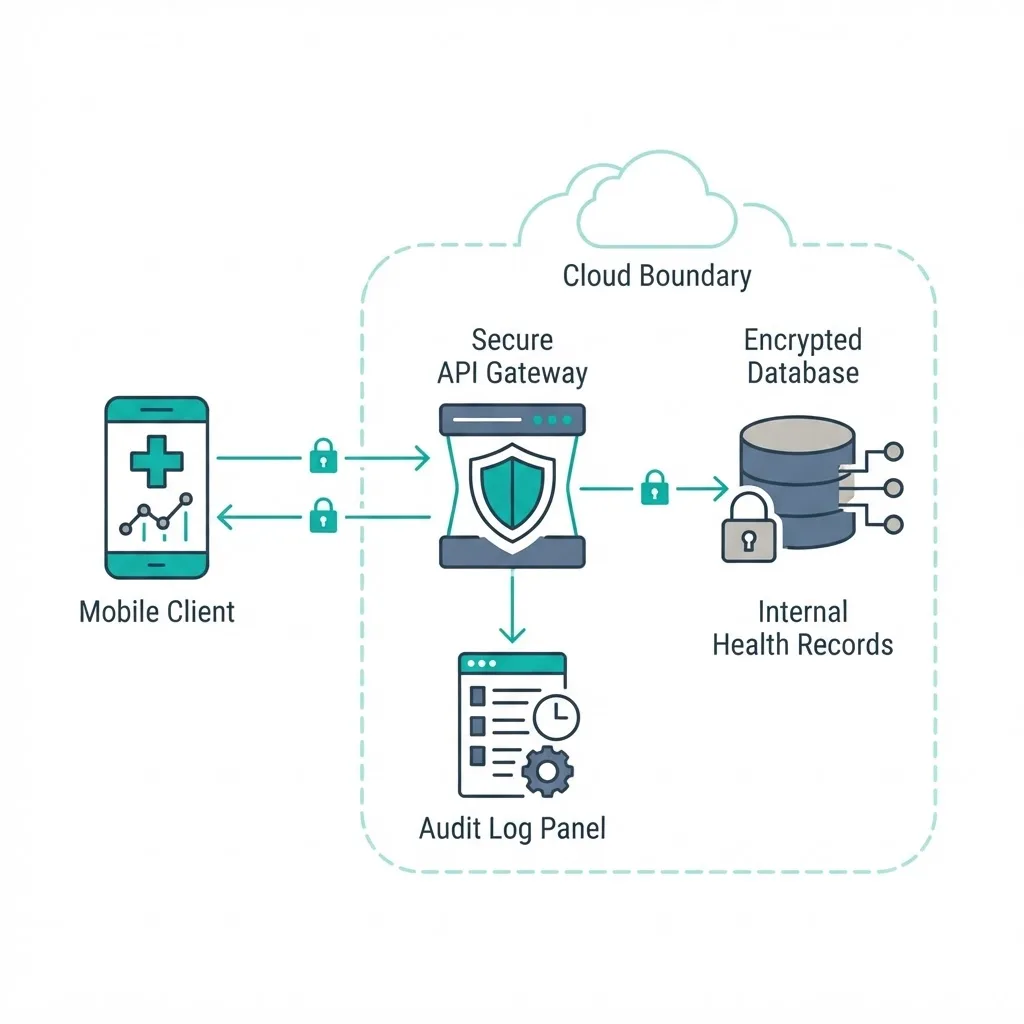
Step 3: Choose a Tech Stack That Survives an Audit
Pick technology you can defend in a security questionnaire. That means managed infrastructure with a signed business associate agreement, mature identity tooling, and libraries that are still actively maintained.
A dependable baseline looks like this:
- Client: React Native or Flutter for cross-platform mobile, Next.js for the web and clinician console.
- Backend: Node.js or Go behind an API gateway, with services separated by data sensitivity.
- Database: managed PostgreSQL with encryption at rest, field-level encryption for identifiers, and immutable audit tables.
- Infrastructure: a single cloud provider, infrastructure as code, and region pinning for data residency.
Decide the delivery model deliberately as well. Clinicians working at fixed workstations may be better served by a browser-based tool, and the trade-offs in desktop application vs web application are worth reading before you commit to a mobile-first roadmap. For patient-facing scale, teams working with an experienced web application agency usually move faster because the compliance scaffolding already exists as reusable modules.
Step 4: Design for Patients Who Are Tired, Stressed, or Impaired
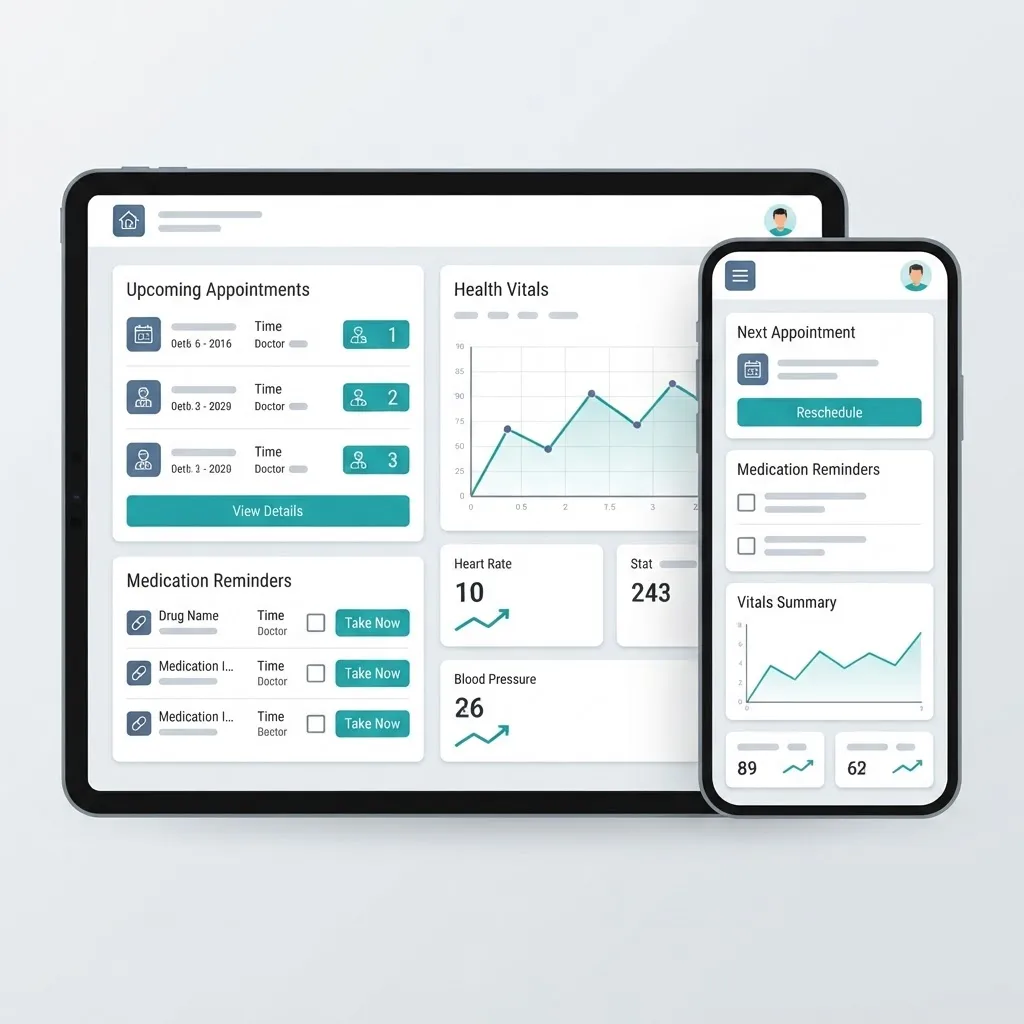
Healthcare interfaces are used in bad conditions: at 3 a.m., in pain, on a cracked phone, sometimes by a caregiver rather than the patient. Design for the worst-case user, not the demo user.
Practical rules that measurably reduce support tickets:
- Minimum 16 pixel body text and touch targets of at least 44 by 44 pixels.
- Contrast ratios of 4.5 to 1 or better, verified against WCAG 2.2 AA.
- One primary action per screen, with destructive actions requiring confirmation.
- Plain language at a grade eight reading level, with no unexplained clinical abbreviations.
- Offline tolerance, so a submitted symptom log is never silently lost.
Accessibility is not optional decoration here. It is the difference between a tool an older patient can use unaided and one that generates a phone call to the clinic.
Step 5: Integrate With Real Clinical Data
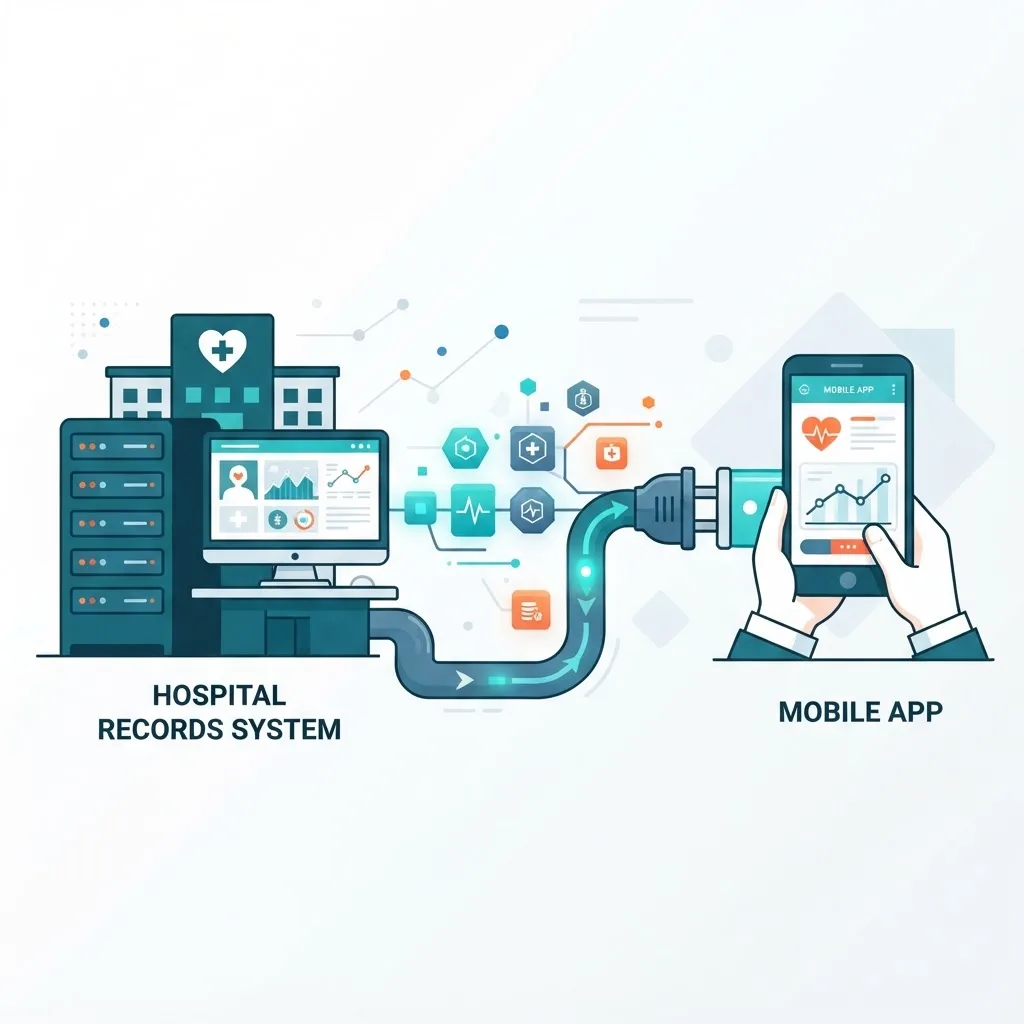
An app that cannot read or write to the systems clinicians already use becomes a second place to type the same information, and it will be abandoned. Interoperability is the feature that turns a prototype into infrastructure.
Use HL7 FHIR release 4 as your primary standard, and map your internal models to FHIR resources such as Patient, Observation, Encounter, and MedicationRequest from the first sprint. Retrofitting FHIR later is one of the most expensive migrations in health software. Support SMART on FHIR for launch context and OAuth 2.0 for delegated access, then plan for older HL7 version 2 message feeds because many hospitals still rely on them.
For consumer signals, integrate Apple HealthKit and Google Health Connect rather than building your own wearable pipeline. If your product needs behaviour that no off-the-shelf platform provides, that is the moment customized application software genuinely pays for itself.
Step 6: Build Security In, Not On
Security in healthcare is an economic question. IBM reported that healthcare recorded the highest average data breach cost of any industry at about 9.77 million US dollars in 2024, a position it has held for more than a decade. Retrofitted controls do not close that gap.
Implement these before your first external user:
- TLS 1.2 or higher in transit, AES-256 at rest, and no health data in logs or crash reports.
- Role-based access control with the minimum necessary standard applied per endpoint, not per screen.
- Immutable audit logging of every read and write to patient records, retained per jurisdiction.
- Automatic session timeout, biometric or PIN re-authentication, and remote revocation.
- Signed business associate agreements with every vendor that touches protected health information.
- Edge protection, since traffic filtering choices such as a web application firewall load balancer materially affect your exposure to credential stuffing and injection attempts.
Schedule an independent penetration test before launch and again after any architectural change. Fix findings in priority order and keep the report, because enterprise buyers will ask for it.

Step 7: Test Like Someone's Health Depends on It
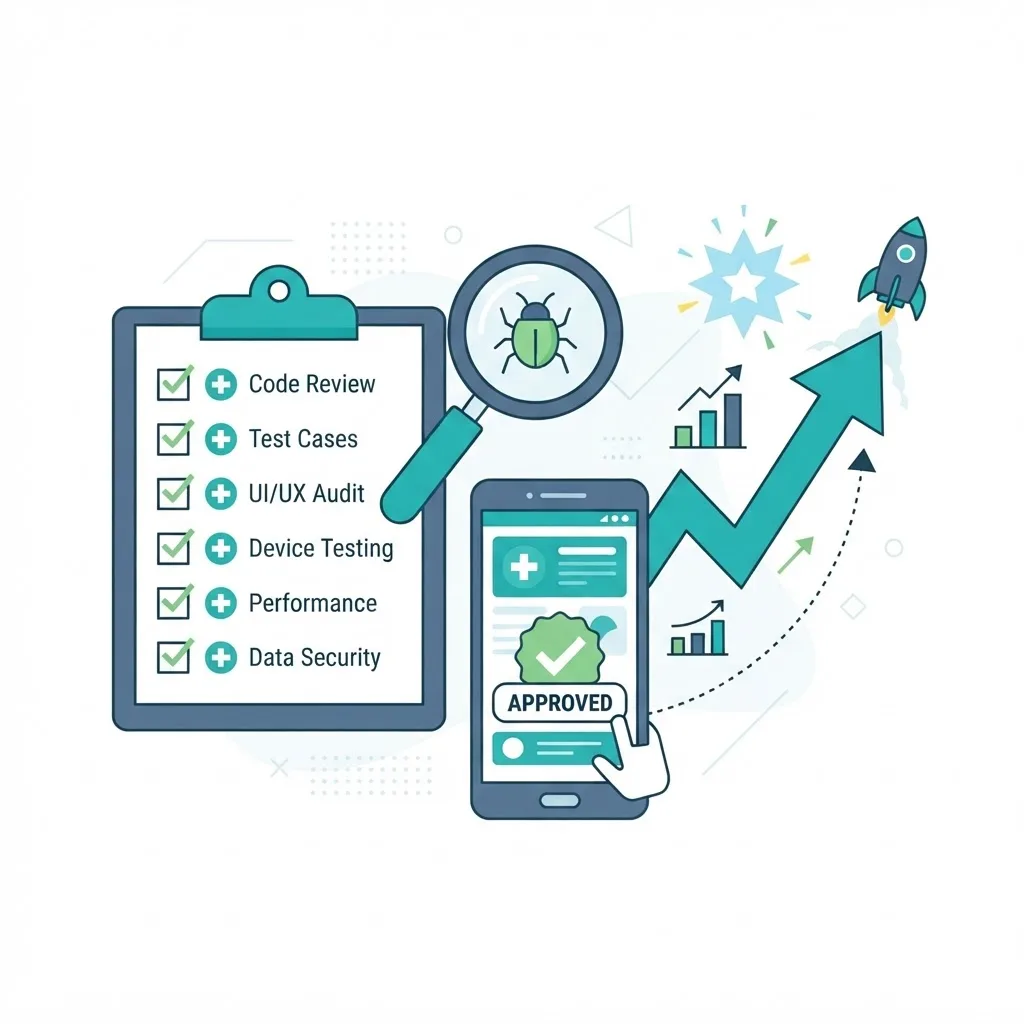
Standard software QA is not enough. Add clinical validation on top of it.
- Unit and integration tests with mandatory coverage on any calculation that touches dosage, scoring, or eligibility.
- Interoperability testing against a sandbox EHR, including malformed and incomplete records.
- Usability testing with at least five real clinicians and five real patients, observed rather than surveyed.
- Failure testing for expired tokens, lost connectivity, and duplicate patient identities.
- Accessibility audits using screen readers on both platforms.
Document every test run. In regulated tiers, the documentation is part of the product. A specialist partner such as WebPeak Digital can shorten this phase considerably, since disciplined release engineering is far cheaper to inherit than to invent.
How Much Does It Cost to Develop a Healthcare App
Cost tracks regulatory tier and integration depth, not screen count.
| Scope | Realistic range | Typical timeline |
|---|---|---|
| Wellness MVP, no PHI | 25,000 to 55,000 USD | 8 to 12 weeks |
| Patient engagement app with HIPAA hosting | 60,000 to 140,000 USD | 3 to 5 months |
| Telehealth platform with EHR integration | 150,000 to 350,000 USD | 6 to 10 months |
| SaMD with clearance pathway | 400,000 USD and above | 12 months and beyond |
Budget 15 to 25 percent of the build cost annually for maintenance, security patching, and standards updates. Also budget for people: the seniority of your engineering team is the single biggest predictor of delivery risk, which is why hiring guidance for senior software engineer jobs is worth reviewing before you scale headcount.
Key Takeaways
- Regulatory classification is driven by your product claims, so write them down before you write code.
- HL7 FHIR release 4 should be your data model from sprint one, because retrofitting it is a costly migration.
- Healthcare carried the highest average breach cost of any industry, roughly 9.77 million US dollars in 2024.
- The global mHealth apps market was valued near 32.4 billion US dollars in 2023 and continues double-digit growth.
- Usability testing with real clinicians and patients catches more defects than any automated suite.
- Plan 15 to 25 percent of build cost per year for ongoing compliance and maintenance.
For a deeper implementation walkthrough of architecture and workflows, see this detailed guide to healthcare web application development.
Frequently Asked Questions (FAQ)
How long does it take to develop a healthcare app?
A wellness app with no protected health information takes eight to twelve weeks. A HIPAA-compliant patient engagement app takes three to five months. A telehealth platform integrated with an electronic health record usually needs six to ten months, mostly because integration testing and security review cannot be compressed.
Does my healthcare app need to be HIPAA compliant?
If your app creates, receives, stores, or transmits protected health information on behalf of a covered entity such as a clinic, hospital, or insurer, then yes. Pure consumer wellness apps that never share data with a covered entity are usually exempt, but still fall under general privacy laws like GDPR.
What is FHIR and why does it matter for healthcare apps?
FHIR, or Fast Healthcare Interoperability Resources, is the HL7 standard that defines how health data is structured and exchanged over modern APIs. It matters because hospitals expect it, national regulations increasingly require it, and building against it means your app can connect to major EHR vendors.
Should I build a native app or a web app for healthcare?
Choose native or cross-platform mobile when you need biometrics, push reminders, offline logging, or wearable data. Choose a web application for clinician dashboards, admin consoles, and anything used at a fixed workstation. Many products ship both, sharing one backend and one permission model.
How do I keep patient data secure in a mobile health app?
Encrypt data in transit with TLS 1.2 or higher and at rest with AES-256. Apply role-based access, enforce session timeouts with biometric re-authentication, log every record access immutably, and keep health data out of analytics and crash reports. Then commission an independent penetration test.
Can a small team realistically build a healthcare app?
Yes, if scope is narrow. A team of four to six senior engineers, a designer, and a clinical advisor can ship a compliant single-workflow product. Problems appear when small teams attempt multi-hospital integrations or regulated diagnostics without dedicated compliance and quality management support.
Final Word
Developing a healthcare app is an exercise in disciplined sequencing. Validate one real clinical problem, fix your regulatory position on paper, choose a stack you can defend, model your data in FHIR, encrypt by default, and test with the people who will actually use the product. Teams that follow that order ship slower in month one and far faster by month six.