A practical guide to Node JS web application development services, covering what is included, real performance benchmarks, stack choices, pricing, and how to vet a development partner.
Node JS Web Application Development Services
Node.js stopped being a trend somewhere around 2018 and became infrastructure. Today it runs checkout flows, trading dashboards, chat systems, streaming platforms, and internal tools at companies that cannot afford downtime. But the phrase "Node JS web application development services" gets used loosely, and the gap between a team that writes JavaScript on a server and a team that engineers production Node systems is enormous. This guide explains exactly what those services include, where Node genuinely outperforms alternatives, what it costs, and how to tell a capable partner from an expensive one.
Quick Answer: Node JS web application development services cover backend architecture, REST or GraphQL API development, real-time features, database design, authentication, third-party integrations, testing, deployment, and ongoing scaling support. Node.js suits API-heavy, real-time, and high-concurrency applications because its non-blocking event loop handles thousands of simultaneous connections on modest hardware.
What Node JS Web Application Development Services Actually Include
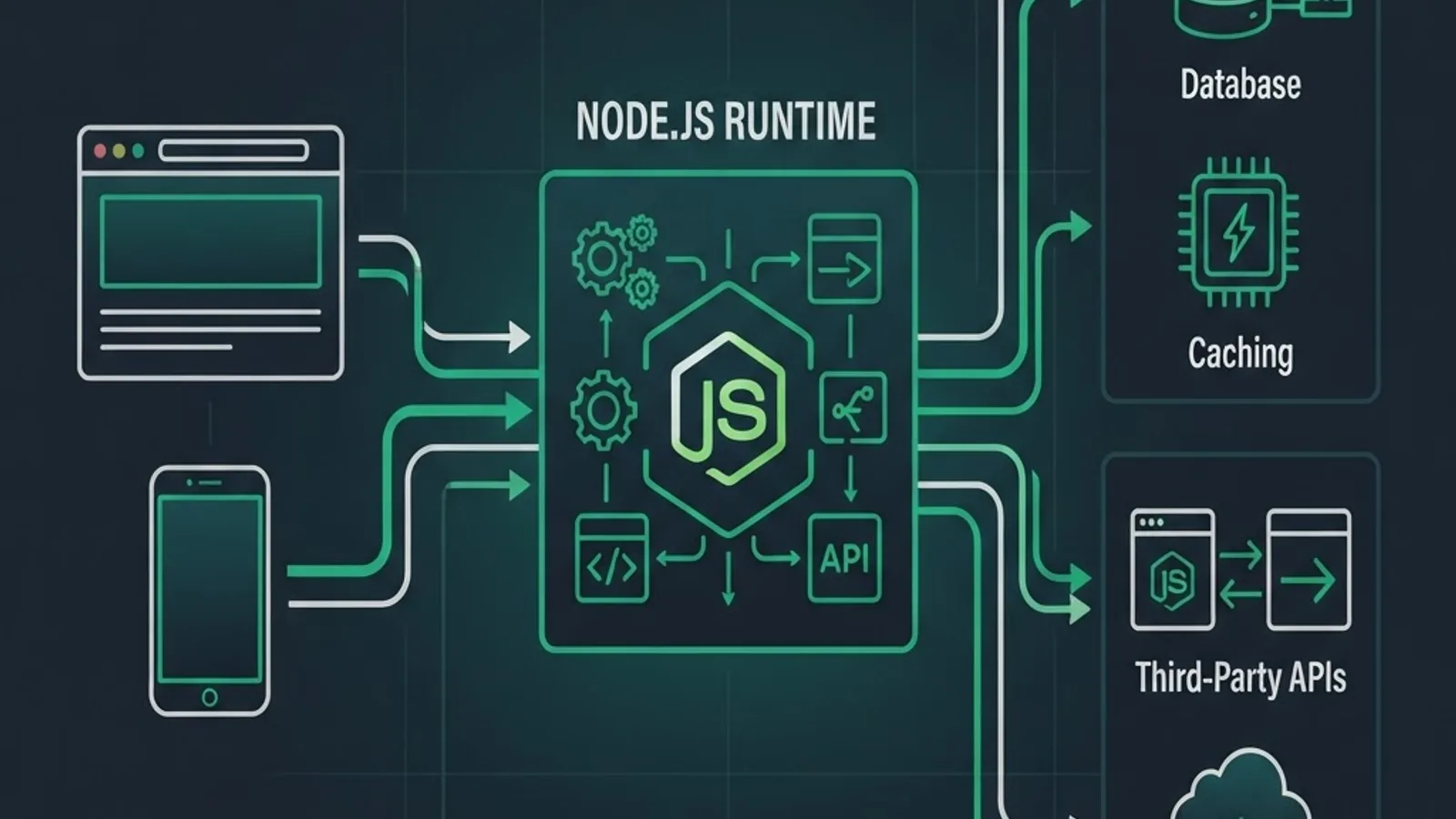
A complete engagement is far broader than "building the backend." When you buy Node.js development services, you should expect deliverables in seven distinct areas, and you should ask for each one in writing before signing.
- Architecture and technical discovery. Data modeling, service boundaries, and a decision on monolith versus modular services. This is where most projects are won or lost.
- API development. REST or GraphQL endpoints with versioning, pagination, rate limiting, and an OpenAPI specification your frontend team can build against.
- Database layer. Schema design, indexing strategy, migrations, and connection pooling. Postgres and MongoDB are both common with Node, and the choice should be justified, not defaulted.
- Real-time features. WebSockets, server-sent events, or a pub/sub layer for notifications, presence, live dashboards, and collaborative editing.
- Security engineering. Authentication and session handling, input validation, dependency auditing, secrets management, and role based access control.
- Testing and CI/CD. Unit and integration tests, contract tests for APIs, automated pipelines, and staging environments that mirror production.
- Observability and support. Structured logging, error tracking, performance metrics, and an on-call or SLA arrangement after launch.
If a proposal covers items one to four and stays silent on five to seven, you are buying a prototype at production prices. Teams like the engineers behind web app development treat observability and testing as line items, not afterthoughts, which is the single clearest signal of engineering maturity.

Why Node.js Wins for Real-Time and API-Heavy Products
Node.js performs well under concurrency because of one architectural decision: it uses a single-threaded, non-blocking event loop instead of one thread per request.
Understanding the event loop in plain terms
Event loop: a continuously running process that accepts incoming events, hands slow operations such as database reads or network calls to the operating system, and immediately moves on to the next request instead of waiting.
In a traditional thread-per-request model, 5,000 concurrent connections can mean 5,000 threads, each consuming memory and forcing the operating system to context-switch constantly. Node handles the same load with one main thread and a small worker pool, because most web workloads are input and output bound rather than CPU bound. Your API spends its time waiting on Postgres, not calculating.
The measurable results are well documented. PayPal reported a 35 percent decrease in average response time and roughly double the requests per second after migrating an application from Java to Node.js, while writing about 33 percent fewer lines of code. Netflix reported cutting application startup time from around 40 minutes to under a minute after moving its user interface layer to Node.js. Those are engineering outcomes, not marketing claims, and they map directly to hosting cost and developer velocity.
The honest limitation: Node is a poor choice for sustained CPU-heavy work such as video transcoding, large-scale image processing, or heavy scientific computation on the main thread. Competent teams offload that work to worker threads, a queue, or a separate service in another language. A team that claims Node is optimal for everything is selling, not advising.

Node.js vs PHP vs Python: An Honest Comparison
Runtime choice should follow workload, team skills, and hiring reality. Here is how the three most common options compare for web application backends.
| Factor | Node.js | PHP (Laravel) | Python (Django) |
|---|---|---|---|
| Concurrency model | Non-blocking event loop | Process or thread per request | Blocking by default, async available |
| Real-time support | Native and mature | Requires extra services | Requires extra services |
| Shared language with frontend | Yes, JavaScript and TypeScript | No | No |
| Best fit | APIs, chat, dashboards, streaming | Content sites, CMS, classic CRUD | Data science, machine learning, analytics |
| CPU-heavy workloads | Weak without workers | Moderate | Strong ecosystem |
| Startup and cold start speed | Fast | Fast | Moderate |
PHP remains an excellent, cost-effective option for content-driven and conventional business applications, and the trade-offs are laid out well in this breakdown of what a full stack development partner delivers on the PHP side. Choose Node when concurrency, real-time behavior, or one shared language across the stack are the deciding constraints.
One underrated advantage: according to the Stack Overflow Developer Survey, Node.js is consistently the most used web technology among professional developers, with roughly 40 percent adoption. That directly affects your hiring pool, library availability, and long-term maintenance risk.
The Stack a Serious Node.js Team Should Propose
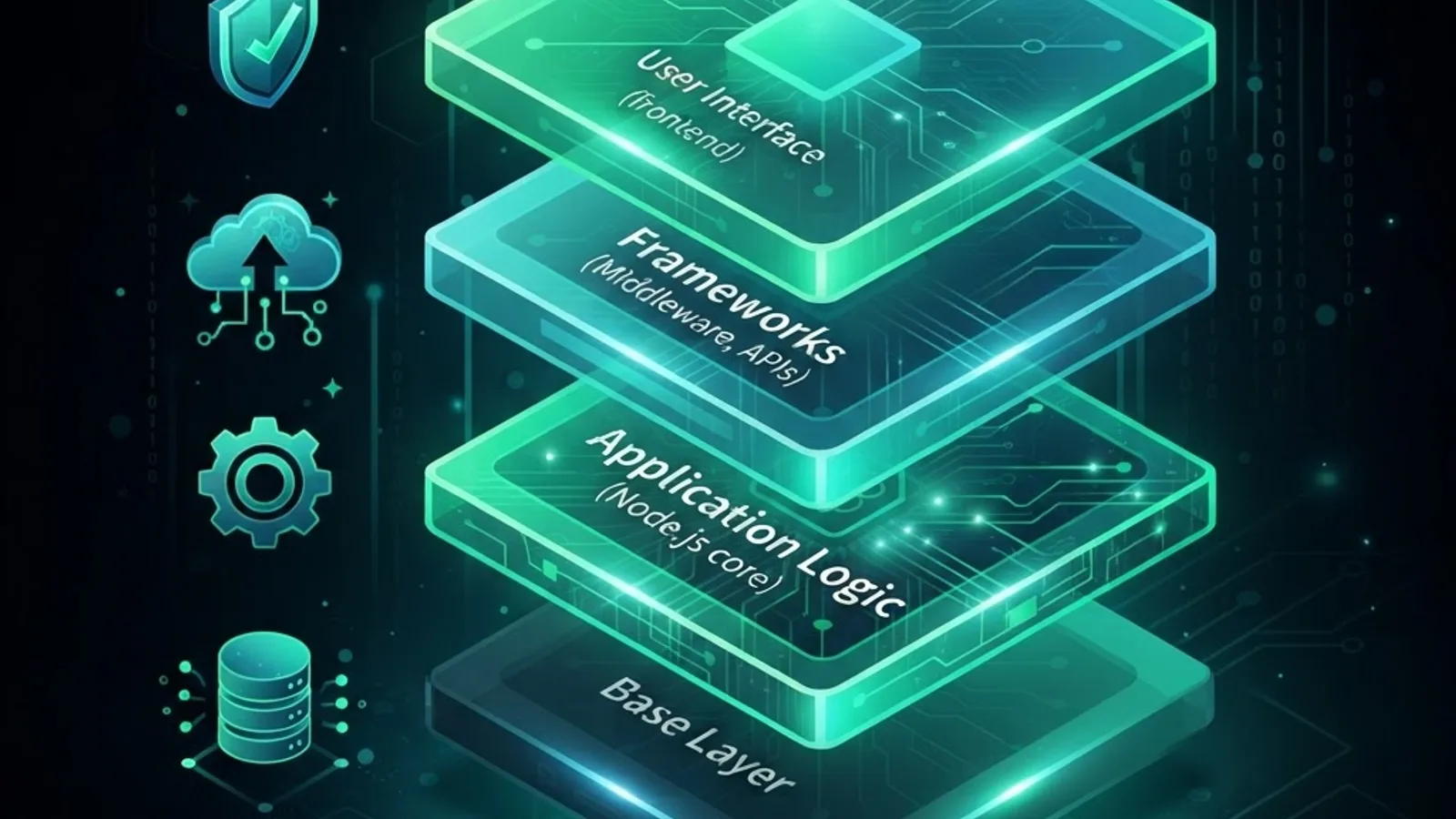
Specific tooling matters more than brand names. A defensible modern Node stack in 2026 looks roughly like this.
- Language: TypeScript, not plain JavaScript. Type safety eliminates an entire class of runtime errors and makes refactoring survivable at scale.
- Framework: Express or Fastify for lean APIs, NestJS when you need enforced structure across a larger team, Next.js route handlers when the frontend and backend ship together.
- Database access: Prisma or Drizzle for typed queries and version-controlled migrations. Raw string concatenation for SQL is a security failure, not a style preference.
- Validation: Zod or a similar schema validator at every trust boundary, including request bodies, environment variables, and webhook payloads.
- Background work: BullMQ with Redis for jobs, retries, and scheduled tasks, so slow work never blocks a request.
- Testing: Vitest or Jest for units, Supertest or Playwright for endpoint and flow coverage.
- Deployment: Containerized or serverless, with infrastructure defined as code and zero-downtime rollouts.
Ask any prospective vendor to defend each choice in one sentence. Teams that cannot explain why they picked Fastify over Express are following a template rather than engineering a solution.

How a Node.js Project Should Actually Run
The delivery process predicts the outcome more reliably than the technology does. A well run engagement follows six phases.
- Discovery and specification. Two weeks maximum. Output is user flows, a data model, non-functional requirements such as expected concurrency, and a prioritized scope.
- Architecture and API contract. The API specification is agreed before implementation, so frontend and backend can proceed in parallel.
- Iterative build in two-week sprints. Each sprint ends with deployable software on a staging URL, not a slide deck.
- Continuous testing. Automated tests run on every commit. Manual quality assurance covers flows that automation cannot judge.
- Hardening and launch. Load testing at two to three times expected peak traffic, security review, database backup verification, and a documented rollback plan.
- Post-launch iteration. Real usage data drives the next roadmap, not assumptions made during discovery.
If you want a deeper walkthrough of each stage with realistic timelines, this guide to the scalable web solutions lifecycle covers the sequencing in detail. Teams that skip phase two consistently produce the most expensive rewrites, because frontend and backend drift apart for weeks before anyone notices.
Performance and Scaling Numbers That Matter
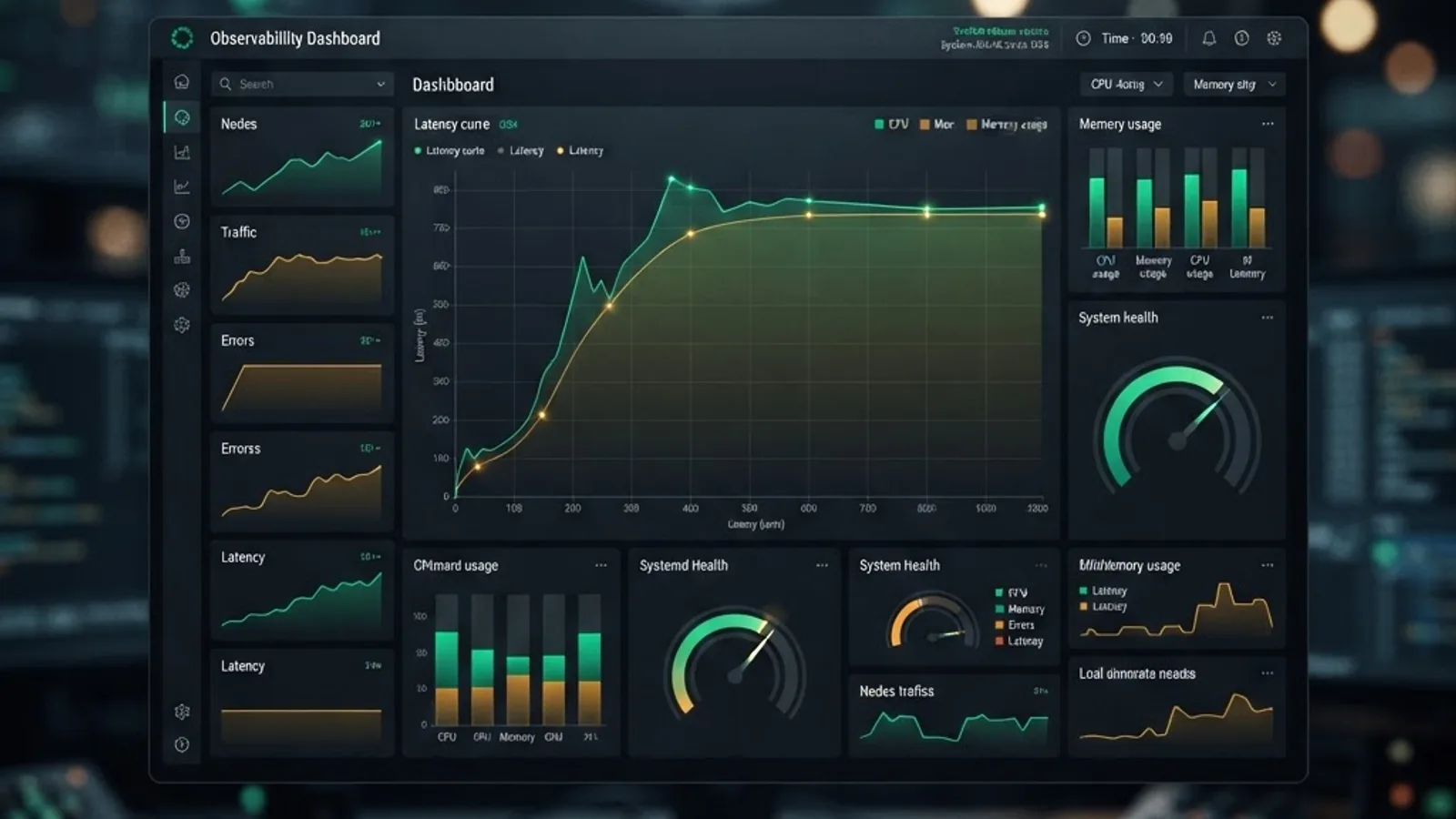
Before launch, insist on measured targets rather than adjectives. These are reasonable benchmarks for a well built Node.js application.
- API response time: median under 200 milliseconds, 95th percentile under 500 milliseconds for database-backed reads.
- Error rate: below 0.1 percent of requests under normal load.
- Concurrency headroom: the application should sustain at least twice projected peak traffic before latency degrades.
- Deployment frequency: shipping should be routine and same-day, not a monthly event requiring downtime.
The usual scaling levers, in order of cost effectiveness, are database indexing, query reduction and caching, horizontal replicas behind a load balancer, and only then architectural change. Most Node performance problems are database problems in disguise. Profiling before rewriting saves budget, and a partner who reaches for microservices before reading a query plan is guessing.

How to Hire the Right Node.js Development Partner
Use these five questions to separate engineering teams from resellers.
- Ask for a live production application they built and its concurrency profile. Portfolio screenshots prove nothing about backend quality.
- Ask who writes the code. Confirm seniority and whether the work is subcontracted after signing.
- Ask about code ownership and repository access from day one. You should own the repository, not receive a zip file at the end.
- Ask how they handle an incident at 2 a.m. The answer reveals whether monitoring and on-call actually exist.
- Ask for their testing coverage policy. A specific number is a good sign, and "we test manually" on a payment system is not.
Geography matters less than accountability, though local teams do simplify workshops and compliance conversations, as this look at web application development in St. Louis illustrates. A senior-focused web application agency will usually cost more per hour and less per project, because fewer hours are spent undoing avoidable mistakes. For a vendor-side view of how scalable Node engagements are structured, WebPeak Digital publishes a useful breakdown in its guide to choosing a Node.js development agency for growth-stage products.
What Node.js Development Services Cost
Pricing varies by region and seniority, but the structure is predictable. A focused API and admin dashboard typically lands in the 12,000 to 30,000 US dollar range. A full multi-role SaaS product with billing, real-time features, and integrations commonly runs 40,000 to 120,000 US dollars. Ongoing maintenance is usually 15 to 20 percent of build cost annually, covering dependency updates, security patches, and monitoring. Fixed-price contracts protect you on well specified scope, while time and materials suits evolving products. Whichever model you choose, tie payments to demonstrable deliverables on a staging environment.
Key Takeaways
- Node.js excels at input and output bound, high-concurrency workloads such as APIs, chat, and live dashboards, and struggles with sustained CPU-heavy tasks unless work is offloaded.
- PayPal measured a 35 percent drop in average response time and roughly double the requests per second after moving to Node.js.
- Node.js is the most used web technology among professional developers at roughly 40 percent adoption, which reduces long-term hiring and maintenance risk.
- A complete service engagement includes architecture, APIs, database design, security, testing, CI/CD, and observability. Missing any of the last three signals an incomplete proposal.
- TypeScript, schema validation at trust boundaries, and typed database access are baseline expectations for production Node code in 2026.
- Most Node performance problems originate in the database layer, so profile and index before considering architectural rewrites.
Frequently Asked Questions (FAQ)
What is Node.js used for in web application development?
Node.js runs server-side JavaScript, powering APIs, authentication, real-time features, background jobs, and integrations with databases and third-party services. It is particularly strong for applications with many simultaneous connections, such as chat platforms, live dashboards, collaborative tools, streaming services, and high-traffic API backends.
Is Node.js good for large scale applications?
Yes. Netflix, LinkedIn, PayPal, and Uber all run Node.js in production at very large scale. Success depends on architecture rather than the runtime itself: proper database indexing, caching, horizontal scaling behind a load balancer, and offloading CPU-heavy work to queues or worker threads.
How long does it take to build a Node.js web application?
A focused minimum viable product with an API, authentication, and an admin dashboard typically takes eight to twelve weeks. A full multi-role SaaS platform with billing, real-time features, and integrations usually needs four to seven months. Clear specifications and an agreed API contract shorten timelines significantly.
Should I choose Node.js or PHP for my web application?
Choose Node.js when you need real-time features, high concurrency, or one shared language across frontend and backend. Choose PHP with Laravel for content-heavy sites, conventional business applications, and CMS-driven projects where the ecosystem is mature and hosting costs are lower.
How much do Node.js web application development services cost?
A focused API with an admin dashboard generally costs 12,000 to 30,000 US dollars. Larger SaaS products with billing and real-time functionality typically range from 40,000 to 120,000 US dollars. Budget an additional 15 to 20 percent of build cost per year for maintenance, security patches, and monitoring.
What should I ask before hiring a Node.js development company?
Ask for a live production reference with its concurrency profile, confirm who writes the code and their seniority, verify you own the repository from day one, ask how incidents are handled outside business hours, and request a specific automated test coverage policy.