A realistic, phase-by-phase breakdown of app development timelines, from a 6-week prototype to a 12-month enterprise platform, plus the factors that stretch schedules.
How Long Does App Development Take
Every founder asks the same question in the first meeting, and almost every agency answers it badly. The honest answer is that app development takes between 6 weeks and 12 months, and the range exists because "an app" can mean a single-screen utility or a regulated platform with 40 user flows, three roles, and a payment ledger. What matters is not the average timeline but knowing which variables move your specific number, and by how much.
Quick Answer: Most apps take 3 to 9 months to build. A simple app needs 6 to 12 weeks, a mid-complexity app with accounts, payments, and an admin panel needs 4 to 6 months, and a complex platform with integrations or compliance needs 8 to 12 months. Scope clarity, team size, and decision speed drive the difference.
What Actually Determines Your Timeline
Three factors explain roughly 80 percent of timeline variance: the number of distinct user flows, the number of external systems you integrate with, and how fast the client makes decisions. Feature count is a weak predictor because ten features inside one flow are cheaper than three features spread across three roles.
A user flow is a complete path a person takes to finish a job, such as sign up, pay, or export a report. Each flow needs design, frontend, backend logic, error states, and testing. In practice, one well-defined flow consumes 1 to 2 weeks of a small team's capacity. Count your flows, multiply, and you have a defensible first estimate before anyone writes code.
Integrations are the second multiplier. A payment provider, a CRM, a hospital records system, and a legacy ERP each carry unknowns you cannot fully scope in advance: sandbox access delays, undocumented edge cases, rate limits, and approval reviews. Budget 1 to 3 weeks per non-trivial integration and treat anything touching regulated data as a 4-week item.
Timeline by App Complexity

The table below reflects delivery patterns for a dedicated team of one designer, two engineers, and one QA specialist working full time. Part-time teams do not simply take twice as long, they take longer than twice as long because context switching adds re-onboarding cost every week.
| App Type | Typical Duration | Screens / Flows | Team Size | Common Risk |
|---|---|---|---|---|
| Simple utility or content app | 6 to 12 weeks | 5 to 12 screens | 2 to 3 people | Design revisions |
| MVP with accounts and payments | 3 to 5 months | 15 to 25 screens | 3 to 5 people | Scope creep |
| Marketplace or two-sided app | 5 to 8 months | 30 to 50 screens | 5 to 7 people | Role permission logic |
| Enterprise or regulated platform | 8 to 12 months | 50 or more screens | 7 to 12 people | Compliance and integrations |
| Full rebuild or migration | 6 to 14 months | Varies | 6 to 10 people | Legacy data quality |
One pattern worth noting from real delivery data: the Standish Group CHAOS research has consistently found that smaller projects succeed at far higher rates than large ones, with success rates above 60 percent for small initiatives compared to under 10 percent for grand-scale programs. That is the single strongest argument for shipping a narrow first version rather than a complete one.
Phase-by-Phase Breakdown
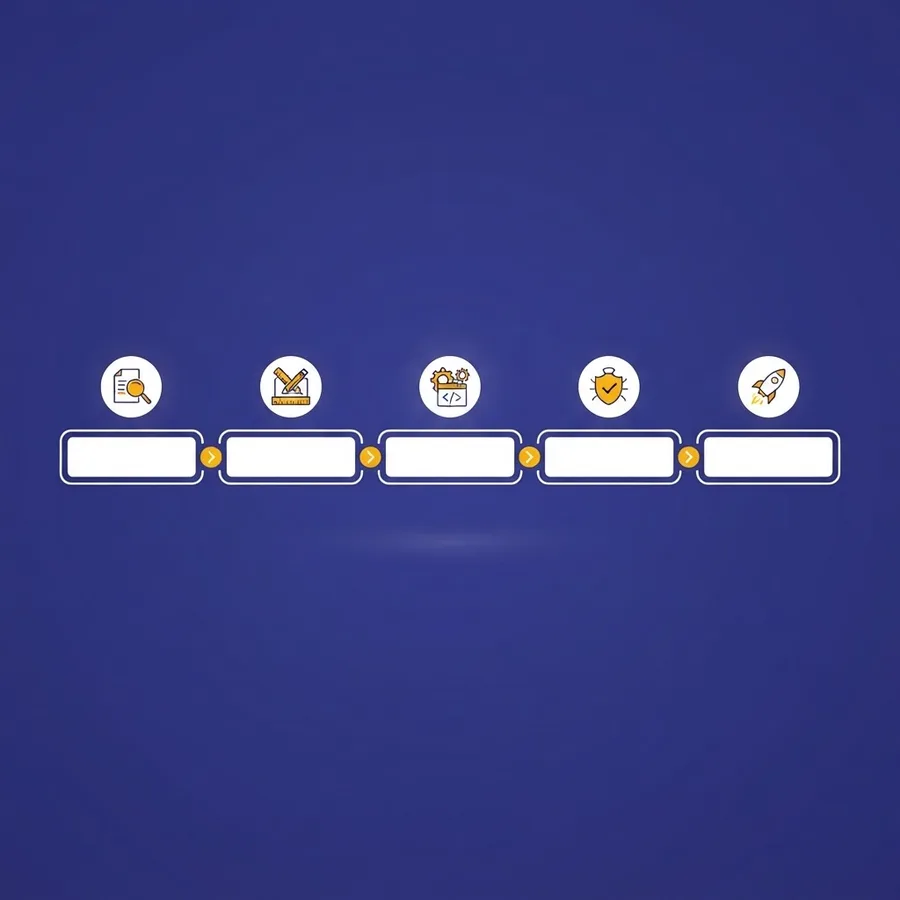
1. Discovery and Requirements: 1 to 3 Weeks
This phase converts an idea into a flow list, a data model sketch, and a prioritized backlog. Teams that skip it usually pay for it later with a mid-build redesign that costs 3 to 6 weeks. Deliverables you should insist on: a flow inventory, a written scope boundary listing what is explicitly out, and an integration list with confirmed sandbox access.
2. UX and UI Design: 2 to 6 Weeks
Wireframes take 1 to 2 weeks, high-fidelity screens and a component system take another 2 to 4 weeks. The variable is not design speed, it is approval speed. Two stakeholders reviewing within 48 hours keeps design on schedule. Five stakeholders reviewing whenever they are free adds weeks of dead time that no one budgets for.
3. Architecture and Setup: 1 to 2 Weeks
Database schema, authentication, hosting, environments, and CI pipelines. This is also where you decide whether to build a native app, a cross-platform app, or a web application. That choice changes the timeline materially, and the practical trade-offs are covered well in this breakdown of desktop application vs web application architecture decisions.
4. Core Development: 8 to 24 Weeks
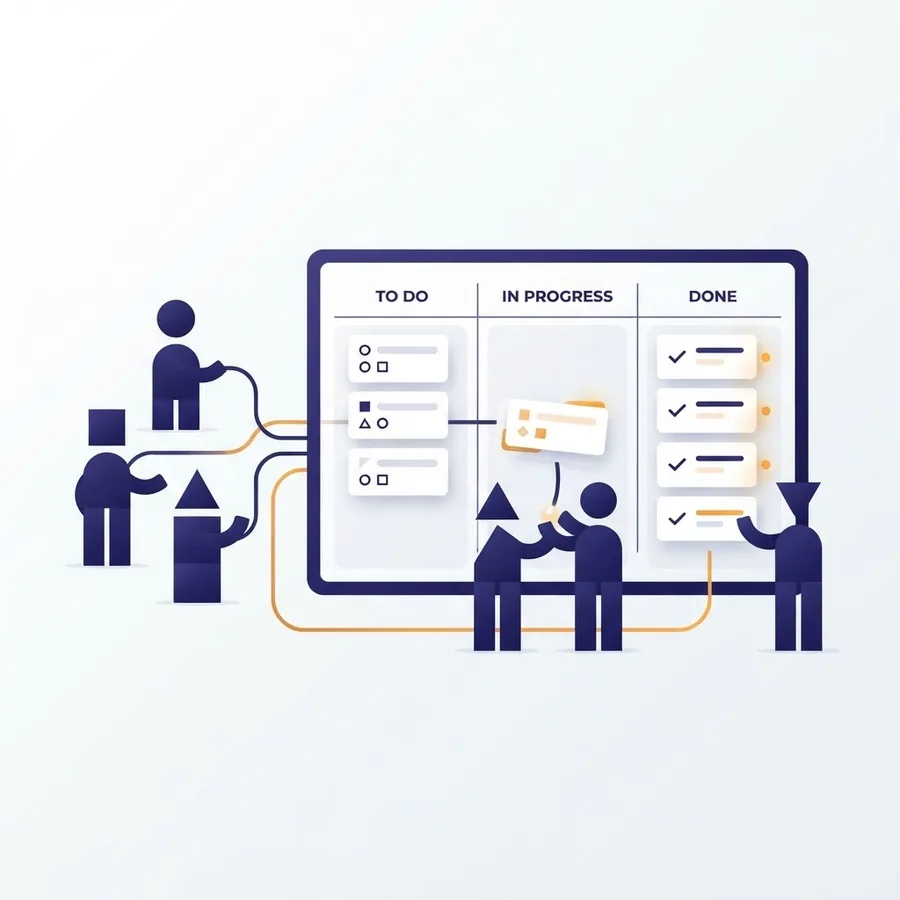
The longest phase, and the one clients misjudge most. Working software should appear in week 3 or 4, not month 4. If your team cannot demo a running build in the first month, the schedule is already at risk. Weekly demos are the only reliable early-warning system for a slipping timeline.
5. Testing and QA: 2 to 6 Weeks
QA overlaps development rather than following it. Reserve a dedicated 2 to 4 week hardening window before launch for device testing, performance profiling, accessibility checks, and security review. B2B products need more here because permission matrices multiply test cases quickly, a reality explored in detail in this guide to b2b web application development.

6. Launch and Store Review: 1 to 3 Weeks
Apple's App Review currently returns a decision on the majority of submissions within 24 to 48 hours, and Google Play typically reviews new apps within a few days, though new developer accounts and sensitive permissions can extend that to a week or more. Plan two submission attempts. First-time rejections for privacy labels, login requirements, or incomplete metadata are routine, not exceptional.

Why the MVP Route Is Usually Faster and Smarter
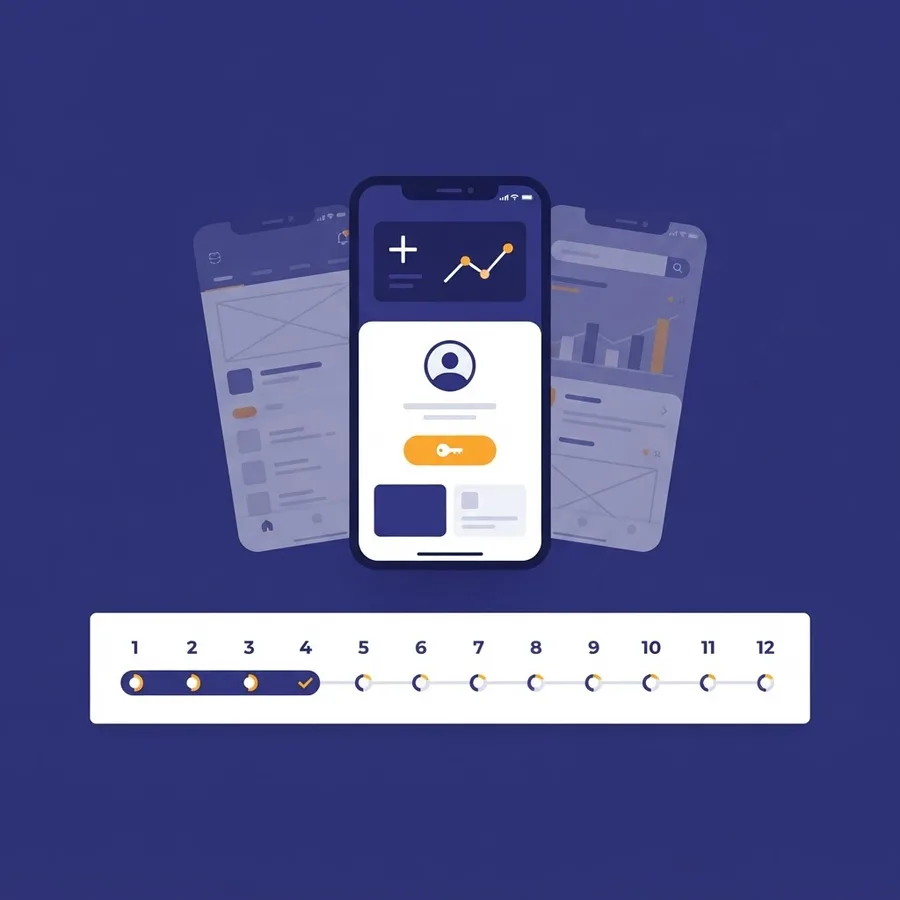
An MVP is the smallest version of your app that lets a real user complete the core job and pay you or generate a measurable signal. Cutting to an MVP does not mean shipping something broken, it means shipping fewer flows at full quality.
A practical MVP scoping method that works:
- Write down every feature on a single list.
- Circle only the features required for one user to complete one core job.
- Move everything else to a phase two list with a date, not a maybe.
- Build the circled set in 10 to 14 weeks.
- Ship, measure retention and drop-off, then fund phase two with evidence.
This approach compresses time-to-first-revenue from roughly 8 months to under 4 in most projects we see, and it prevents the most expensive outcome in software: spending 9 months building features nobody opens. Teams that need senior engineers who can scope this way rather than simply take orders often work with a partner like ZoneTechify Team precisely because scope discipline, not coding speed, is what protects a deadline.
Hidden Factors That Stretch Timelines
Understanding the relationship between duration, budget, and quality helps you make better trade-offs than simply asking for everything faster.
- Decision latency. Client feedback cycles longer than 3 business days are the most common cause of quiet slippage. It rarely appears in status reports because no one calls waiting a delay.
- Content and data readiness. Missing product copy, legal text, or a clean data export can idle a finished feature for weeks.
- Compliance requirements. HIPAA, GDPR, PCI, or SOC 2 obligations add design, documentation, and audit work. Regulated builds such as healthcare web application development commonly run 30 to 50 percent longer than equivalent consumer apps.
- Infrastructure and security work. Traffic protection, request filtering, and traffic distribution are not afterthoughts. Provisioning and tuning a web application firewall load balancer setup properly is a real line item, not a checkbox.
- Custom versus configured. Bespoke logic takes longer than assembling proven components, a trade-off examined in this piece on customized application software.
- Hiring gaps. Starting a build before the team is complete guarantees rework. Recruiting for senior software engineer jobs commonly takes 6 to 10 weeks, which belongs in your schedule if you are staffing in-house.
How to Compress a Timeline Without Breaking Quality
Adding people to a late project rarely helps, a principle Fred Brooks documented decades ago and one that still holds. What actually shortens delivery:
- Cut scope, not quality. Removing two flows saves 3 to 4 weeks with zero technical debt.
- Parallelize design and development. Once the design system is locked, engineers build screen by screen while design stays one sprint ahead.
- Name one decision maker. A single approver with authority can save 2 to 3 weeks across a build.
- Use proven infrastructure. Managed authentication, payments, and hosting remove weeks of undifferentiated work.
- Freeze scope during the final sprint. Late additions are the leading cause of missed launch dates.
An experienced web development company will push back on unrealistic dates rather than agree and quietly miss them. Take that pushback as a positive signal about the partner, not a negative one.
Key Takeaways
- Simple apps take 6 to 12 weeks, mid-complexity apps 3 to 5 months, and complex or regulated platforms 8 to 12 months.
- One well-defined user flow consumes 1 to 2 weeks of a small dedicated team's capacity.
- Budget 1 to 3 weeks per non-trivial integration, and 4 weeks for regulated data integrations.
- App Store review usually resolves in 24 to 48 hours, but plan for two submission attempts.
- Smaller scoped projects succeed at dramatically higher rates than large ones, per long-running CHAOS research.
- Decision latency, not engineering speed, is the most common hidden cause of delay.
- Regulated builds run 30 to 50 percent longer than equivalent consumer apps.
Frequently Asked Questions (FAQ)
How long does it take to build a simple app?
A simple app with 5 to 12 screens, no payments, and no complex integrations takes 6 to 12 weeks with a dedicated team of two or three people. That includes design, development, testing, and store submission. Reviews handled within 48 hours keep this timeline realistic.
Can an app be developed in one month?
Yes, but only a narrow prototype or single-flow utility. In four weeks a strong team can ship a working product with one core flow, basic authentication, and minimal design polish. It will not include payments, admin panels, or extensive testing, so treat it as a validation tool.
Why do app development timelines slip so often?
Slippage usually comes from scope changes, slow approvals, and integrations that behave differently than documented. Engineering estimates are often reasonable while the surrounding process is not. Weekly demos, a single decision maker, and a written scope boundary prevent most delays before they compound.
Does iOS or Android take longer to build?
Building both natively roughly doubles frontend effort. Cross-platform frameworks let one codebase serve both, typically cutting 30 to 40 percent from combined timelines. Native still wins when you need deep hardware access, advanced animation, or platform-specific performance guarantees.
How long does App Store approval take?
Apple reviews most submissions within 24 to 48 hours, and Google Play typically decides within a few days. New developer accounts, sensitive permissions, or subscription setups can extend review to a week or more. Always plan for one rejection and resubmission cycle.
Should I hire an agency or build in-house for a faster launch?
An agency is usually faster to start because the team already exists. Hiring senior engineers takes 6 to 10 weeks before any code is written. In-house makes sense for long-term ownership, while agencies suit fixed-scope launches and validation timelines.