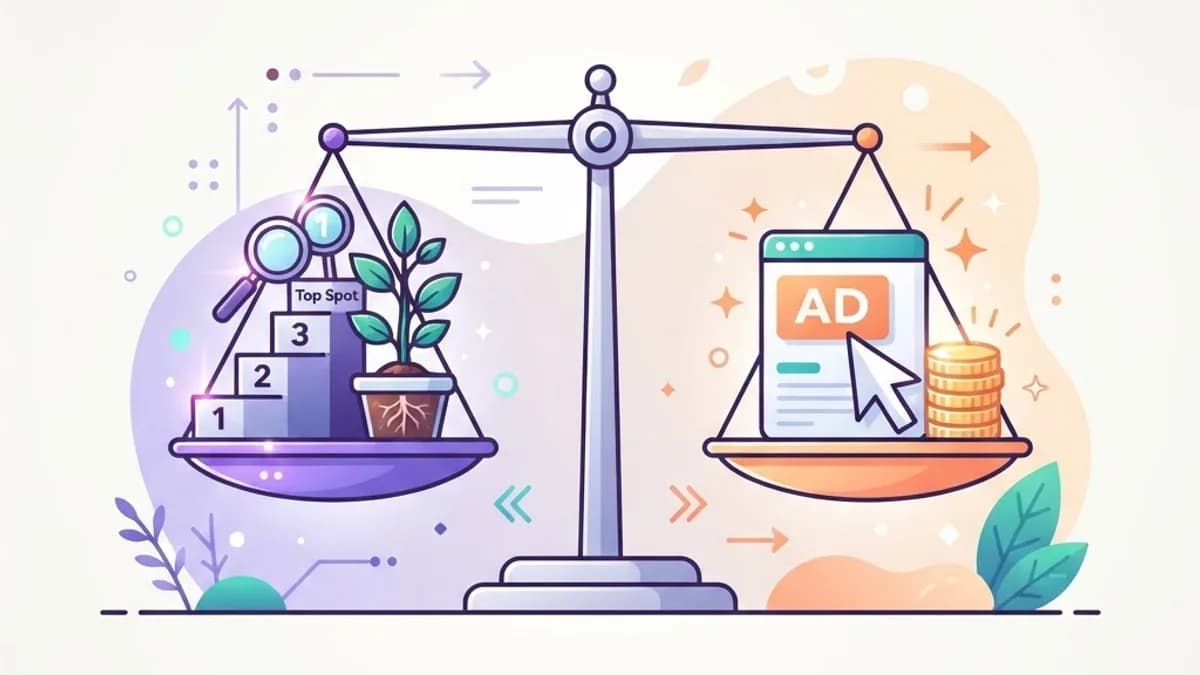
A decision framework comparing SEO and PPC in digital marketing, with budget splits, timelines, cost behavior, and how to run both channels so they strengthen each other.
Digital Marketing SEO PPC
SEO and PPC are usually presented as a choice. That framing is the reason so many budgets underperform. They are not competing options, they are two different instruments that capture demand at different costs, on different timelines, with different risk profiles. The real question is not which one to pick but how to sequence them and how much of each to fund at your current stage.
This guide gives a concrete decision framework, the cost behavior of each channel over time, and the specific ways running both together produces results neither achieves alone.
Quick Answer: SEO builds compounding organic visibility over six to twelve months at low marginal cost per visit, while PPC buys immediate traffic at a fixed cost per click that never decreases. Most businesses should run PPC first to validate demand and messaging, then fund SEO to reduce long term acquisition cost.
Defining the Two Channels Precisely
Search engine optimization is the practice of earning unpaid search visibility by improving technical accessibility, content relevance, and site authority. Pay per click advertising is the practice of buying placement in search results or partner networks, charged when a user clicks.
The critical distinction is cost structure. PPC has a near linear cost curve. Doubling traffic roughly doubles spend, and often more than doubles it as you bid into less efficient inventory. SEO has a front loaded investment curve. Costs are highest before results appear, then marginal cost per additional visit falls toward zero while the asset continues producing.
That difference, not ranking position, is the strategic core of the comparison.
Head to Head Comparison
| Factor | SEO | PPC |
|---|---|---|
| Time to first meaningful results | Three to nine months typically | Same day to one week |
| Cost per incremental visit over time | Declines toward near zero | Flat or rising with competition |
| Budget pause effect | Traffic persists for months | Traffic stops immediately |
| Testing speed for messaging | Slow, weeks per iteration | Fast, days per iteration |
| Competitive vulnerability | Algorithm updates and competitor content | Bid inflation and auction pressure |
| Best for | Durable acquisition cost reduction | Immediate demand capture and validation |
| Attribution clarity | Harder, multi touch and assisted | Clear at click level |
One widely cited behavioral pattern is worth noting carefully: organic results collectively receive a large majority of search clicks on typical informational queries, while paid results capture a higher share on transactional, high commercial intent queries. This is why product and service queries often justify PPC economics that informational queries never will.
When PPC Should Come First
PPC is the correct opening move in four situations.
First, when demand exists but your site has no authority. A new domain cannot rank for competitive commercial terms within a quarter regardless of content quality. PPC bridges that gap.
Second, when you need message validation. Running five ad variations for two weeks reveals which value proposition resonates faster and cheaper than any survey. That insight then shapes the SEO content plan, which is far more expensive to redo.
Third, for time bound offers, launches, and seasonal peaks where organic timelines simply do not fit.
Fourth, for high margin commercial keywords where the math works even at premium click costs. If a single conversion is worth thousands, a forty dollar click is rational.
The Validation Sequence
- Run tightly themed exact and phrase match campaigns for two to four weeks.
- Record which keyword clusters produce qualified conversions, not just clicks.
- Identify the winning headline and value proposition combinations.
- Build SEO content around the proven clusters rather than keyword tool guesses.
- Shift budget gradually as organic rankings mature for those same clusters.
This sequence prevents the most expensive SEO mistake, which is investing nine months of content production into topics that attract traffic but never convert.
When SEO Should Lead
SEO deserves the larger share when the business has time, a thin margin per sale, or an audience that researches extensively before buying.
Ecommerce businesses with modest per order margins often cannot sustain competitive paid click costs at scale. Professional services with long consideration cycles benefit disproportionately from educational organic content that builds trust across months. Local businesses in low competition markets can frequently achieve map pack visibility in a matter of weeks, making organic the cheapest reliable channel available.
Technical foundations matter more than most teams expect here. Core Web Vitals are part of Google's page experience signals, and slow, layout unstable pages suppress both organic performance and paid landing page quality simultaneously. Teams rebuilding on a modern framework, frequently with a Next.js development agency, routinely see both organic rankings and ad quality scores improve from the same underlying performance work.
How the Two Channels Strengthen Each Other
Running SEO and PPC in isolation forfeits several compounding advantages.
Keyword intelligence transfer. PPC search term reports show exactly which queries produce revenue, including long tail phrases no keyword tool surfaces. That data should directly drive organic content priorities.
SERP coverage. Appearing in both the ad block and the organic results increases total click share for branded and high intent queries, and reduces the share a competitor can capture by bidding on your brand terms.
Landing page testing. Paid traffic produces statistically usable conversion data in days. Winning layouts, headlines, and form structures can then be applied to organic landing pages that would take months to accumulate equivalent sample size.
Remarketing organic visitors. Organic traffic that does not convert becomes a paid remarketing audience, which typically converts at a much lower cost than cold prospecting.
Defensive brand bidding. When competitors bid on your brand name, a modest brand campaign protects traffic you already earned organically at a low cost per click.
Budget Allocation by Business Stage
There is no universal split, but stage based guidance holds up well in practice.
- Pre revenue or new domain: roughly seventy percent PPC, thirty percent SEO foundations covering technical setup and core service pages.
- Early traction with proven messaging: an even split, funding content production while maintaining paid demand capture.
- Established with organic rankings: thirty to forty percent PPC focused on high intent and remarketing, sixty to seventy percent SEO and content.
- Market leader: PPC narrowed to defensive brand terms and high margin segments, with the majority of budget in content, digital public relations, and authority building.
Agencies that operate both disciplines under one strategy, rather than in separate silos, tend to reallocate faster between them. Teams such as data-driven marketing specialists generally review the split quarterly rather than annually, because auction costs and ranking positions both shift within that window.
Measuring Both Channels Honestly
The most common measurement error is comparing last click conversions between channels. Organic search frequently initiates the journey and paid frequently closes it, so last click systematically overvalues PPC and undervalues SEO.
A workable measurement approach:
- Track assisted conversions, not only last click
- Compare blended customer acquisition cost across all channels month over month
- Run geographic or time based holdout tests to estimate true incrementality
- Measure branded search volume growth as a leading indicator of SEO and content impact
- Evaluate SEO on twelve month cohorts and PPC on thirty day windows, since their timelines genuinely differ
Key Takeaways
- SEO and PPC differ fundamentally in cost structure, with PPC costs staying linear and SEO marginal costs declining over time.
- Organic results capture the majority of clicks on informational queries, while paid captures a larger share on high commercial intent queries.
- PPC should generally run first on new domains to validate messaging before expensive SEO content production begins.
- PPC search term reports are the most accurate keyword research source available for planning organic content.
- Core Web Vitals improvements raise organic rankings and paid landing page quality at the same time.
- Last click attribution systematically undervalues SEO, so assisted conversions and blended acquisition cost provide fairer comparison.
Frequently Asked Questions (FAQ)
Should I choose SEO or PPC if I can only afford one?
If you need revenue within ninety days, choose PPC, because SEO rarely produces meaningful traffic that quickly. If you have six to twelve months of runway and thin margins that cannot absorb click costs, choose SEO. Most businesses eventually need both, so treat the single channel choice as temporary.
How long does SEO take to beat PPC on cost?
For most competitive commercial markets, organic traffic begins costing less per visit than paid somewhere between nine and eighteen months, assuming consistent content and technical investment. The crossover arrives sooner in low competition local markets and later in national markets with entrenched authoritative competitors.
Does running PPC ads help organic rankings?
No, paid spend is not a direct ranking factor. However, PPC indirectly supports SEO by revealing converting keywords, testing landing page messaging quickly, and increasing brand familiarity, which can raise branded search volume and click through rates on organic listings over time.
What percentage of budget should go to each channel?
New businesses commonly start near seventy percent PPC and thirty percent SEO, then shift toward sixty or seventy percent SEO once organic rankings mature. The right split depends on runway, margin per sale, and how competitive your commercial keywords are, so review it quarterly rather than setting it once.
Can small businesses compete with large brands in search?
Yes, by narrowing focus. Large brands dominate broad head terms but rarely cover specific long tail, local, or niche questions well. Small businesses that publish genuinely specific local or specialist content, and maintain fast accessible pages, regularly outrank far larger competitors on those queries.
Why did my traffic drop when I paused PPC?
Paid traffic stops the moment spend stops, which is the defining difference from SEO. If total sessions fell sharply after pausing, that reveals how much of your visibility was rented rather than owned, and it is usually the clearest signal that organic investment has been underfunded.