
A transparent breakdown of custom web application development cost in 2026, including real price ranges, hidden expenses, regional rates, and how to budget accurately.
Custom Web Application Development Cost
Most buyers asking about custom web application development cost get the same useless answer: "it depends." That answer is technically true and practically worthless. What you actually need is a range, the variables that move you inside that range, and the line items agencies rarely put on the first quote. This guide gives you all three, based on how real software estimates are constructed on the inside.
A custom web application is software built specifically for your workflow, running in a browser, with its own database, business logic, and user accounts. That is different from a website, which mainly presents information. The moment your project needs users to log in, save data, and perform actions that change that data, you have crossed into web application territory, and pricing rules change completely.
Quick Answer: Custom web application development cost typically ranges from 15,000 to 40,000 USD for a focused MVP, 40,000 to 120,000 USD for a mid-sized production application, and 150,000 USD or more for enterprise systems. Price is driven by feature count, integrations, user roles, compliance needs, and your team's hourly rate.

What Actually Drives the Price of a Custom Web App
Every credible estimate is built the same way: scope is decomposed into features, features are decomposed into tasks, tasks are given hour ranges, and hours are multiplied by a blended rate. If a vendor cannot show you that decomposition, they are guessing, and you will absorb the cost of their guess later.
The five variables that move budgets most, in order of impact:
- Number of distinct user roles. An app with one user type is roughly linear to build. Add an admin role, then a manager role, and permission logic, dashboards, and testing surface multiply. Each additional role commonly adds 15 to 25 percent to build effort.
- Third-party integrations. Payments, CRMs, ERPs, shipping, and accounting systems each carry their own authentication, error handling, and edge cases. Budget 8 to 40 hours per integration, and treat any legacy or poorly documented API as the top of that range.
- Data complexity. A flat list of records is cheap. Relational data with historical versioning, audit trails, and reporting requirements is not. Reporting alone is frequently underestimated by half.
- Compliance requirements. HIPAA, SOC 2, GDPR, or PCI obligations add architecture work, documentation, logging, and access controls. Expect a 20 to 35 percent uplift on any project carrying real compliance scope.
- Design ambition. A clean interface built on an existing component system is efficient. Bespoke animation, custom data visualization, and heavy interaction design are separate disciplines with separate budgets.
Realistic Cost Ranges by Project Tier
The table below reflects blended rates common to North American and European agencies working with senior teams. Rates from offshore vendors run lower, which is covered in the next section.
| Project Tier | Typical Scope | Timeline | Cost Range (USD) |
|---|---|---|---|
| Prototype | Clickable demo, no real backend | 2 to 4 weeks | 5,000 to 15,000 |
| MVP | One core workflow, auth, basic admin | 6 to 12 weeks | 15,000 to 40,000 |
| Production App | Multiple roles, integrations, reporting | 3 to 6 months | 40,000 to 120,000 |
| Enterprise Platform | Compliance, SSO, high scale, legacy sync | 6 to 18 months | 150,000 to 500,000+ |
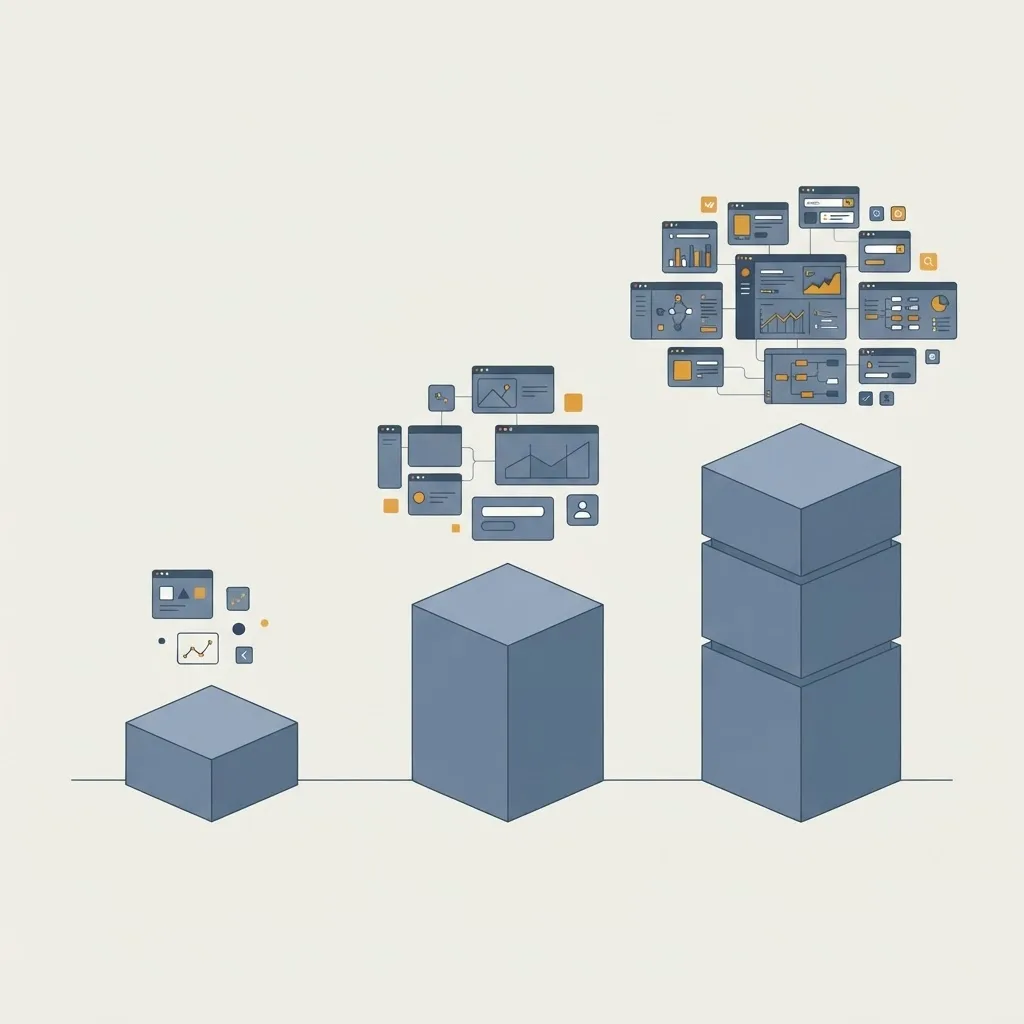
The boundary that matters most is between MVP and production app. An MVP is designed to validate a hypothesis with real users, and it accepts manual workarounds. A production app removes those workarounds. Teams that budget for an MVP but expect production quality are the single most common source of blown budgets I have seen in software procurement.
How Hourly Rates Change the Math
Hourly rate is the multiplier on every hour of scope, so it is the fastest way to change a total, and the fastest way to damage a project.
| Region | Typical Senior Rate (USD/hour) | Practical Consideration |
|---|---|---|
| United States and Canada | 100 to 200 | Timezone overlap, strongest contract enforcement |
| Western Europe | 85 to 160 | Strong engineering standards, GDPR fluency |
| Eastern Europe | 45 to 90 | Common quality-to-cost sweet spot |
| Latin America | 40 to 85 | Good North American timezone alignment |
| South and Southeast Asia | 25 to 60 | Widest quality variance, vet aggressively |
The US Bureau of Labor Statistics reports median annual pay for software developers at roughly 133,080 USD as of its 2024 occupational data, which anchors why domestic agency rates rarely dip below the ranges above once overhead is included. Meanwhile, Standish Group CHAOS research has consistently found that only about 31 percent of software projects are delivered on time and on budget, with smaller projects succeeding at far higher rates than large ones. That second statistic is the more useful one for a buyer: the strongest cost-control lever available to you is scope size, not rate.
A practical rule from experience: a 40 USD per hour developer who needs three attempts to get a feature right costs more than a 120 USD per hour developer who ships it once, and the cheap version usually arrives with technical debt that inflates every future change. Rate arbitrage only works when the vendor's delivery discipline is genuinely comparable.

The Hidden Costs Nobody Puts in the First Quote
Build cost is not total cost. Plan for 15 to 25 percent of the original build cost annually just to keep the application healthy. Specific line items to demand in writing:
- Infrastructure and hosting. Small apps run for 20 to 100 USD monthly. Anything with heavy media, background jobs, or real-time features climbs quickly.
- Third-party service fees. Authentication providers, email delivery, payment processing, monitoring, and error tracking each carry recurring costs that scale with usage.
- Security patching and dependency upgrades. Frameworks release breaking changes. Deferring upgrades for two years converts routine maintenance into a migration project.
- Quality assurance. Proper testing is typically 15 to 20 percent of development hours. Vendors who exclude it are shifting that cost onto your users.
- Post-launch iteration. Real usage always reveals wrong assumptions. Reserve 20 percent of your budget for changes you cannot predict today.
- Knowledge transfer. Documentation and handoff protect you from vendor lock-in. Its absence is a cost you pay only when you try to leave.

Does the Tech Stack Change the Budget
Yes, but less through licensing and more through hiring, speed, and longevity. Modern stacks built on React, Next.js, TypeScript, and managed Postgres reduce build hours because component ecosystems, hosting platforms, and authentication services eliminate work that used to be custom. Agencies specializing in these stacks, including teams like ZoneTechify, often ship comparable functionality faster because they are not rebuilding infrastructure on every engagement.
Where stack choice genuinely raises cost:
- Niche or aging languages, where senior talent is scarce and rates rise accordingly
- Self-managed infrastructure instead of managed platforms, which adds DevOps hours indefinitely
- Requirements pushing you toward native mobile alongside web, effectively creating a second product
If you are weighing architecture decisions against budget, it helps to review real project structures. Detailed breakdowns of scoping and delivery for web app development engagements are more useful than generic pricing calculators, because they show which decisions actually consumed hours.
How to Estimate Your Own Project in Five Steps
You can produce a defensible internal number before contacting a single vendor. Do this first, then use it to evaluate quotes.
- List every user role. Write each type of person who logs in and what they are allowed to do.
- Write user stories per role. Format: as a role, I need to action, so that outcome. Aim for 20 to 60 stories for a first release.
- Assign a t-shirt size to each story. Small equals 4 to 8 hours, medium equals 8 to 24 hours, large equals 24 to 60 hours. Anything larger is not yet a story, it is a feature that needs splitting.
- Add overhead multipliers. Add 20 percent for QA, 15 percent for project management, 15 percent for deployment and DevOps, and 20 percent contingency.
- Multiply by your target blended rate. Present the result as a range of plus or minus 25 percent, never a single figure.
When you take this document to vendors, quote quality improves immediately, because you have removed the ambiguity vendors normally price as risk. Agencies that work this way, such as the team at scalable web solutions specialists WebPeak, will typically return an estimate mapped story by story rather than a single lump sum, which is exactly what you want to see.

Legitimate Ways to Reduce Cost Without Reducing Quality
Cutting cost is easy. Cutting cost without paying for it later is the skill. These approaches work:
- Ruthlessly sequence, do not delete. Ship one workflow completely rather than five workflows partially. Partial features cost full price and deliver nothing.
- Use a component library. Building a design system from scratch can consume 80 to 200 hours before a single feature exists.
- Accept manual operations at launch. If a task happens five times a week, a human can do it while you spend those development hours on something users touch daily.
- Choose managed services. Managed databases, auth, and hosting convert unpredictable DevOps hours into a predictable monthly bill.
- Fix scope, flex timeline. Rushed timelines carry a premium of 20 to 40 percent because they require parallel work and larger teams.
What does not work: skipping testing, skipping documentation, hiring the cheapest available bidder, or accepting a fixed-price contract for scope nobody has defined yet. Each of these trades a known cost today for a larger unknown cost later.
When Custom Development Is Worth the Cost
Custom software earns its price when off-the-shelf tools force you to change how your business works, or when the workflow itself is your advantage. Run the comparison honestly: if a 200 USD monthly SaaS product covers 85 percent of your needs, spending 60,000 USD to cover the last 15 percent rarely pays back.
Custom is justified when at least one of these is true:
- Staff waste measurable hours weekly on manual work between disconnected tools
- Your process is a differentiator competitors cannot buy off the shelf
- Per-seat SaaS licensing costs exceed a custom build within 24 to 36 months
- Data ownership, integration depth, or compliance rules out available products
Most successful custom builds reach breakeven somewhere between month 14 and month 30, driven by labor saved rather than new revenue. Model that curve before signing, and revisit it quarterly after launch.

Key Takeaways
- Custom web application development cost ranges from 15,000 USD for a focused MVP to 150,000 USD or more for enterprise platforms.
- Feature count, user roles, integrations, and compliance scope drive cost more than technology choice.
- Senior developer rates range from roughly 25 USD per hour in South Asia to 200 USD per hour in North America, with Eastern Europe and Latin America often offering the best quality-to-cost balance.
- Annual maintenance realistically runs 15 to 25 percent of the original build cost.
- Standish Group CHAOS research finds only about 31 percent of software projects finish on time and on budget, and smaller scopes succeed far more often.
- Reserve 20 percent contingency and present every estimate as a range, never a single number.
- Custom development typically reaches breakeven between month 14 and month 30 through labor savings.
Frequently Asked Questions (FAQ)
How much does it cost to build a custom web application from scratch?
A focused MVP with one core workflow, authentication, and a basic admin panel typically costs 15,000 to 40,000 USD. Production applications with multiple user roles, integrations, and reporting run 40,000 to 120,000 USD. Enterprise platforms with compliance requirements commonly exceed 150,000 USD.
Why do web app quotes vary so much between agencies?
Quotes diverge because vendors interpret undefined scope differently and apply different rates. One agency may include testing, project management, and deployment while another excludes them. Always request a feature-by-feature hour breakdown, then compare identical line items rather than comparing totals.
How long does it take to build a custom web application?
A prototype takes 2 to 4 weeks, an MVP takes 6 to 12 weeks, and a full production application takes 3 to 6 months. Enterprise systems with compliance and legacy integrations often run 6 to 18 months. Compressing these timelines usually adds 20 to 40 percent to cost.
What ongoing costs should I expect after launch?
Budget 15 to 25 percent of the original build cost annually. That covers hosting, third-party service fees, security patching, dependency upgrades, monitoring, and bug fixes. Feature development after launch is a separate budget line and should not be confused with maintenance.
Is it cheaper to use no-code tools instead of custom development?
No-code is cheaper upfront and excellent for validating an idea or automating internal tasks. Costs invert once you need complex logic, high user volume, or deep integrations, because per-seat pricing scales and platform limits force expensive rebuilds. Validate on no-code, then build custom when constraints appear.
Should I choose fixed-price or time-and-materials billing?
Fixed price suits small, tightly defined projects where scope will not change. Time and materials suits anything exploratory, because fixed-price vendors price uncertainty as risk and add a premium. A practical hybrid is a fixed-price discovery phase followed by time and materials for the build.