
Explore how artificial intelligence and Sanskrit intersect, from Panini's ancient grammar to modern NLP, translation, and manuscript digitization.
artificial intelligence and Sanskrit
Few pairings sound as unlikely as artificial intelligence and Sanskrit. One is the cutting edge of modern computing; the other is a language whose roots stretch back more than three thousand years. Yet the relationship between the two runs deeper than most people realize. Sanskrit is not merely an object that AI studies. Its remarkably precise grammar has, in subtle ways, shaped how computer scientists think about language, rules, and structure. Today, machine learning is breathing new life into ancient texts, while linguists rediscover why Sanskrit fascinated computing pioneers in the first place.
In this article we trace the surprising history that connects these two worlds, look at how modern AI processes a highly inflected classical language, and explore the practical tools that are making vast Sanskrit archives searchable for the first time. Whether you are a technologist, a student of language, or simply curious, the story of artificial intelligence and Sanskrit offers a fresh way to think about how machines understand human expression.
Why Sanskrit Matters to Computer Science
Sanskrit is often described as one of the most systematic languages ever documented. Its phonetics, morphology, and syntax follow rules so consistent that they resemble a formal system more than a natural language. This is precisely what caught the attention of researchers working on early computing and linguistics. A language that behaves predictably is a language a machine can model.
The key figure here is Panini, an ancient grammarian who lived roughly in the fifth or fourth century BCE. His work, the Ashtadhyayi, is a set of nearly four thousand concise rules that generate correct Sanskrit forms from basic roots. What makes this extraordinary is the method: Panini used abbreviations, ordered rules, and recursive definitions in a way that strongly resembles the production rules used in modern programming languages and compilers.
The Panini Connection
When computer scientists in the twentieth century developed formal grammars to describe programming languages, they independently arrived at structures Panini had outlined millennia earlier. The idea of a rule that rewrites one symbol into another, applied in a strict order to produce valid output, is the backbone of context-free grammars. Some scholars have called the Ashtadhyayi the world's first generative grammar. The comparison is not just poetic; it is structural.
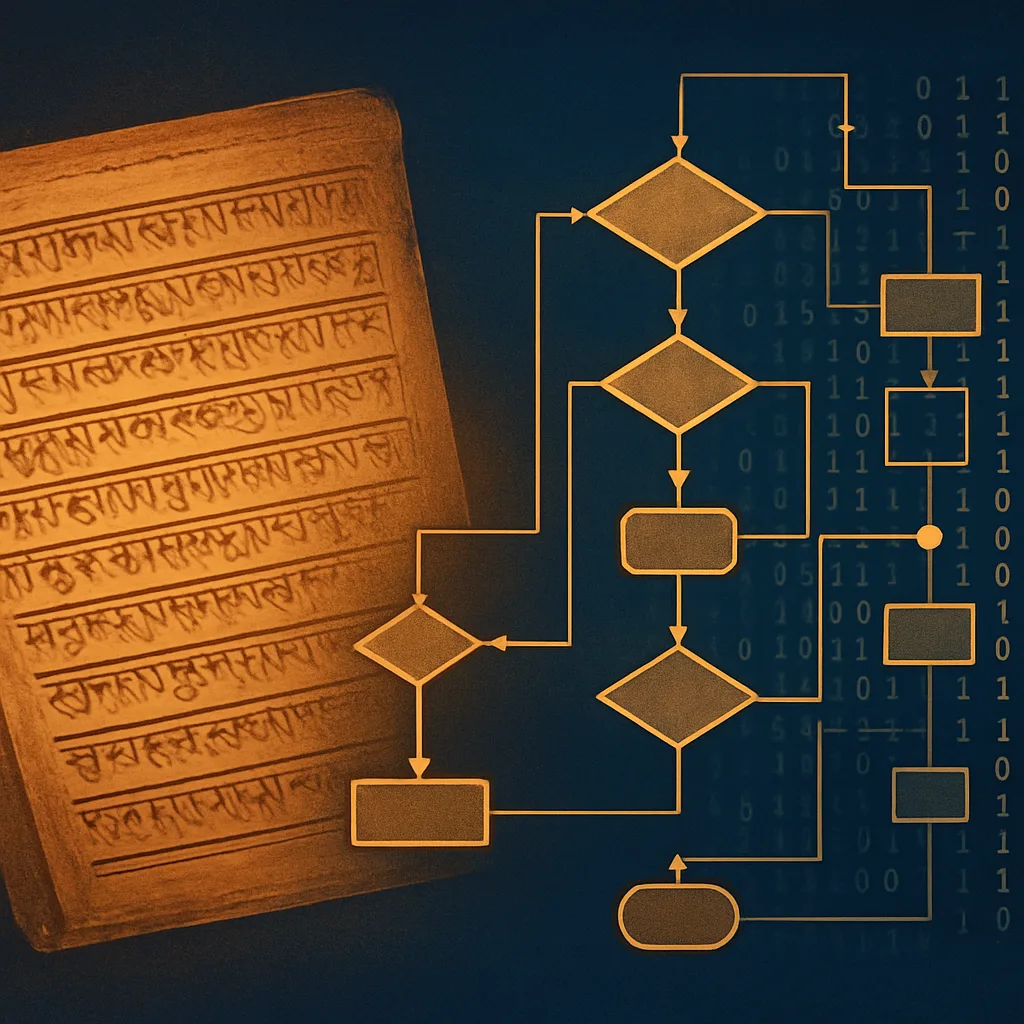
This lineage matters because it shows that the bond between artificial intelligence and Sanskrit is not a modern marketing gimmick. The descriptive rigor of Sanskrit grammar anticipated concepts that would later become foundational to computational linguistics. Understanding that history helps explain why Sanskrit remains an attractive testbed for rule-based language processing today.
How AI Processes the Sanskrit Language
Processing Sanskrit with modern AI is both easier and harder than processing a language like English. It is easier because the grammar is so regular that rule-based systems can model large parts of it accurately. It is harder because Sanskrit is heavily inflected, words combine through a process called sandhi, and classical texts contain almost no punctuation or spacing as we know it.
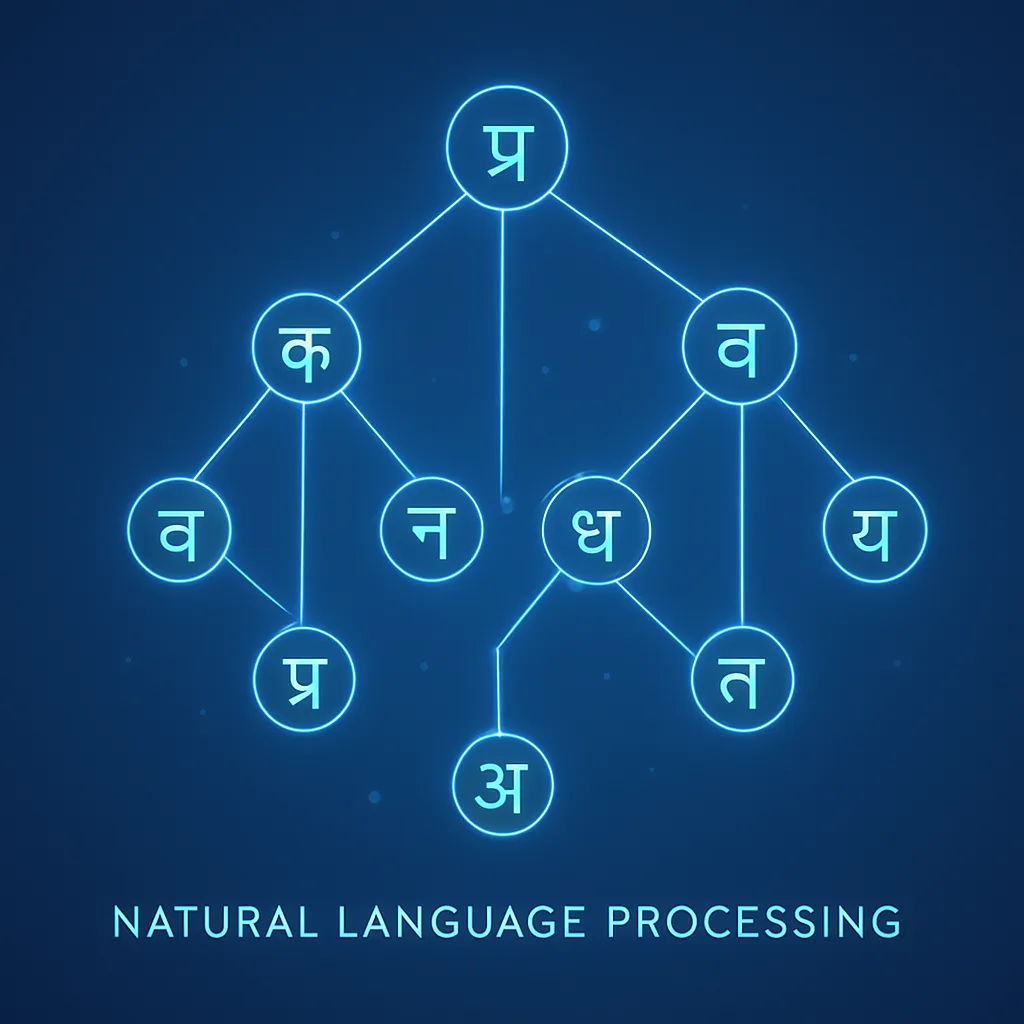
Natural language processing, or NLP, is the branch of AI that teaches machines to read and analyze human language. For Sanskrit, NLP must first solve problems that simply do not exist in many other languages. Consider sandhi: when words meet, their sounds blend, so two separate words can fuse into a single continuous string. A model must learn to split that string back into its components before it can analyze meaning. This is a uniquely demanding task that pushes the limits of segmentation algorithms.
Tokenization and Morphological Analysis
Tokenization is the process of breaking text into meaningful units. In Sanskrit, a single word can carry information about number, gender, case, tense, and mood through its endings. A morphological analyzer must recognize the root, identify each affix, and reconstruct the grammatical role of the word in the sentence. Because Sanskrit endings are so systematic, these analyzers can achieve impressive accuracy when built on Panini-style rules combined with statistical learning.
Modern approaches blend two philosophies. Rule-based engines encode the classical grammar directly, giving precise and explainable results. Machine learning models, trained on digitized corpora, handle ambiguity and the irregularities that creep into real texts. The most effective systems are hybrids, using rules where the grammar is firm and learned models where context decides meaning. This combination reflects a broader trend in AI development, where structured knowledge and data-driven learning reinforce each other.
Machine Translation and Sanskrit
Translation is one of the most visible applications of artificial intelligence and Sanskrit working together. Translating classical Sanskrit into modern languages is not a simple word swap. The translator, human or machine, must interpret dense philosophical vocabulary, recognize layered meanings, and respect a sentence structure where word order is flexible because grammatical endings carry the relationships.
Neural machine translation has improved dramatically for major world languages, but low-resource languages like classical Sanskrit pose a challenge. These models are hungry for data, and high-quality parallel texts, where the same passage appears in Sanskrit and another language, are limited. Researchers address this with transfer learning, using knowledge gained from data-rich languages to bootstrap performance on Sanskrit, and with carefully curated digital editions of canonical works.
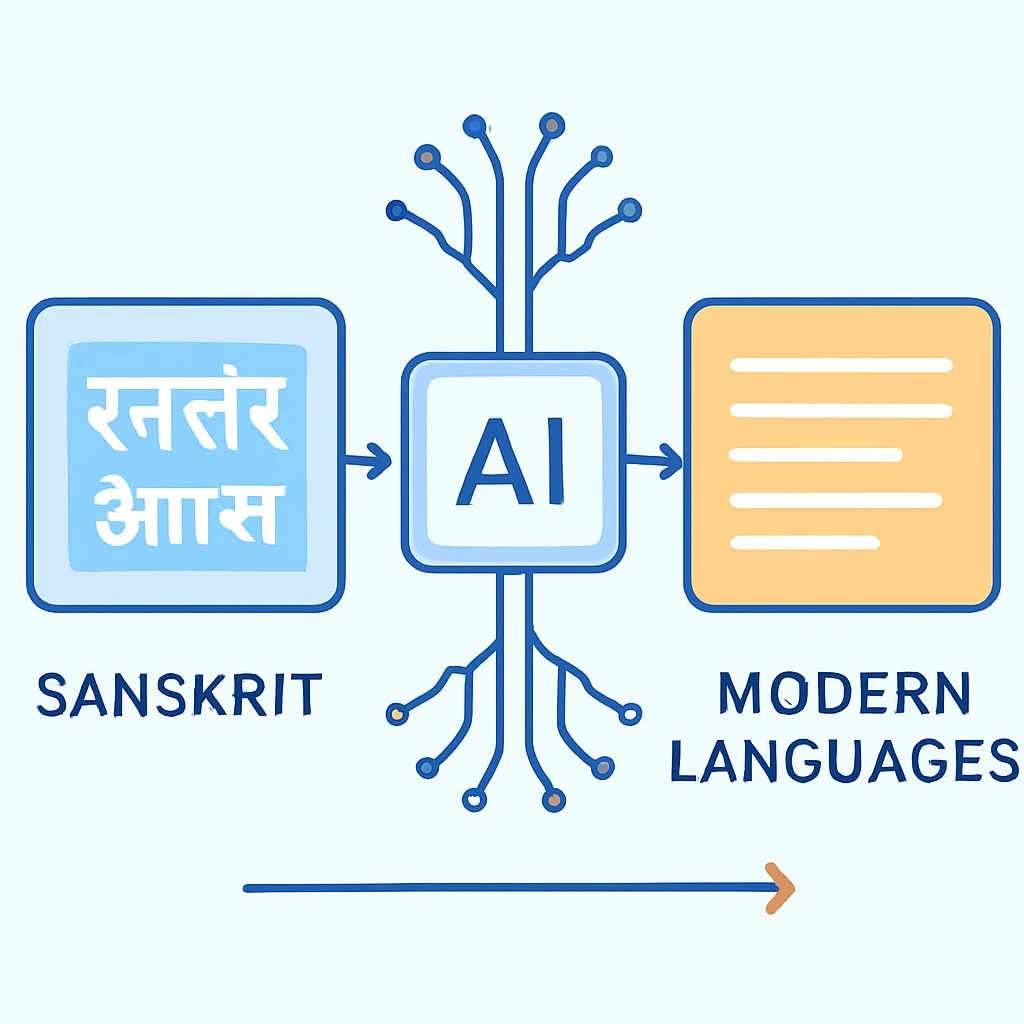
The payoff is significant. Reliable translation tools open ancient philosophy, science, poetry, and medicine to a global audience. They also assist scholars who can use AI as a first-pass collaborator, producing a draft that a human expert then refines. Organizations building these capabilities often draw on specialized artificial intelligence services to combine linguistic expertise with robust engineering. For teams seeking a partner on such projects, the team at WebPeak focuses on applied AI solutions that bridge research and real-world deployment.
Digitizing and Preserving Ancient Texts
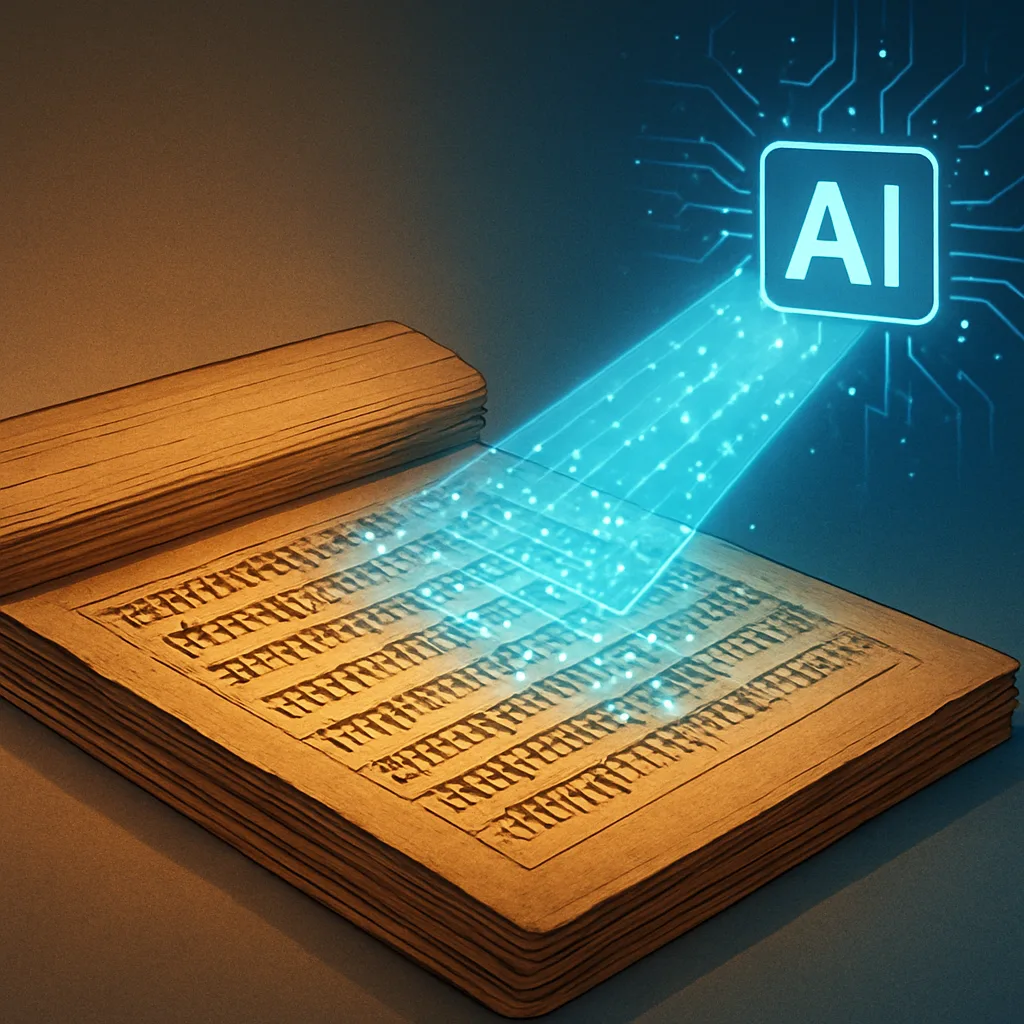
Perhaps the most urgent contribution of AI is preservation. Countless Sanskrit manuscripts survive only as fragile palm-leaf or paper documents stored in libraries, temples, and private collections. Many are deteriorating. Digitization captures these works before they are lost, and AI accelerates the process at every stage.
Optical character recognition, or OCR, has historically struggled with Devanagari and other Indic scripts because of their connected characters and complex ligatures. Recent deep learning models have changed that. Trained on annotated samples, modern OCR can read printed and even some handwritten Sanskrit with growing reliability, turning images of pages into searchable, editable text.
From Manuscript to Searchable Archive
Once text is digitized, AI does more than store it. Indexing engines make millions of lines searchable in seconds. Clustering algorithms group related passages, helping researchers trace how an idea appears across different works. Named entity recognition identifies deities, places, authors, and technical terms, building a knowledge graph of an entire literary tradition. What once took a scholar a lifetime to cross-reference can now be queried in moments.
This is where modern engineering meets ancient scholarship. Building a durable, searchable archive requires thoughtful software design, scalable storage, and careful user experience work. Companies that deliver end-to-end digital products, such as ZoneTechify, help cultural institutions turn raw scans into living digital libraries. For projects centered specifically on intelligent automation and language tools, dedicated artificial intelligence expertise ensures the models are accurate, maintainable, and genuinely useful to the people who rely on them.
The Future of Artificial Intelligence and Sanskrit
Where is this relationship heading? Several directions look promising. Large language models are beginning to incorporate classical languages, and as more Sanskrit data becomes available, these models will read, summarize, and even compose grammatically correct Sanskrit with greater fluency. The dream of a tireless digital assistant for Sanskrit study is moving from concept to prototype.
There is also a deeper, almost philosophical thread. Because Sanskrit grammar is so explicit, it offers a window into explainable AI. When a system can justify its analysis by pointing to a specific grammatical rule, it becomes transparent in a way that opaque neural networks are not. Studying how machines reason about Sanskrit may teach us how to make AI more interpretable across the board.
At the same time, responsibility matters. Ancient texts carry cultural and spiritual weight. AI tools must be built with respect for that context, with scholars and communities involved in shaping how the technology is used. The goal is not to replace human understanding but to extend it, giving more people access to a heritage that belongs to all of humanity.
Conclusion
The pairing of artificial intelligence and Sanskrit turns out to be one of the most rewarding meetings of old and new. Sanskrit gave early thinkers a model of language as a rule-governed system, an idea that echoes in the formal grammars at the heart of computer science. In return, modern AI is preserving, translating, and unlocking a literary tradition that might otherwise fade. From Panini's elegant rules to today's neural networks, the conversation between this ancient language and our newest technology is far from over. It is, in many ways, just beginning, and it reminds us that progress often comes from looking backward and forward at the same time.