
A practical library of 50 smart SEO prompts for ChatGPT covering keyword research, content briefs, on-page optimization, technical SEO, link building, and local SEO.
50 Smart SEO Prompts for ChatGPT
Search engine optimization has always rewarded people who work smarter, not just harder. ChatGPT gives SEO professionals, marketers, and business owners a way to compress hours of research, planning, and drafting into minutes — but only if you know how to ask. A vague prompt produces vague output. A precise, well-structured prompt produces work you can actually use.
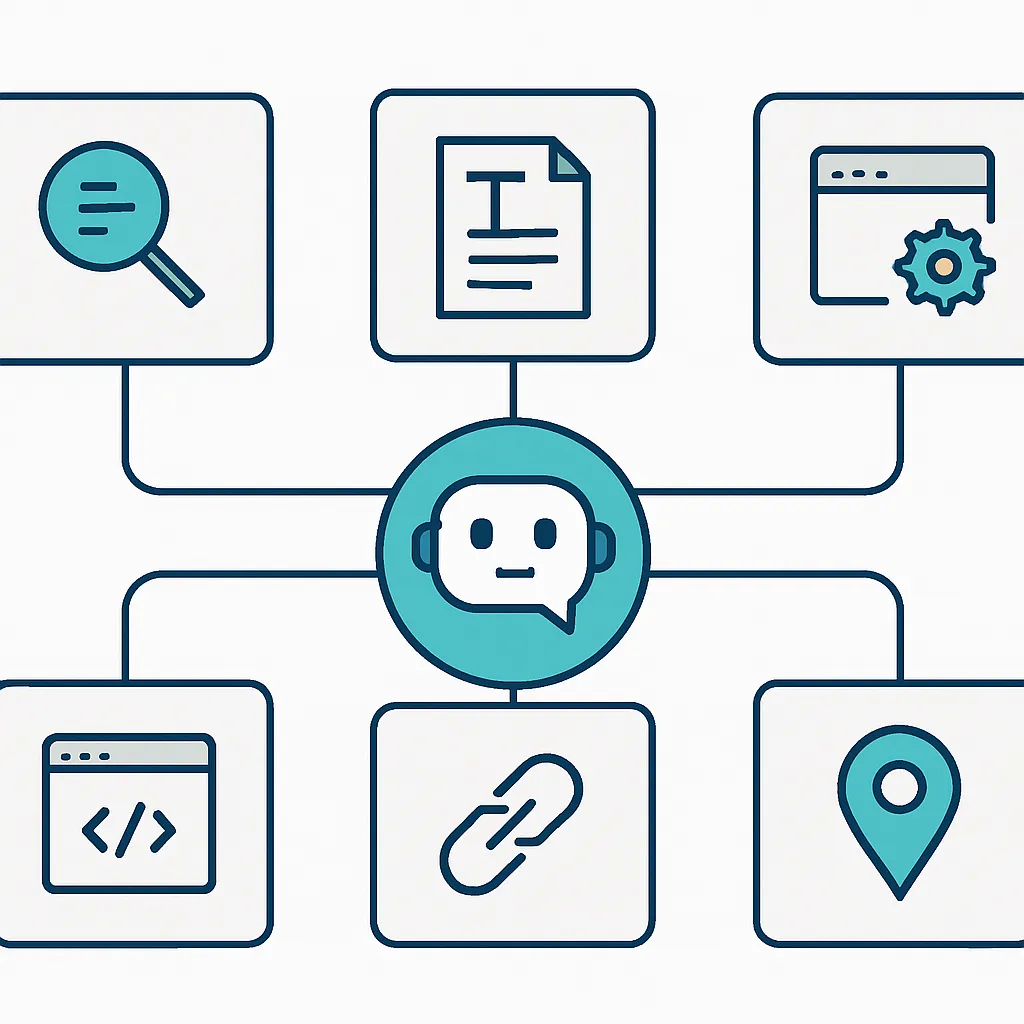
This guide collects 50 smart SEO prompts for ChatGPT, organized by the stages of a real SEO workflow: keyword research, content strategy, on-page optimization, technical SEO, link building, and local SEO. Copy them, adapt the bracketed placeholders to your niche, and treat the output as a strong first draft that you refine with your own expertise and data.
Why Prompt Quality Determines SEO Output Quality
ChatGPT is a language model, not a crawler. It does not know your current rankings, your competitors' backlink profiles, or yesterday's algorithm update. What it does extremely well is structure thinking, generate variations, summarize patterns, and draft content quickly.
That means the best SEO prompts share three traits:
- Context — who the audience is, what the business does, and what stage of the funnel you are targeting.
- Constraints — word counts, formats, tone, and the exact deliverable you expect.
- A role — telling the model to act as a technical SEO consultant or a conversion copywriter changes the framing of every answer.
Every prompt below is built around those three traits. If you want a team to handle the full strategy behind these workflows, the specialists at ZoneTechify's SEO services build campaigns where AI-assisted research is paired with human review and real ranking data.
Keyword Research Prompts (1–10)
Keyword research is where ChatGPT saves the most time. Use it to expand seed terms, cluster ideas, and map intent before you validate volumes in a dedicated tool.

- Seed expansion: "Act as an SEO strategist. Generate 30 long-tail keyword ideas related to [topic] for a [business type] targeting [audience]. Group them by search intent: informational, commercial, transactional."
- Question mining: "List 25 questions people ask about [topic] that would make strong FAQ or blog content. Phrase them exactly as a user would type them into Google."
- Intent classification: "Here is a list of keywords: [paste list]. Classify each by search intent and suggest the best content format for each (blog post, product page, comparison, tool)."
- Topic clustering: "Cluster these 40 keywords into topic groups suitable for a pillar-and-cluster content model: [paste keywords]. Name each cluster and identify the pillar keyword."
- Competitor gap brainstorm: "My competitor ranks for content about [topic A] and [topic B]. Suggest 15 adjacent subtopics they likely have not covered that a [business type] could target."
- Seasonal angles: "Identify seasonal or time-sensitive keyword opportunities for [industry] across a 12-month calendar, with a suggested publish month for each."
- Low-competition finder: "Suggest 20 ultra-specific long-tail keywords for [niche] that a new website with low authority could realistically rank for."
- Buyer-journey mapping: "Map keyword ideas for [product/service] across the buyer journey: awareness, consideration, decision. Provide 5 keywords per stage."
- Synonym and entity expansion: "List semantically related terms, entities, and LSI-style phrases that should appear in a comprehensive article about [keyword]."
- Voice search variants: "Rewrite these keywords as natural-language voice search queries: [paste keywords]."
Content Strategy and Brief Prompts (11–20)
Once you know what to target, ChatGPT can turn keywords into briefs, outlines, and editorial calendars.
- Full content brief: "Create a detailed content brief for the keyword [keyword]. Include target audience, search intent, suggested title, H2/H3 outline, word count range, internal linking ideas, and 5 questions to answer."
- Editorial calendar: "Build a 3-month editorial calendar for a [business type] blog targeting [audience]. Include 12 article titles, primary keywords, and content formats."
- Outline from SERP logic: "For the query [keyword], describe what a searcher most likely wants to see, then write an H2/H3 outline that satisfies that intent better than a generic listicle."
- Title variations: "Write 10 SEO title options for an article about [topic]. Keep each under 60 characters and include the keyword [keyword] naturally."
- Content refresh plan: "Here is an outline of my existing article: [paste outline]. Suggest sections to add, merge, or remove to make it more comprehensive and current."
- Pillar page planner: "Design a pillar page structure for [broad topic] with 8 supporting cluster articles, including how they should interlink."
- Audience pain points: "List the top 10 pain points of [audience] related to [topic], and match each pain point to a content idea that addresses it."
- Comparison content: "Generate 8 'X vs Y' comparison article ideas relevant to [industry], with a one-line angle for each."
- Featured snippet targeting: "Write a 45–55 word direct answer to the question [question] formatted to win a featured snippet, followed by a supporting paragraph."
- Content repurposing: "Take this blog topic: [topic]. Suggest how to repurpose it into a video script outline, a LinkedIn post, an email, and an infographic concept."

On-Page Optimization Prompts (21–30)
These prompts tighten up pages you have already written — metadata, headings, readability, and internal links.
- Meta descriptions: "Write 5 meta description options for a page about [topic]. Each must be 150–160 characters, include [keyword], and contain a clear benefit or call to action."
- Title tag audit: "Here are my current title tags: [paste]. Critique each for length, keyword placement, and click appeal, then rewrite the weak ones."
- Header structure review: "Review this heading structure: [paste H1–H3 list]. Identify hierarchy problems and rewrite it for both SEO and scannability."
- Readability pass: "Rewrite this paragraph at an 8th-grade reading level without losing meaning or keywords: [paste paragraph]."
- Internal linking ideas: "I have articles about [list topics]. For a new article about [topic], suggest 5 internal links with natural anchor text."
- Image alt text: "Write descriptive, keyword-aware alt text for these images on a page about [topic]: [describe images]. Avoid keyword stuffing."
- Intro rewrite: "Rewrite this introduction to hook the reader in the first two sentences and include [keyword] naturally: [paste intro]."
- FAQ schema content: "Generate 6 FAQ question-and-answer pairs about [topic], each answer under 60 words, suitable for FAQ schema markup."
- E-E-A-T signals: "Suggest 8 specific ways to demonstrate experience, expertise, authoritativeness, and trust on a page about [YMYL topic]."
- CTA optimization: "Write 6 call-to-action variations for a page selling [product/service], each under 12 words, with different psychological angles."
Technical SEO Prompts (31–38)
ChatGPT cannot crawl your site, but it can explain crawl data, draft directives, and debug structured data faster than documentation can.

- Robots.txt drafting: "Write a robots.txt file for a [platform] site that blocks [sections] but allows all main content and the sitemap at [URL]. Explain each line."
- Schema generation: "Generate valid JSON-LD Article schema for a blog post titled [title], published [date], by [author], on [site]. Output only the code block."
- Redirect mapping: "I am migrating these old URLs to new ones: [paste pairs]. Write the 301 redirect rules for [server type] and flag any redirect chains."
- Crawl issue triage: "Here is a summary of my crawl errors: [paste]. Prioritize them by SEO impact and explain how to fix the top three."
- Core Web Vitals explainer: "My LCP is [X]s and CLS is [X]. Explain the most likely causes for a [platform] site and list fixes in order of effort versus impact."
- Hreflang setup: "Generate hreflang tags for a site with English (US), English (UK), and Spanish (Spain) versions at these URLs: [paste]."
- Canonical logic: "Explain how I should set canonical tags for paginated category pages and faceted filters on an ecommerce site, with examples."
- Log file insights: "Here is a sample of my server log data: [paste]. Identify which sections Googlebot crawls most and least, and what that implies for crawl budget."
Link Building and Authority Prompts (39–44)
Outreach is still human work, but ChatGPT makes the research and drafting dramatically faster.

- Outreach email: "Write a concise outreach email pitching a guest post about [topic] to the editor of a [niche] blog. Under 120 words, no flattery clichés, include 3 title ideas."
- Linkable asset ideas: "Suggest 10 linkable asset ideas for [industry] — original data, tools, templates, or guides that bloggers and journalists would cite."
- Broken link pitch: "Write a polite broken-link outreach email: the broken resource was about [topic] and my replacement article is [URL]."
- Digital PR angles: "Generate 8 newsworthy story angles a [business type] could pitch to journalists, tied to current trends in [industry]."
- HARO-style responses: "A journalist asks: [paste query]. Draft a 100-word expert response from the perspective of a [role] at a [business type]."
- Anchor text variety: "For the target page [URL] about [topic], suggest 10 natural anchor text variations that avoid over-optimization."
Local SEO Prompts (45–50)
Local visibility depends on consistency, reviews, and locally relevant content — all things ChatGPT can help systematize.

- Google Business Profile description: "Write a 750-character Google Business Profile description for a [business type] in [city], including services and a natural mention of the service area."
- Local landing pages: "Outline a location landing page for [service] in [city] that avoids thin, duplicated content. Include unique local elements to feature."
- Review responses: "Write professional responses to one 5-star, one 3-star, and one 1-star review for a [business type]. Keep each under 75 words."
- Local content ideas: "Suggest 10 locally relevant blog topics for a [business type] in [city] that connect the service to community events, seasons, or landmarks."
- Citation audit checklist: "Create a checklist for auditing NAP consistency across the top local citation sources for a [business type]."
- Local keyword matrix: "Build a keyword matrix combining these services [list] with these locations [list], and flag which combinations deserve dedicated pages versus shared pages."
How to Get the Most from These Prompts
A few working principles separate teams that get real value from AI and teams that publish generic filler:
- Always verify. ChatGPT can hallucinate statistics, tools, and URLs. Check every factual claim before publishing.
- Layer prompts. Use the output of a keyword prompt as the input for a brief prompt, then a drafting prompt. Chained prompts outperform single mega-prompts.
- Add your data. Paste in your own analytics summaries, Search Console queries, or customer questions. Specific inputs produce specific outputs.
- Keep a human editor in the loop. Google's helpful content guidance rewards people-first content. AI should accelerate your expertise, not replace it.
- Iterate. If an answer is mediocre, do not start over — reply with "make it more specific to [audience]" or "cut this to half the length."

Final Thoughts
These 50 smart SEO prompts for ChatGPT cover the entire optimization lifecycle — from the first keyword idea to the last review response. Used well, they remove the blank-page problem from SEO and free your time for the judgment calls that actually move rankings: strategy, quality control, and relationship building.
Start with the five prompts that match your biggest current bottleneck, customize the placeholders, and build a personal prompt library as you refine what works for your niche. And if you would rather pair AI efficiency with a proven human team, explore the full range of growth services at ZoneTechify — from technical audits to complete content programs designed to rank and convert.