A clear, technical answer to whether an adaptive moving average counts as machine learning, where the line actually sits, and how to combine both correctly.
Is an Adaptive Moving Average Machine Learning
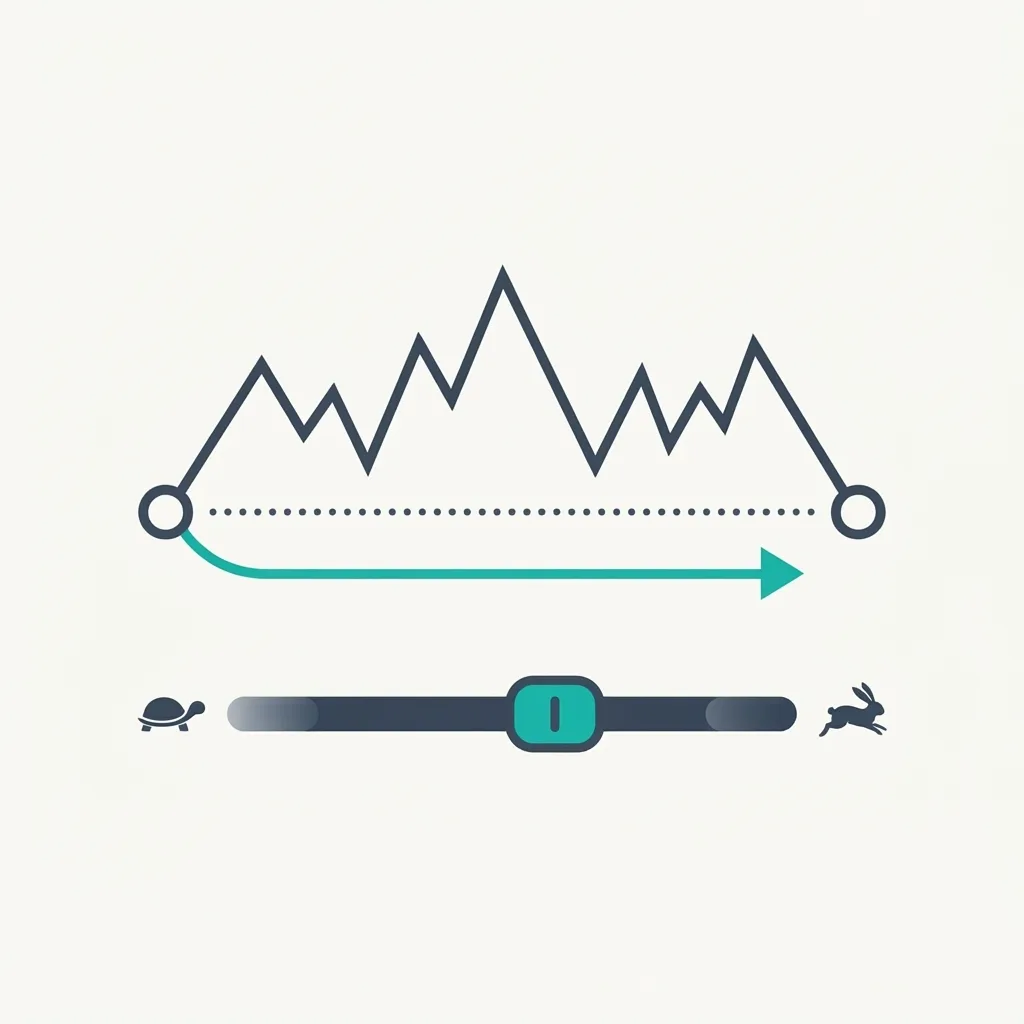
Ask ten quantitative analysts whether an adaptive moving average is machine learning and you will get three camps: an emphatic no, a cautious "sort of," and a marketing team insisting it is AI. The confusion is understandable. Adaptive moving averages change their behavior in response to data, and adaptation feels like learning. But adaptation and learning are not the same operation, and the distinction matters enormously when you are choosing tools, writing documentation, or explaining a model to a client or a regulator.
This article settles the question with precision. We define both terms, walk through the actual mathematics of the most common adaptive moving averages, show exactly where the boundary sits, and then explain how practitioners legitimately combine adaptive filters with machine learning models to get better results than either alone.
Quick Answer: No. A standard adaptive moving average such as KAMA, VIDYA, or FRAMA is a deterministic signal-processing filter, not machine learning. It adjusts its smoothing factor using a fixed formula, without training data, a loss function, or learned parameters. It only becomes machine learning when its parameters are optimized by an algorithm against labeled outcomes.
What an Adaptive Moving Average Actually Is
Definition: An adaptive moving average is a moving average whose smoothing period or weighting factor changes automatically based on a measured property of the input series, most often volatility, trend efficiency, or fractal dimension.
A simple moving average treats every one of its N observations identically. An exponential moving average applies a fixed decay. Both use a constant you choose once and never change. An adaptive moving average replaces that constant with a value computed fresh at every bar from the data itself.
The three most widely used variants are:
- KAMA (Kaufman's Adaptive Moving Average) — scales the smoothing constant by an efficiency ratio comparing net directional movement to total path length.
- VIDYA (Variable Index Dynamic Average) — scales smoothing by a volatility index, typically the Chande Momentum Oscillator or a standard-deviation ratio.
- FRAMA (Fractal Adaptive Moving Average) — derives the smoothing factor from an estimate of the series' fractal dimension.
All three share one structural property that decides our question: the rule that maps data to smoothing factor was written by a human and is fixed forever. Nothing in the algorithm updates that rule based on whether the output was any good.
What Machine Learning Requires
Definition: Machine learning is a class of methods in which a model's parameters are automatically adjusted by an optimization procedure to minimize error on observed data, so that performance improves with experience rather than with additional human-written rules.
Tom Mitchell's canonical 1997 formulation is still the cleanest test. A program learns from experience E with respect to task T and performance measure P if its performance at T, measured by P, improves with E. Apply that test to KAMA and it fails immediately. Feed KAMA a decade of data and it performs exactly as it would on day one. There is no E, no P, and no improvement.
Three components must be present for a method to qualify:
- A parameterized hypothesis space — a family of candidate functions, not a single fixed formula.
- An objective or loss function — a measurable definition of what "better" means.
- An optimization procedure — gradient descent, tree splitting, coordinate descent, or similar, that searches the space to reduce the loss.
Adaptive moving averages have none of these. They have a single fixed function with a data-dependent argument. That is adaptive filtering, a discipline that predates machine learning by decades and belongs to digital signal processing.
Adaptive Moving Average vs Machine Learning: The Direct Comparison
| Property | Adaptive Moving Average (KAMA, VIDYA, FRAMA) | Machine Learning Model |
|---|---|---|
| Parameters set by | Human, once, by hand | Optimization against data |
| Requires training data | No | Yes |
| Has a loss function | No | Yes |
| Improves with more data | No | Yes |
| Deterministic output | Yes | Yes at inference, No during training |
| Risk of overfitting | Very low | High without validation |
| Explainability | Complete, closed form | Varies from high to opaque |
| Compute cost | Negligible, O(n) | Substantial for training |
| Field of origin | Digital signal processing | Statistical learning |
The row that matters most for the headline question is "improves with more data." That single property separates a filter from a learner.
Where the Line Genuinely Blurs
Honesty requires acknowledging three cases where the answer stops being a clean no.
Case 1: Learned Hyperparameters
If you run a grid search or Bayesian optimization over KAMA's fast and slow period bounds, scoring each candidate against out-of-sample prediction error, you have introduced a hypothesis space, a loss function, and an optimizer. That pipeline is machine learning — specifically, hyperparameter optimization of a one-parameter model. The filter itself is still not ML; the procedure wrapped around it is.
Case 2: Adaptive Filters With Update Rules
The Least Mean Squares filter and the Recursive Least Squares filter compute a weighted average whose weights are updated at each step by gradient descent on squared prediction error. These are genuinely both adaptive averages and online machine learning. LMS is, in a strict sense, a single-layer neural network trained with stochastic gradient descent. If someone claims their adaptive moving average is machine learning and they are using LMS or a Kalman-filter-based smoother with learned noise covariances, they are correct.
Case 3: Neural Smoothers
Modern architectures such as N-BEATS and Autoformer contain trend and seasonality decomposition blocks that behave like learned moving averages. The kernel weights are trained. These are unambiguously machine learning, even though a slice of the architecture performs smoothing.
Why the Distinction Has Practical Consequences
This is not a semantics argument. Four concrete consequences follow from getting the classification right.
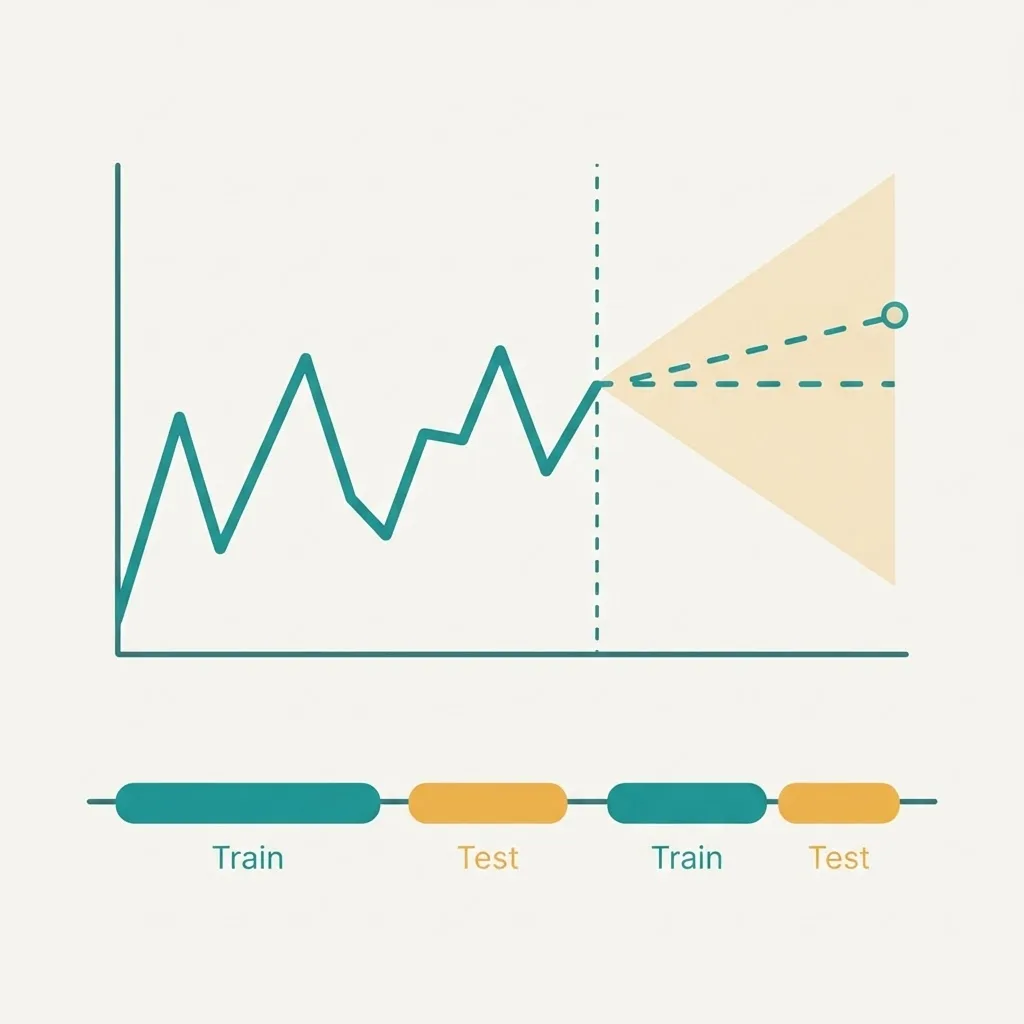
Validation requirements differ. KAMA needs no train/test split because nothing was fitted. An ML model that skips walk-forward validation on time series data will report inflated accuracy. Random k-fold cross-validation leaks future information into training folds and is simply wrong for sequential data.
Overfitting risk differs by orders of magnitude. A filter with two human-chosen bounds cannot memorize noise. A gradient-boosted model with 400 engineered features absolutely can, and will, unless constrained.
Compliance and documentation differ. Financial and healthcare regulators increasingly require model risk documentation for anything described as AI or ML. Labeling a deterministic filter as machine learning creates obligations you did not need. Labeling a trained model as "just a moving average" creates far worse exposure.
Cost and latency differ. A filter runs in microseconds on a microcontroller. A transformer forecaster needs GPU inference infrastructure. Teams building production data pipelines with WebPeak frequently discover that a well-tuned adaptive filter meets the latency budget where a learned model would not.
The Better Question: How Should You Combine Them?
The productive framing is not which one is machine learning, but how adaptive smoothing and learned models fit together. In practice, adaptive moving averages make excellent feature engineering inputs for machine learning models.
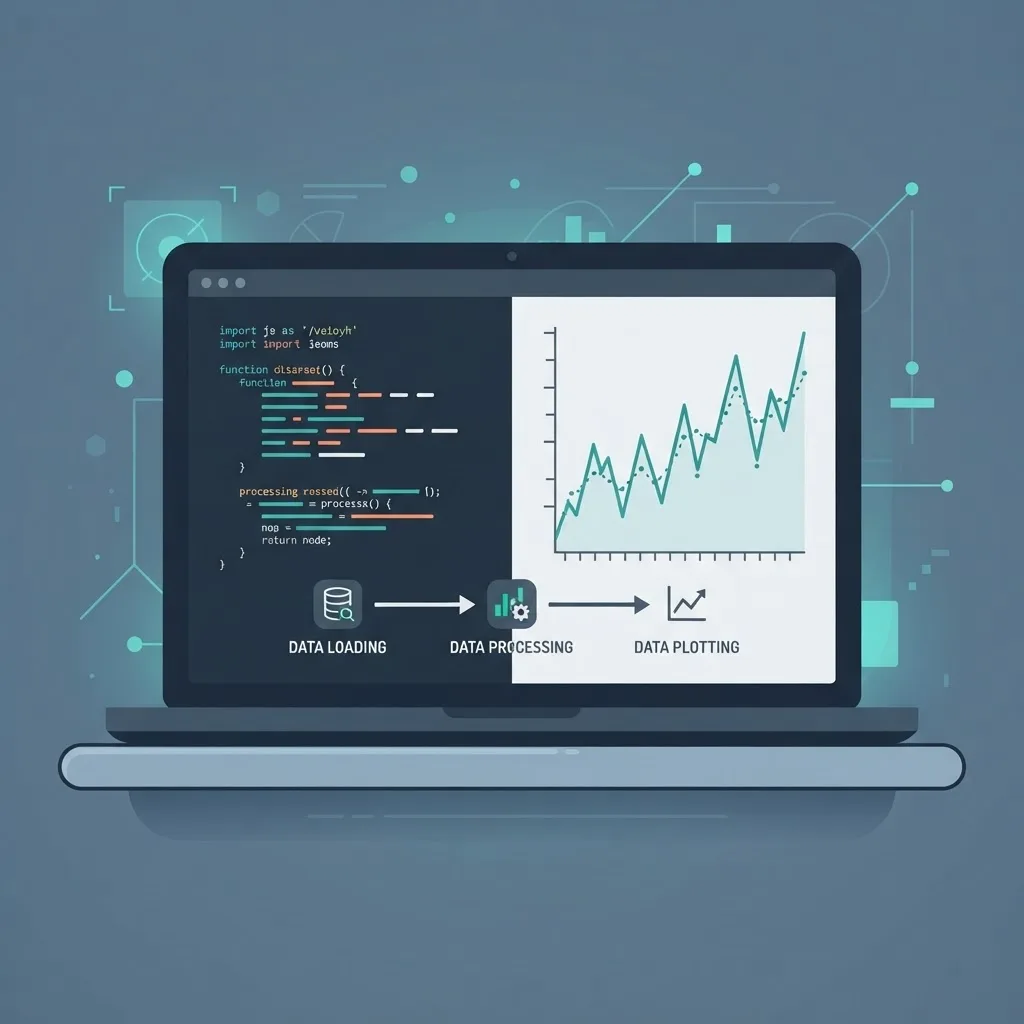
A proven hybrid pipeline looks like this:
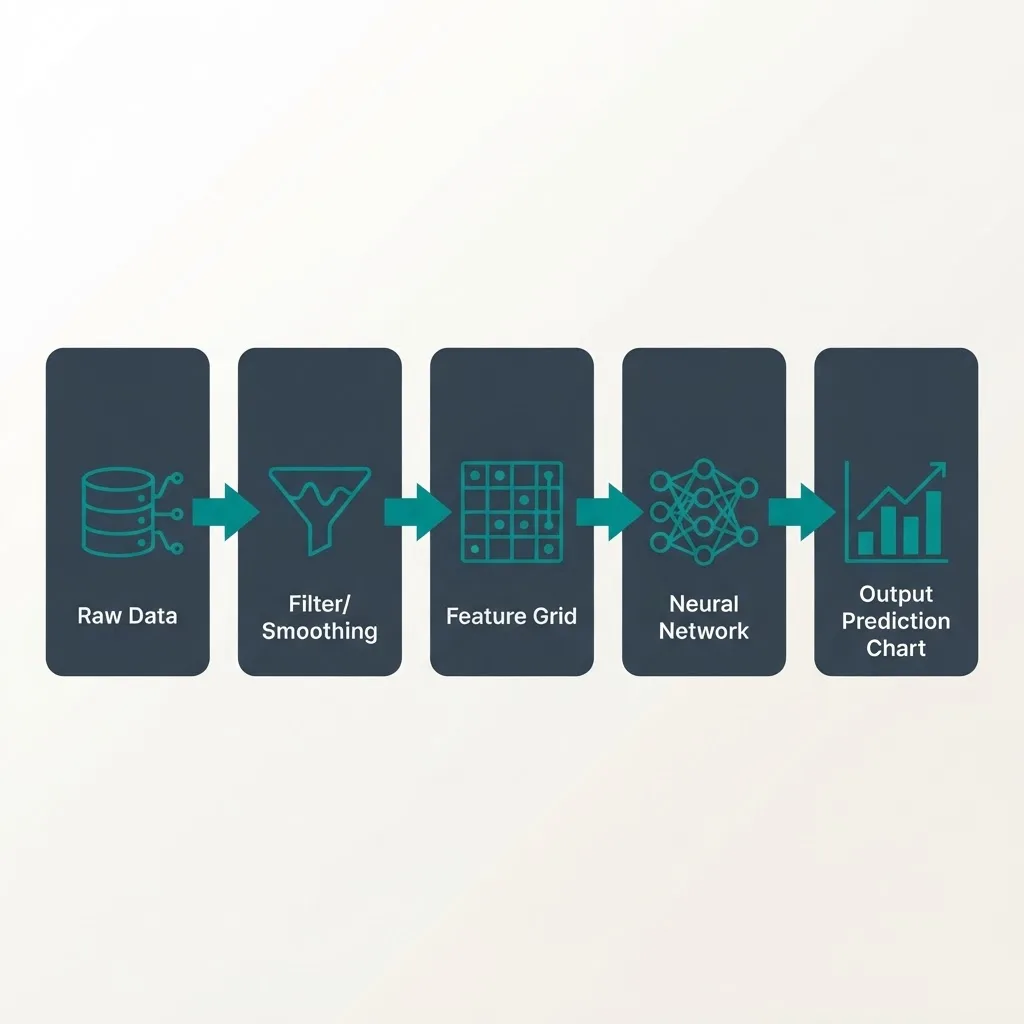
- Compute adaptive smoothers as features. Feed KAMA, VIDYA, and their slopes and spreads into the model as columns. The filter does denoising cheaply; the model does not have to learn denoising from scratch.
- Decompose the series first. Subtract the adaptive average to isolate the residual, then model trend and residual separately. This mirrors the decomposition strategy that made N-BEATS competitive on the M4 competition benchmark, where the winning hybrid method reduced forecasting error by roughly 10 percent over the pure statistical benchmark across 100,000 series.
- Let the model choose the regime. Train a classifier to predict whether conditions are trending or ranging, then switch which smoothing configuration is active. The classifier is the ML component; the filter remains a filter.
- Validate with walk-forward splits only. Expanding or rolling windows, never shuffled folds.
- Benchmark against the filter alone. If your model cannot beat plain KAMA on out-of-sample error, ship KAMA. According to repeated findings in the M-competition series, simple methods beat complex ones more often than practitioners expect.
This hybrid approach is exactly the pattern our engineering teams apply when delivering forecasting systems through ZoneTechify, and it is a core part of our artificial intelligence services work. The filter handles the parts of the problem that have closed-form answers. The learned model handles the parts that do not. Neither is asked to do the other's job.
How to Test Any Claim in Two Minutes
When a vendor or a colleague tells you their adaptive average is machine learning, ask three questions:
- What is the loss function? No answer means no learning.
- What data was it trained on, and when was it last retrained? A filter has no answer here either.
- Would the output change if you fitted it on a different dataset? If the formula produces identical results regardless of training history, it is a filter.
These questions cut through marketing language faster than any technical audit.
Key Takeaways
- A standard adaptive moving average is not machine learning. It is a deterministic adaptive filter from digital signal processing with human-fixed rules.
- Machine learning requires three things a classic adaptive moving average lacks: a parameterized hypothesis space, a loss function, and an optimization procedure.
- Mitchell's test settles it: KAMA's performance does not improve with more experience, so it does not learn.
- Exceptions exist. LMS and RLS adaptive filters, Kalman smoothers with learned covariances, and neural decomposition blocks in N-BEATS or Autoformer are genuinely machine learning.
- Optimizing an adaptive moving average's hyperparameters against out-of-sample error makes the surrounding pipeline machine learning, not the filter.
- Adaptive smoothers are among the highest-value engineered features for time series ML models because they remove noise before the model has to learn to.
- Always validate time series models with walk-forward splits. Shuffled k-fold cross-validation leaks future data and invalidates results.
- Benchmark every learned model against the plain adaptive filter. Simple baselines win more often than complexity advocates admit.
Frequently Asked Questions (FAQ)
Is a moving average considered AI?
No. A moving average, adaptive or not, is a mathematical smoothing calculation with no learning component. It does not train, does not store learned parameters, and does not improve with data. It belongs to signal processing and descriptive statistics rather than artificial intelligence, despite marketing claims that suggest otherwise.
What is the difference between adaptive and machine learning?
Adaptive means the algorithm changes behavior based on current input using a fixed human-written rule. Machine learning means the algorithm changes its own rule by optimizing a loss function on training data. Adaptation reacts to the present; learning encodes lessons from the past into updated parameters.
Can KAMA be used as a machine learning feature?
Yes, and it is one of the more effective time series features available. Supply KAMA values, its slope, and the price-minus-KAMA spread as model inputs. This offloads denoising to a cheap closed-form filter, letting your model spend capacity on genuine pattern recognition rather than relearning smoothing.
Which adaptive moving averages actually are machine learning?
Least Mean Squares and Recursive Least Squares adaptive filters qualify, because their weights update through gradient-based error minimization. Kalman smoothers with learned noise covariances qualify. Neural decomposition blocks in architectures like N-BEATS also qualify. KAMA, VIDYA, and FRAMA do not.
Does an adaptive moving average beat machine learning for forecasting?
Sometimes, especially on short, noisy, or low-signal series where learned models overfit. Always benchmark your machine learning model against a tuned adaptive filter on walk-forward out-of-sample data. If the model cannot beat the filter, deploy the filter and save the infrastructure cost.
Why do vendors call adaptive moving averages AI?
Because adaptation superficially resembles intelligence and AI labeling sells. Test any claim by asking for the loss function, the training dataset, and the retraining schedule. A deterministic filter has none of the three, which exposes the label as marketing rather than a technical description.