
A practical, expert guide to how artificial intelligence and legal analytics work together to predict outcomes, automate contract review, and modernize law firms.
Artificial Intelligence and Legal Analytics

The legal profession has always run on precedent, pattern, and evidence. Artificial intelligence and legal analytics simply accelerate that logic, turning decades of case files, contracts, and court rulings into signals a lawyer can act on in seconds. Having advised legal and professional-services teams on technology adoption, we have watched firms move from skepticism to dependence in under two years. This guide explains, in plain language, how the technology actually works, where it delivers measurable value, and where you still need a human in the loop.
Quick Answer: Artificial intelligence and legal analytics use machine learning to analyze large volumes of legal data, such as case law and contracts, to predict outcomes, surface risks, and automate research. The result is faster, more consistent, and more data-driven legal decision-making for lawyers and clients.
What Is Legal Analytics?
Legal analytics is the practice of applying statistical and machine learning techniques to legal data to reveal patterns that inform strategy. Instead of relying only on a lawyer's memory of similar cases, legal analytics quantifies how a specific judge rules on motions, how long a case type typically takes, or which arguments historically succeed in a jurisdiction.
Artificial intelligence supercharges this by processing unstructured text, the natural language found in opinions, briefs, and contracts, at a scale no human team can match. Traditional analytics needed clean, structured spreadsheets. Modern AI reads the documents directly.

Why AI and Legal Analytics Matter Now
The volume of legal information has become impossible to manage manually. According to a widely cited McKinsey analysis, roughly 23% of a lawyer's work can be automated with existing technology, most of it in document review and research. That is not a threat to the profession; it is a reclaiming of billable hours for higher-value strategy.
There is also a cost pressure. Thomson Reuters research has repeatedly found that clients increasingly expect efficiency and refuse to pay for routine tasks that software can perform. Firms that adopt analytics protect their margins while delivering faster answers.
The demand for legal technology reflects this shift. Industry analysts project the global legal tech market to grow into the tens of billions of dollars this decade, driven largely by AI-powered research and analytics tools. For a broader look at how businesses operationalize this kind of intelligence, ZoneTechify works with teams building data-driven digital systems.
How Artificial Intelligence Processes Legal Data
Understanding the pipeline helps demystify the technology. Most legal AI systems follow four steps.
- Ingestion: The system collects documents, court dockets, contracts, and filings.
- Extraction: Natural language processing identifies parties, dates, clauses, citations, and legal issues.
- Analysis: Machine learning models compare the new data against historical patterns.
- Output: The tool surfaces predictions, summaries, risk scores, or recommended citations.

The quality of every output depends on the quality of the training data. This is why reputable legal AI vendors invest heavily in curated, jurisdiction-specific datasets rather than scraping the open web.
Predictive Legal Analytics: Forecasting Outcomes
Predictive legal analytics is the most talked-about application, and for good reason. By analyzing thousands of past decisions, an AI model can estimate the probability that a motion will be granted, that a case will settle, or that an appeal will succeed.
In practice, lawyers use these forecasts to advise clients realistically. A litigator who can say a summary judgment motion has historically succeeded 30% of the time before a particular judge is giving evidence-based counsel, not a gut feeling.
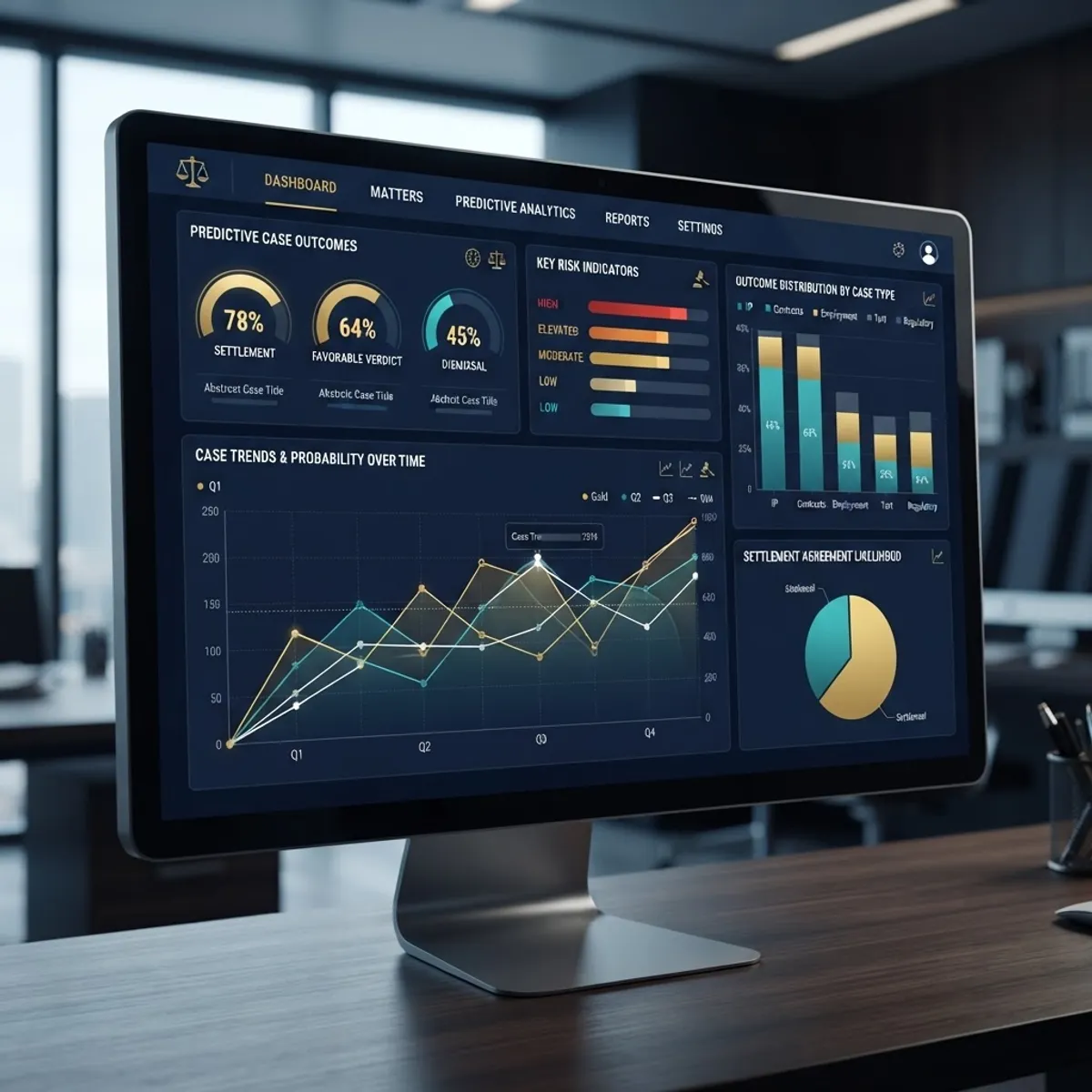
The key limitation to communicate honestly: prediction is not prophecy. These tools express probabilities based on historical data. Novel facts, changing law, and human judgment still shape every real case.
AI Contract Review and Automation
Contracts are where AI delivers the fastest, clearest return on investment. Machine learning models trained on millions of agreements can flag missing clauses, non-standard indemnification language, and unusual liability terms in seconds.
A task that once took a junior associate several hours, reviewing a lengthy commercial agreement, can be reduced to a focused review of the clauses the AI flagged. The human still decides; the machine just removes the tedium.
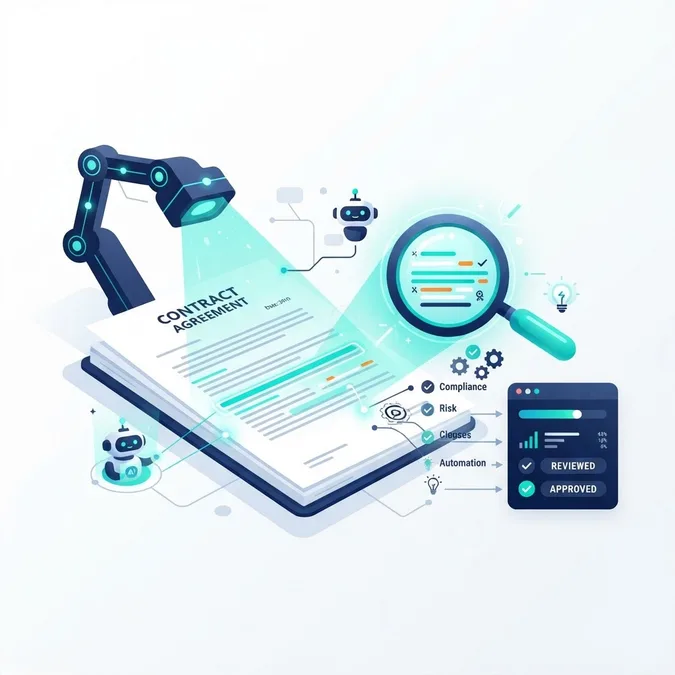
Typical automation gains include:
- Faster due diligence during mergers and acquisitions.
- Consistent clause libraries so every contract meets firm standards.
- Automatic risk scoring that ranks agreements by exposure.
- Deadline and obligation tracking pulled directly from contract text.
Because these features are fundamentally AI and automation problems, teams often pair them with specialists such as WebPeak's artificial intelligence services to integrate the tools into existing workflows.
Machine Learning and Case Law Research
Machine learning has transformed legal research from keyword hunting into meaning-based discovery. Older systems matched exact words. Modern models understand that "wrongful termination" and "unjust dismissal" may point to the same legal concept, then rank precedents by genuine relevance.

This matters because missing a controlling precedent is a professional risk. AI research assistants now surface citations a lawyer might overlook, verify whether a case is still good law, and summarize long opinions into digestible briefs. The lawyer reviews and validates, but starts from a far more complete picture.
Comparing Traditional and AI-Driven Legal Work
The difference between conventional methods and AI-assisted workflows is measurable across everyday tasks.
| Legal Task | Traditional Approach | AI and Legal Analytics Approach |
|---|---|---|
| Document review | Manual, hours per file | Automated flagging in minutes |
| Case research | Keyword search | Meaning-based, ranked results |
| Outcome prediction | Experience and intuition | Data-driven probability scores |
| Contract risk | Line-by-line reading | Automatic clause and risk detection |
| Consistency | Varies by individual | Standardized across the firm |
| Scalability | Limited by headcount | Scales with computing power |
The table makes the value proposition clear: AI does not replace legal judgment, it removes the repetitive work that dilutes it.
AI-Powered Legal Research Tools in Daily Practice
The most successful adopters treat AI tools as a first draft, never a final word. A research assistant might generate a memo outline, cite relevant statutes, and summarize opposing arguments. The attorney then verifies every citation, because AI systems can occasionally produce confident but incorrect references, a phenomenon known as hallucination.
This verification step is not optional. Courts in several jurisdictions have sanctioned attorneys who submitted AI-generated citations without checking them. Trustworthy practice means using AI to accelerate work and a licensed professional to confirm it.
Ethics, Bias, and Trust
Any honest discussion of AI in law must address bias. Machine learning models learn from historical data, and historical legal data can reflect systemic inequities. If a model is trained on biased outcomes, it can quietly reproduce them.
Responsible firms mitigate this by auditing model outputs, demanding transparency from vendors, and keeping humans accountable for every decision. Client confidentiality is equally critical: legal data is highly sensitive, so tools must offer strong encryption, clear data-retention policies, and compliance with professional conduct rules.
The Future of AI and Legal Analytics
The next phase is integration rather than novelty. AI will increasingly live inside the tools lawyers already use, such as document management and practice management systems, rather than as separate products. Expect deeper predictive capabilities, real-time litigation analytics, and AI assistants that draft routine filings under supervision.

The firms that win will not be those with the most technology, but those that combine analytics with sound human judgment. The augmented lawyer, not the automated one, defines the next decade.
Key Takeaways
- Legal analytics applies machine learning to legal data to reveal actionable patterns.
- Predictive analytics estimates case outcomes as probabilities, not guarantees.
- Contract review offers the fastest ROI, cutting review time from hours to minutes.
- McKinsey estimates around 23% of legal work can be automated with current technology.
- Human verification remains mandatory, as AI can produce incorrect citations.
- Bias and confidentiality are the two most important risks to manage.
Frequently Asked Questions (FAQ)
What is the difference between AI and legal analytics?
Legal analytics is the practice of analyzing legal data to find patterns, while artificial intelligence is the underlying technology that makes large-scale analysis possible. AI reads and understands unstructured legal text, and legal analytics turns that understanding into predictions, risk scores, and strategic insights for lawyers.
Can AI predict the outcome of a court case?
AI can estimate the probability of an outcome based on historical case data, judge behavior, and similar disputes. It cannot guarantee results. Predictions are decision-support tools that help lawyers advise clients realistically, but novel facts, evolving law, and human judgment still determine what actually happens in court.
Is AI going to replace lawyers?
No. AI automates repetitive tasks like document review and research, but it cannot exercise legal judgment, argue in court, or take ethical responsibility. The realistic outcome is augmentation: lawyers who use AI handle more work faster, while human expertise remains essential for strategy, advocacy, and client trust.
Are AI legal tools accurate and safe to rely on?
AI legal tools are powerful but imperfect. They can occasionally produce incorrect citations, so every output must be verified by a licensed professional. Reputable tools trained on curated legal data are highly reliable for research and review, provided lawyers treat results as a starting point rather than a final answer.
How do law firms start using legal analytics?
Firms usually start with one high-value use case, such as contract review or research, then expand. Success depends on choosing vendors with strong data security, training staff properly, and keeping humans accountable for decisions. Partnering with experienced technology teams helps integrate the tools into existing workflows smoothly.
Is client data secure when using AI legal tools?
Data security depends entirely on the vendor. Trustworthy legal AI platforms offer encryption, clear data-retention policies, and compliance with professional conduct and privacy rules. Firms should confirm that client data is not used to train public models and that confidentiality obligations are fully respected before adopting any tool.