
A practical engineering guide to the motors inside robot arms — AC servos, brushless DC actuators, steppers, and the gearboxes and encoders that make them precise.
What Do Robot Arms Use for Motors
Every robot arm you have ever seen — a 2,000 kg automotive welder, a tabletop pick-and-place unit, or a surgical manipulator — moves because of electric motors hidden inside its joints. The motor choice determines how heavy a payload the arm can lift, how repeatably it returns to a taught position, and how much the whole system costs. After a decade of building and integrating automation systems, our engineering team has found that most robot arm failures trace back not to software but to a motor or gearbox that was specified without understanding the duty cycle.
This guide explains exactly which motors robot arms use, why each type is chosen, and how the surrounding gearbox and feedback hardware turn a spinning shaft into millimetre-accurate motion.
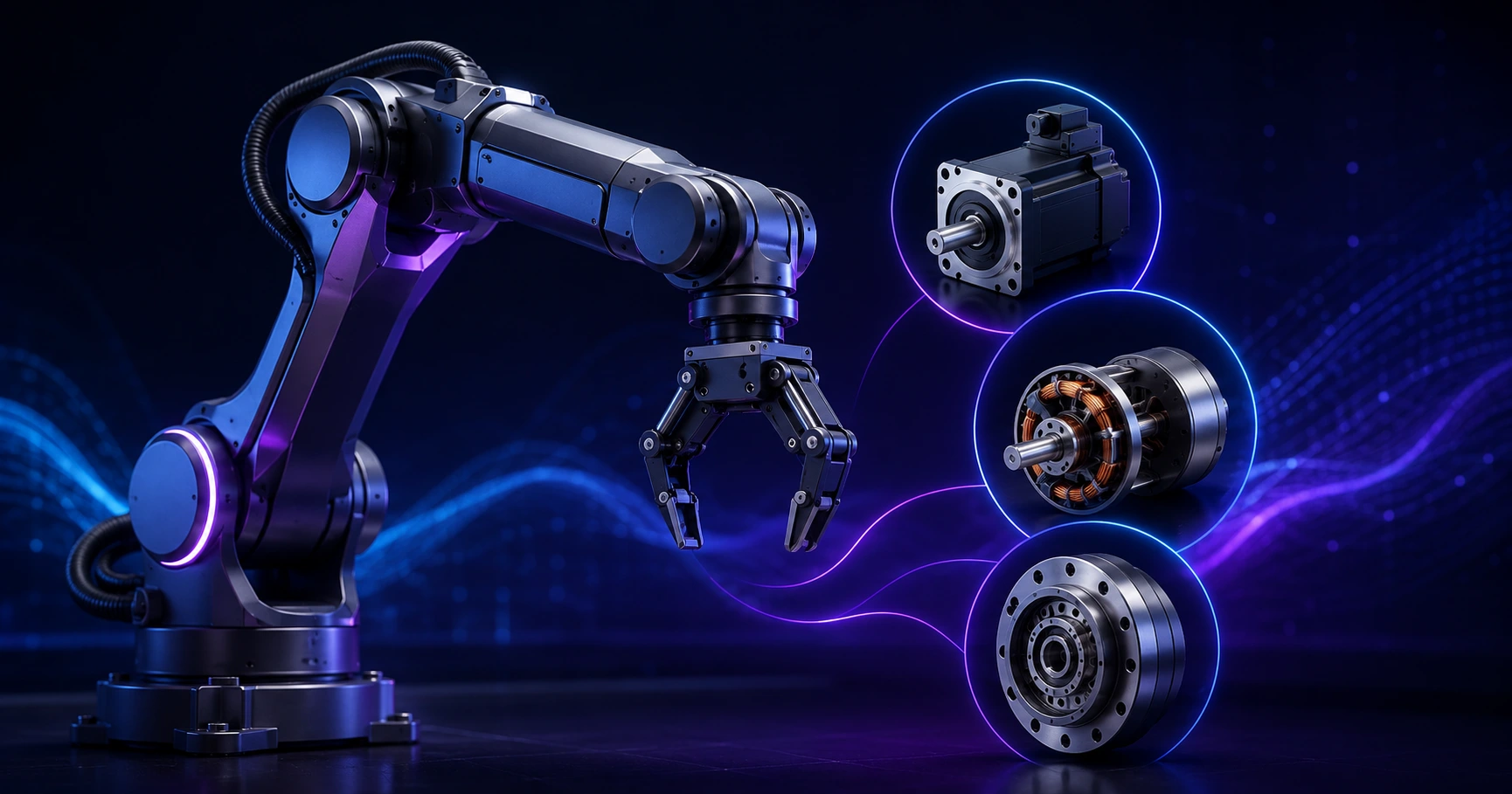
Quick Answer: Most robot arms use permanent-magnet AC servo motors or brushless DC (BLDC) motors paired with harmonic or cycloidal gearboxes and high-resolution encoders. Industrial six-axis arms almost always use AC servos; collaborative and hobby arms use frameless BLDC actuators or stepper motors where cost matters more than torque density.
The Short List: Motors Actually Used in Robot Arms
Robot arms use a surprisingly narrow set of motor technologies. Each one exists because it solves a specific problem in torque, control, or budget.
- Permanent-magnet AC servo motors — the default for industrial six-axis arms.
- Brushless DC (BLDC) motors, often frameless — the standard for collaborative robots and modern joint modules.
- Stepper motors — used in low-cost, education, and desktop arms.
- Brushed DC gearmotors — legacy and hobby designs only.
- Direct-drive torque motors — used in high-speed SCARA arms and force-controlled research joints.
- Pneumatic and hydraulic actuators — not electric motors, but still used for heavy lifting and soft robotics.
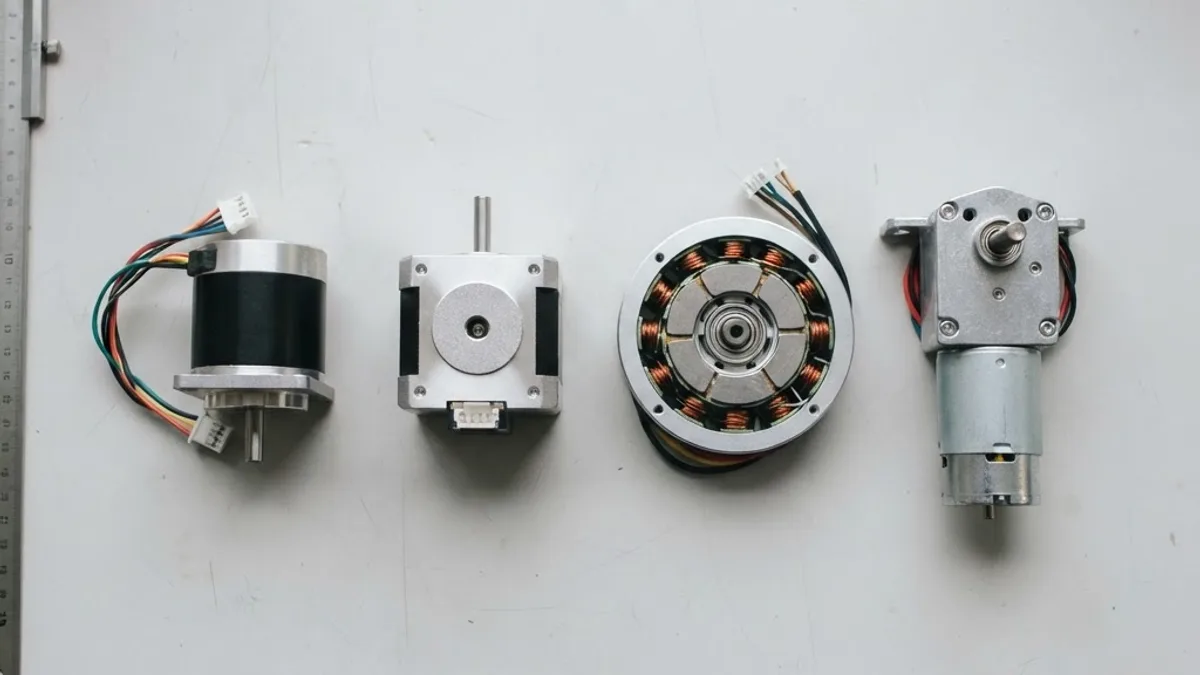
AC Servo Motors: The Industrial Standard
Definition: An AC servo motor is a permanent-magnet synchronous motor operated in a closed control loop with a position feedback device and a dedicated servo drive that regulates torque, velocity, and position continuously.
If you open the base of a FANUC, KUKA, ABB, or Yaskawa arm, you will find AC servo motors. They dominate industrial robotics for four measurable reasons:
- Repeatability. Industrial arms commonly publish repeatability figures of plus or minus 0.02 mm to 0.1 mm, which is only achievable with servo-grade feedback and stiff transmission.
- Torque overload capacity. A quality AC servo can deliver roughly 200–300 percent of rated torque for short bursts, which matters during acceleration and emergency stops.
- Thermal endurance. Industrial arms run 20 or more hours per day. Servo motors are rated for continuous duty with predictable thermal curves.
- Brake integration. Every vertical-axis servo in a robot arm includes a fail-safe electromagnetic brake that holds position when power is removed — a safety requirement, not a convenience.
In our integration work, the most common specification mistake is sizing servos on static payload alone. A 10 kg payload at 1.5 m reach with a 0.3 second acceleration ramp can demand three to five times the static torque. Always size on peak dynamic torque, then verify RMS torque across the full cycle.
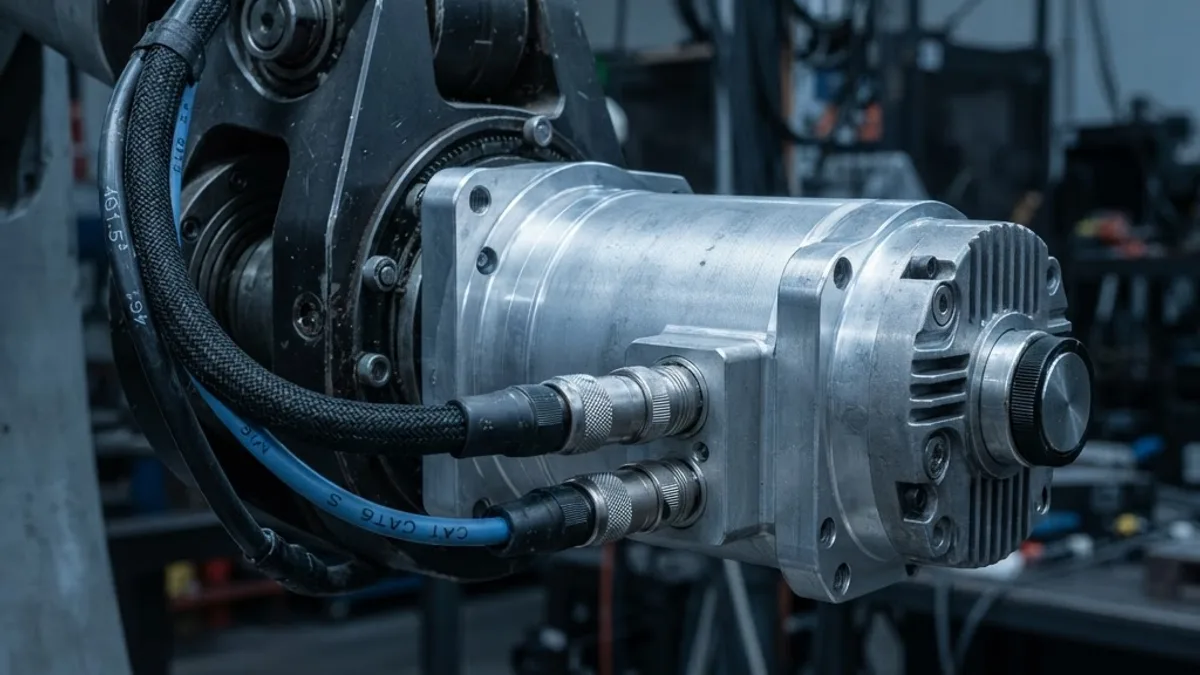
Brushless DC Motors and Frameless Actuators
Brushless DC motors are electrically similar to AC servos but are typically supplied as frameless kits — a bare stator and rotor that the robot designer builds directly into the joint housing. This removes the motor's own bearings, shaft, and casing, cutting joint mass significantly.
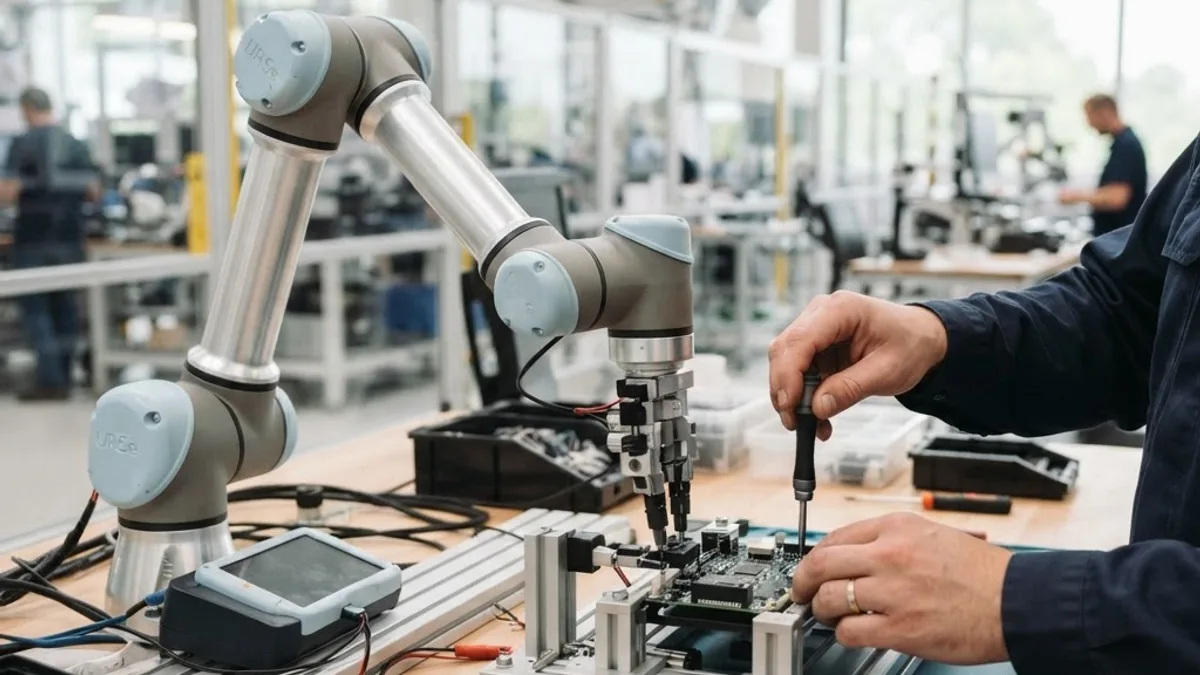
This is why nearly every collaborative robot arm built in the last decade uses frameless BLDC actuators. Cobots must be lightweight enough to be safe around people, and a modular joint containing a frameless BLDC motor, a harmonic gearbox, a dual encoder, a brake, and the drive electronics can be produced as a single sealed cartridge. Swapping a failed joint becomes a 30-minute job instead of a full teardown.
BLDC motors also enable current-based force sensing. Because motor current is proportional to torque, a cobot can detect a collision by watching for unexpected current spikes, without adding external force sensors. That capability underpins hand-guided teaching and power-and-force-limited safety modes.
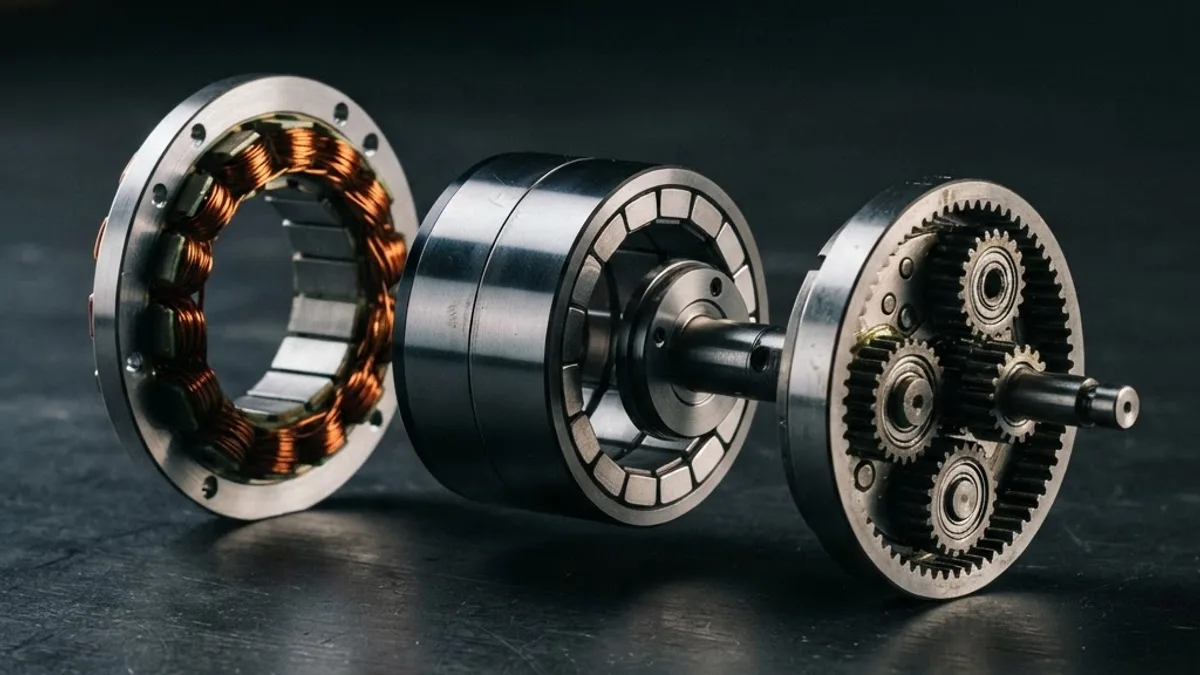
Stepper Motors: Where Cost Beats Torque Density
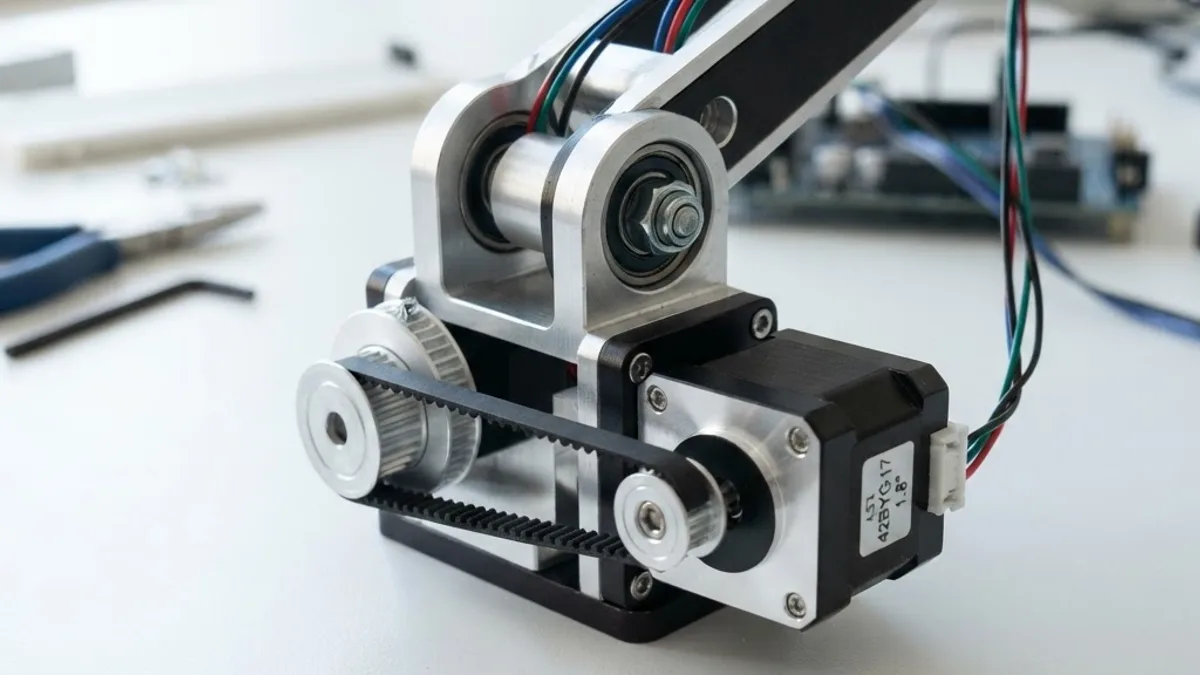
Definition: A stepper motor divides one rotation into fixed discrete steps — typically 200 full steps, or 1.8 degrees each — and moves by energising coils in sequence, allowing open-loop position control without an encoder.
Stepper motors power most desktop and educational robot arms, plus a large share of laboratory automation. They are inexpensive, hold position when energised, and need no feedback device for basic operation.
The trade-offs are real and worth stating plainly:
- Steppers lose torque sharply as speed increases, so they suit slow, deliberate motion.
- Without an encoder they can skip steps under overload and silently lose position — the single most common failure in hobby arms.
- They draw near-full current even while holding still, which wastes power and generates heat.
Modern closed-loop steppers add a magnetic encoder and correction firmware, eliminating step loss for a modest price increase. For any arm that must be trusted unattended, closed-loop is the minimum acceptable specification.
Motor Comparison Table
| Motor Type | Typical Use in Robot Arms | Torque Density | Needs Encoder | Relative Cost | Key Limitation |
|---|---|---|---|---|---|
| AC servo | Industrial six-axis arms | High | Yes | High | Cost and drive complexity |
| Frameless BLDC | Collaborative and modular joints | Very high | Yes | Medium to high | Requires custom joint design |
| Closed-loop stepper | Desktop, lab, education arms | Low to medium | Yes | Low | Poor high-speed torque |
| Open-loop stepper | Hobby and prototype arms | Low | No | Very low | Can skip steps and lose position |
| Brushed DC gearmotor | Legacy, toys, simple grippers | Low | Optional | Very low | Brush wear and maintenance |
| Direct-drive torque motor | SCARA, research force control | Medium | Yes | High | Low output torque without gearing |
The Gearbox Matters as Much as the Motor
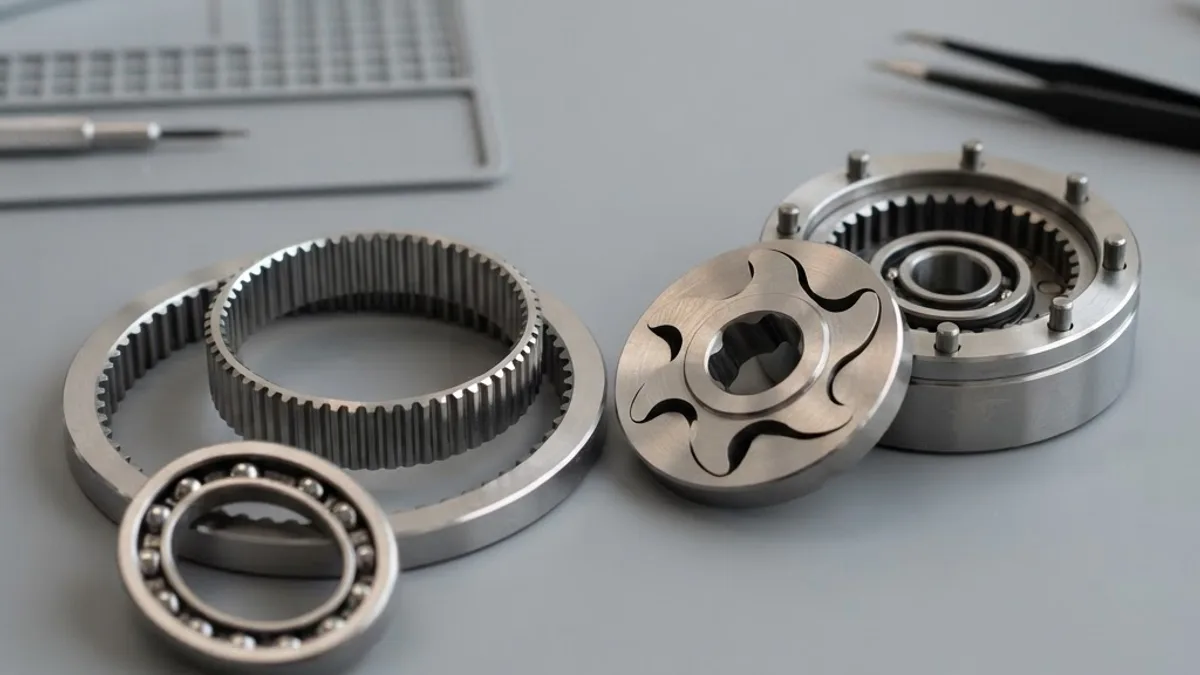
A motor alone cannot move a robot arm usefully. Electric motors produce their best efficiency at thousands of RPM and low torque, while a robot joint needs the opposite — high torque at a few dozen RPM. The gearbox performs that conversion, and its quality sets the arm's accuracy ceiling.
Three transmission types cover almost all robot arms:
- Harmonic (strain wave) drives. Near-zero backlash, ratios of roughly 30:1 to 160:1, and a compact hollow shaft for cable routing. Standard in cobot joints and the wrist axes of industrial arms.
- Cycloidal (RV) reducers. Extremely high shock-load tolerance and stiffness, used in the base and shoulder axes of heavy industrial robots where a harmonic drive would deflect.
- Planetary gearboxes and belt drives. Lower cost, some backlash, common in desktop arms and long-reach linear axes.
Backlash — lost motion when direction reverses — is the metric that separates these options. A planetary gearbox may exhibit 10 to 30 arc-minutes of backlash, while a harmonic drive is often specified under 1 arc-minute. On a 1 metre arm, 10 arc-minutes translates to roughly 3 mm of positional uncertainty at the tool tip. That is why precision arms pay for harmonic drives.
Encoders and Feedback: How the Arm Knows Where It Is
A servo motor is only as accurate as the encoder reporting its position. Robot arms use two families of feedback device:
- Incremental encoders count pulses from a known reference and must be homed after every power cycle.
- Absolute encoders report exact shaft position immediately at power-up, typically with 17 to 23 bits of resolution — 131,072 to over 8 million counts per revolution.
Modern arms use absolute multi-turn encoders so the robot resumes work after a power loss without re-homing. Premium designs add a second encoder on the gearbox output, letting the controller measure the joint angle directly and compensate for gear flex and thermal drift.
One field lesson worth passing on: encoder cabling failures are far more common than motor failures. Continuous-flex cable rated for millions of bend cycles is not optional in a moving arm, and shielding must be grounded at one end only to avoid noise-induced position faults.

How to Choose Motors for a Robot Arm: A Practical Sequence
Work through these steps in order. Skipping any of them is what produces underpowered arms.
- Define the payload and reach, including the gripper and any cables — grippers routinely add 2 to 5 kg that designers forget.
- Calculate the worst-case static torque at each joint with the arm fully extended horizontally.
- Add dynamic torque from your required acceleration and the joint's moment of inertia.
- Select the gear ratio so the motor operates near its efficient speed band at your target end-effector velocity.
- Check RMS torque across the whole cycle against the motor's continuous rating, not its peak rating.
- Choose the encoder resolution to give at least ten times finer resolution than your required repeatability.
- Add a safety brake on every axis that could fall under gravity.
- Apply a 20 to 30 percent torque margin for wear, friction, and future payload growth.
Our teams at ZoneTechify and WebPeak apply this same discipline to automation and control software projects — the calculations happen before any code is written, because no controller can compensate for a motor that is out of torque.

Where Non-Electric Actuators Still Win
Electric motors dominate, but two alternatives remain in production use. Hydraulic actuators deliver unmatched force density and are still used in very heavy manipulators, forestry equipment, and some legged robots. Pneumatic actuators are cheap, inherently compliant, and common in simple two-position arms and soft grippers, where their lack of precise positioning is irrelevant. Both add plumbing, noise, and leak risk, which is why electric motors replaced them almost everywhere precision matters.
Key Takeaways
- Industrial robot arms overwhelmingly use permanent-magnet AC servo motors with absolute encoders and fail-safe brakes.
- Frameless BLDC motors dominate collaborative and modular joint designs because they cut joint mass and enable current-based collision detection.
- Stepper motors are viable for desktop and educational arms; use closed-loop versions to prevent step loss.
- Harmonic drives (under 1 arc-minute backlash) and cycloidal reducers are what make sub-0.1 mm repeatability possible — the gearbox is as critical as the motor.
- Absolute encoders with 17 to 23 bits of resolution let arms resume position after power loss without re-homing.
- Size motors on peak dynamic torque and RMS torque, never on static payload alone, and keep a 20 to 30 percent margin.
Frequently Asked Questions (FAQ)
What kind of motors do industrial robot arms use?
Industrial robot arms use permanent-magnet AC servo motors in every axis, paired with absolute encoders, fail-safe brakes, and harmonic or cycloidal gearboxes. This combination delivers the repeatability, overload torque, and continuous duty rating that factory production demands, typically holding accuracy within 0.02 to 0.1 mm.
Can you build a robot arm with stepper motors?
Yes. Most desktop, educational, and laboratory arms use stepper motors because they are inexpensive and need no feedback device for basic motion. Use closed-loop steppers with magnetic encoders for anything that runs unattended, since open-loop steppers can skip steps under load and silently lose their position.
Why do robot arms need gearboxes instead of direct drive?
Electric motors are efficient at high speed and low torque, while robot joints need high torque at low speed. Gearboxes convert between the two. Harmonic and cycloidal reducers also add stiffness and near-zero backlash, which is what allows a long arm to position its tool tip within a fraction of a millimetre.
What is the difference between a servo motor and a brushless DC motor?
Both use permanent magnets and electronic commutation. The practical difference is packaging and control: a servo motor ships as a complete housed unit with integrated feedback and a matched drive, while brushless DC motors are often sold frameless so designers can embed the stator and rotor directly inside a lightweight robot joint.
How much torque does a robot arm motor need?
Calculate static torque with the arm fully extended, add dynamic torque from your acceleration and joint inertia, then divide by the gear ratio and efficiency. Verify RMS torque across the full duty cycle against the motor's continuous rating, and add 20 to 30 percent margin for friction and future payload growth.
Do robot arms use hydraulic motors anymore?
Hydraulics remain in use where force density is critical — heavy manipulators, forestry machinery, and some legged robots. For nearly all factory, laboratory, and collaborative arms, electric motors have replaced hydraulics because they are cleaner, quieter, more controllable, and free of leak and plumbing maintenance.