
A practical breakdown of the hardest artificial intelligence challenges, from dirty data and model bias to governance, integration debt, and proving real ROI.
The Toughest Challenges to Overcome with Artificial Intelligence
Artificial intelligence rarely fails because the model is not smart enough. It fails because of the unglamorous work surrounding the model: the data pipeline nobody owns, the compliance question nobody answered, the process nobody redesigned. After delivering AI features across content systems, internal tooling, and customer-facing products, one pattern holds consistently. The math is the easy part. Everything around the math is the hard part.
This guide breaks down the toughest artificial intelligence challenges in the order teams actually hit them, and what specifically to do about each one.

Quick Answer: The toughest AI challenges are poor data quality, model bias, the talent shortage, integration with legacy systems, governance and regulatory compliance, hallucination and reliability, and proving measurable ROI. Data readiness is the single biggest blocker, and most stalled AI projects fail on data foundations rather than on model capability.
Why Most AI Projects Stall Before Production
The gap between an AI demo and an AI product is where budgets die. A demo needs one good example. A product needs consistent behavior across thousands of messy real inputs, plus monitoring, fallbacks, and an owner.
Gartner has repeatedly estimated that roughly 85 percent of AI projects fail to deliver on their original objectives, and MIT Sloan Management Review research with Boston Consulting Group found that only about 10 percent of companies report significant financial benefit from AI initiatives. Those numbers are not an indictment of the technology. They describe an organizational readiness problem.
Key definition: Production readiness in AI means the system performs acceptably on unseen real-world data, has defined failure behavior, is monitored for drift, and has a named human owner accountable for its outputs.
Challenge 1: Data Quality Is the Real Bottleneck
The hardest AI challenge is almost always the data. Models learn the patterns you give them, including the errors, duplicates, and gaps. Teams routinely underestimate this by an order of magnitude.

Specific failure modes we see repeatedly:
- Silent schema drift. An upstream field changes meaning and prediction quality decays over weeks without an alarm.
- Label inconsistency. Two annotators disagree on the same case, so the model learns noise instead of signal.
- Leakage. A feature secretly contains the answer, so offline accuracy looks excellent and live accuracy collapses.
- Unrepresentative samples. Training data reflects last year's customers, not this quarter's.
What to do instead of buying a bigger model:
- Write a data contract for every input source, defining field types, allowed ranges, and null policy.
- Run a leakage check before trusting any evaluation score above 95 percent.
- Compute a per-segment accuracy breakdown, not a single average, so weak groups cannot hide.
- Build a small, hand-curated golden test set of 100 to 300 real cases and re-run it on every change.
A 300-case golden set catches more production bugs than another 100,000 raw training rows.
Challenge 2: Bias, Fairness, and the Limits of Auditing
Bias is difficult because it is a statistical property of the world, not a bug in a line of code. If historical hiring, lending, or pricing decisions were skewed, a model trained on them will reproduce that skew efficiently and at scale.

The genuinely hard part is that fairness definitions conflict mathematically. You usually cannot equalize both error rates and outcome rates across groups at once, so someone must choose a definition and defend it in writing. That is a policy decision, not an engineering one.
Practical mitigations that actually move the needle:
- Document the intended use and the out-of-scope uses before launch.
- Test performance separately across the segments your business genuinely serves.
- Keep a human decision-maker in the loop for consequential outcomes such as credit, employment, and health.
- Log inputs and outputs so a disputed decision can be reconstructed months later.
Challenge 3: The Talent and Skills Shortage
AI talent scarcity is not really a shortage of people who can call an API. It is a shortage of people who can judge whether an AI output is wrong.

The roles teams under-hire for are data engineering, evaluation design, and applied product thinking. A senior data engineer who fixes your pipelines often unlocks more value than a research hire. This is why many organizations bring in a partner for the first two or three deployments and transfer the patterns internally afterward. Teams that need this capability quickly often work with an established provider of AI automation services rather than spending a year recruiting a full internal function.
A workable staffing sequence for a first serious AI initiative:
- One data engineer to make inputs trustworthy.
- One applied engineer to build and evaluate the system.
- One domain expert, part-time, to define what correct means.
- One accountable owner with authority to stop a launch.
Challenge 4: Integrating AI with Legacy Systems
The model is stateless and fast. Your core systems are stateful, brittle, and thirty years old. That mismatch is where timelines double.

Common integration blockers and the pragmatic workaround for each:
| Integration Blocker | Why It Is Hard | Practical Workaround |
|---|---|---|
| No API on the core system | Vendor lock or unsupported version | Read from a replica or nightly export first |
| Latency budget too tight | Model inference adds hundreds of milliseconds | Precompute predictions in batch and cache them |
| No place to store outputs | Legacy schemas resist change | Write to a side table keyed by record ID |
| Unclear data ownership | Multiple departments claim the source | Name one data owner before writing code |
| No rollback path | Deployments are manual and rare | Ship behind a feature flag with a kill switch |
The underrated rule: never let an AI feature become a hard dependency of a critical path until it has run in shadow mode beside the existing process for at least one full business cycle.
Challenge 5: Governance, Regulation, and Explainability
Regulation has moved from theoretical to concrete. The EU AI Act entered into force in August 2024 with obligations phasing in over the following years, and it classifies systems by risk tier, with the heaviest documentation duties on high-risk uses such as employment, credit, and essential services.

Key definition: AI governance is the set of documented decisions covering what a system may be used for, what data it may consume, who approves changes, and how outputs are logged and contested.
A governance baseline that is realistic for a mid-sized team:
- A one-page model card per system: purpose, data sources, known limits, owner.
- A retention and consent statement for every dataset used in training or prompting.
- An incident process defining who is paged when outputs go wrong, and how the feature is disabled.
- A quarterly review of live performance against the original acceptance criteria.
Explainability deserves a caveat that vendors gloss over. Post-hoc explanation tools describe correlations the model used, not the reasoning a human would accept in court. Treat them as debugging aids, not legal cover.
Challenge 6: Reliability, Hallucination, and Trust
Generative systems introduce a failure mode classic software never had: confidently fluent wrong answers. You cannot eliminate this, so design around it.
What reduces hallucination in practice:
- Ground every factual claim in retrieved source text rather than model memory.
- Return citations so a user can verify in one click.
- Constrain the output format with a schema and validate it programmatically.
- Add an explicit abstain path so the system can say it does not know.
- Sample and review real outputs weekly, not just at launch.
Trust is also a UX problem. Showing a confidence signal and an easy correction control raises adoption more than a marginal accuracy improvement, because users forgive a system that admits uncertainty.
Challenge 7: Proving ROI Without Fooling Yourself
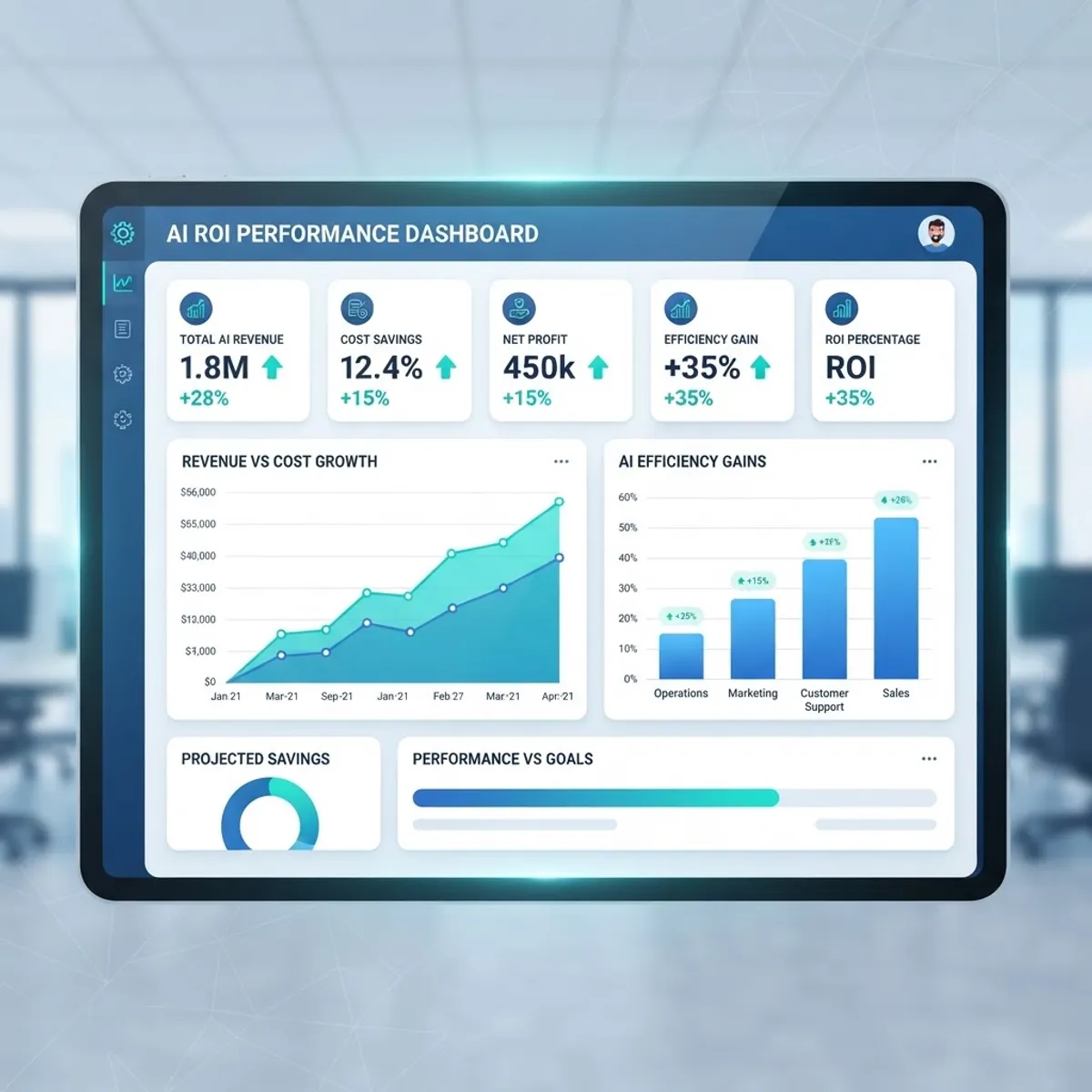
The final challenge is commercial. Time saved is not money saved unless capacity is redeployed or headcount cost changes.
A defensible measurement approach:
- Baseline the metric for four weeks before launch.
- Run a holdout group that keeps the old process.
- Count the full cost, including inference spend, review labor, and maintenance.
- Report one primary business metric, not a dashboard of vanity numbers.
Agencies that publish measured outcomes rather than capability lists tend to be safer partners, and smart digital experiences built by teams working this way ship with measurement designed in from the start rather than retrofitted after launch.
Key Takeaways
- Gartner has estimated roughly 85 percent of AI projects miss their original objectives, and MIT Sloan and BCG research found only about 10 percent of firms report significant financial gain.
- Data quality, not model capability, is the primary cause of stalled AI initiatives.
- Fairness definitions conflict mathematically, so organizations must choose and document one.
- The EU AI Act entered into force in August 2024 and imposes tiered obligations based on risk level.
- A curated golden test set of 100 to 300 real cases catches more production defects than adding raw training volume.
- Shadow-mode deployment for one full business cycle is the cheapest insurance against a bad AI launch.
- ROI is only real when a holdout group and full cost accounting confirm it.
Frequently Asked Questions (FAQ)
What is the biggest challenge in artificial intelligence today?
Data quality and availability remain the biggest challenge. Models amplify whatever patterns exist in their training data, including errors, gaps, and historical bias. Most organizations discover that cleaning, labeling, and governing their data consumes far more effort than building or fine-tuning the model itself.
Why do so many AI projects fail?
AI projects usually fail for organizational reasons, not technical ones. Common causes include unclear success metrics, no named owner, data that was never production-ready, no plan for handling wrong outputs, and no process redesign around the new capability. A working demo does not equal a working product.
How can companies reduce AI bias?
Start by testing accuracy separately across the segments you serve rather than looking at one average score. Document intended and prohibited uses, keep humans in the loop for consequential decisions, and log every input and output so disputed cases can be reconstructed and audited later.
Is AI hallucination a solvable problem?
It can be reduced substantially but not eliminated. The effective controls are grounding answers in retrieved source documents, returning citations, validating output against a strict schema, and giving the system an explicit way to say it does not know instead of guessing fluently.
How long does it take to deploy AI in a business?
A focused first use case typically takes eight to sixteen weeks, with most of that time spent on data plumbing, evaluation design, and integration rather than modeling. Timelines stretch when data ownership is unclear, legacy systems lack APIs, or approval authority has not been assigned.
Do small businesses face the same AI challenges as enterprises?
They face the same categories with different weights. Small businesses struggle more with talent and budget but move faster because governance and integration surfaces are smaller. Enterprises have data and funding but face legacy integration debt, compliance load, and slower internal decision cycles.
The Honest Conclusion
The toughest AI challenges are organizational, not algorithmic. Fix the data contracts, name the owners, define correctness before you build, ship behind a kill switch, and measure with a holdout group. Teams that do these five unremarkable things outperform teams chasing the newest model, consistently and by a wide margin.